
The UT Tyler School of Medicine MD program
What you actually study, and where you will be
UT Tyler School of Medicine's MD is a 4-year program taught through case-based learning in an integrated curriculum, with patient contact from Year 1 and clinical rotations in Tyler and clinical sites across East Texas (2027 entry). UT Tyler's MD trains doctors for East Texas in classes of 40. For the first three semesters you study the body in themed science blocks, through small-group patient cases, large-group sessions and a weekly structure lab for anatomy and related subjects. During this time you also qualify as an emergency medical technician (EMT). Clerkships, the core clinical rotations, begin in January of year 2 at sites across East Texas, and Step 1, the first national licensing exam, comes after them.
- Degree
- MD
- Length
- 4 years
- Teaching
- Integrated + Case-based learning
- Clinical contact
- Year 1

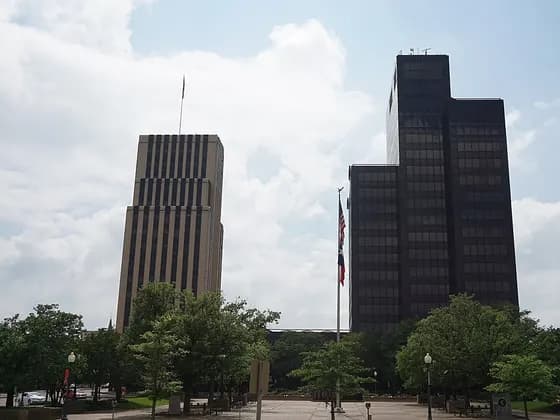
Photo: L'être et le néant · CC BY-SA 4.0 · cropped
Photo: Michael Barera · CC BY-SA 4.0 · Photo: Robert Nunnally from Allen, TX, USA · CC BY 2.0 · Photo: Larry D. Moore · CC BY 4.0
The UT Tyler School of Medicine MD program at a glance (2027 entry)
The University of Texas at Tyler School of Medicine, usually called UT Tyler School of Medicine, runs a four-year Doctor of Medicine (MD) program in Tyler, East Texas. The University of Texas (UT) System's Board of Regents approved the school in 2020, and its first class started in 2023. It was founded to address the shortage of doctors and lack of access to care in East Texas, and its MD focuses on primary care and preventive health while preparing you for any specialty.
The Liaison Committee on Medical Education (LCME) accredits MD programs in the United States. Its directory of accredited programs, updated November 13, 2026, lists the school as Preliminary, with the next survey in 2026-27. Preliminary is the first of three accredited stages for a new program, before provisional and full accreditation, and it lets a school accept students. UT Tyler says it has held preliminary accreditation since July 1, 2022, and that its next LCME visit is in January or February 2027.
The first class, the Class of 2027, graduates on April 30, 2027, after its Match Week in March, when students learn where they will train as residents. If you start in 2027, you join the fifth class. The school has admitted 40 students in each year from 2023 to 2026, and it says 90 percent of the class that started in 2025 have ties to East Texas counties.
Phase 1, Scientific Foundations, fills the first three semesters with themed science blocks, taught through large-group sessions, a weekly structure lab and case-based learning, where small groups work through patient cases. Phase 2, Clinical Experiences, is about a year of core clerkships from January of year 2. Phase 3, Clinical Practice and Scholarship, opens in January of year 3 with dedicated Step 1 study. It goes on to acting internships, where you work close to the level of a first-year resident, then electives and a block for scholarship.
Clinical and community work starts early. You qualify as an EMT in your first semester and begin a Community and Rural Medicine Clerkship after the year 1 winter break. In year 2 you visit rural field sites across northeast Texas. Your base is the School of Medicine Building in Tyler's medical district, opened in April 2026, and clerkships take you to clinical sites across East Texas.
| Degree | MD (Doctor of Medicine) |
|---|---|
| Program length | 4 years in three phases; recent classes started in late June |
| Class size | 40 a year in every entering class from 2023 to 2026 |
| Main campus | School of Medicine Building, Tyler, opened April 2026 |
| Teaching style | Integrated themed blocks with case-based learning, large groups and a structure lab |
| First patient contact | Year 1: EMT course with ambulance ride-outs and Emergency Department shifts |
| Clinical sites | UT Health East Texas (main affiliate) and other sites across East Texas |
| Step 1 timing | After the core clerkships, in a study block from January of year 3 |
| Grading | Pass/fail in Phase 1; clerkships graded Honors, High Pass, Pass or Fail |
| Accreditation | LCME Preliminary; next survey 2026-27 (directory updated November 13, 2026) |
What makes the UT Tyler School of Medicine MD program different
EMT certification in your first semester
Year 1 opens with a four-week EMT course, and you must be certified by the end of December of year 1 to graduate. Alongside the class hours, the course sends you on ambulance ride-outs and Emergency Department shifts, so your first clinical work is emergency care.
A community and rural clerkship from year 1
The Community and Rural Medicine Clerkship is longitudinal: instead of one block, it runs alongside your other courses. It starts after the winter break of year 1 and continues through the rest of Phase 1. It then carries on through the year of core clerkships.
Population health with field visits in rural northeast Texas
Population Health and Systems Science (PHSS) is an 18-month course alongside Phase 1, covering healthcare administration and leadership, preventive medicine, and occupational and environmental medicine. Twelve monthly modules use case-based learning. Then, after a month on health equity early in year 2, small groups rotate through five field sites in rural northeast Texas, one each month.
Step 1 after a year of clerkships
You complete the Phase 2 core clerkships before your dedicated Step 1 study. Phase 3 opens in January of year 3 with a block the four-year plan labels independent study, Step 1 preparation and vacation. The 2026-27 catalog allows 12 weeks of independent study in Phase 3, and Student Affairs runs workshops and individual consultations for this study period.
Teamwork training with other health professions
Interprofessional education runs through all four years. In Phase 1 you learn with nursing, pharmacy and other health professions students, first through cases and simulation, then on service-learning projects for community partners. On clerkships you are evaluated on teamwork, and Phase 3 adds training and certification in TeamSTEPPS, a teamwork system from the Agency for Healthcare Research and Quality.
Classes of 40, in a building linked to the hospital
Every class so far has had 40 students. Since April 2026 their home has been the five-story School of Medicine Building, with 16 clinical skills rooms and four simulation labs. A skybridge connects it to UT Health East Texas' Tyler hospital.
How UT Tyler School of Medicine teaches medicine
The 2026-27 catalog describes an integrated curriculum aimed at rural health, combining case-based and team-based learning, guided self-directed learning and interprofessional education across all four years. In Phase 1 each themed block teaches its biomedical science together with its structure content, meaning anatomy, histology, imaging, pathology, clinical correlations and embryology. So the anatomy of a body system is taught in the same block as how it works and what goes wrong with it.
Three longitudinal strands run beside the blocks: Teaching Outstanding Physician Skills (TOPS), the clinical skills course; Interprofessional Education (IPE); and Population Health and Systems Science (PHSS).
From January of year 2 most teaching happens in hospitals and clinics. On clerkships you work under faculty and residents, joining teaching rounds, writing up patients and attending case conferences and interactive lectures, and you take on more responsibility as you show you are ready. Attendance is required for small groups, exams and clinical work.
The ways you will learn
| Case-based learning (CBL) | Small groups work through patient cases with a faculty facilitator, several times a week in Phase 1. Under the school's 2023 assessment policy you get weekly verbal feedback from yourself, classmates or the facilitator, and the facilitator writes a narrative assessment of your work at the midpoint of each block. |
|---|---|
| Large-group sessions | Hour-long teaching sessions that usually follow case-based learning. They are the one regular class format where attendance is strongly encouraged rather than required. |
| Structure lab | A weekly afternoon, shared with TOPS, for the structure content of the current block. |
| TOPS clinical skills | A four-year course of mentored small groups and simulated clinical practice. In Phase 1 it covers the doctor-patient relationship, history taking, physical examination, write-ups and presentations, and clinical reasoning. In 2024 the school's director of clinical clerkships said students had worked with simulated patients and lifelike robotic manikins in their first two years. |
| Independent study | Open time for independent study and self-directed learning fills much of the Phase 1 week. The school's 2024 policy on student access to health care asks you to book routine health appointments in this time where you can. |
A typical week on the UT Tyler School of Medicine program
The school's sample Phase 1 schedules, created in April 2025, show the shape of a week. In year 1, Monday opens with Synthesis and Consolidation from 8 to 10, a required session, then case-based learning until noon, with the afternoon given to PHSS, IPE or TOPS communication. Wednesday and Friday each start with two hours of case-based learning followed by two hour-long large-group sessions.
Thursday afternoon, from 1 to 5, is the structure lab and TOPS. The rest of the week is open for independent study: all of Tuesday, Thursday morning, and Wednesday and Friday afternoons. In spring of year 1 and fall of year 2, the schedule marks those slots for independent study or a Family Medicine Rotation.
In fall of year 2 the pattern shifts. Case-based learning and large groups move mostly to Monday and Tuesday afternoons and Thursday morning. The structure lab moves to Wednesday afternoon, after a morning of PHSS, IPE or TOPS, and Friday is open all day.
Workload rules cap scheduled Phase 1 activities other than the four-week EMT course at 28 hours a week, and assigned preparation at 42 hours, each averaged over four weeks. Total Phase 1 workload is limited to 70 hours a week. On clerkships, duty hours, meaning all required clinical and teaching time, are capped at 80 a week. Overnight hospital call comes no more often than every third night on average, and a shift lasts at most 24 hours plus four for handovers or teaching.
How anatomy is taught at UT Tyler School of Medicine
Anatomy is part of the structure strand of each Phase 1 block, which covers gross anatomy, histology, imaging, pathology, clinical correlations and embryology, with a weekly structure lab. In the first block, Seasons, the strand covers the mediastinum, heart, pericardium, lungs and esophagus. Balance covers the cardiac, respiratory and renal systems, Nutrition the gut, liver, pancreas and blood, and Regulation cell biology, genetics and the endocrine and reproductive systems.
Defense turns to immunology and rheumatology, Invaders to microbiology, and Uniqueness to the nervous system, cognition and emotion. Structure lab is a required session, and the school's 2024 table of program objectives lists in-house laboratory practical exams among the ways Phase 1 tests your knowledge of normal structure and function.
When you first meet patients at UT Tyler School of Medicine
Your first clinical work is the EMT course at the start of year 1. Its 24 hours of class time come with required ambulance ride-outs and Emergency Department shifts. These can push up your weekly hours, but you may schedule them over five months, and EMT certification by the end of December of year 1 is a graduation requirement.
After the year 1 winter break the Community and Rural Medicine Clerkship begins, running alongside Phase 1 and then through Phase 2 with an assigned clinical faculty member. The weekly schedules also show a Family Medicine Rotation in some independent study slots in spring of year 1 and fall of year 2.
In Phase 1 you work under direct supervision, with a supervisor in the room. With the patient's consent you may take histories, examine patients and review records, observe surgery, and assist with minor procedures once your supervisor judges you ready. You may not write orders, and every note goes through a physician before it enters the record. These limits come from the school's 2024 delegation guidelines.
Full-time clerkships start in January of year 2, after a Student Clinician Ceremony that marks the end of Phase 1. Your supervisor can then let you see patients while they are on site and immediately available, rather than in the room. You may take part in surgery, write notes that a physician reviews at once, and write orders under direct supervision, and procedures always stay under direct supervision.
The UT Tyler School of Medicine curriculum, year by year
- Phase 1: year 1
EMT and the first five science blocks
Year 1 starts in late June with orientation, the EMT course and the first block, Seasons. Five of the seven blocks fall in this year, and classes run into July before a short summer break. In the 2023-24 catalog the blocks ran seven to ten weeks each, adding up to the 65 weeks the current catalog still gives Phase 1.
- Seasons: the context of disease, cell injury and repair, how drugs act and move through the body, cell physiology, and the peripheral nervous system and pain pathways.
- Balance: pressure, fluids and acid-base balance. Nutrition: how the body takes in and uses food. Regulation: the structural, microscopic and chemical controls on the body.
- Defense: host defense, and inflammation both helpful and harmful.
- PHSS IA: 12 monthly modules, roughly every fourth Monday afternoon, using case-based learning and other active methods.
- IPE: team roles and core interprofessional competencies through cases and simulation in the first semester, then population and public health sessions alongside team service-learning projects for community partners.
- On the 2026-27 calendar, first-year assessment weeks fall on September 1-4, November 16-20, February 8-12 and April 26-30. Classes end July 9, followed by a summer break from July 12 to 22.
- You must pass every course through Regulation before the first day of year 2.
- Phase 1: fall of year 2
The last two blocks and rural field visits
Year 2 starts in late July with the final two blocks, Invaders and Uniqueness. PHSS moves into the field, and the Community and Rural Medicine Clerkship, TOPS and IPE continue. Phase 1 ends in December, and the Student Clinician Ceremony marks your move into clerkships.
- Invaders: infection by bacteria, viruses, fungi, parasites and worms, with microbiology as its structure content.
- Uniqueness: what makes humans unique, with the nervous system, cognition and emotion as its structure content.
- PHSS IB, once a month for the first six months of year 2: a month on health equity, then field visits as groups rotate through five rural sites. The visits cover healthcare administration and leadership, preventive medicine, and occupational and environmental medicine.
- On the 2026-27 calendar, second-year assessment weeks fall on September 28 to October 2 and November 23-25, and winter break starts December 14.
- You must pass every Phase 1 course before moving into Phase 2.
- Phase 2
A year of core clerkships
Phase 2 runs for about a year from January of year 2. The catalog describes it as 49 weeks of clinical instruction and a transition week, with 42 weeks of core requirements and six weeks of specialty selectives, rotations you choose from set options. The four-year plan groups the clerkships into four blocks: medicine; surgery; obstetrics and gynecology with pediatrics; and psychiatry, neurology and inpatient family medicine.
- Core clerkships, each with its own clerkship director: internal medicine, surgery, obstetrics and gynecology, family medicine, pediatrics, psychiatry and neurology.
- Selectives: two weeks in internal medicine and four in surgery.
- IPE moves into clerkships: you spend parts of rotations alongside other health professionals, find out about their roles and are evaluated on teamwork and communication.
- Phase 3: spring of year 3
Step 1 study, then acting internships
Phase 3 starts in January of year 3. It opens with the dedicated Step 1 study block, followed by a transition to Phase 3, two acting internships and an Acute Care clerkship. TOPS and IPE continue.
- 12 weeks of independent study and a four-week transition to Phase 3 with career preparation, in the 2026-27 catalog.
- Academic Success workshops on preparing for the dedicated study period, with individual Step consultations.
- Acting Internship 1 and Acting Internship 2, which the grading policy calls sub-internships.
- An Acute Care clerkship.
- During Phase 3, TeamSTEPPS training: online modules, reflective assignments on your teamwork during clerkships and an in-person simulation, leading to TeamSTEPPS certification.
- Phase 3: year 4
Electives, scholarship and the move to residency
Year 4 begins with a Critical Care clerkship and four elective blocks, then time for residency interviews before the winter break. The spring holds a Scholarship block, then Transition to Residency and graduation week. On the 2026-27 calendar, the final-year class has Match Week in mid-March and graduates at the end of April.
- Phase 3 totals 62 weeks, including 16 weeks of required clinical rotations and a two-week residency preparation course.
- The Scholarly Project, a graduation requirement.
- Transition to Residency, just before graduation week.
- Career support: Phase 3 orientation, Career Day, mock interviews and coaching on residency applications.
How you are assessed at UT Tyler School of Medicine
Phase 1 courses are pass/fail, and each block ends with an assessment. From Phase 2, clinical rotations are graded on scales of up to four steps, as the list below shows, under the grading policy revised in July 2026. The Student Progress and Promotions Committee reviews every student at the end of each phase. For a student not making satisfactory progress, its possible actions include remediation, extra time, repeating parts of the curriculum, a leave of absence and dismissal.
The school's 2024 table of program objectives lists the methods behind those grades. Phase 1 uses in-house written and computer-based exams, laboratory practical exams and clinical performance exams; Phase 2 adds nationally standardized subject exams, often called shelf exams. Academic Success runs Phase 1 workshops on taking multiple-choice and National Board of Medical Examiners (NBME) exams, and a Phase 2 workshop on shelf exams.
Clinical skills are checked by direct observation under a 2024 policy. In each core clerkship a faculty member must watch you take one history and do one set examination, which you log in a Clinical Experience and Skills Passport. The exams are musculoskeletal and back in family medicine, lung and cardiovascular in internal medicine, and pelvic and breast in obstetrics and gynecology. Neurology checks a neurologic exam, pediatrics an ear, nose and throat exam, psychiatry a psychiatric and mental status exam, and surgery an abdominal exam.
Clinical Assessment Team members also observe your patient encounters and collect feedback from staff, patients, caregivers and peers on professionalism and communication. Clerkship directors hold midpoint and final feedback sessions that review your actual patient notes, and under a 2023 policy required courses and clerkships include a written narrative assessment wherever the teaching format allows. Objective structured clinical examinations (OSCEs), in which you rotate through timed stations that each test a clinical task, are compulsory under the attendance rules in the school's 2024 health care access policy.
To graduate you must pass Step 1 and Step 2 Clinical Knowledge (CK) of the United States Medical Licensing Examination (USMLE), with no more than three attempts at each. Step 1 has been reported only as pass or fail since January 26, 2022. You prepare for it in the dedicated study block that opens Phase 3 in January of year 3, after the core clerkships.
In August 2026 the USMLE program announced a move to designated testing dates from January 2029, with Step exams offered less often each year. Its June 2026 notice had said 2028. On the current schedule, a student entering in June 2027 would start clerkships in January 2029 and sit Step 1 in early 2030, about a year after the switch. That student would also need to pass Step 2 CK before graduating in spring 2031, so both exams fall after the change.
- Phase 1 courses: Pass or Fail.
- Phase 2 clerkships: Honors, High Pass, Pass or Fail. TOPS and IPE: Pass or Fail.
- Phase 3 required clerkships: Honors, High Pass, Pass or Fail.
- Phase 3 sub-internships (the acting internships): Honors, Pass or Fail.
- Clinical and non-clinical electives: Pass or Fail.
UT Tyler School of Medicine clinical rotations: where you will actually train
Clinical training is based in Tyler and reaches across East Texas. The school calls UT Health East Texas its main affiliate, and UT Tyler describes it as a 10-hospital, 90-clinic system that serves as the region's university medical center. The School of Medicine Building connects by skybridge to UT Health East Texas' Tyler hospital and houses UT Health East Texas services where the school's clinical faculty see patients.
The school also names CHRISTUS Trinity Mother Frances and Family Circle of Care as partners. CHRISTUS announced in June 2024 that UT Tyler students would begin 12-month rotations with an emphasis on primary care in January 2025, at CHRISTUS hospitals and CHRISTUS Trinity Clinic locations.
When the first class started clerkships in January 2025, the school said they would work across 58 clinical sites in East Texas. Their specialties included psychiatry, neurology, inpatient family medicine, pediatrics, gynecology, surgery and internal medicine. Students are assigned to sites, where they work under the school's faculty and residents. Every hospital or clinic with a major role in a required clerkship must have an affiliation agreement that keeps your teaching and assessment under the school's control.
Your teaching base in Tyler's Midtown medical district.
- School of Medicine Building, 1100 S. Beckham Avenue
The school said the first class's clerkships would span 58 clinical sites across the region.
- UT Health East Texas, the school's main affiliate
- CHRISTUS hospitals and CHRISTUS Trinity Clinic locations
Five field sites that small groups rotate through, one a month, in the PHSS course in the first half of year 2.
Electives, selectives and away rotations at UT Tyler School of Medicine
Choice starts in Phase 2 with six weeks of specialty selectives, two in internal medicine and four in surgery. Most of the flexibility comes in Phase 3: the 2026-27 catalog gives it 16 weeks of clinical or research electives and 12 weeks of individualized pathway experiences. On the four-year plan, four elective blocks fill the fall of year 4 before residency interviews. The faculty bylaws also refer to distinction, pathway and certificate programs, overseen by the Phase 2 and Phase 3 curriculum committees.
Electives are graded pass/fail, and clinical electives also carry a written narrative assessment. Student Affairs offers one-on-one help choosing Phase 3 electives and a workshop on building an individualized fourth-year schedule. Away rotations, electives at another institution, are covered by the school's affiliation policy, and on one you follow the host institution's supervision rules.
Dual degrees and research years at UT Tyler School of Medicine
Scholarship is built into Phase 3, which the faculty bylaws describe as a chance to take part in scholarly research and evidence-based medicine. Completing a Scholarly Project is a graduation requirement. The four-year plan includes a Scholarship block in the spring of year 4, and the two-year course rotation lists Scholarly Activity in every term. The Phase 3 committee includes a Director of Scholarly Projects.
Your 16 weeks of Phase 3 electives can be research rather than clinical. The School of Medicine lists four research centers. They are the Center for Biomedical Research, the Center for Clinical Research, the Southwest Center for Agricultural Health, Injury Prevention and Education, and the Texas Institute of Occupational Safety and Health.
Facilities and support at UT Tyler School of Medicine
Where you will learn
The School of Medicine Building held its grand opening on April 24, 2026. It sits on nearly five acres in Tyler's Midtown medical district at 1100 S. Beckham Avenue, has five stories and nearly 250,000 square feet, and is LEED-certified, a green-building rating. For teaching it has 16 clinical skills rooms, four simulation labs and a student lounge.
More than 140,000 square feet of the building is clinical space where the school's clinical faculty provide care. It holds UT Health East Texas' Advanced Imaging Center, Women's Health Center, Orthopedic and Sports Medicine Institute, Pulmonary Institute and a Surgical Center with eight operating rooms.
Simulation runs through the Simulation in Medicine and Immersive Learning Experience (SMILE) Center. In May 2025 it staged a mass casualty exercise for medical, nursing, pharmacy and respiratory therapy students. They helped stabilize victims, played by simulated patients and manikins, and escorted them to a triage area or the SMILE Center.
Support while you study
Every student joins one of four Academic Houses during welcome week. Houses mix students from all four classes with faculty mentors and Student Affairs staff, and host socials, wellness reflections, community service and competitions such as House Olympics. They are also one of the four parts of the school's career advising system.
Outside the curriculum, student interest groups cover specialties such as internal medicine, surgery and pediatrics, as well as research, global health, advocacy and wellness. You can join existing groups or start your own. Student Affairs lists ways to serve: free clinics for underserved patients, health education in schools and community centers, public health and advocacy projects, and volunteering with shelters, food banks and nonprofits.
For academic help, Student Affairs has a Director of Academic and Career Success and a Learning Specialist for one-on-one advising, study plans and exam preparation. Fellow students tutor through the Peer Assisted Learning Specialist (PALS) program. Workshops follow the phases, from study and test-taking skills in Phase 1 to clerkship and shelf exam preparation in Phase 2. Drop-in advising runs on Thursdays from 11 to noon in Phases 1 and 3, and by appointment during clerkships.
Career advising follows the Association of American Medical Colleges (AAMC) Careers in Medicine framework, with departmental faculty advisors and student interest group advisors, and help with CVs, personal statements, residency applications and rank lists. Wellness support includes free counseling through the UT Tyler Counseling Center, with a counselor on site at least once a month, and round-the-clock TimelyCare. There are also Workshops on Wellness (WOW) days, a student gym and one-on-one meetings with the Director of Student Wellness and Professional Formation.
Professional identity formation has its own program: the REST (Relating, Engaging, and Sharing Together) curriculum, a reflection guide and a three-part assertive communication series. Traditions mark the stages, from Fifth Week, a check-in five weeks after orientation, to the White Coat Ceremony and the Student Clinician Ceremony at the end of Phase 1. Students also have a say in the curriculum, with one voting student from each class on the Curriculum Oversight Committee.
Is the UT Tyler School of Medicine program right for you?
This program may suit you if
- You want to practice in East Texas or a similar region: the school was founded to address the area's doctor shortage, and its MD focuses on primary care and preventive health.
- You like a hands-on start: you qualify as an EMT in your first semester, with ambulance ride-outs and Emergency Department shifts.
- You want community and rural medicine through your training, from a clerkship that starts in year 1 to rural field visits in year 2.
- You would rather prepare for Step 1 with a year of clerkships behind you than straight after the science blocks.
- You want a small class: every entering class so far has had 40 students.
Things to think about
- The school is new. The LCME lists it as Preliminary (directory updated November 13, 2026), and its first class is due to graduate in April 2027.
- Phase 1 fits seven science blocks, the EMT course and three longitudinal strands into three semesters, and the EMT ride-outs and Emergency Department shifts can push your weekly hours up.
- Clerkships are graded Honors, High Pass, Pass or Fail, so your grades are tiered again after pass/fail Phase 1.
- Clinical training spreads across East Texas, where the school said its first class would work at 58 clinical sites, so some rotations may be away from Tyler.
UT Tyler School of Medicine MD program — frequently asked questions
Applying to UT Tyler School of Medicine?
How to get into UT Tyler School of Medicine
Prerequisites, MCAT, AMCAS personal statement, secondaries and interview, step by step.
Open the guide →UT Tyler School of Medicine admissions profile
MCAT and GPA profile, acceptance rate, interview format and key dates.
See the profile →Compare UT Tyler School of Medicine with other schools
Put the teaching style, anatomy teaching and clinical sites next to another school.
Open the comparison →Prepare for the UT Tyler School of Medicine interview
Format breakdown, school-specific sample questions and prep tips for this interview.
Read the guide →Where this UT Tyler School of Medicine program guide came from
This guide was written from 42 official sources — The University of Texas at Tyler School of Medicine's own program pages and curriculum documents, plus the accreditor and the hospitals and health systems the school trains students in where they publish detail — read on 2026-11-28, then checked claim by claim against those sources.
- School of Medicine home page, The University of Texas at Tyler
- Doctor of Medicine (MD) program page, UT Tyler
- School of Medicine Curriculum: four-year program graphic, Phase 1 schematic and weekly schedules
- School of Medicine Two-Year Rotation, Fall 2026 to Spring 2029
- 2026-2027 Catalog: Doctor of Medicine
- 2023-2024 Catalog: Doctor of Medicine (superseded; used only for Phase 1 block lengths)
- School of Medicine four-year educational program schematic (2023 PDF)
- School of Medicine Academic Calendar 2026-2027
- School of Medicine Academic Calendar 2025-2026
- Policy 10.03.1 Academic Assessment, Grading, and Advancement (revised July 2026)
- Policy 10.03.6 Graduation Requirements (revised July 2024)
- Policy 8.08.1 Medical Student Workload and Duty-Hour Policy (revised August 2026)
- Policy 9.03.01 Medical Student Supervision (revised April 2025)
- Policy 9.03.2 Delegation of Responsibilities Guidelines (May 2024)
- Policy 9.04.1 Direct Observation of Core Clinical Skills (May 2024)
- Policy 9.05.1 Narrative Assessment (revised December 2023)
- Competencies, Program Objectives and Outcome Measures table (August 2024)
- Policy 1.4.1 Affiliation Agreement Policy (revised March 2025)
- Policy 12.4.1 Student Access to Health Care Services, with attendance expectations (March 2024)
- Bylaws of the Faculty, UT Tyler School of Medicine (adopted October 7, 2026)
- School of Medicine Policies: Accreditation
- LCME Accredited Programs directory (updated November 13, 2026)
- LCME Accreditation Process Overview: stages of accreditation
- USMLE Designated Testing Dates Information Hub
- USMLE: Updated Timeline for Designated Testing Dates, Transition in January 2029 (August 6, 2026)
- USMLE Examination Results and Scoring
- About the School of Medicine, UT Tyler
- School of Medicine Admissions Statistics (class size)
- Health at UT Tyler
- Academic Houses, UT Tyler School of Medicine Student Affairs
- Academic Success, UT Tyler School of Medicine Student Affairs
- Career Success, UT Tyler School of Medicine Student Affairs
- Student Life, UT Tyler School of Medicine
- Wellness and Professional Identity Formation, UT Tyler School of Medicine
- Annual Student Events, UT Tyler School of Medicine
- Research Centers at the School of Medicine, UT Tyler
- UT Tyler news: grand opening of the School of Medicine Building (April 24, 2026)
- UT Tyler news: School of Medicine Building open house (April 20, 2026)
- UT Tyler news: first Student Clinician Ceremony for the Class of 2027 (December 16, 2024)
- UT Tyler news: White Coat Ceremony for the third School of Medicine class (July 29, 2025)
- UT Tyler news: SMILE Center mass casualty simulation training (May 23, 2025)
- CHRISTUS Health: affiliation agreement with UT Tyler for primary care medical students (June 20, 2024)
Curricula are restructured between cycles. Anything here that decides your application — how anatomy is taught, a clinical campus assignment, a required research year — should be confirmed against the official page for your entry year.
Applying to UT Tyler School of Medicine?
We help US applicants with MCAT strategy, the AMCAS personal statement, secondary essays and interview prep — everything you need for a competitive UT Tyler School of Medicine application.