
The USD Sanford School of Medicine MD program
What you actually study, and where you will be
USD Sanford School of Medicine's MD is a 4-year program with an integrated curriculum, with patient contact from Year 1 and clinical rotations in Sioux Falls, Rapid City, Yankton and rural South Dakota towns (2027 entry). USD Sanford's MD follows the Three Pillar Curriculum. Pillar 1 is about 18 months of organ-system science with clinical skills, Pillar 2 a 12-month longitudinal integrated clerkship, and Pillar 3 rotations and electives from March of Year 3 to graduation. Clinical training is on a campus in Sioux Falls, Rapid City or Yankton, or in a rural town through the Frontier And Rural Medicine (FARM) program. Students entering in 2027 start in Vermillion and move to Sioux Falls for the last few months of Pillar 1.
- Degree
- MD
- Length
- 4 years
- Teaching
- Integrated
- Clinical contact
- Year 1

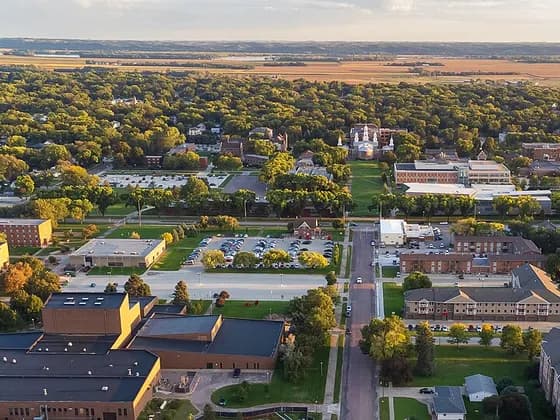
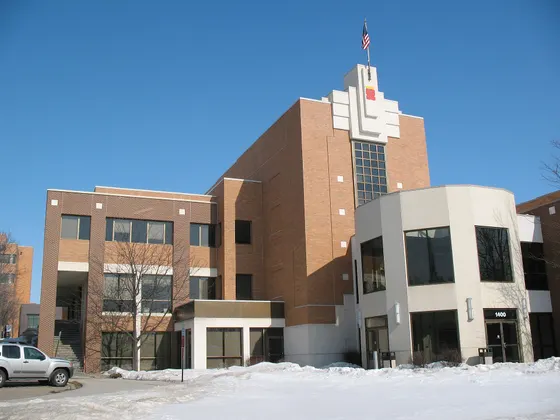
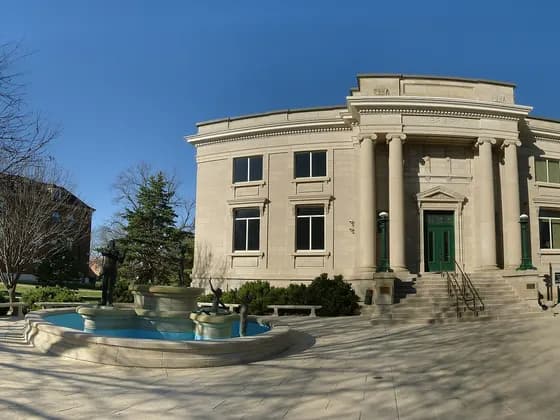
Photo: Jack Boucher (HABS, Library of Congress) · Public domain · cropped
Photo: anup khanal · CC BY-SA 4.0 · Photo: Sdgjake · CC BY-SA 3.0 · Photo: Jerry from Sioux Falls, South Dakota, United States · CC BY-SA 2.0
The USD Sanford School of Medicine MD program at a glance (2027 entry)
The University of South Dakota Sanford School of Medicine (USD Sanford School of Medicine, or USD SSOM) is, in its own words, South Dakota's only medical school. Its MD is a four-year program for 71 new students a year. The Liaison Committee on Medical Education (LCME), which accredits MD programs in the United States, has granted it full accreditation, with its next review due in 2034-35. It is the only South Dakota program listed in the LCME's directory, updated November 13, 2026.
The Three Pillar Curriculum replaced two years of science followed by two clinical years in 2013. Pillar 1, the pre-clerkship (pre-clinical) phase, is about 18 months of science taught by organ system alongside clinical skills. Pillar 2 is a 12-month longitudinal integrated clerkship (LIC): instead of block clerkships, core clinical rotations of several weeks in one specialty at a time, you learn seven specialties side by side. Pillar 3, from March of Year 3 to graduation, brings required rotations and electives.
The school is community-based and owns no teaching hospital. When the state approved a four-year school in 1974, it was set up to teach in existing hospitals and clinics, and its first 39 four-year graduates received MDs in May 1977. You train with the state's four major health systems, Avera, Monument Health, Sanford Health and Veterans Affairs (VA) Health, and about 2,200 faculty statewide.
Pillar 1 has been taught in Vermillion but is moving to Sanford Health's Talley Building in Sioux Falls, which the school expects to occupy by summer 2028. Under the April 2026 plan, students starting in 2027 do the first year of Pillar 1 in Vermillion and its last few months in Sioux Falls, and 2028 entrants start there. The four-year timeline does not change.
You must pass Step 1 of the United States Medical Licensing Examination (USMLE), the national licensing exam series, before Pillar 2 starts. Clinical training is on a campus in Sioux Falls, Rapid City or Yankton, and the Pillar 2 year is mostly in outpatient clinics. Up to 17 students a year spend 11 months of it in a rural town through FARM.
| Degree | MD, fully accredited by the LCME |
|---|---|
| Program length | 4 years: Pillar 1 about 18 months, Pillar 2 12 months, then Pillar 3 |
| Class size | 71 entering students a year (fall 2026) |
| Curriculum | Three Pillar Curriculum, in place since 2013 |
| Pillar 1 location | 2027 entrants: Vermillion for Year 1, then Sioux Falls |
| Clinical campuses | Sioux Falls, Rapid City or Yankton, or a rural FARM community |
| Anatomy | Dissection of donor bodies in lab teams, with plastinated specimens |
| Grading | Satisfactory/Unsatisfactory through Pillar 2's first semester, then letter grades |
| USMLE Step 1 | Before Pillar 2; on the current schedule, around the turn of 2029 |
| Rural track | FARM: 11 months of Pillar 2 in a rural town, up to 17 students |
What makes the USD Sanford School of Medicine MD program different
Seven clerkships side by side for a whole year
In Pillar 2 you learn family medicine, internal medicine, neurology, obstetrics and gynecology, pediatrics, psychiatry and surgery together over 53 weeks, mostly in outpatient clinics. You follow at least 28 continuity patients to surgeries, deliveries and appointments. The model grew from the Yankton Ambulatory Program, which replaced block clerkships in Yankton in 1991 and is now used at every campus.
FARM: 11 months of training in a rural town
Selected students spend 11 months of Pillar 2 in a rural community, working with the local team in clinic, hospital and extended care and following families over time. You take call, sometimes from home, and complete a project that meets a local need. In September 2026 the school announced FARM will take 17 students a year at 10 sites from March 2027.
Rural family medicine for every student, twice
Rural practice is not only for FARM students. Early in Pillar 2 everyone does a family medicine rural preceptorship, three weeks long in the school's sample calendar. Pillar 3 adds a four-week Rural Family Medicine rotation spanning clinic, hospital, nursing home and home visits. The school says both requirements continue after the move to Sioux Falls.
Competencies graded as courses in their own right
Alongside the seven clerkships, Pillar 2 grades six competency courses: patient care, medical knowledge, practice-based learning and improvement, interpersonal and communication skills, professionalism, and systems-based practice. Each draws on its own evidence, from patient logs and observed encounters to Triple Jump case exercises, journal club, small groups and quality improvement workshops.
Cultural immersion, including a visit to a Hutterite colony
Cultural Immersion is a one-credit Pillar 2 course on health care across South Dakota's cultural communities. After two speaker sessions, every student visits a Hutterite colony, then chooses a community for a three-day immersion, reflected on in a journal and a group poster. Past settings include Indian reservations and care facilities for disabled, deaf and blind people.
How USD Sanford School of Medicine teaches medicine
Pillar 1 teaches gross and microscopic anatomy, embryology, neuroscience, biochemistry, physiology, microbiology and pharmacology as integrated, system-based courses, with pathology built into each. Two Medical Foundations courses, of about 12 and 8 weeks, come first, then eight organ-system blocks. Foundations of Clinical Medicine, coordinated by the Department of Family Medicine, runs beside them, building from basic interviewing and examination to system-specific skills.
The curriculum map stresses limited lectures, early clinical exposure, active learning, case-based small groups and high-fidelity simulation. Even so, the education office estimates that at least half of Pillar 1 learning time is lectures, live or recorded. Lectures are recorded, but you are expected to attend, and active-learning sessions are compulsory.
In the Pillar 2 LIC, the seven disciplines are interleaved across the year, mostly in outpatient clinics, with hospital teaching, call and campus sessions around them. Schedules vary by campus and student, and the Office of Medical Education monitors campuses for comparability. Pillar 3 is deliberately less regimented: beyond the required rotations, you plan your own electives, research and away rotations at other medical schools.
The ways you will learn
| Lectures and flipped classrooms | Lectures carry much of the Pillar 1 science. In flipped sessions you review material beforehand and class becomes an interactive conference, which may open with a graded quiz. |
|---|---|
| Patient-based learning | One or two sessions per course in which a small group works a patient case: forming hypotheses, researching, interpreting test results and reaching treatment options. It is graded pass/fail on your contribution. |
| Team-based learning | You prepare in advance and take a readiness test alone and then as a team, before teams apply what they know to complex problems or cases and defend their answers. |
| High-fidelity simulation | In the third semester, the cardiovascular, renal and respiratory blocks each include a simulation at the Parry Center in Sioux Falls. Students from other health programs may join, and clinicians lead a debrief. |
| Pillar 2 small groups and Triple Jumps | Small groups of five or six students and a faculty facilitator explore cases students have seen. Once a semester, a Triple Jump has you work a new case alone with a facilitator, research your knowledge gaps and revise your plan. |
A typical week on the USD Sanford School of Medicine program
In Pillar 1, classes are scheduled between 8 a.m. and 5 p.m. on weekdays, with noon to 1 p.m. generally kept for lunch. Policy caps required activities, including assigned preparation, at 32 hours a week, and a normal week has at least 8 unscheduled hours for study.
A week typically mixes lectures, active learning, clinical foundations sessions and at least one in-person assessment, usually a Monday morning quiz. Each science course ends with a final exam and a customized test from the National Board of Medical Examiners (NBME), which writes national medical exams.
In Pillar 2 your week is built around clinic half-days of two to four hours with your LIC preceptors, plus about two half-days of independent learning. Continuity patients in hospital mean morning rounds, sometimes arriving an hour early to see them first.
Campuses add shifts: emergency department evenings about every 10 to 12 weekdays in Yankton, four 12-hour obstetrics shifts and four surgery night shifts in Sioux Falls, and six 12-hour obstetrics shifts in Rapid City. Duty hours are capped at 80 a week averaged over four weeks, with one day in seven free. Across the 53-week year you get six holidays, plus six vacation days that you book in advance and cannot take on exam dates. You also attend five grand rounds of your choice, the teaching conferences each campus holds.
How anatomy is taught at USD Sanford School of Medicine
Anatomy is taught in Pillar 1 by dissecting donated bodies. Medical Foundations 1, the first course, emphasizes human anatomy with biochemistry, embryology and physiology, and anatomy continues through the organ-system blocks. In Vermillion, the gross anatomy lab is in the basement of the Lee Medicine Building and serves the school's Body Donation Program.
You work in a lab team on a donor, keep the body in good condition and cut only where directed. Rules are strict: lab coats at all times, no photographs, no nicknames for donors and nothing about your donor shared outside class. Bone saws and hand saws are used with eye protection and masks, and tissue is preserved with formalin and phenol.
Plastinated specimens, including a full-size donor, are studied with laser pointers rather than touched. A Sectra Table, a virtual dissector, lets you rotate the body, highlight structures and view cross-sections, and holds X-rays, angiograms, MRI and CT scans.
Sanford Health is providing a new anatomy lab in Sioux Falls as part of the move, the school announced in April 2026. In Pillar 3, a Clinical Anatomy Elective lets you dissect a region of your choice and research surgical approaches you may use in residency.
When you first meet patients at USD Sanford School of Medicine
Clinical skills start in the first semester with Foundations of Clinical Medicine, also called Clinical Foundations: Patient Care, Skills and Service Learning, which teaches interviewing, history taking and examination. From the second semester, Pillar 1 includes a monthly half day in a clinical setting, and you have a clinical faculty mentor.
Pillar 1 also brings six Objective Structured Clinical Examinations (OSCEs), practical exams with timed clinical stations, at the Parry Center in Sioux Falls, which uses standardized patients, actors trained to portray patients. The school tells clinical faculty that students reach Pillar 2 after a year of shadowing different preceptors.
Students also volunteer in student-run free clinics. The Coyote Clinic, started in 2006, offers primary care, acute care and sports physicals to uninsured people in downtown Sioux Falls on Tuesday evenings, plus monthly psychiatric care, with local physicians supervising. The Vermillion Community Clinic, opened in 2022, is also on the student organization list.
In Pillar 2, after a few shadowed sessions, you see patients first and present your findings, differential diagnosis and plan, and you write notes in every discipline. Faculty observe you take a focused history and examination in each discipline every semester. In the Pillar 3 sub-internship, an inpatient rotation, you work at the level of a first-year resident.
The USD Sanford School of Medicine curriculum, year by year
- Year 1
Pillar 1: foundations and the first four systems
Classes begin on the third Monday of July and end on the Friday before Memorial Day, with a two-week winter break. Fall brings the Medical Foundations courses and spring the first four organ-system blocks. For 2027 entrants this year is in Vermillion.
- Medical Foundations 1: human anatomy, biochemistry, embryology and physiology.
- Medical Foundations 2: microbiology, immunology, pharmacology, pathology, epidemiology and biostatistics.
- Blocks on the skin and musculoskeletal, nervous, gastrointestinal and hepatobiliary, and blood and lymphatic systems, with Foundations of Clinical Medicine 1 and 2.
- One or two patient-based learning sessions in each course.
- Deadlines: FARM applications in November and December, campus sign-up in January, and applications by January for Scholarship Pathways, a mentored project program.
- Year 2, July to February
The last systems, Step 1 and Scholarly Activities
The third semester covers the last four organ systems; for 2027 entrants, the last few months of Pillar 1 are in Sioux Falls. Pillar 1 ends in December, followed by a study break for USMLE Step 1 and, for those who pass in time, a February Scholarly Activities course.
- Cardiovascular, renal and urinary, respiratory, and endocrine and reproductive blocks, with Foundations of Clinical Medicine 3.
- The third Comprehensive Basic Science Exam (CBSE), a secure NBME exam the school uses to check readiness for Step 1, in the second week of December. Below 55 percent estimated correct means joining the Step 1 Prep program.
- A Step 1 study plan agreed with the Medical Education Learning Specialist before dedicated study.
- Step 1, passed by the Friday before the 4-credit Scholarly Activities course starts in early February.
- Pillar 2 Essentials in the first week of March.
- Pillar 2: March of Year 2 to February of Year 3
The longitudinal integrated clerkship
Pillar 2 runs 53 weeks on your clinical campus or FARM site. After an Essentials week you learn seven disciplines together, with continuity patients, call and, on some campuses, inpatient weeks. The first semester is graded Satisfactory or Unsatisfactory, the second with letter grades.
- Seven two-semester clerkships: family medicine, internal medicine, neurology, obstetrics and gynecology, pediatrics, psychiatry and surgery.
- A family medicine rural preceptorship and a simulation week early in the year.
- 31 histories and physicals, 28 progress notes, 17 observed encounters, 45 online cases and 396 entries in the Student Patient Experience Log.
- Basic Life Support and Advanced Cardiac Life Support training, two Triple Jumps, journal club, small groups, two quality improvement workshops and a palliative care workshop.
- One-credit courses in Radiology, Clinical Ethics, Cultural Immersion and VITALS, a mainly online series on communication, societal challenges and clinical skills.
- NBME subject (shelf) exams in all seven disciplines at midyear and year end, a clinical science exam each semester, and two OSCEs in Sioux Falls.
- Pillar 3: March of Year 3 to May of Year 4
Required rotations, electives and residency
Pillar 3 brings 17 credits of required rotations and courses, plus electives, including away rotations. Flexible weeks leave time for USMLE Step 2 Clinical Knowledge (CK) and residency interviews. It ends on the Friday before the university's May commencement.
- A four-week sub-internship in family medicine, internal medicine, obstetrics and gynecology, pediatrics, psychiatry or surgery.
- Three weeks of emergency medicine, four of Rural Family Medicine and two two-week surgical specialty rotations, such as anesthesia, ophthalmology, orthopedics, urology or ear, nose and throat (ENT).
- A one-week Transition to Residency course with an interprofessional intensive care unit (ICU) rounding simulation, and a one-week Professional Development course.
- A professionalism and ethics paper, a required mock interview and meetings to prepare your Medical Student Performance Evaluation (MSPE), the dean's letter for residency applications.
- Step 2 CK taken by June 30 of the year before graduation, with a pass expected by the end of that June.
How you are assessed at USD Sanford School of Medicine
Pillar 1 courses are reported as Satisfactory or Unsatisfactory, but numerical scores are kept. You need 75 percent on each course's comprehensive final exam, with a second attempt after remediation if you fall short. Exams follow NBME rules at about 90 seconds a question, and a score under 70 percent on any quiz or test means a meeting with the course director.
In Pillar 2 you sit the NBME subject exam in each of the seven disciplines twice. The better score is 40 percent of each second-semester clerkship grade, and you must reach the 15th percentile nationally at least once. Miss it on both sittings and you retake before Pillar 2 ends; a third-attempt pass caps that clerkship at a B, and you cannot start Pillar 3 until all seven are passed. Pass every first attempt and, with your campus dean's approval, you can skip the second sitting wherever you scored at the 85th percentile or higher.
The NBME Comprehensive Clinical Science Exam (CCSE) comes each semester. You need the 5th percentile nationally in the first sitting and the 15th in the second, when it is 80 percent of your Medical Knowledge grade. Attendings grade you on a shared scale with written comments, and Pillar 3 rotations earn A to F letter grades.
OSCEs run through the program: six in Pillar 1, then a formative and a summative one in Pillar 2, in Sioux Falls. Pillar 2 OSCEs combine standardized-patient encounters and progress notes with a station on X-rays, EKGs or heart and lung sounds and a blended simulation case. You must pass the OSCE to graduate.
Step 1 has been reported pass/fail since January 2022. You must pass by the Friday before the Scholarly Activities course in early February, or with an approved delay by the end of February; otherwise you take a leave of absence. In August 2026 the USMLE program announced a move to designated testing dates from January 2029, with Step exams offered less often each year. Its June 2026 announcement had named 2028, so the date has already moved once.
On the current schedule, a student entering in July 2027 would sit Step 1 around the turn of 2029, close to the USMLE's January 2029 switch to designated testing dates. Which side of the switch it falls on depends on the 2028-29 calendar. Step 2 CK, on clinical science, must be taken by June 30 of the year before graduation: June 30, 2030 for a 2027 entrant, after the switch. School policy also expects a pass by the end of that June unless an extension is approved.
- To graduate: 166 credits, at least a C in required courses, a 2.0 grade point average, Step 1 and Step 2 CK passed within three attempts each, and an OSCE pass, within six years.
- Pillar 1 percentage scores decide the top half of the class, who are eligible for nomination to Alpha Omega Alpha, the medical honor society.
- Your MSPE states if you finished in the top 10, 25 or 50 percent of your graduating class.
- Falling below set standards, for example two remediation finals in a Pillar 1 semester or failing the CCSE, four or more first-attempt shelf exams or the summative OSCE, puts you on monitored academic status. It means a learning plan and needing approval for extras such as research or the Coyote Clinic, but stays out of your academic record and MSPE.
USD Sanford School of Medicine clinical rotations: where you will actually train
All clinical teaching happens in affiliated hospitals and clinics. The main teaching hospitals are in Sioux Falls, Rapid City and Yankton, with VA affiliations in Sioux Falls and Fort Meade. The 2025 Bulletin counts over 50 hospitals and clinics statewide used for clinical foundations, parts of Pillar 2 and Pillar 3 electives.
Campuses are settled in Year 1, and by accepting your place you agree to train wherever you are assigned from the fourth semester. FARM applicants are interviewed and selected in December. In January the rest of the class signs up for a campus, with a lottery if one is oversubscribed. Students with a significant hardship, such as treatment available only in one city, can petition to be exempt.
In February, Sioux Falls students choose an Avera-based or Sanford-based program, 17 places each, again by lottery if needed. Each is based in the health system it is named for and has its own advising committee. The 2026-27 student affairs handbook gives capacities of 10 to 15 in Rapid City, 10 to 12 in Yankton and up to 34 in Sioux Falls, including places for returning MD/PhD students.
You normally stay on your campus through Pillar 3, though you get some choice of where you live then, and FARM students move to a campus. Students outside Sioux Falls are repaid mileage for required trips such as OSCEs, Cultural Immersion and Transition to Residency week, and the school books hotel rooms. You may also ride along on ambulance, helicopter or plane transports with faculty, insured through the health system.
About half of each class trains here. The 2025 Bulletin lists Sanford USD Medical Center as a Level I trauma center.
- Sanford USD Medical Center
- Avera McKennan Hospital & University Health Center
- Sioux Falls VA Health Care System
- Avera Behavioral Health Center
10 to 15 students a class; students have trained here since 1948. Pillar 2 includes inpatient surgery and hospitalist weeks, six obstetrics shifts and a day of rounds with the family medicine residents.
- Monument Health Rapid City Hospital
- Monument Health regional clinics
- Monument Health Family Medicine Residency
10 to 12 students a class, 30 miles from Vermillion. Pillar 2 students take evening and weekend shifts with the emergency, labor and delivery and surgery teams.
- Avera Sacred Heart Hospital
- Yankton Medical Clinic, with an affiliated clinic in Vermillion
- South Dakota Human Services Center (psychiatry)
- Indian Health Service, Wagner (obstetrics and gynecology clinics)
Up to 17 students a year from March 2027, matched to towns by preference and availability; Aberdeen, Brookings and Mitchell are the newest. Call averages one weeknight every other week and one 24-hour weekend every four weeks.
- Aberdeen
- Brookings
- Chamberlain
- Milbank
- Mitchell
- Mobridge
- Parkston
- Pierre
- Spearfish
- Vermillion
Electives, selectives and away rotations at USD Sanford School of Medicine
Pillar 3 is mostly yours to plan. Required rotations and courses total 17 credits, and a credit is roughly a week. Students who took the 4-credit Scholarly Activities course add 30 elective credits, keeping the degree total the same. Students granted a Step 1 delay skip that course and take 34 elective credits instead, with four fewer weeks of vacation.
You can take at most 24 credits in one discipline and 16 extramural credits, meaning electives away from the school. Up to 14 flexible weeks, taken in one-week blocks, cover interviews, Step 2 CK, extra coursework, research or rest. Pillar 3 has no scheduled holidays.
The Bulletin lists electives in every department. Examples include Native American Health Care in reservation-based facilities, telemedicine linking specialists with rural emergency departments and intensive care units, and One Health with veterinarians and the livestock industry. Others cover kidney and pancreas transplantation at the Avera McKennan Transplant Institute, point-of-care ultrasound, sports medicine, and humanities, spirituality and ethics.
Away rotations are common in Pillar 3. Career sessions cover applying through Visiting Student Learning Opportunities (VSLO), the national application service, and a clerkship director reviews grades from outside schools. The curriculum also allows global health experiences; past trips include a medical mission to Guatemala.
You can also earn a 12-credit Bioethics certificate through online electives in the final 18 months, focused on ethical issues in rural and underserved settings.
Dual degrees and research years at USD Sanford School of Medicine
The Physician Scientist Program awards an MD and a PhD. Launched in 2006, it is designed to take seven years: Pillar 1, a pass on Step 1, about three years of PhD research ending in a dissertation defense, then Pillars 2 and 3. Research areas include biochemistry, molecular and cellular biology, anatomy, pharmacology, physiology, microbiology, immunology and neuroscience.
During research you keep up clinical skills through structured clinical experiences, three in the first year, six in the second and eight a year after, arranged with the Sioux Falls or Yankton campus. A first-author manuscript must be submitted before you defend. The program filled two places in July 2026 and had 11 students and 29 graduates.
The university also lists concurrent MD/MBA and MD/MPH programs, pairing the MD with business administration or public health.
For MD students, the Scholarship Pathways Program is a competitive, mentored project in research, service, education or social science across all four years. You apply by January of Year 1 and complete ethics training, review-board paperwork and a summer abstract in Pillar 1. A virtual poster follows in Pillar 2, then a 4-to-8-week Pillar 3 elective, a manuscript and the Scholars' Research Symposium; completion appears on your transcript and diploma.
Newly accepted students can also join the Medical Student Summer Research Program, and every clinical department offers Pillar 3 research electives.
Facilities and support at USD Sanford School of Medicine
Where you will learn
In Vermillion, Pillar 1 has used the Andrew E. Lee Memorial Medicine and Science Building, opened in 2008 and shared with the School of Health Sciences. It has three auditoriums seating 222, 104 and 48, 19 rooms for groups of 10 to 20, five clinical exam rooms and the gross anatomy lab. After the move it will be renovated for other sciences.
In Sioux Falls, the Health Science Center, opened in 1994 on the Sanford Health campus, houses administration and clinical departments beside the Wegner Health Science Information Center, the medical library. The planned renovation of the neighboring Talley Building for Pillar 1 includes lecture halls, active-learning classrooms and more space for study aids, career counseling and mental health services.
The Parry Center for Clinical Skills and Simulation, opened in 2012, has 10 clinical exam rooms, eight high-fidelity simulation rooms including an operating room, three classrooms and four control rooms. It uses SimMan 3G, SimJunior and SimNewB manikins, standardized patients and dozens of task trainers, and records sessions for review.
Rapid City has a student lounge with lockers and study areas and a multi-use skills and simulation room. In Yankton, Avera Sacred Heart Hospital built dedicated education space in 2007.
Support while you study
Advising follows the pillars. In Pillar 1 you have a biomedical sciences faculty advisor and a clinical faculty mentor, and second-year students volunteer as peer mentors. In Pillar 2 a member of your campus advising committee writes monthly feedback and meets you at midsemester. In Pillar 3 you choose a clinical faculty advisor and meet an academic coach at least three times one to one.
Academic support is open to all: confidential counseling, study skills, test-taking strategies, Step preparation, and peer-led Supplemental Instruction and tutoring. Every student plans Step 1 study with the Learning Specialist, and students in the bottom quarter of the class meet regularly with the Pillar 1 Director and the Learning Specialist.
For wellbeing there is a Chief Wellbeing Officer and a counselor who links the school with the free USD Student Counseling Center. A 24/7 crisis line, six free counseling sessions a year through an assistance plan and confidential professional support services are also available, and each class elects wellness officers with an events budget.
First-year students can take the Healer's Art, a five-session fall elective, offered since 2005, on why you chose medicine. Career advising runs from department chair talks in Pillar 1 and a career fair in Pillar 2 to personal statement reviews in Pillar 3, when students also serve as career peer mentors.
Is the USD Sanford School of Medicine program right for you?
This program may suit you if
- You want to learn clinical medicine by following your own patients across a whole year rather than in block clerkships.
- Rural practice appeals: everyone does rural family medicine twice, and FARM offers 11 months in a small South Dakota town.
- You like frequent, structured feedback, with monthly advisor reviews and separate grades for competencies such as communication and professionalism.
- You want to dissect a donor body as part of a lab team.
- You want a long, flexible final stretch: 30 elective credits, away rotations, and up to 14 flexible weeks for interviews, Step 2 CK, research or rest.
Things to think about
- Expect to move: 2027 entrants switch from Vermillion to Sioux Falls partway through Pillar 1, and your clinical campus may come down to a lottery.
- Pillar 1 is reported pass/fail, but its percentage scores count toward honor society eligibility, and shelf exams weigh heavily in second-semester Pillar 2 grades.
- The Step 1 deadline is firm: if you have not passed by the end of February of Year 2, you go on leave instead of starting Pillar 2.
- Pillar 2 brings heavy logging: hundreds of patient log entries plus written histories, progress notes and online cases.
USD Sanford School of Medicine MD program — frequently asked questions
Applying to USD Sanford School of Medicine?
How to get into USD Sanford School of Medicine
Prerequisites, MCAT, AMCAS personal statement, secondaries and interview, step by step.
Open the guide →USD Sanford School of Medicine admissions profile
MCAT and GPA profile, acceptance rate, interview format and key dates.
See the profile →Compare USD Sanford School of Medicine with other schools
Put the teaching style, anatomy teaching and clinical sites next to another school.
Open the comparison →Prepare for the USD Sanford School of Medicine interview
Format breakdown, school-specific sample questions and prep tips for this interview.
Read the guide →Where this USD Sanford School of Medicine program guide came from
This guide was written from 46 official sources — University of South Dakota Sanford School of Medicine's own program pages and curriculum documents, plus the accreditor and the hospitals and health systems the school trains students in where they publish detail — read on 2026-11-12, then checked claim by claim against those sources.
- USD Sanford School of Medicine: Office of Medical Education (Three Pillar Curriculum, assessment and OSCE)
- USD Sanford School of Medicine: school home page
- Three Pillar Curriculum map, updated August 22, 2025
- Pillar 1 Student Handbook, Class of 2029 (2025-26)
- Pillar 2 Student Handbook, Class of 2028 (2026-27), revised September 10, 2026
- Pillar 3 Student Handbook, Class of 2027, revised September 10, 2026
- Pillar 2 and 3 Clinical Faculty Handbook, Class of 2027, revised January 2, 2026
- USD Sanford School of Medicine Bulletin, Version 25, April 4, 2025
- Medical Student Affairs Handbook 2026-2027
- USMLE Performance Policy, revised July 2026
- Requirements for Advancement, Graduation, Dismissal Policy, revised December 2025
- Pillar 2 Comprehensive Clinical Science Subject Exam (CCSE) Testing Policy, revised August 2026
- Pillar 2 NBME Subject Examination Failure and Retesting Policy, revised November 2025
- Monitored Academic Status Policy, February 2026
- Pre-clerkship Workload Policy, revised April 2025
- Medical Student Duty Hours Policy
- Physician Scientist (MD/PhD) Program Handbook 2026
- Sample Pillar 2 calendar, Class of 2027 (2025-26)
- USD Sanford School of Medicine 2026-2027 Data Reference Card
- USD Sanford School of Medicine Sioux Falls Transition (FAQ)
- Momentum for USD Sanford School of Medicine Transition Accelerates Timeline (April 2, 2026)
- Frontier And Rural Medicine (FARM) Program
- USD SSOM Expands FARM Program to Three More Locations (September 24, 2026)
- Sioux Falls Medical Campus
- Rapid City Medical Campus
- Yankton Medical Campus
- Vermillion Medical Campus (Lee Medicine Building)
- Parry Center for Clinical Skills and Simulation
- Human Anatomy Lab
- Medical Student Affairs (academic support, career advising, wellbeing)
- Medical Student Research
- Scholarship Pathways Program
- Graduate Medicine: MD and concurrent MD/MBA and MD/MPH programs
- Physician Scientist (MD/PhD) program
- Bioethics certificate
- Department of Emergency Medicine
- Coyote Clinic (student-run free clinic)
- Coyote Clinic Celebrates 20 Years of Service and Professional Training (July 20, 2026)
- Vermillion Community Clinic Serves, Teaches (May 19, 2022)
- About Us: school history, curriculum reform and service
- LCME directory of accredited programs
- USMLE: Updated Timeline for Designated Testing Dates, Transition in January 2029 (August 6, 2026)
- USMLE Designated Testing Dates Information Hub
- USMLE to Transition to Limited Testing Dates Each Year Starting in 2028 (June 23, 2026)
- USMLE Examination Results and Scoring
- NBME Comprehensive Subject Exams (Comprehensive Basic Science and Comprehensive Clinical Science)
Curricula are restructured between cycles. Anything here that decides your application — how anatomy is taught, a clinical campus assignment, a required research year — should be confirmed against the official page for your entry year.
Applying to USD Sanford School of Medicine?
We help US applicants with MCAT strategy, the AMCAS personal statement, secondary essays and interview prep — everything you need for a competitive USD Sanford School of Medicine application.