




Single station
One station, any tier.
£6
Each station £6
Buy one credit1 live station. Credits never expire.
Clinical Years · UK
171 stations, each with the examiner’s mark sheet, free to study at your year’s standard. Practise alone or with friends, or sit any station live with an AI patient or examiner.
Opens the chest pain history at the door, with the clock ready: 1:00 to read, 8:00 in the room.


The patient, on your phone
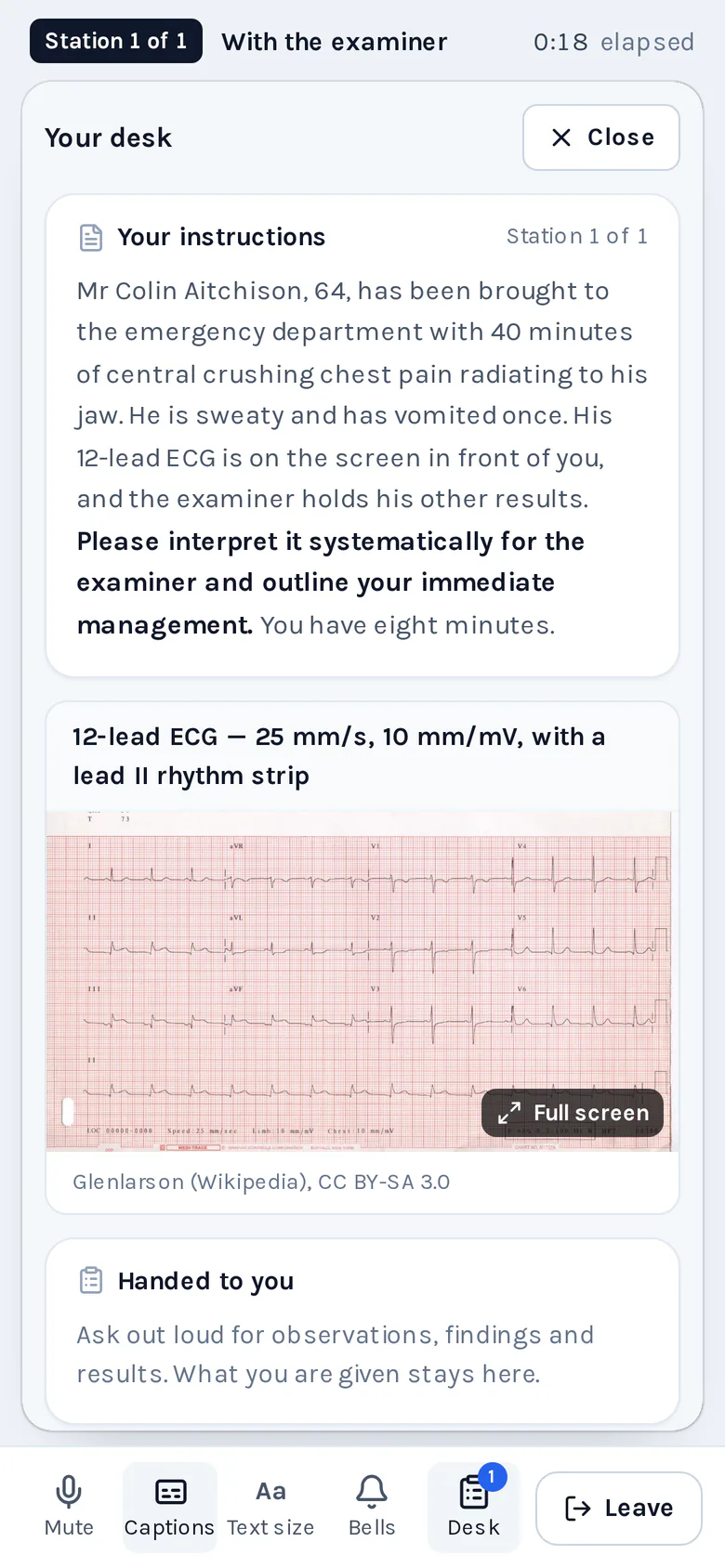
Your desk, one tap away
PopularChest painECGBreaking bad newsCardiovascular examABGConsent
Read the door notice, run the station out loud against the clock, then tick the examiner’s sheet at your year’s standard.
 Chest pain historyYear 3 standard
No account needed
One of you sits the station, one plays the patient from the brief, and one marks on their own phone.
Who does what
One clock on both screens. The marks come back to yours.
In the browser, on any phone
An AI patient or examiner runs the station in real time, the bell goes on time, and your sheet comes back marked line by line.
From £3.67 a station. Credits never expire.
Tonight’s circuit
Reading + in the room
Station guides
The routine, every system sequence, and presenting findings so the examiner hears a diagnosis.
On the door: Cardiovascular examination · 8 minutes
This 74-year-old man has been referred to the cardiology clinic with breathlessness on exertion and two episodes of collapse while gardening. Please examine his cardiovascular system, talking the examiner through each step as you do it.
The order it is marked
44% of the marks across all 28 stations are for a systematic approach.
MarksOne system for films, ECGs, gases and bloods, said out loud under time pressure.
On the door: ECG interpretation · 8 minutes
Mr Colin Aitchison, 64, has been brought to the emergency department with 40 minutes of central crushing chest pain radiating to his jaw. He is sweaty and has vomited once. His 12-lead ECG is on the screen in front of you, and the examiner holds his other results. Please interpret it systematically for the examiner and outline your immediate management.

44% of the marks across all 30 stations are for clinical reasoning.
MarksBad news, consent, capacity and the angry relative, with the lines that score.
On the door: Breaking bad news · 10 minutes
Mrs Eileen Prosser, 67, has come to the respiratory clinic alone for the result of a staging CT scan of her chest and abdomen. She was referred with a six-week cough and weight loss, and the scan, performed eleven days ago, shows a 4 cm mass in the right upper lobe with several deposits in the liver. The appearances are highly suspicious of a lung cancer with metastatic spread. There is no tissue diagnosis and her case is going to the lung MDT on Thursday. She has not been told the result. Your consultant has asked you to speak to her. Please do so.
“Cancer. So it is cancer. That is what you are saying to me.”
39% of the marks across all 32 stations are for communication.
MarksIdentity, consent, asepsis and sharps, then each procedure in the order it is marked.
On the door: Peripheral intravenous cannulation · 5 minutes
Mr Alan Reid, 74, has been admitted to the acute medical unit with a community-acquired pneumonia and needs intravenous antibiotics. Please insert a peripheral cannula, talking the examiner through each step as you do it and saying why.
The order it is marked
37% of the marks across all 22 stations are for patient safety.
MarksThe five station guides are reviewed by Isaac Butler-King, medical student at the University of Glasgow, most recently on . Editorial policy
On the door, at every year: Cardiovascular examination
This 74-year-old man has been referred to the cardiology clinic with breathlessness on exertion and two episodes of collapse while gardening. Please examine his cardiovascular system, talking the examiner through each step as you do it.
AI OSCE simulator
A microphone cannot see your hands, so examination and skills sittings rehearse your routine, your findings and your answers. Practise the technique itself on a friend.
1 credit, £3.67–£6 a station.
All 171 stations can be sat live.
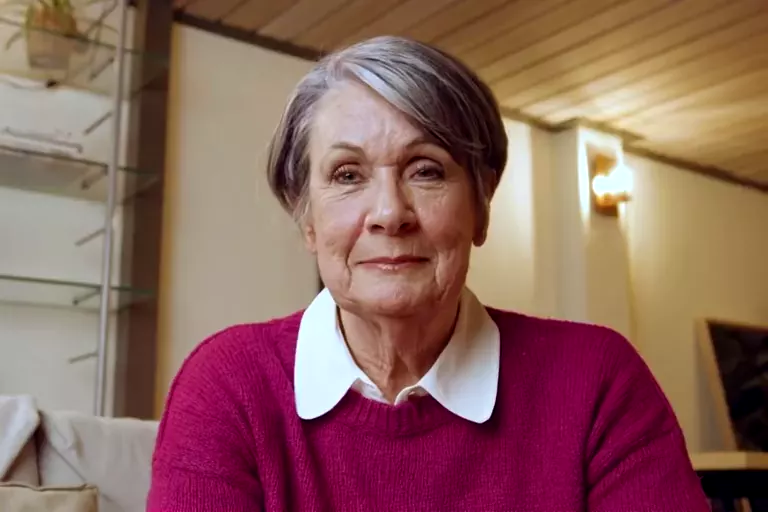
“Morning, doctor. Sorry, I’m early, I could never work out that car park.”
Eileen Prosser, 67Breaking bad news · Year 4Open the station
Examiner’s mark sheetMark sheetTick a line · 1 / 31 marks“Sorry, can we have the lights down? My head is absolutely splitting and I’m struggling to cope with the pain.”
Zoe Hartley, 34Headache history · Year 3Open the station
Examiner’s mark sheetMark sheetTick a line · 1 / 25 marks“Are you the doctor? I have been asking since Sunday night and nobody has given me a straight answer.”
Dean Halloran, 44Angry relative · Year 4Open the station
Examiner’s mark sheetMark sheetTick a line · 1 / 29 marks“Alright, doc. The receptionist said the blood test was abnormal.”
Marcus Bello, 52Explaining a diagnosis · Year 3Open the station
Examiner’s mark sheetMark sheetTick a line · 1 / 20 marks“Hello doctor. I’ve had this pain in my chest since this morning and, well, the wife made me come in.”
David Whitmore, 58Chest pain history · Year 3Open the station
Examiner’s mark sheetMark sheetTick a line · 1 / 25 marksReal stations and mark sheet lines. The patients are played by AI avatars.
Breaking bad newsExample resultYear 4 standardAnd 23 more lines, marked the same way.
Credit packs
One station, any tier.
£6
Each station £6
Buy one credit1 live station. Credits never expire.
Five stations, or a circuit and two.
£25
Each station £5
Buy 5 credits5 live stations or 1 full circuit. Credits never expire.
Five full circuits.
£60
Each station £4
Buy 15 credits15 live stations or 5 full circuits. Credits never expire.
A whole finals season.
£110
Each station £3.67
Buy 30 credits30 live stations or 10 full circuits. Credits never expire.
Already have credits? Set up a station
Necessary cookies keep the site working; analytics and marketing cookies run only if you allow them. Privacy