OSCE station guide

Practical skills in the OSCE Safe, in order, and out loud

How UK procedure stations are marked, the routine that wraps every practical skill, and step-by-step technique for cannulation, catheterisation, IM injection and adult BLS, with the words to say.

  • Free mark schemes Every station tiered by year
  • Critical-fail items Identity, asepsis, sharps
  • BLS numbers (RCUK 2025) 30:2, 100–120/min, 5–6 cm
  • Free to study, no account needed
  • Sit it live: 1 credit, £3.67–£6

Candidate instructions

Peripheral intravenous cannulation

Mr Alan Reid, 74, has been admitted to the acute medical unit with a community-acquired pneumonia and needs intravenous antibiotics. Please insert a peripheral cannula, talking the examiner through each step as you do it and saying why.

1:00Read5:00In the roomBell
Examiner’s mark sheetYear 3
Tick a lineRunning total1/26

A real station and real mark sheet lines.

Practise it free Worked minute by minute below

The station

What a practical skills station tests

A procedure station is marked on sequence and safety, not flair. Examiners tick what they can see and hear, and on a manikin much of what matters is invisible unless you say it. The candidates who pass check identity and allergies before touching anything, keep the key parts untouched, put every sharp straight into the bin, and narrate each step as they do it.

This guide takes you step by step through peripheral cannulation, male catheterisation, intramuscular injection and adult in-hospital basic life support, all of which we run as stations. Our library also has acute-care stations, where you assess and treat an unwell patient from A to E, and more resuscitation stations, and it keeps growing. Every station has a free mark scheme tiered by year. The core routine fits any skill on the GMC's practical skills list, including those we do not run as stations.

Study these free, and sit them live with our AI examiner: you say each step out loud and they tell you what happens. It cannot watch your hands, so it tests your sequence and your safety checks, not your technique.

  • Asepsis is a defined method

    The Association for Safe Aseptic Practice classes cannulation, venepuncture and intravenous drug preparation as Standard-ANTT, and indwelling catheterisation as Surgical-ANTT, with a sterile drape and sterile gloves.

    For you: Name the key parts as you protect them.

  • Skin prep has a recipe

    The epic3 national guidelines recommend 2% chlorhexidine in 70% alcohol, allowed to dry, a sterile transparent dressing, a phlebitis score at least every shift, and removal once the line is not needed.

    For you: Say the drying out loud, not just the cleaning.

  • No need to aspirate

    The Green Book, the UK's immunisation guidance, gives intramuscular injections at 90 degrees with the skin stretched, through a 23G or 25G 25 mm needle, and says it is not necessary to aspirate.

    For you: Have a one-sentence reason ready. Examiners like to ask.

  • The BLS numbers held in 2025

    Resuscitation Council UK's 2025 guidelines keep 100–120 compressions a minute, 5–6 cm deep, and 30:2 for rescuers trained in breaths. In hospital the call is 2222, and the algorithm reads call, compress, collect.

    For you: Say the numbers as you work. The examiner marks what they hear.


How procedure stations are marked

A checklist, a global grade and a short list of things that fail you on their own.

A UK procedure station is usually marked two ways at once. The checklist lists observable actions, such as confirming identity against the wristband, with safety-critical lines often worth double. The examiner also gives a global grade, typically from clear fail through borderline to excellent, for how safe and fluent you were.

That grade matters more than it looks. Many schools set the pass mark by borderline regression: across the cohort, checklist scores are plotted against global grades, and the pass mark is the checklist score that lines up with borderline.

Then there are items that fail you outright: critical fails in our mark schemes, unsafe practice at some schools. For students graduating from 2024–25 onwards, the clinical and professional skills part of the GMC's Medical Licensing Assessment is run by your own school, and practical skills and procedures are one domain of its content map.


Global ratingClear failBorderlinePassGood passExcellent

What fails each of our stations outright

Read from the mark schemes themselves, so this is what the examiner is holding today.

What fails each of our stations outright
StationTimeSat fromLines that fail it outright
Peripheral intravenous cannulation5 minYear 3Confirms patient identity with the full name and date of birth; Asks specifically about allergies, including chlorhexidine, latex and adhesive dressings, and acts on the answer; Disposes of every sharp directly into the sharps bin at the point of use, and never recaps a needle
Male urethral catheterisation8 minYear 4Offers a chaperone and states that the offer and the outcome will be documented; Confirms patient identity with the full name and date of birth; Asks about allergies, specifically latex and local anaesthetic, before any equipment touches the patient; Maintains the sterile field throughout, keeping one hand clean and one hand working, and re-gloves rather than continuing if it is contaminated; Confirms urine is draining, with the catheter advanced to the bifurcation so the balloon is in the bladder, BEFORE inflating it
Adult basic life support5 minYear 3Puts out the cardiac arrest call — dials 2222, or sends someone to, and states "adult cardiac arrest"; Recognises that occasional agonal gasps are NOT normal breathing and starts CPR without delay; Compresses to a depth of at least 5 cm but not more than 6 cm; Compresses at a rate of 100-120 per minute
Intramuscular injection5 minYear 3Confirms patient identity with the full name and date of birth before giving anything; Works through the five rights against the prescription — right patient, right drug, right dose, right route, right time; Checks for allergies before drawing up, by asking the patient or reading the allergy box on the chart; Disposes of the needle and syringe as a single unit directly into the sharps bin at the point of use, without recapping or disassembling; Recognises the flushing, itch and tingling lips as a possible anaphylactic reaction and acts on it at once
Acutely unwell after an antibiotic8 minYear 4Stops the infusion; Gives intramuscular adrenaline without waiting for the assessment to be finished
The other 17 stationsAcutely unwell and drowsy, Acutely unwell with breathlessness, Acutely unwell with a fever and 14 more
What fails each of our stations outright, continued
StationTimeSat fromLines that fail it outright
Acutely unwell and drowsy8 minYear 3Checks a capillary glucose; Moves to intravenous glucose or glucagon when he cannot safely swallow, and gives nothing more by mouth
Acutely unwell with breathlessness8 minYear 4Gives nebulised salbutamol without delay; Calls intensive care, an anaesthetist or the emergency team once she deteriorates
Acutely unwell with a fever8 minYear 4Asks about allergies before naming an antibiotic; Gives a broad-spectrum intravenous antibiotic within one hour of the first NEWS2 score; Calls the medical registrar or another senior early
Adult choking6 minYear 3Gives back blows; Gives abdominal thrusts when back blows have not worked; Starts CPR without delay
Paediatric basic life support6 minYear 4Phones for an ambulance straight away; Gives rescue breaths before starting compressions; Starts chest compressions straight after the rescue breaths
Arterial blood gas sampling8 minYear 4Asks the patient to state her own full name and date of birth; Asks about anticoagulants or a bleeding tendency, or checks the drug chart, before the puncture; Removes the needle into the sharps bin using the safety guard, without re-sheathing it
Blood cultures8 minYear 3Asks the patient to state his own full name and date of birth; Puts each used needle straight into the sharps bin at the bedside without re-sheathing it
Blood transfusion bedside check8 minYear 4Asks the patient to state his own full name and date of birth; States that the unit must not be transfused, because the dates of birth differ
Intravenous medication administration8 minYear 4Asks the patient to state her own full name and date of birth; Asks the patient directly about allergies, or asks what the red wristband is for, before any drug is given; Does not give the flucloxacillin
Suturing a simple laceration10 minYear 4Tests sensation, movement or circulation beyond the wound before any local anaesthetic is given; Puts every needle straight into the sharps bin without re-sheathing, and accounts for them
Venepuncture6 minYear 3Asks the patient to state her own full name and date of birth; Labels the tubes at the bedside, immediately after filling them; Puts each used needle straight into the sharps bin at the bedside without re-sheathing it
Blood pressure measurement: lying and standing10 minYear 3Sits or lies him back down
Capillary glucose and insulin injection8 minYear 3Asks the patient to state his own full name and date of birth; Does not give the insulin until the prescriber has made the dose clear; Puts each used sharp straight into the sharps bin without recapping it
Recording a 12-lead ECG8 minYear 3Asks the patient to state her own full name and date of birth; Checks that the printed trace carries this patient's name and details
Hand hygiene and personal protective equipment8 minYear 3Washes hands with soap and water after removing the PPE
Nasogastric tube insertion8 minYear 4Puts nothing down the tube until its position has been confirmed
Peak flow and inhaler technique8 minYear 3Asks him to show the inhaler and spacer technique himself

On a manikin, unsaid is undone

The examiner cannot see chlorhexidine drying or know you checked an expiry date unless you say so. Narrate in short, factual sentences, and talk to the patient as though the arm were attached to someone.

What a live skills station looks like

  • An AI examiner runs the station by voice.
  • Say each step out loud, from checks and consent to disposal, and they tell you what happens.
  • It rehearses your sequence and your safety checks.
  • It cannot see your hands, so practise the technique itself on a manikin.
Sit a station live

1 credit a station, £3.67–£6

Try a station free
AI OSCE station · UKReal screen
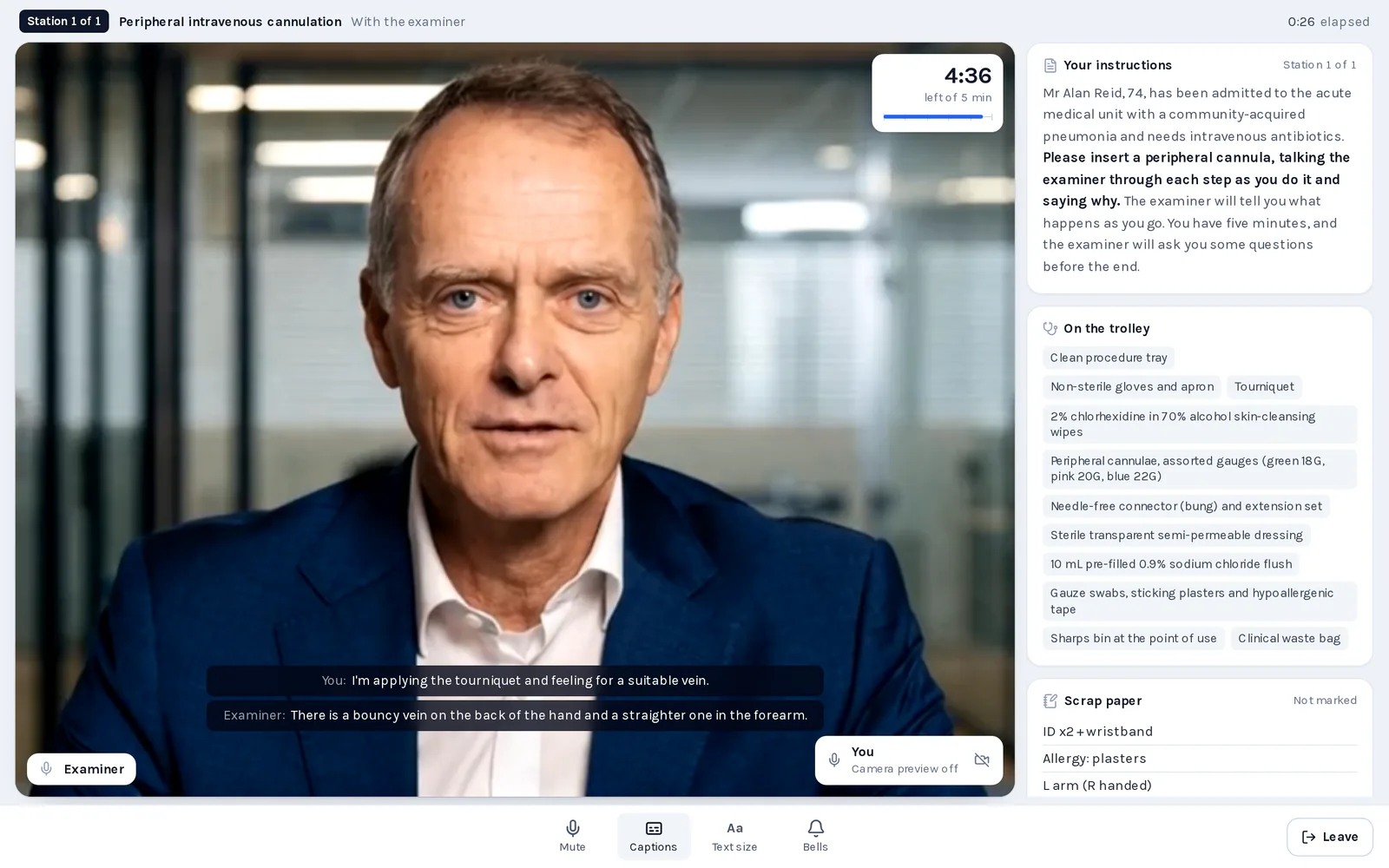
A live AI OSCE skills station from the UK library, peripheral cannulation: the candidate says each step and an examiner tells them what happens. The desk shows the kit on the trolley and the candidate's notes.
AI OSCE station · UKReal screen
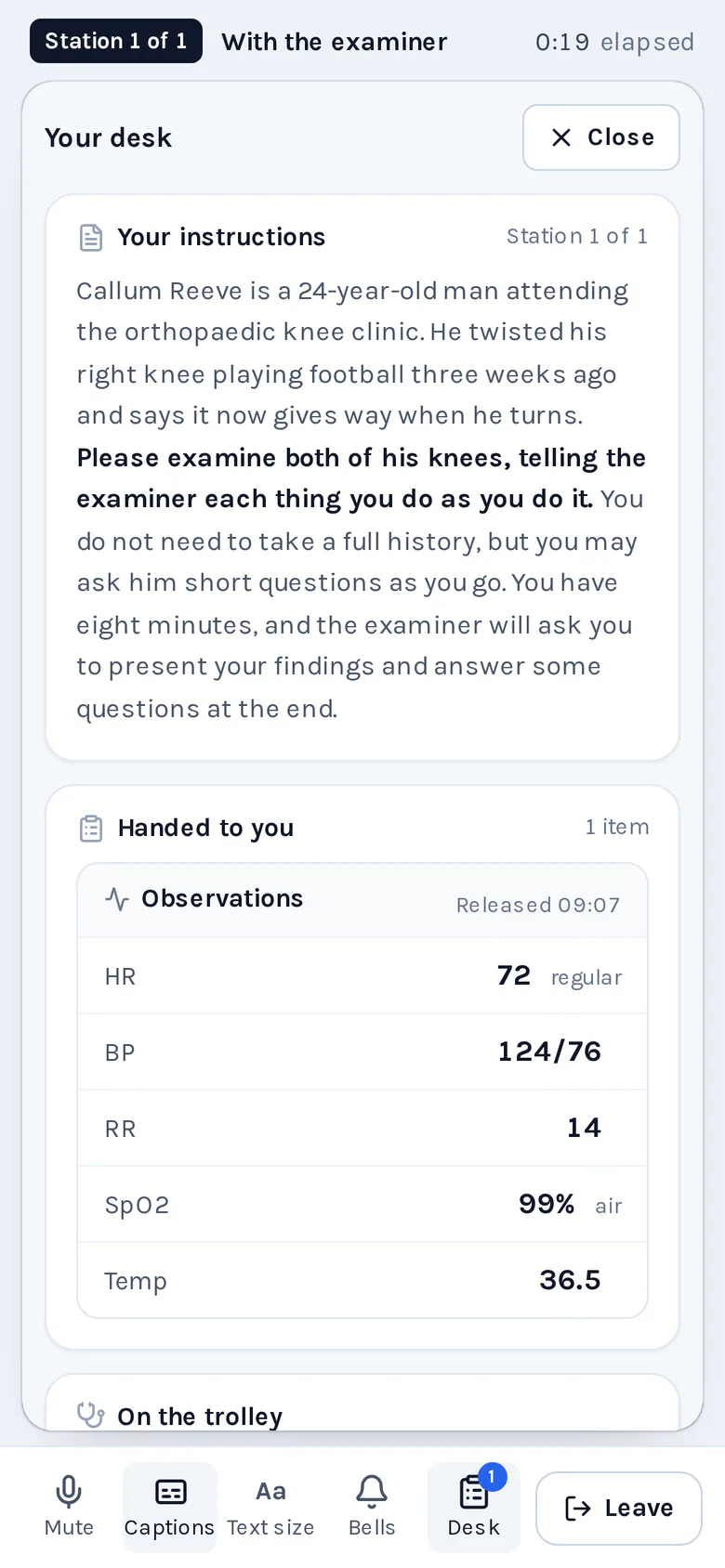
The candidate's desk on a phone during an AI OSCE knee examination from the UK library: the instructions, and the observations the examiner has just handed over.
A real screen of the live room: the examiner saying what happens, on our peripheral cannulation station.

The method

The routine that wraps every procedure

The hands-on part is short. Most marks sit in the checks before it and the tidy-up after, the same for every skill except resuscitation and acute care, which run to their own sequence.

Ten steps, always in this order

  1. Hands, introduction, indication

    Clean your hands, give your name and role, and confirm why the procedure is needed.

    Say: Hello, I am Alex, a medical student. I have come to put a small tube into a vein for your antibiotics.

  2. Confirm identity

    Ask for full name and date of birth, then check both against the wristband and the chart. Reading the name out is not a check.

    Say: Can you tell me your full name and date of birth?

  3. Explain and consent

    What, why and what it will feel like, in plain words, with a real chance to say no. For anything intimate, offer a chaperone and record the answer.

    Say: It will feel like a sharp scratch, then it should settle. Are you happy for me to go ahead?

  4. Allergies, by name

    Chlorhexidine, latex, plasters, local anaesthetic and the drug itself, from the chart and from the patient. A yes changes your equipment.

    Say: Any allergies to latex, plasters, skin-cleaning fluid or medicines?

  5. Anything that changes the plan

    Previous difficulty, needle phobia, a preferred arm, a fistula, lymphoedema, axillary surgery, anticoagulation; for a catheter, strictures and prostate problems.

    Say: Have you had one of these before, and was there any difficulty?

  6. Prepare the equipment

    Check every packet is intact and in date, prime what needs priming, and bring the sharps bin to your side so a used needle never travels.

    Say: Each packet is sealed and in date, and the sharps bin is at the bedside.

  7. Hand hygiene, apron, gloves

    Clean your hands again just before the aseptic part, the WHO moment before a clean procedure, then apron and gloves.

    Say: I am cleaning my hands again, then apron and gloves.

  8. Protect the key parts

    Clean the site, let it dry, and do not touch it again. Key parts touch only key parts or the key site; if one is contaminated, say so and replace it.

    Say: I am letting the skin dry, and I will not touch it again.

  9. Sharps and waste

    Every sharp straight into the bin, by you, never recapped, needle and syringe as one unit. Then clinical waste, gloves and apron off, and hands cleaned.

    Say: Straight into the sharps bin, and I will not recap it.

  10. Document and safety-net

    Record what you did, where, with what, how many attempts and who did it. Tell the patient what to watch for and who to tell.

    Say: If it gets sore, red, swollen or starts to leak, press your call bell straight away.

Lines worth rehearsing

  • The allergy answer is yesThank you, that changes my equipment, and I will make sure it is on your allergy record.
  • An attempt has failedThat has not worked, so I am stopping and pressing on the site rather than moving the needle around.
  • Before a second attemptWould you be happy for me to try once more? After two attempts I would ask someone more experienced.
  • You have contaminated somethingMy glove has touched the trolley, so I am changing gloves before I go on.

Asepsis, ANTT and sharps: the marks you cannot lose

One slip here can fail a station outright, because the harm lands on the patient or on you.

Aseptic non-touch technique in four ideas

  • Key-Parts and Key-Sites

    Key-Parts would carry infection in if contaminated: needle, cannula tip, bung, syringe tip, catheter. Key-Sites are the patient's portals, such as a cleaned puncture site. Key-Parts touch only other Key-Parts or the Key-Site.

    For you: Name two Key-Parts as you handle them.

  • Standard or Surgical ANTT

    Standard-ANTT uses a clean tray, non-touch technique and usually non-sterile gloves. Surgical-ANTT manages everything on a sterile drape with sterile gloves, as for an indwelling catheter.

    For you: Say which approach you are using.

  • Micro critical aseptic fields

    Caps, covers and the inside of a freshly opened sterile packet protect a Key-Part until the moment you use it. Leave the cap on the bung until you connect.

    For you: Open packets so nothing inside is touched.

  • The WHO five moments

    Before touching a patient, before a clean or aseptic procedure, after body fluid exposure risk, after touching a patient, and after touching their surroundings. Soap and water when hands are visibly soiled.

    For you: Name the moment as you clean your hands.

Sharps rules examiners watch for

  • Bring the sharps bin to the point of use before you start.
  • Never recap. The Health and Safety (Sharp Instruments in Healthcare) Regulations 2013 allow it only where a risk assessment requires it and a device makes it safe.
  • Needle and syringe go in as one unit, never taken apart.
  • Dispose of your own sharps; never leave one on the tray for someone else.
  • Close the bin between uses and seal it at the fill line.

If you get a needlestick injury

Let it bleed under running water, wash with soap without scrubbing, do not suck it, and cover it with a waterproof dressing. Report it at once to occupational health, or the emergency department out of hours: reporting every sharps injury is a legal requirement, and post-exposure prophylaxis, if needed, works best started early.


Cannulation and intramuscular injection

Same frame, different marks: cannulation rewards technique and recovery, the injection rewards medicines checks.

Peripheral cannulation

  1. Gauge and vein

    Pink 20G for fluids and antibiotics, green 18G or grey 16G for blood or rapid fluid, blue 22G for fragile veins: the smallest that does the job. Tourniquet 7–10 cm above the site, and a straight, bouncy vein found by feel, away from joints, starting distally.

    Say: A pink 20G is plenty for antibiotics, and this vein feels straight and bouncy.

  2. Clean and dry

    2% chlorhexidine in 70% alcohol for 30 seconds, or povidone-iodine in alcohol if allergic, then let it dry completely. Do not re-palpate; if you must, clean again.

    Say: Cleaning for thirty seconds and letting it dry.

  3. Insert and advance

    Warn, anchor the skin below the site, and insert bevel up at 10–30 degrees. At flashback, lower the angle, go a few millimetres further, then slide the cannula off the needle. Never re-advance the needle into the cannula: it can shear the plastic.

    Say: Sharp scratch now. Flashback, so I am lowering the angle and advancing the cannula.

  4. Release, occlude, bin

    Tourniquet off first, pressure on the vein above the tip, then the stylet straight into the sharps bin.

    Say: Tourniquet off, pressure above the tip, needle straight in the bin.

  5. Secure, flush, record

    Primed extension and bung, and a sterile transparent dressing, dated, with the insertion point visible. Flush 5–10 mL of 0.9% sodium chloride, watching for resistance, swelling and pain. Document it and start a VIP chart; a phlebitis score of 2 or more means it comes out.

    Say: It flushes easily. Is that comfortable?

Deltoid intramuscular injection

  1. The chart, then the patient

    Identity against the wristband and the chart, then the five rights aloud: right patient, drug, dose, route and time. Legible, signed, not already given, and allergies checked on the chart and with the patient.

    Say: Hydroxocobalamin, 1 milligram, intramuscular, due at ten, signed, and not yet given today.

  2. Ampoule and needles

    Name, strength, expiry, intact glass, clear solution, and a second checker for a controlled or high-risk drug. Draw up with a 21G green needle, expel air at eye level, then change to a 23G blue 25 mm needle.

    Say: I am changing to a fresh needle, because the drawing-up needle is blunted.

  3. Landmark the deltoid

    Find the acromion and come down two to three finger-breadths, about 5 cm, into the middle of the muscle. The deltoid takes up to about 1 mL; the dorsogluteal site is avoided. Skin cleaning follows local policy; for vaccines, the Green Book says clean skin needs none.

    Say: Two to three finger-breadths below the acromion, in the middle of the muscle.

  4. Inject without aspirating

    Stretch the skin and insert at 90 degrees in one quick movement, leaving about a third of the needle showing. Inject about 1 mL per 10 seconds. The Green Book says aspirating is not necessary; a drug's own instructions come first.

    Say: I will not aspirate: there are no large vessels at this site, and it prolongs the injection and adds pain.

  5. Withdraw, bin, sign, stay

    Wait 10 seconds, withdraw, press without rubbing, bin needle and syringe as one, sign the chart with site and time, and stay with the patient.

    Say: I will stay with you for a few minutes. Tell me at once if you feel itchy or unwell.

If she flushes and her lips tingle

Say it could be anaphylaxis, call for help and assess ABCDE. Any airway, breathing or circulation problem confirms it: lie her flat, or sitting if breathing is easier, and give adrenaline 500 micrograms intramuscularly, 0.5 mL of 1 mg/mL, into the anterolateral thigh, repeated after 5 minutes if she is no better. Skin and lip changes alone are not anaphylaxis: stay and reassess.


Male catheterisation: three moments that decide it

Offer a chaperone, keep the field sterile, and see urine before the balloon. Identity and allergies can fail it too. The rest is a sequence you can rehearse.

  1. Consent and chaperone

    Warn him it will be uncomfortable and will relieve the pain. Offer a chaperone before any exposure, record the answer, and draw the curtains.

    Say: This is an intimate procedure, so I would like to offer you a chaperone.

  2. Allergies and history

    Latex and local anaesthetic, with a silicone catheter if latex is a problem; previous catheters, strictures and prostate disease; a bladder scan to confirm retention. A 12–14 Ch catheter for routine use.

    Say: Have you ever reacted to latex, or to the numbing gel?

  3. Sterile field

    Hands, apron, pack opened onto the trolley, equipment dropped on without touching, sodium chloride poured. Hands again, sterile gloves, and a drape leaving only the penis exposed.

    Say: I am opening the pack onto the trolley to make a sterile field.

  4. Clean and anaesthetise

    Retract the foreskin and clean from the meatus outwards with sterile 0.9% sodium chloride, each swab once. Instil the whole tube of lidocaine gel and wait 3–5 minutes. The hand holding the penis is no longer sterile; only the other touches the catheter.

    Say: I will give the gel three to five minutes to work.

  5. Insert fully

    Penis at 60–90 degrees to the abdomen, catheter advanced all the way to the bifurcation. At resistance near the prostate, steady gentle pressure while he breathes out or strains as if passing urine. Never force.

    Say: Take a slow breath out for me, as if you were passing urine.

  6. Urine, then the balloon

    See urine drain, then inflate with 10 mL of sterile water, asking about pain. Withdraw gently to the bladder neck and connect the bag.

    Say: The catheter is in to the bifurcation and urine is draining, so the balloon is in the bladder, and I am inflating it with ten millilitres of sterile water.

  7. Foreskin, bag, notes

    Replace the foreskin, hang the bag below the bladder and off the floor, and record the residual volume, catheter type, size, batch number and removal plan. A large residual means watching for post-obstructive diuresis.

    Say: And I am replacing the foreskin.

Never inflate in the urethra

A 10 mL balloon inflated in the urethra can rupture it. If no urine comes, wait, because gel can block the eyes of the catheter, and never inflate to test. Stop at once after a traumatic attempt, and call urology after two failed gentle ones.


Adult basic life support in hospital

BLS is marked mostly in the first minute: safety, response, help, airway, breathing, the call and the first compression.

  1. Safe, then response

    Check the area aloud, then shake the shoulders and shout. If there is no response, shout for help at once.

    Say: The area is safe. Hello, are you all right? I need help over here!

  2. Airway

    Head tilt and chin lift, or a jaw thrust for a suspected neck injury. Remove only an obstruction you can see; never sweep blindly.

    Say: I am opening the airway with a head tilt and chin lift.

  3. Breathing and pulse, under 10 seconds

    Look, listen and feel for normal breathing, checking the carotid pulse at the same time only if you are experienced at it. Occasional noisy gasps are agonal breathing, a sign of arrest. Any doubt counts as no.

    Say: That was an agonal gasp, and there is no pulse. This is a cardiac arrest.

  4. Call, compress, collect

    A named person dials 2222 with adult cardiac arrest and the exact location; another brings the trolley and defibrillator. Start compressions now.

    Say: You, please dial 2222: adult cardiac arrest, Ward 12, bay 3, bed 4. You, please bring the trolley and the defibrillator.

  5. Compressions

    Bed flat, with the mattress CPR release on if it has one. Chest exposed, heel of the hand on the lower half of the sternum, arms straight. 5–6 cm deep, 100–120 a minute, full recoil, 30:2.

    Say: Compressing at 100 to 120 a minute, 5 to 6 centimetres deep, thirty to two.

  6. Breaths

    Bag-valve-mask, two-person if possible, an oropharyngeal airway if needed, 15 L/min oxygen into the reservoir, and each breath about 1 second with visible chest rise.

    Say: Two breaths, chest rising, and back on the chest.

  7. Pads and the shock

    Pads on while compressions continue; pause only to read the rhythm. For VF or pulseless VT, keep compressing while it charges, then oxygen away, everyone clear, shock, and straight back on the chest with no pulse check, under 5 seconds off it.

    Say: I am clear, you are clear, oxygen is away, everybody clear. Shocking.

  8. Handover

    Hand over while compressions continue: what you found, when, and what has been done. Mention checking for a DNACPR or ReSPECT decision, which never delays starting CPR.

    Say: Found at 09:05 with agonal breathing and no pulse, CPR from 09:06, one shock for VF at 09:09.

The numbers to say out loud

The numbers to say out loud
WhatNumber
Breathing and pulse checkNo more than 10 seconds
In-hospital arrest call2222, with ward, bay and bed
Rate and depth100–120 a minute, 5–6 cm, full recoil
Compressions to breaths30:2 until an advanced airway is in
Pauses in compressionsUnder 10 seconds; under 5 around a shock
Changing compressorEvery 2 minutes, at each rhythm check
With an advanced airwayContinuous compressions, 10 breaths a minute

The 2025 guidelines in brief

Resuscitation Council UK published new guidelines on 27 October 2025. Rate, depth and ratio are unchanged from 2021. The in-hospital algorithm reads call, compress, collect, and switches compressor at every rhythm assessment. New in BLS: early in an arrest, athletes may breathe near-normally or pant.

The standard

What changes from first clinical year to finals

Each station is marked more deeply as you move up. Higher tiers add items; they never take any away.

What examiners expect

Year 3

A complete, safe procedure in the right order, narrated throughout, with identity, allergies, asepsis and sharps handled without prompting.

  • Every check said before you touch anything
  • Clean, let it dry, and hands off the site
  • The BLS sequence and its numbers, said aloud
Year 3 stations

Year 4

Justifies each choice, recovers calmly from a miss, documents properly and starts to lead.

  • Gauge, catheter, needle and site, each with a reason
  • A miss narrated, with the two-attempt limit named
  • Why no aspiration; a safe shock with no pulse check after it
  • An early reaction recognised, with help called at once
Year 4 stations

Year 5

Works like a new foundation doctor: manages complications, escalates early and asks whether the procedure was needed at all.

  • First actions for extravasation, post-obstructive diuresis and anaphylaxis
  • Arrest drug timings and the reversible causes
  • Honest reporting of an error, and the team debrief
Year 5 stations

Questions move with the tier: early on, what and how; later, why and what next, such as what you do if the catheter will not pass.


Walkthrough: peripheral cannulation in five minutes

One of our stations from door to bell, including the miss it is built around.

Peripheral intravenous cannulation

Door notice: Mr Alan Reid, 74, has been admitted to the acute medical unit with a community-acquired pneumonia and needs intravenous antibiotics. Please insert a peripheral cannula, talking the examiner through each step as you do it and saying why. The examiner will tell you what happens as you go. You have five minutes, and the examiner will ask you some questions before the end.

  1. DoorNote

    Sixty seconds: who to identify, what the line is for (antibiotics, so a pink 20G), and expect a miss. Under the notice: marked at the Year 4 standard, and the examiner's questions start when you say you have finished, or at 3:15 if you are still going.

  2. 0:10You

    I am gelling my hands. Hello Mr Reid, I am Alex, a medical student. I would like to put a thin tube into a vein for your antibiotics: a sharp scratch, then it settles. Is that all right?

  3. 0:20Examiner

    He says yes, that is fine.

  4. 0:25You

    Can you tell me your full name and date of birth? I am checking both against your wristband.

  5. 0:30Examiner

    He says Alan Reid, the fourteenth of March nineteen fifty-two. The wristband reads Alan Reid, fourteenth of March nineteen fifty-two.

  6. 0:40You

    Any allergies, to plasters, latex, skin-cleaning fluid or medicines?

  7. 0:45Examiner

    He says sticking plasters bring his skin up in a rash. He has no other allergies.

  8. 0:50You

    Then no plasters: gauze and hypoallergenic tape, an eye on the skin under the clear dressing, and a note on your allergy record. Any trouble with cannulas before? Which arm would you prefer, and any fistula or surgery on either side?

  9. 1:05Examiner

    He says needles do not bother him. His last cannula was no trouble. He is right handed and would rather you used the left. He has no fistula, no drip running, and no surgery or swelling in either arm.

  10. 1:20You

    Gel. I am checking each packet is sealed and in date, taking a pink 20G, plenty for antibiotics, priming the extension and bung, and bringing the sharps bin over. Gel again, then apron and gloves on.

  11. 1:30Examiner

    Everything is sealed and in date.

  12. 1:35You

    Tourniquet on the forearm, 7–10 cm above the hand. I am feeling for a vein, not just looking.

The rest of the station19 more lines, picking up at 1:40
  1. 1:40Examiner

    There is a bouncy vein on the back of the hand and a straighter one in the forearm.

  2. 1:50You

    I will start with the hand, so the forearm is still there if I miss. Cleaning for thirty seconds, letting it dry, and not touching it again.

  3. 2:00You

    Sharp scratch. I am anchoring the skin and going in bevel up at about 20 degrees.

  4. 2:05Examiner

    No blood appears in the chamber. The vein rolls away as you advance.

  5. 2:10You

    That has not worked, so I am stopping. Tourniquet off, cannula out and into the bin, pressure, then gauze and tape. I am sorry, Mr Reid. May I try once more? After a second miss I would ask someone more experienced.

  6. 2:25Examiner

    He says that stung a bit. The bleeding stops. He says yes, go ahead.

  7. 2:30You

    Fresh gel, gloves and cannula, the tourniquet moved higher, and the forearm vein above the first puncture. I am cleaning again and letting it dry. Sharp scratch, and I am going in.

  8. 2:40Examiner

    Blood appears in the chamber.

  9. 2:45You

    Flashback: lowering the angle, two more millimetres, now advancing the cannula off the needle. The needle never goes back in.

  10. 2:50Examiner

    Blood runs up the cannula and it slides in to the hub.

  11. 2:55You

    Tourniquet off, pressure above the tip, stylet straight into the bin. Primed extension and bung on, then a clear dressing with the site visible, dated.

  12. 3:05You

    Flushing 10 mL of sodium chloride and watching for swelling. Is that comfortable?

  13. 3:10Examiner

    It flushes easily. He says it does not hurt. There is no swelling.

  14. 3:15You

    Waste away, gloves and apron off, hands gelled. If it gets sore, red, swollen or wet, press your call bell. I would document this now: date, time, indication, a 20G in the left forearm, two attempts with the first in the hand unsuccessful, my name and role, and a VIP chart. That is everything.

  15. 3:35Examiner

    Thank you. I have some questions for you. How do you choose a cannula gauge, and what difference does it make?

  16. 3:40You

    The smallest that will do the job: pink 20G for ward fluids and antibiotics, green 18G or grey 16G for blood or rapid fluid, blue 22G for fragile veins. A wider cannula flows faster but irritates the vein more.

  17. 3:55Examiner

    What is aseptic non-touch technique, and what are key parts and key sites?

  18. 4:00You

    A set way of protecting the parts that must stay uncontaminated, without trying to keep everything sterile. Key parts are the cannula tip, the bung and the syringe tip; the key site is the cleaned skin. Key parts touch only other key parts or the key site, which is why I did not feel the vein again after cleaning.

  19. 5:00Note

    Bell. Above borderline because the miss was narrated and handled, the two-attempt limit came unprompted, the allergy changed the equipment, and every sharp went straight in the bin.

The mark sheet for this station is free.Open the peripheral intravenous cannulation station

Common mistakes, and the fix

These are the errors our mark schemes are built to catch. Very few of them are about dexterity.

  • Reading the name off the wristband and waiting for a yes.

    Instead: Ask for full name and date of birth, then compare them with the wristband and the chart.

  • Putting the needle down on the tray for a moment.

    Instead: Bin at the bedside first, and every sharp straight in as one unit.

  • Going silent after a missed cannula.

    Instead: Say the plan: stop, pressure, dispose, re-glove, a new site above, and two attempts at most.

  • Inflating the balloon as soon as the catheter is in.

    Instead: Wait for urine, say you can see it, then inflate with 10 mL of sterile water.

  • Forgetting the foreskin.

    Instead: End every male catheterisation by saying you are replacing the foreskin.

  • Treating agonal gasps as breathing, or checking a pulse straight after a shock.

    Instead: Gasps mean arrest: call 2222 and compress. After a shock, go straight back on the chest for two minutes.

Practice

How to practise, and what else could come up

Procedures are learned with your hands and examined through your mouth. Practise both.

A practice plan

  1. Learn the routine cold

    Say the ten steps aloud until you can run them without notes.

  2. Alone, with a timer

    Set the time on the station's door notice, five minutes for cannulation and eight for catheterisation, and narrate to a pillow or a rolled towel. Record it and listen for the silences.

  3. In threes

    Candidate, patient and examiner, rotating. The examiner ticks our free mark scheme at your year, only for what they see or hear, and releases each twist when it is earned.

  4. Lab and ward

    Use your school's manikins for the feel of real equipment, and do the real thing under supervision. Your school's checklist outranks ours.

More from the GMC list

Six more of the GMC's 23 skills, all fair game in OSCEs.

More from the GMC list
SkillThe safety point examiners watch
VenepunctureIdentity, the order of draw, and labelling at the bedside
Blood culturesA fresh venepuncture, not an existing cannula; bottle tops cleaned and dried; with a winged set, the aerobic bottle first
Arterial blood gasAnticoagulation checked, firm pressure for at least five minutes afterwards, and the inspired oxygen recorded
Intravenous drug preparationReconstitution from your trust's injectable medicines guide, a label on the syringe at once, and a second checker where policy says
Nasogastric tube positionAspirate pH 5.5 or below on CE-marked strips; an X-ray only if that fails, reported by someone trained; never the whoosh test
Wound closureExplored for foreign bodies and tendon injury, the anaesthetic dose checked (1% lidocaine is 10 mg/mL), tetanus status asked

What the AI examiner can and cannot test here

Our AI examiner listens and talks; it cannot see your hands. Say each step out loud and they tell you what happens, which rehearses your order, your checks and your recovery when something goes wrong. Practise the handling itself on a manikin. Consent and explanation around a procedure also run as communication stations.

Questions

Practical skills stations: your questions

Expect skills from the GMC's list of 23 practical skills and procedures for new graduates, such as venepuncture, cannulation, blood cultures, arterial blood gas sampling, injections, intravenous drug preparation, male and female catheterisation, nasogastric tube placement and wound closure, plus basic life support. Schools choose which to examine, and some are signed off on the wards instead. Every procedure station in our library has a free, tiered mark scheme.

Sources

The guidance, standards and teaching this guide was checked against.

Practise it out loud, against the clock

Every mark sheet is free to work through. When you want the real thing, sit a station live by voice and see exactly which lines you dropped.