Year 3 plan · UK

Year 3 OSCE stations. Safe, fluent technique.

76 stations, marked on clean, safe technique. This is where every mark sheet starts.

  • 76 stations in scope
  • 135 lines that fail a station on their own

Which year are you in?

  • Free to study, no account needed
  • Sit it live: 1 credit, £3.67–£6
Chest pain historyWhere the sheet starts
17 more lines on this sheetRunning total3/25
Where the chest pain history sheet starts. Tick a line and the total adds up. Open the station

Start here

The Year 3 plan

Five stations to start with, one of each type, the way a real circuit mixes them. Then the rest, a type at a time.

The starter circuit

5 stations 43 min with reading time

One of each station type, from five body systems: the shape of a real circuit.

  1. Chest pain history1:00 + 8:00History taking CardiovascularMr David Whitmore, 58, has attended A&E with central chest pain that began this morning. Please take a focused history.
  2. Respiratory examination1:00 + 8:00Examination RespiratoryThis 68-year-old woman has attended the respiratory clinic with breathlessness on walking to the local shops and a cough most mornings. Please examine her respiratory system, talking the examiner through each step as you do it.
  3. Chest X-ray interpretation1:30 + 8:00Data interpretation ImagingMr Alan Reddick, 68, has attended the emergency department with four days of fever, a productive cough and right-sided pleuritic chest pain. His chest radiograph is displayed, and the examiner holds his observations and other results. Please present the film systematically to the examiner and describe your findings.
  4. Explaining a diagnosis1:00 + 8:00Communication EndocrineMr Marcus Bello, 52, is a self-employed electrician who attended his GP surgery because he had been feeling tired and thirsty. His HbA1c was 74 mmol/mol, repeated two weeks later at 74 mmol/mol. He has come in today to be told the result. Please explain the diagnosis to him and agree an initial plan.
  5. Peripheral intravenous cannulation1:00 + 5:00Practical skills ProceduresMr Alan Reid, 74, has been admitted to the acute medical unit with a community-acquired pneumonia and needs intravenous antibiotics. Please insert a peripheral cannula, talking the examiner through each step as you do it and saying why.
Start with Chest pain history

Free. No account needed.

  • Run it with friends, free

    One of you sits the station, one plays the patient from their brief, and one marks on their own phone from a QR code. One clock for all of you.

    Run it with friends
  • Or sit the whole circuit live

    The same five stations back to back, by voice, with an AI patient or examiner. Each sheet comes back marked at the Year 3 standard.

    Sit the whole circuit live, 3 credits

What Year 3 covers, type by type

Read the guide for a type, then drill its stations. Every station here opens at the Year 3 standard.

The standard

What changes when you walk out of the skills lab

Nothing in a Year 3 OSCE is harder than what you practised on a manikin. What changes is that the whole sequence now has to happen once, in order, in front of someone with a clipboard, with a real person in the bed and a bell at the end.
Chest pain historyWhere the sheet starts
17 more lines on this sheetRunning total3/25
Where the chest pain history sheet starts. Tick a line and the total adds up. Open the station
The Year 3 standardFirst clinical year

What a passing candidate does at Year 3

  • A slick introduction: name, role, consent, hand hygiene and the patient identified by name and date of birth
  • A complete, well-ordered history or examination sequence performed within the time, with nothing skipped under pressure
  • Findings presented back clearly and in a structure the examiner can follow
  • Normal distinguished from abnormal, and obvious findings named correctly
  • Patient comfort, dignity and exposure managed without being prompted

How the examiner probes

Expect closed, factual questions: name the sign you found, name the normal range, say which structure you were palpating.

Global ratingClear failBorderlinePassGood passExcellent
  1. One take, and no restart

    In teaching you could stop and go again. In the exam the tick is awarded for what the examiner watched you do the first time, so the step you remember on the way out of the room scores nothing. Rehearse the running order until it survives being nervous.

  2. The introduction carries marks of its own

    Name, role, what you would like to do, permission to go ahead, hand hygiene, and the patient identified by name and date of birth are separate ticks before any clinical work begins. On the practical stations, confirming identity and consent before you touch the patient is a critical-fail item — miss it and the station is failed however good the rest was.

  3. You are examining a person, not a model

    Positioning at 45 degrees, exposure managed for dignity, asking about pain before you press, covering the patient back up. These are marked separately from the manoeuvres themselves, and they are the first things candidates drop when they fall behind the clock.

  4. Every station ends with you presenting

    You close by summarising to the examiner in a structure they can follow: who the patient is, the positive findings, the relevant negatives. At Year 3 you are not yet expected to commit to a diagnosis. You are expected to stop, turn round and present rather than trail off after the last manoeuvre.

AI OSCE simulator

Then sit one live, at the Year 3 standard

Read the notice at the door and go in at the bell. An AI patient answers only what you ask; on an examination, data or skills station an AI examiner tells you what you find.
  • Every station on this page can be sat live, by voice.
  • The sheet comes back marked at the Year 3 standard, with your own words beside each line.
  • A microphone cannot see your hands, so practise the technique itself on a friend.
Sit a station live

1 credit a station, £3.67–£6

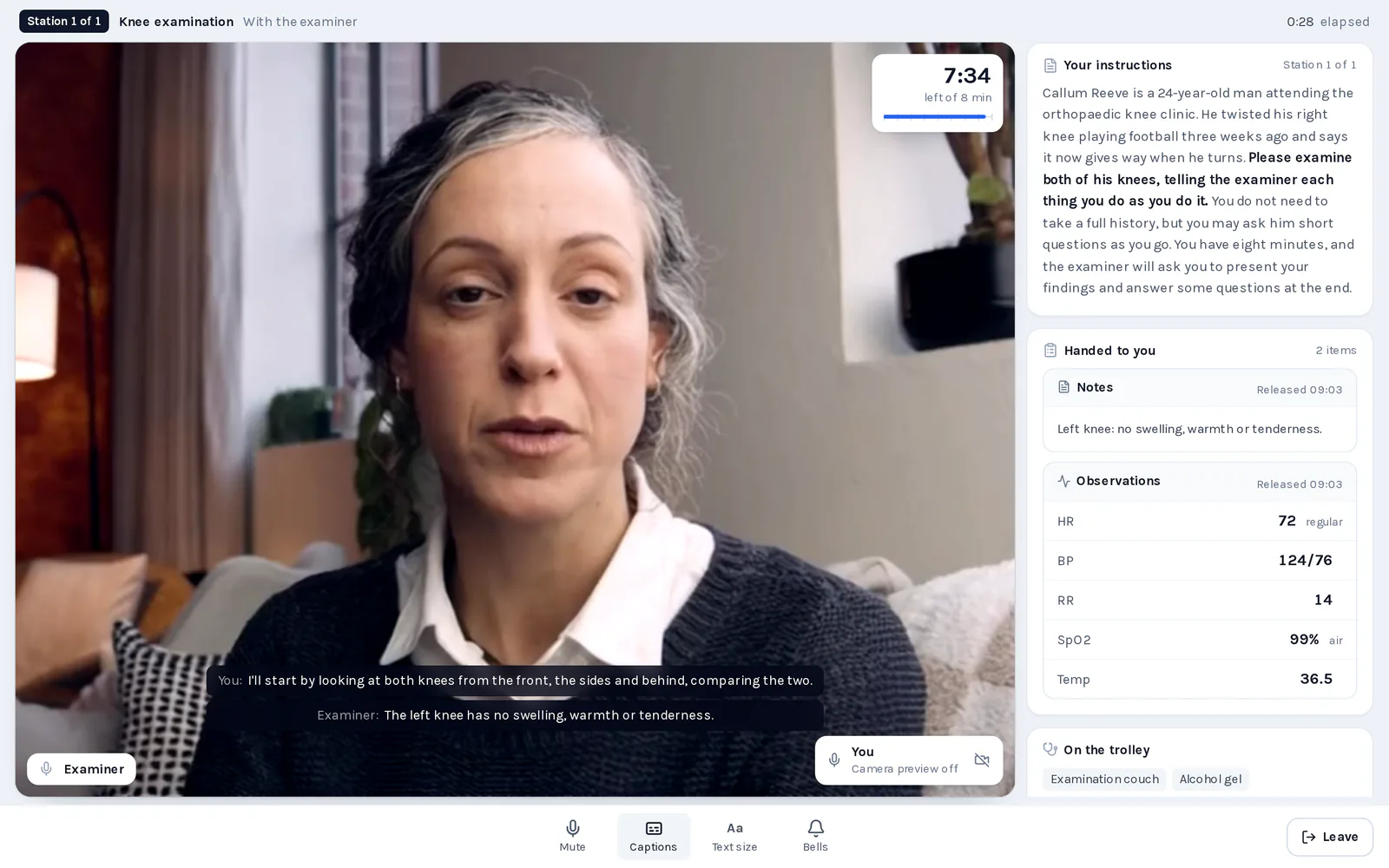
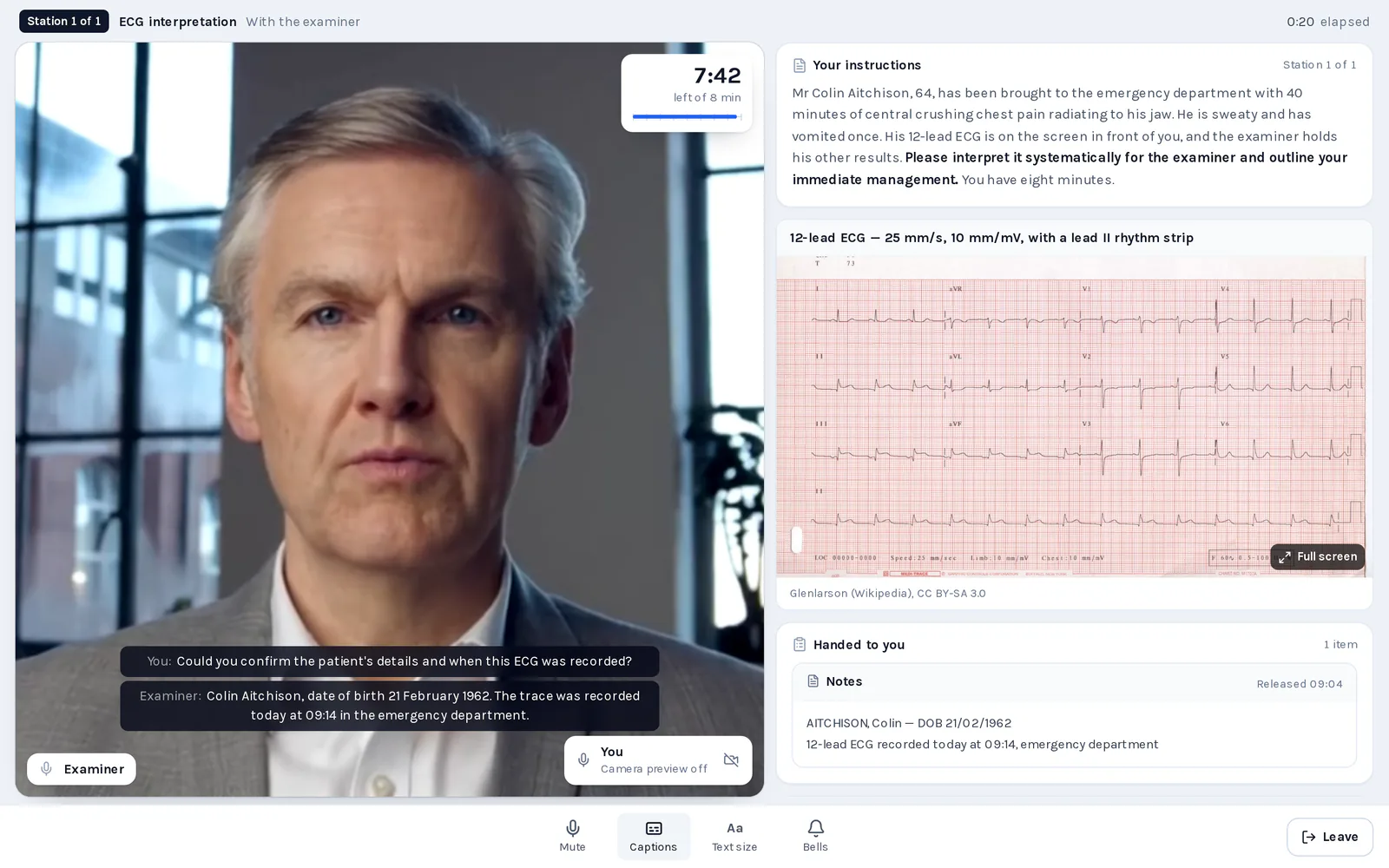
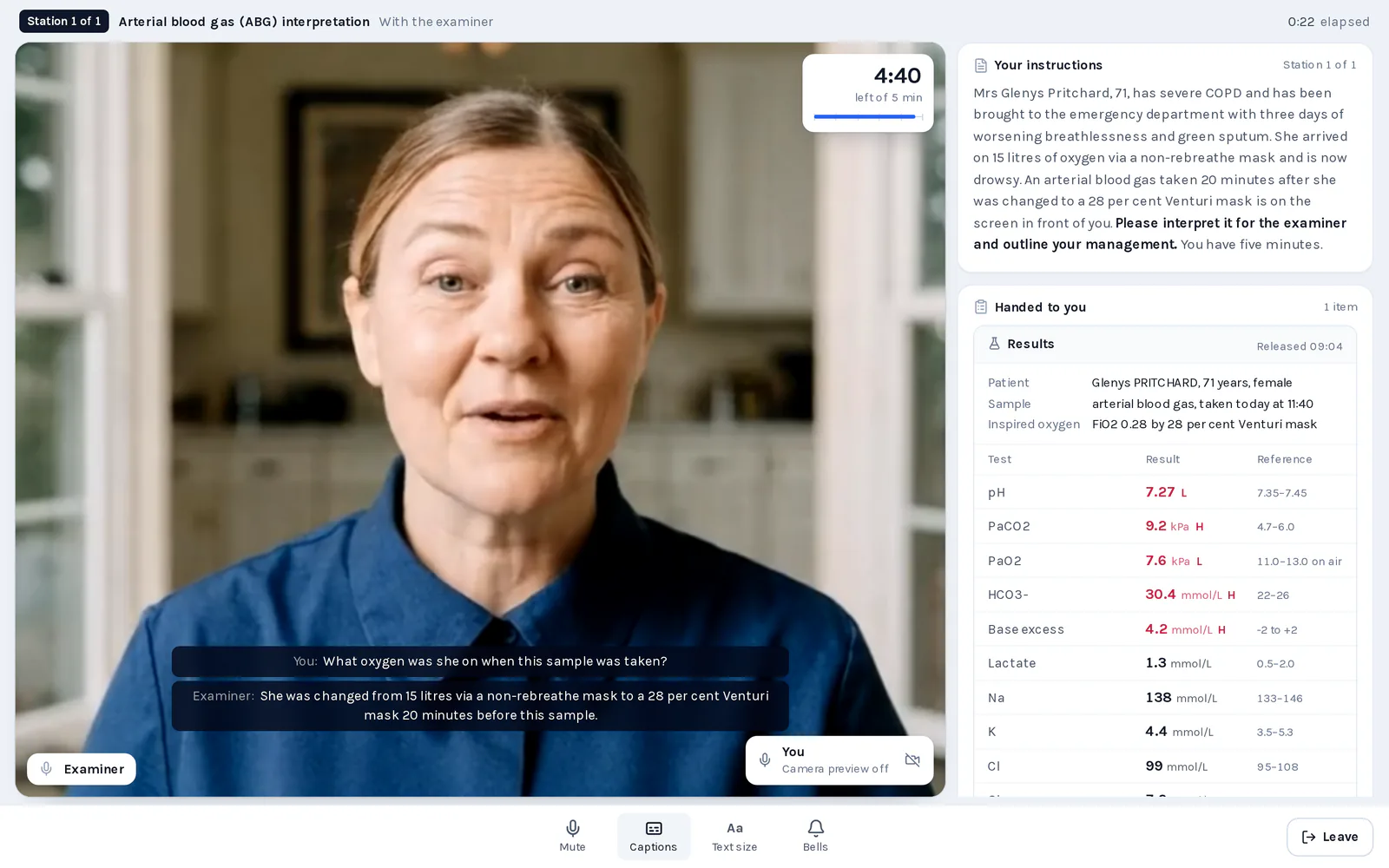
AI OSCE station · UKReal screen
A live AI OSCE history station from the UK library: the patient, a man with chest pain, is answering a question on screen with captions. The examiner sits in the corner, a clock shows the time left, and the candidate's desk holds the instructions and a sheet of scrap paper with notes.

Real screen
The same AI OSCE history station from the UK library on a phone: the patient fills the screen, with the examiner's chair, the clock and the controls around him.
The patient, on your phone
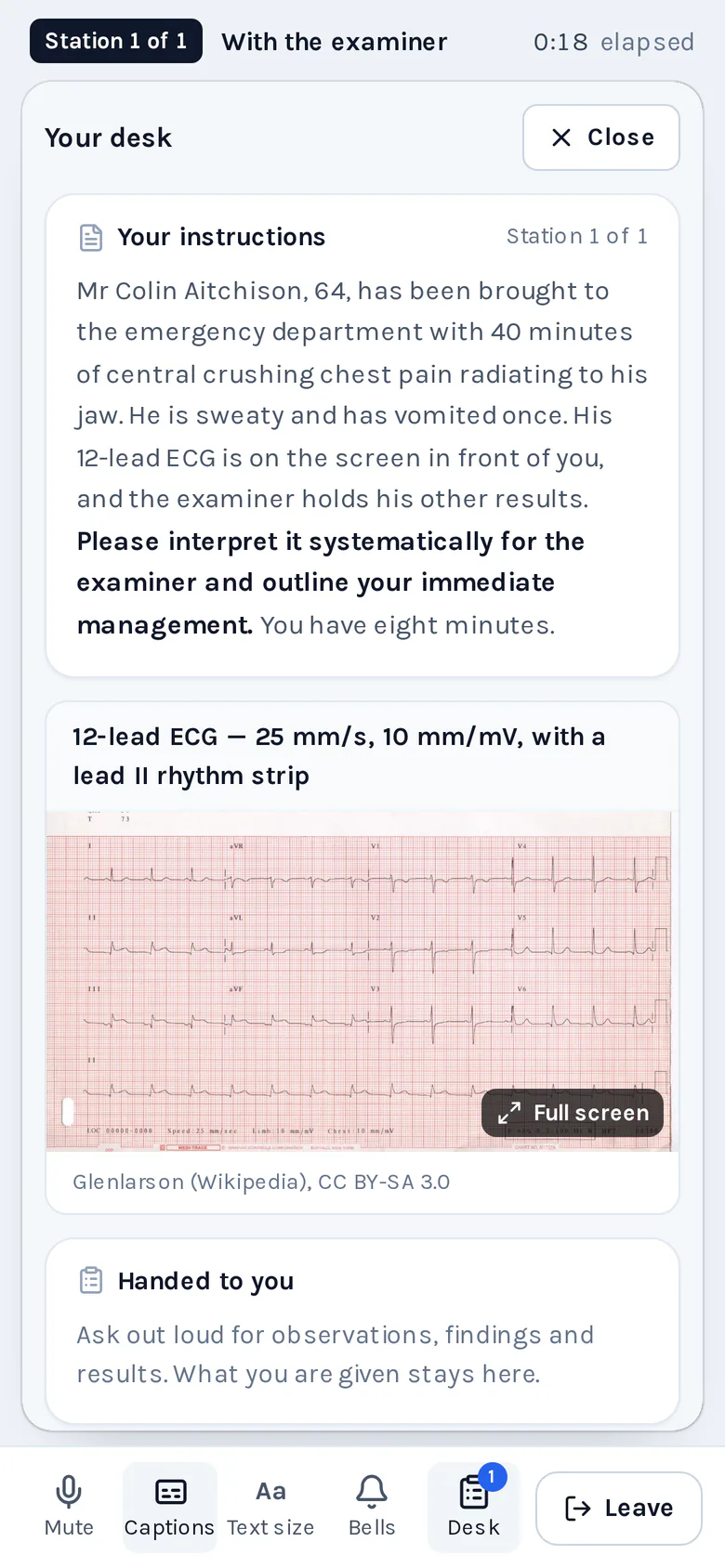
The candidate's desk on a phone during an AI OSCE data station from the UK library: the instructions, the ECG and the space for what the examiner hands over.
Your desk, one tap away
Real screens of a live station, one of each kind. How the live room works

Start the Year 3 circuit tonight

Open the first station, run it out loud against the clock and tick your own sheet. It is free and needs no account.