Year 4 plan · UK

Year 4 OSCE stations. Reason to a differential.

Year 4 adds 89 stations to the 76 from Year 3, and every sheet now asks for interpretation and a differential.

  • 165 stations in scope
  • 89 new at Year 4
  • 393 lines that fail a station on their own

Which year are you in?

  • Free to study, no account needed
  • Sit it live: 1 credit, £3.67–£6
Chest pain historyNew at Year 4
25 more lines on this sheetRunning total3/36
What Year 4 adds to the chest pain history sheet. Tick a line and the total adds up. Open the station

Start here

The Year 4 plan

Five stations to start with, one of each type, all new at Year 4. Then everything else the year adds, a type at a time.

The starter circuit

5 stations 45 min with reading time

One of each station type, all new at Year 4, from five body systems.

  1. Dizziness and vertigo history1:00 + 8:00History taking Neurology New at Year 4Mrs Sandra Lomax, 55, has booked a same-day appointment at her GP surgery with dizziness that started five days ago. Please take a focused history.
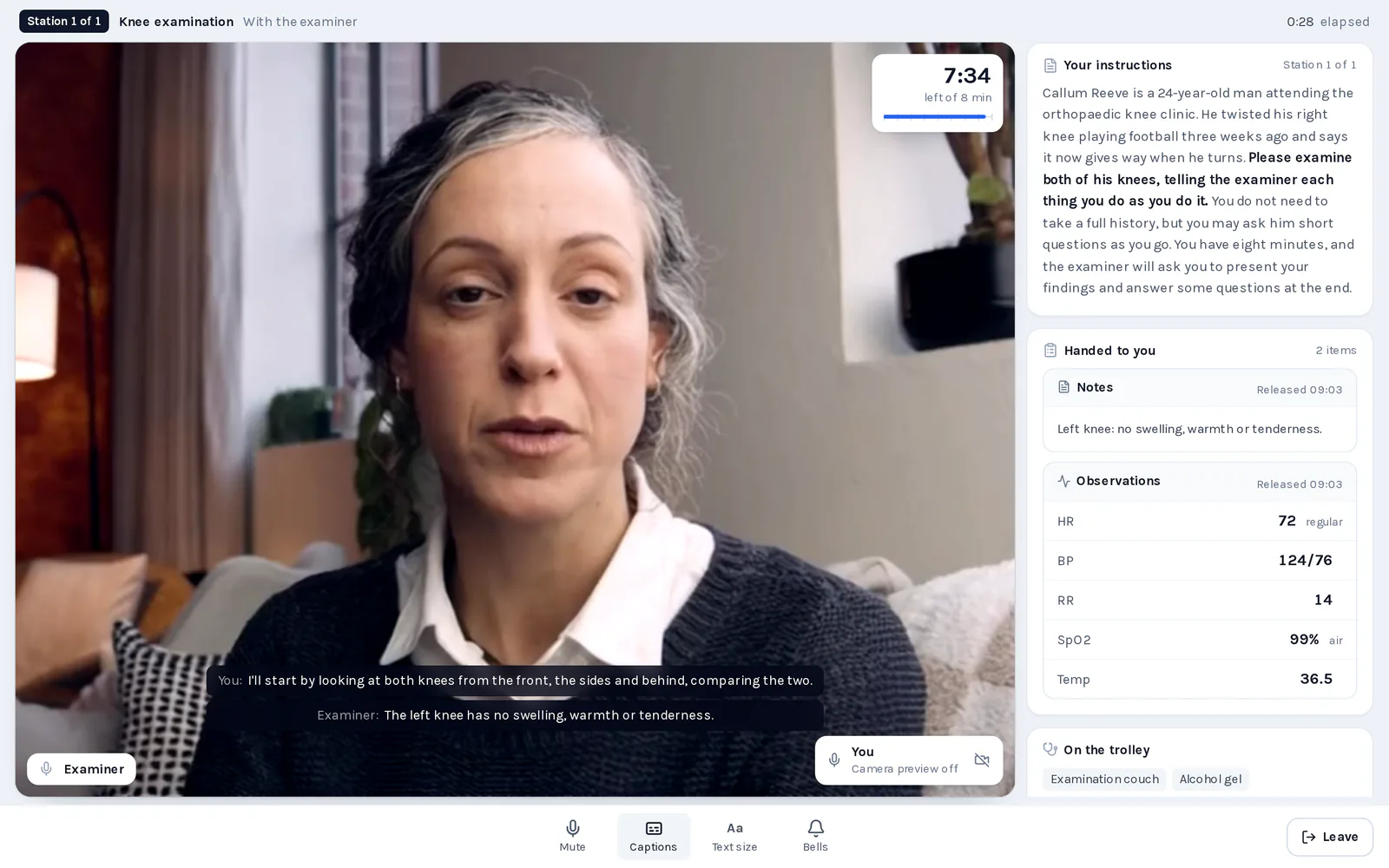
  2. Shoulder examination1:00 + 8:00Examination Musculoskeletal New at Year 4Mr Malcolm Rudd is a 55-year-old self-employed painter and decorator who has come to the orthopaedic outpatient clinic with three months of right shoulder pain, worse when he reaches overhead and when he lies on that side at night. Please examine his shoulders, telling the examiner each thing you do as you do it.
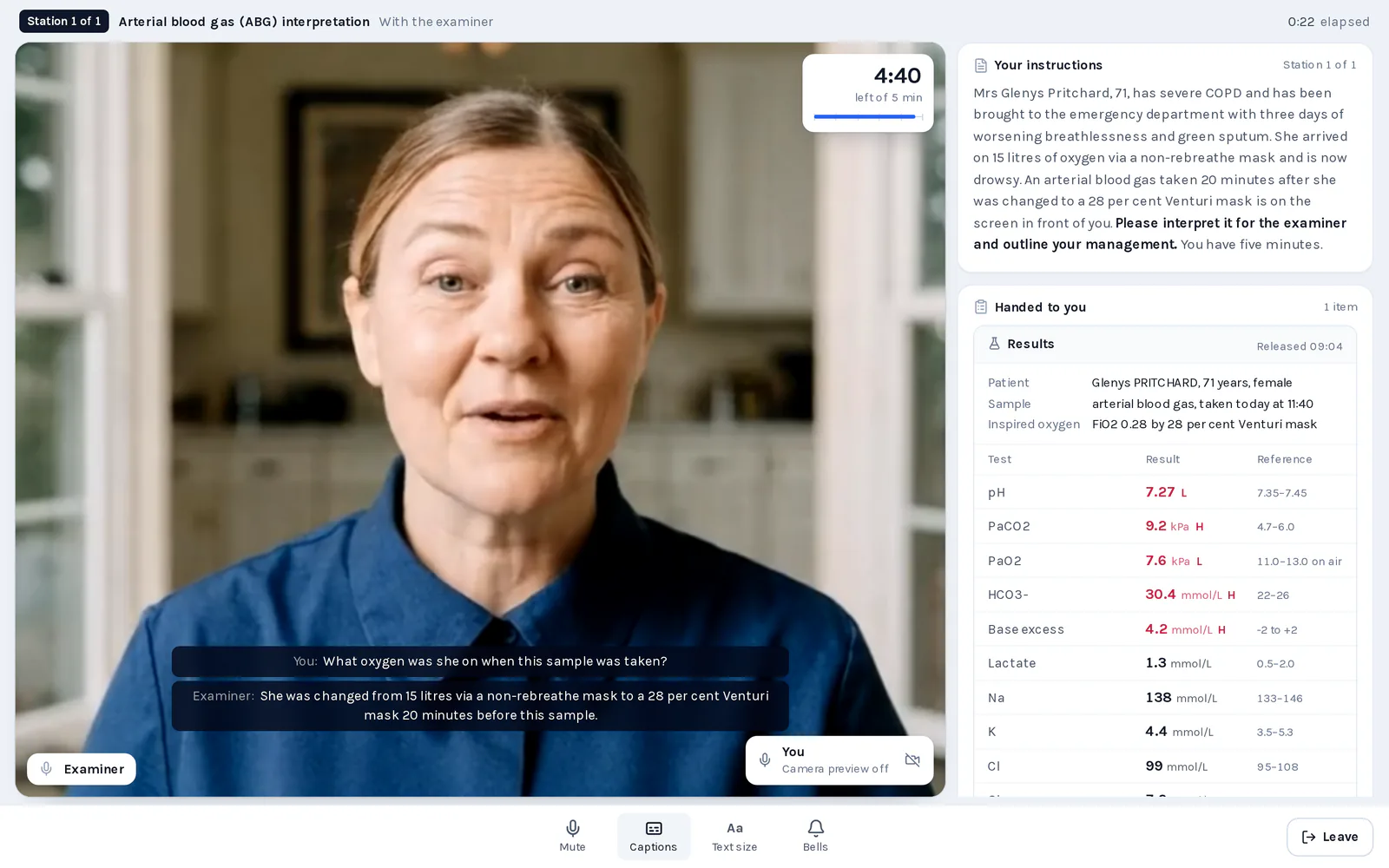
  3. Arterial blood gas (ABG) interpretation1:30 + 5:00Data interpretation Bloods New at Year 4Mrs Glenys Pritchard, 71, has severe COPD and has been brought to the emergency department with three days of worsening breathlessness and green sputum. She arrived on 15 litres of oxygen via a non-rebreathe mask and is now drowsy. An arterial blood gas taken 20 minutes after she was changed to a 28 per cent Venturi mask is on the screen in front of you. Please interpret it for the examiner and outline your management.
  4. Consent for a procedure1:00 + 8:00Communication Surgery New at Year 4Pauline Achebe, 58, has had four months of dyspepsia and has been found to have iron-deficiency anaemia with a haemoglobin of 96 g/L. She has been referred on the urgent suspected cancer pathway for a diagnostic upper GI endoscopy (gastroscopy), which is booked for next Wednesday. She is not on anticoagulants. Your registrar has asked you to take her consent. She has been given the departmental information leaflet but says she has not read it. Please consent her for the procedure.
  5. Suturing a simple laceration1:00 + 10:00Practical skills Procedures New at Year 4Mr Ryan Sutcliffe, 34, has come to the minor injuries unit with a cut to his left forearm. You are a medical student working with the emergency nurse practitioner, who has asked you to assess the wound and, if it is suitable, to close it with sutures. Please take a brief history, assess the wound and the arm, anaesthetise and suture it, and give him aftercare advice, talking the examiner through each thing you ask, check and do, and why.
  • Run it with friends, free

    One of you sits the station, one plays the patient from their brief, and one marks on their own phone from a QR code. One clock for all of you.

    Run it with friends
  • Or sit the whole circuit live

    The same five stations back to back, by voice, with an AI patient or examiner. Each sheet comes back marked at the Year 4 standard.

    Sit the whole circuit live, 3 credits

What Year 4 adds, type by type

Read the guide for a type, then drill its stations. Every station here opens at the Year 4 standard.

The standard

What changes between Year 3 and Year 4

Year 3 marks were mostly for doing. Year 4 marks are mostly for thinking. Every technique item is still on the sheet — it is simply no longer where the station is won or lost, because by now everybody can do it.
Chest pain historyNew at Year 4
25 more lines on this sheetRunning total3/36
What Year 4 adds to the chest pain history sheet. Tick a line and the total adds up. Open the station
The Year 4 standardMid clinical years

What a passing candidate does at Year 4

  • Everything expected in Year 3, performed fluently and comfortably inside the time
  • Positive AND relevant negative findings drawn together into a coherent clinical picture
  • A prioritised differential diagnosis, with the most dangerous cause named even when it is not the most likely
  • First-line investigations selected and justified, not simply listed
  • A structured summary that ends with an impression rather than trailing off

How the examiner probes

Expect to be asked what else could cause this, what you would do next, and what would change your mind.

Global ratingClear failBorderlinePassGood passExcellent
  1. Every station now ends with a differential

    At Year 4 the examiner expects you to name a differential and justify your first investigation. A Year 3 candidate can pass the chest-pain history by asking every SOCRATES question; a Year 4 candidate cannot pass it without saying this sounds like an acute coronary syndrome and that he needs an immediate 12-lead ECG, monitoring, a troponin and senior review — and that last item is a critical fail if it never comes.

  2. Relevant negatives start earning marks

    Screening out loud for what it is not becomes separately marked: pleuritic pain, haemoptysis and calf swelling for a pulmonary embolism, tearing pain radiating through to the back for a dissection, positional and reflux-related pain for the non-ischaemic causes. Excluding the dangerous diagnosis in front of the examiner is what makes a history a Year 4 history.

  3. Stations appear that do not exist at Year 3

    CT head interpretation, arterial blood gases, breaking bad news, consent for a procedure, the angry relative and male urethral catheterisation all come into scope this year. Two of them are pure data interpretation and three are pure communication — between them they are where most Year 4 candidates lose marks.

  4. Signs have to be named, not merely found

    On the cardiovascular station, auscultating correctly is no longer the mark. You are marked on calling the pulse slow-rising and low volume, describing the murmur by timing, site, radiation, character and grade, checking for radiation to the carotids, and presenting a summary that ends in a differential.

AI OSCE simulator

Then sit one live, at the Year 4 standard

Read the notice at the door and go in at the bell. An AI patient answers only what you ask; on an examination, data or skills station an AI examiner tells you what you find.
  • Every station on this page can be sat live, by voice.
  • The sheet comes back marked at the Year 4 standard, with your own words beside each line.
  • A microphone cannot see your hands, so practise the technique itself on a friend.
Sit a station live

1 credit a station, £3.67–£6

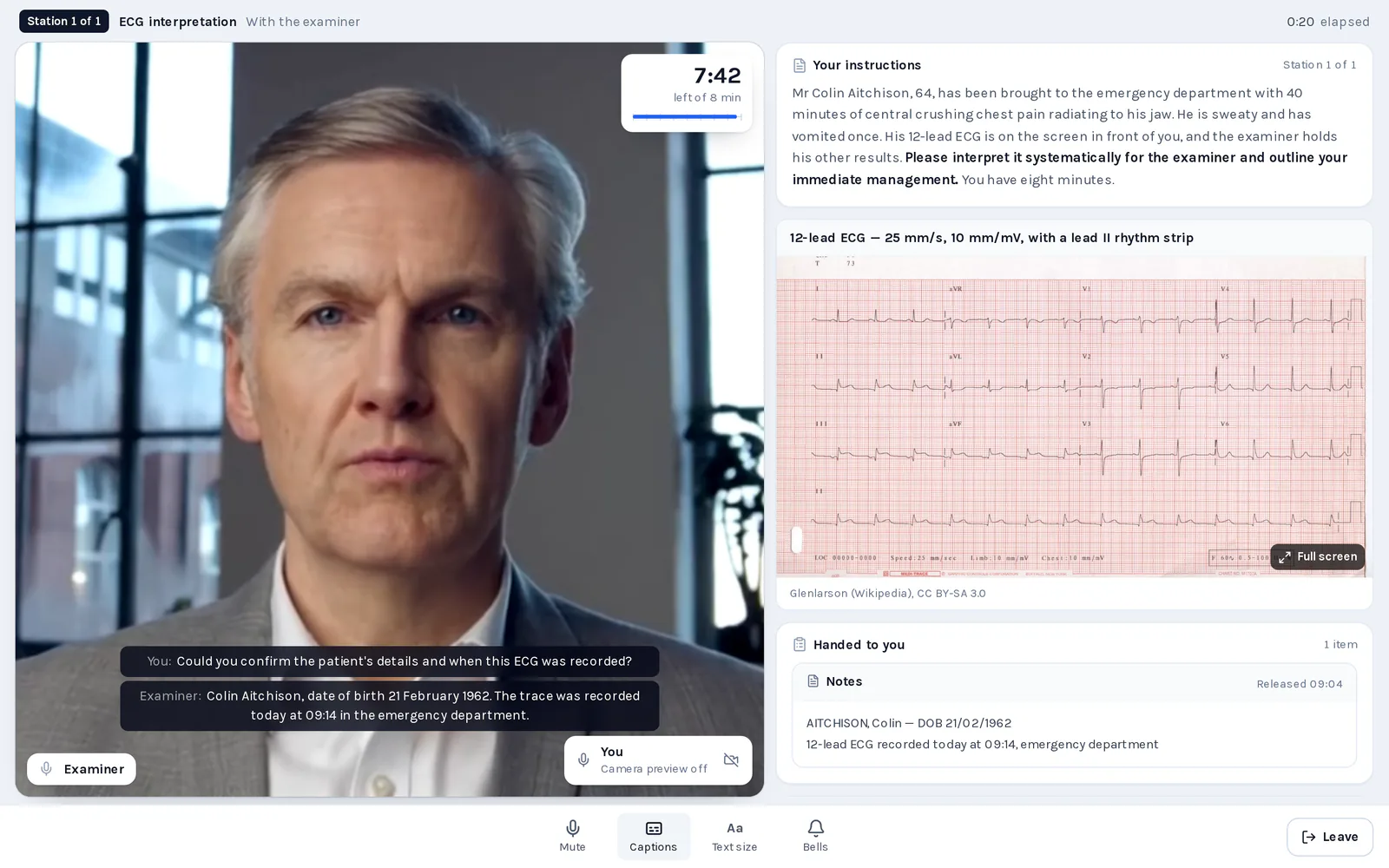
AI OSCE station · UKReal screen
A live AI OSCE history station from the UK library: the patient, a man with chest pain, is answering a question on screen with captions. The examiner sits in the corner, a clock shows the time left, and the candidate's desk holds the instructions and a sheet of scrap paper with notes.

Real screen
The same AI OSCE history station from the UK library on a phone: the patient fills the screen, with the examiner's chair, the clock and the controls around him.
The patient, on your phone
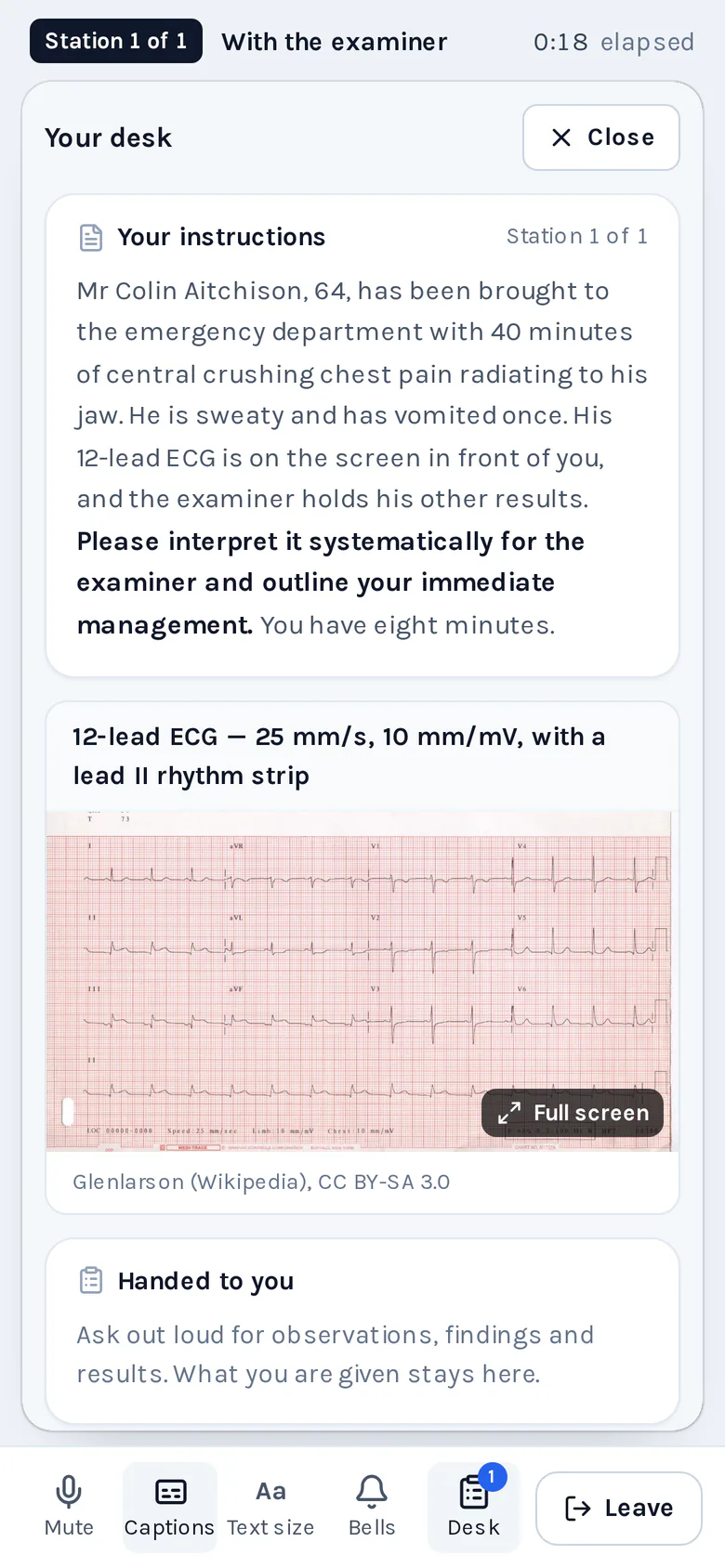
The candidate's desk on a phone during an AI OSCE data station from the UK library: the instructions, the ECG and the space for what the examiner hands over.
Your desk, one tap away
Real screens of a live station, one of each kind. How the live room works

Start the Year 4 circuit tonight

Open the first station, run it out loud against the clock and tick your own sheet. It is free and needs no account.