
Data interpretation · Bloods
Blood gas: vomiting teenager OSCE mark scheme, Year 4
A venous gas and a bedside ketone in a vomiting 17-year-old: reading them in order, making the diagnosis and turning it into a safe first two hours.
Year 4 is where this sheet starts: 18 lines and 25 marks, most of them on clinical reasoning and patient safety.
- 1:30 + 8:00 reading, then the room
- 5 examiner questions
- Sat from Year 4
- Free to practise, no account needed
- Reviewed
How do you want to practise?
Read the notice, run the clock, then mark yourself on the real sheet.
You present to a friend, who runs the clock and marks on their own phone.
Their marks land on your screen.
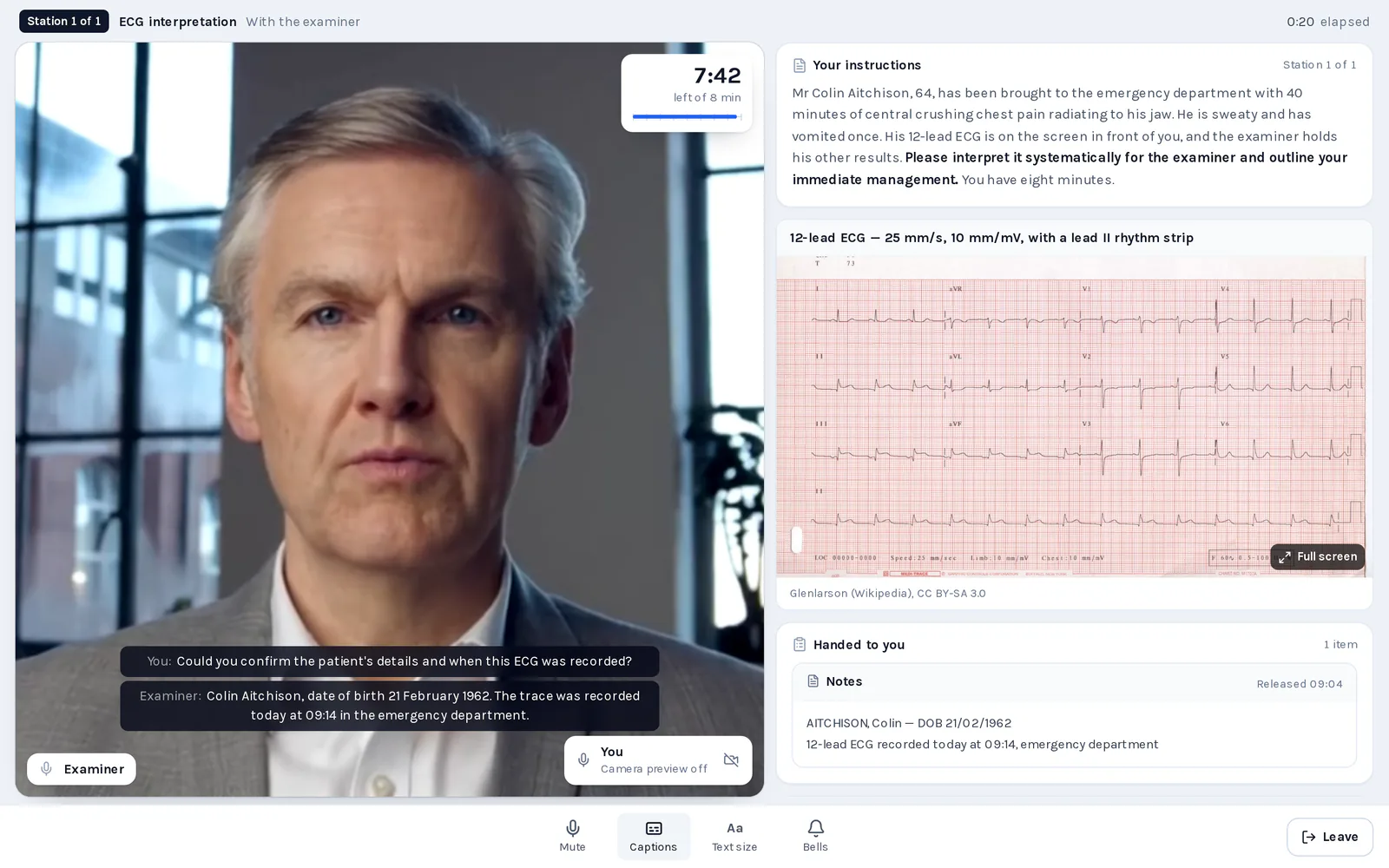
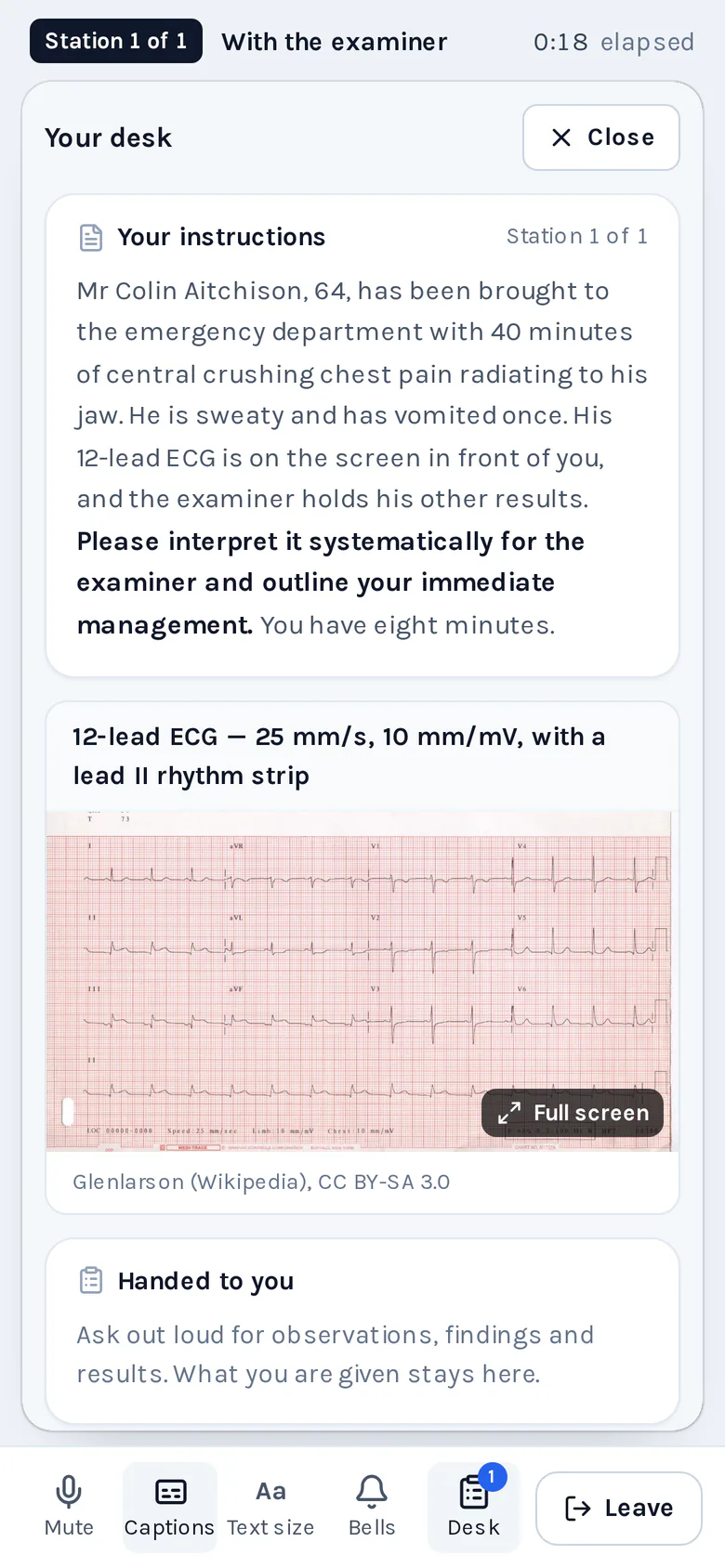
The image or results are on your screen and an AI examiner listens, by voice, while you present them.
Candidate instructions
The notice on the door
Ellie Hughes, 17, was brought to the emergency department this evening by her mother with a day of vomiting and abdominal pain. A venous blood gas and a bedside blood ketone taken at triage are in front of you, and the examiner has the rest of her notes. Please talk the examiner through the results, say what you think is going on and how you would treat her. The examiner will then ask you some questions. You have eight minutes.
90 sec reading, then 8 min in the station
On the trolley
- Venous blood gas printout with bedside ketone
- Pen and paper
Your notes from reading time
Saved in this browser only.
Year 4 is where this sheet starts: 18 lines and 25 marks, most of them on clinical reasoning and patient safety.
Year 4 standard. Reads the gas fluently, diagnoses ketoacidosis, works out which protocol applies and why, and starts fluid, potassium and insulin safely by that protocol.
3 critical lines. Miss one and the station is failed, however well the rest goes.
Communication 0/2Systematic 0/3Clinical reasoning 0/11Professionalism 0/1Patient safety 0/8
Run the station before you look
The answers are the most useful thing on this page once you have had a go, and the least useful before.
When the candidate asks to confirm the patient's name or details, or whose gas this is
The gas is labelled Ellie Hughes, aged 17, hospital number H 553021. It was taken today at 19:20.When the candidate asks for the venous blood gas result
Venous pH 7.13, carbon dioxide 3.3 kilopascals, bicarbonate 8.2, base excess minus 19.4, lactate 1.9. Sodium 133, potassium 4.9, chloride 100, glucose 27.8, haemoglobin 152. Bedside blood ketone 5.6.Patient: Ellie HUGHES, female, 17 years, hospital number H553021 Sample: venous blood gas, collected today at 19:20; bedside blood ketone at 19:15 Venous pH 7.13 (7.32 - 7.42) Venous pCO2 3.3 kPa (5.5 - 6.8) Venous pO2 5.2 kPa (4.0 - 6.0) HCO3- 8.2 mmol/L (22 - 26) Base excess -19.4 mmol/L (-2 to +2) Lactate 1.9 mmol/L (0.5 - 2.0) Na+ 133 mmol/L (133 - 146) K+ 4.9 mmol/L (3.5 - 5.3) Cl- 100 mmol/L (95 - 108) Glucose 27.8 mmol/L (4.0 - 7.8 random) Hb 152 g/L (115 - 165) Bedside blood ketone (beta-hydroxybutyrate) 5.6 mmol/L (below 0.6)
When the candidate asks for the history
Three weeks of thirst, passing a lot of urine and losing weight. Since yesterday, vomiting and abdominal pain. She has no known diabetes.History: 3 weeks of thirst, polyuria and weight loss; vomiting and abdominal pain since yesterday. No known diabetes. No regular medicines. No known drug allergies.
When the candidate asks which team will admit her, or about the hospital policy for her age
In this hospital, patients under 18 are admitted under the paediatric team.When the candidate asks for her weight
She was weighed on arrival at 52 kilograms.When the candidate asks for the observations
Heart rate 122, blood pressure 108 over 66, respiratory rate 28 and deep, saturations 99 per cent on air, temperature 36.9. Central capillary refill 2 seconds. GCS 15.HR 122 regular | BP 108/66 | RR 28 (deep) | SpO2 99% on air | Temp 36.9 °C Central capillary refill 2 s | GCS 15
When the candidate asks for the examination findings
She looks dry, with dry lips and sunken eyes. Her breathing is deep. Her abdomen is soft and mildly tender all over.When the candidate asks whether she has passed urine
She passed urine in the department 20 minutes ago.When the candidate asks for the laboratory blood results
Sodium 133, potassium 4.8, urea 7.9, creatinine 92. White cells 15.2, CRP 6. HbA1c 118.Sample: laboratory bloods, collected today at 19:25 Na 133 mmol/L (133 - 146) | K 4.8 mmol/L (3.5 - 5.3) | Urea 7.9 mmol/L (2.5 - 7.8) | Creatinine 92 umol/L (45 - 84) WCC 15.2 x10^9/L (4.0 - 11.0) | CRP 6 mg/L (below 5) | HbA1c 118 mmol/mol (20 - 41)
When the candidate asks for a urine dipstick
Urine dipstick: glucose 4 plus, ketones 4 plus, no nitrites and no leucocytes.When the candidate asks for a pregnancy test
No hCG is detected in her urine.When the candidate asks for an ECG
Sinus tachycardia at 120. The T waves are not peaked.When the candidate asks for a repeat gas after treatment has started
Two hours into treatment: pH 7.19, bicarbonate 11.0, potassium 4.2, glucose 21.5. The blood ketone is 4.6.Sample: repeat venous gas, 2 hours into treatment Venous pH 7.19 (7.32 - 7.42) | HCO3- 11.0 mmol/L (22 - 26) | K+ 4.2 mmol/L (3.5 - 5.3) | Glucose 21.5 mmol/L (4.0 - 7.8) | Ketone 4.6 mmol/L (below 0.6)
Talk me through these results. · Year 4
This is a venous gas for Ellie Hughes, a 17-year-old with three weeks of thirst, polyuria and weight loss and a day of vomiting and abdominal pain, taken at 19:20 today. Because it is venous I will not interpret the oxygen. The pH is 7.13, an acidaemia. The bicarbonate is 8.2 with a base excess of minus 19.4, so this is a metabolic acidosis, and the carbon dioxide of 3.3 is respiratory compensation from her deep breathing. The anion gap is 133 minus the sum of 100 and 8.2, about 25, so it is raised, and a lactate of 1.9 cannot explain it. The bedside ketone is 5.6 and the glucose is 27.8. With acidosis, ketones above 3 and a high glucose, this is diabetic ketoacidosis, almost certainly a first presentation of type 1 diabetes. By the BSPED grading, a pH of 7.1 to 7.19 or a bicarbonate below 10 is moderate. Her potassium of 4.9 is in range but will fall with insulin. My next question is which team will admit her.
What would you do in the first two hours? · Year 4
I would assess her with an ABCDE approach, put in two cannulae, attach a cardiac monitor and call the paediatric registrar, because under-18s with ketoacidosis are admitted under the paediatric team here, so the BSPED protocol applies. She weighs 52 kilograms. She is tachycardic but not shocked, with a central capillary refill of 2 seconds, so she has a 10 mL/kg bolus, 520 millilitres of 0.9% sodium chloride, over 30 minutes. Her deficit at 5 per cent is 2,600 millilitres; minus the bolus, that leaves 2,080 over 48 hours, about 43 an hour, plus maintenance of 2,140 a day, about 89 an hour, so about 133 millilitres an hour of 0.9% sodium chloride with 40 millimoles of potassium per litre, because she has passed urine. One to two hours after the fluids start, I would begin soluble insulin at 0.1 units per kilogram per hour, 5.2 units an hour, with no bolus. She needs hourly glucose and neurological observations, ketones every one to two hours, and a repeat gas at two hours.
Her potassium is 4.9. What would you do about her potassium, and why? · Year 4
She still needs potassium in her fluids, because the 4.9 is misleading. In ketoacidosis potassium moves out of the cells with the acidosis and the lack of insulin, while the osmotic diuresis and the vomiting have been losing it in the urine and gut for days, so the whole-body stores are depleted even when the plasma level looks normal or high. Once insulin starts, potassium moves back into the cells and the plasma level falls, sometimes fast, and hypokalaemia can cause dangerous arrhythmias. BSPED therefore puts 40 millimoles of potassium chloride per litre into every bag after the initial bolus, unless there is renal failure. If the potassium were above the normal range at presentation, BSPED would wait until she had passed urine, or until the level had fallen into range. If it fell below 3.0, BSPED asks you to think about pausing the insulin and to involve critical care urgently, because stronger solutions need central access. She has passed urine and her level is 4.9, so potassium goes in now, with a cardiac monitor and a recheck at two hours.
Suppose four hours into treatment she complains of a headache, becomes irritable and her heart rate falls to 58. What do you do? · Year 5
This is cerebral oedema until proven otherwise, and the treatment cannot wait for a scan. A headache, irritability and an unexpected fall in heart rate are among its early signs. I would call for senior and critical care help immediately and treat with whichever is most readily available: hypertonic saline, 2.7 or 3 per cent, 2.5 to 5 millilitres per kilogram over 10 to 15 minutes, which is about 130 to 260 millilitres for her, or mannitol 20 per cent, 0.5 to 1 gram per kilogram over 10 to 15 minutes. I would restrict her fluids to half the maintenance rate, nurse her head up, check her glucose to exclude hypoglycaemia, and repeat her neurological observations frequently, watching for a falling conscious level, abnormal breathing, unequal pupils or posturing. If there is no response, a further dose can be given after specialist advice. Intubation should wait for an experienced doctor. Once she is stable, a CT excludes other intracranial events such as thrombosis or haemorrhage, which can look the same.
Suppose she had been admitted under the adult medical team instead. What would change in her treatment? · Year 5
She would then be treated by the JBDS adult guideline, which both guidelines accept for 16 to 18-year-olds under adult teams, and the differences are large. Her systolic pressure is above 90, so she would have 1 litre of 0.9% sodium chloride over the first hour, then 1 litre with potassium over the next 2 hours, another over 2 hours and another over 4 hours: about 2.5 litres in the first 4 hours, against about 1 litre under BSPED. Potassium follows the adult table, none in the first litre, then 40 millimoles per litre while it is 3.5 to 5.5. The fixed-rate insulin infusion at 0.1 units per kilogram per hour, 5.2 units an hour, starts in the first hour rather than after a wait. When the glucose falls below 14, 10% glucose at 125 millilitres an hour runs alongside, and the insulin can be reduced to 0.05. As a new diagnosis she would start basal insulin at 0.25 units per kilogram. JBDS itself asks for more cautious fluids in young adults, so a 17-year-old warrants care either way.
How it is marked
What this station is really testing
The gas on this station is not hard to read, and the examiner knows it. A venous pH of 7.13, a bicarbonate of 8.2, a ketone of 5.6 and a glucose of 27.8 in a teenager with three weeks of thirst is diabetic ketoacidosis at first presentation of type 1 diabetes, and you should say so within a minute. The station is about what happens next, because a 17-year-old sits on the boundary between two protocols that treat the same numbers very differently. Reading the gas fluently and then prescribing a litre of saline over an hour by habit is the commonest way to lose the station.
Read the restShow less
Both UK guidelines settle the boundary in the same words. The Joint British Diabetes Societies adult guideline and the British Society for Paediatric Endocrinology and Diabetes guideline both say that young people aged 16 to 18 managed by adult teams can be treated with the adult guideline those teams know, and that those managed by paediatric teams should follow the paediatric one. So the first question is which team will admit her, which local policy decides, and the second is to follow that protocol completely rather than mixing the two. Here she is going to the paediatric team, so BSPED applies: a 10 mL/kg bolus over 30 minutes if she needs intravenous fluid and is not shocked, a deficit of 5 or 10 per cent by pH replaced over 48 hours with maintenance, potassium in every bag after the bolus, and the insulin infusion started 1 to 2 hours after the fluids, with no bolus.
The reason for the difference is cerebral oedema. Its cause is not known, but children and young people are at the greatest risk, especially at a new diagnosis. The paediatric protocol spreads the deficit over 48 hours and starts insulin later, as there is some evidence that early insulin makes cerebral oedema more likely. Slower fluid has not been shown to prevent it: the PECARN FLUID trial found no significant difference in brain injury between faster and slower rehydration, so NICE relaxed its old restriction on the fluid rate, and BSPED warns that inadequate resuscitation is likely to increase the risk of brain injury, so a shocked patient still has fluid boluses at once. You must know the early signs of cerebral oedema, headache, irritability, a falling heart rate and a rising blood pressure, and its treatment, hypertonic saline or mannitol without waiting for a scan. In Year 4 the diagnosis, the guideline choice with its reason and safe fluid, potassium and insulin are a pass. In Year 5 add the arithmetic for her weight, the change to glucose-containing fluid, cerebral oedema, thromboprophylaxis and the new-diagnosis plan.
Where the 25 marks are at Year 4
- Communication2
- Systematic approach3
- Clinical reasoning11
- Professionalism1
- Patient safety8
3 critical lines. Miss one and the station is failed, whatever the total.
What a pass looks like in each year
Year 4
18 lines, 25 marks
The sheet starts here.
Reads the gas fluently, diagnoses ketoacidosis, works out which protocol applies and why, and starts fluid, potassium and insulin safely by that protocol.
What lifts it to a clear pass
- Diagnose within the first minute: pH, bicarbonate, ketone and glucose, matched to the criteria.
- Ask which team will admit her before you prescribe anything. For a 17-year-old, that answer decides the protocol.
- Say the BSPED order out loud: 10 mL/kg bolus over 30 minutes, deficit over 48 hours with maintenance, potassium in every bag after the bolus, insulin 1 to 2 hours later with no bolus.
- Ask for her weight. Every number on this station depends on it.
Year 5
24 lines, 32 marks
Adds six lines, most of them on clinical reasoning and patient safety.
Does the arithmetic for her weight, grades the severity, plans glucose-containing fluid and monitoring, and can recognise and treat cerebral oedema.
What lifts it to a clear pass
- Work the rate through: 2,600 minus 520 over 48 hours plus 2,140 over 24 hours is about 133 mL an hour.
- Know the cerebral oedema doses: hypertonic saline 2.5 to 5 mL/kg or mannitol 0.5 to 1 g/kg, over 10 to 15 minutes.
- Know what the adult protocol would have done differently, so you can explain why it is not used for her.
- Think beyond tonight: thromboprophylaxis over 16, the diabetes team, and a family who have just learned she has type 1 diabetes.
A system you can run under pressure
Step 1 — read the gas and make the diagnosis
- Confirm the name, the hospital number and the time, and that the sample is venous — the oxygen tension on a venous gas says nothing about her lungs
- pH and bicarbonate first — a venous pH below 7.3 or a bicarbonate below 15 is the acidosis that defines ketoacidosis
- Read the carbon dioxide — low in an acidaemic patient means respiratory compensation, and a rising value later means she is tiring
- Calculate the anion gap, sodium minus the sum of chloride and bicarbonate — a raised gap with a lactate near normal points to ketones
- Match the ketone and the glucose — a blood ketone above 3 with acidosis is ketoacidosis, and a glucose above 11 or known diabetes completes the picture
Step 2 — decide which protocol applies
- Ask which team will admit her — JBDS and BSPED both say 16 to 18-year-olds follow the protocol of the team managing them, and local policy decides that team
- Under a paediatric team, use BSPED; under an adult team, use JBDS — and follow one protocol completely, because mixing them is how fluid and potassium errors happen
- Grade her by the protocol you are using — BSPED grades by pH or bicarbonate as mild, moderate or severe, which sets the deficit; JBDS lists severity markers that call for consultant review and consideration of level 2 care
- Weigh her — BSPED calculates fluid and insulin from her actual weight, with the fluid worked out on a maximum of 75 kg, and an estimated weight is the start of most fluid errors
Step 3 — the paediatric protocol in practice
- Not shocked but needing intravenous fluid: 10 mL/kg of 0.9% sodium chloride over 30 minutes, subtracted from the deficit
- Deficit of 5 per cent for mild or moderate and 10 per cent for severe, minus the bolus, over 48 hours, plus Holliday-Segar maintenance, given at an even hourly rate
- Potassium chloride 40 mmol/L in every bag after the bolus, unless there is renal failure or the potassium is above the normal range before she has passed urine
- Soluble insulin 0.05 to 0.1 units/kg/hour, no bolus, started 1 to 2 hours after the intravenous fluids begin
- When the glucose reaches 14, change to 0.9% sodium chloride with 5% glucose and potassium, and keep the insulin running
Step 4 — watch for cerebral oedema
- Early signs: headache, agitation or irritability, an unexpected fall in heart rate and a rise in blood pressure
- Later signs: falling conscious level, abnormal breathing, oculomotor palsies, abnormal posture and unequal or dilated pupils
- Treat at once with hypertonic saline (2.7 or 3 per cent, 2.5 to 5 mL/kg over 10 to 15 minutes) or mannitol (20 per cent, 0.5 to 1 g/kg over 10 to 15 minutes), whichever is to hand
- Restrict fluids to half maintenance, call the senior and critical care teams, and scan only once she is stable — treatment never waits for imaging
The lines that carry marks
Opening the presentation
This is a venous gas for Ellie Hughes, 17, hospital number H553021, taken at 19:20 with a bedside ketone at 19:15.
Making the diagnosis
A pH of 7.13, bicarbonate of 8.2, ketone of 5.6 and glucose of 27.8: this is diabetic ketoacidosis, probably a first presentation of type 1 diabetes.
Asking the deciding question
Before I prescribe anything, which team will she be admitted under? At 17 that decides whether the adult or the paediatric protocol applies.
Naming the protocol
She is going to the paediatric team, so I will follow the BSPED guideline all the way through rather than mixing it with the adult one.
Show the other 4Show fewer
Prescribing fluid
She is not shocked, so 520 millilitres of 0.9% saline over 30 minutes, then about 133 millilitres an hour with 40 millimoles of potassium per litre.
Timing the insulin
The insulin infusion starts an hour or two after the fluids, at 0.1 units per kilogram per hour, with no bolus.
Watching for cerebral oedema
I want hourly neurological observations, and anyone who hears her complain of a headache should call me straight away.
Handing over
Ellie Hughes, 17, 52 kilograms, moderate DKA at first presentation: pH 7.13, bicarbonate 8.2, ketone 5.6, potassium 4.9. I have started BSPED fluids with potassium and plan insulin at 0.1 units per kilogram per hour from the second hour. Please come and see her.
How candidates lose marks here
- Writing up a litre of 0.9% saline over an hour out of adult habit, without asking which team will manage her.
- Mixing the protocols — adult fluid volumes with paediatric potassium, or the reverse.
- Starting the insulin infusion at the same time as the fluids, or giving an insulin bolus.
- Being reassured by a potassium of 4.9 and leaving it out of her fluids.
- Calculating fluids on an estimated weight when she has been weighed.
- Not knowing the early signs of cerebral oedema, or waiting for a CT before treating it.
- Stopping the insulin when the glucose falls, instead of adding glucose to the fluids.
Where to read more
- BSPED guideline for the management of children and young people under 18 with diabetic ketoacidosisBritish Society for Paediatric Endocrinology and Diabetes · guide
- The management of diabetic ketoacidosis in adults (JBDS 02)Joint British Diabetes Societies · guide
- Diabetes (type 1 and type 2) in children and young people: diagnosis and management (NG18)NICE · guide
Now sit it live