
Examination · Surgery
Breast examination OSCE mark scheme, Year 3
Breast and axillary examination of a woman who has found a lump: consent, chaperone and dignity, inspection in four positions, systematic palpation, a described lump, both axillae and the supraclavicular fossae.
Year 3 is where this sheet starts: 21 lines and 23 marks, most of them on systematic approach and professionalism.
- 1:00 + 8:00 reading, then the room
- 6 examiner questions
- Sat from Year 3
- Free to practise, no account needed
- Reviewed
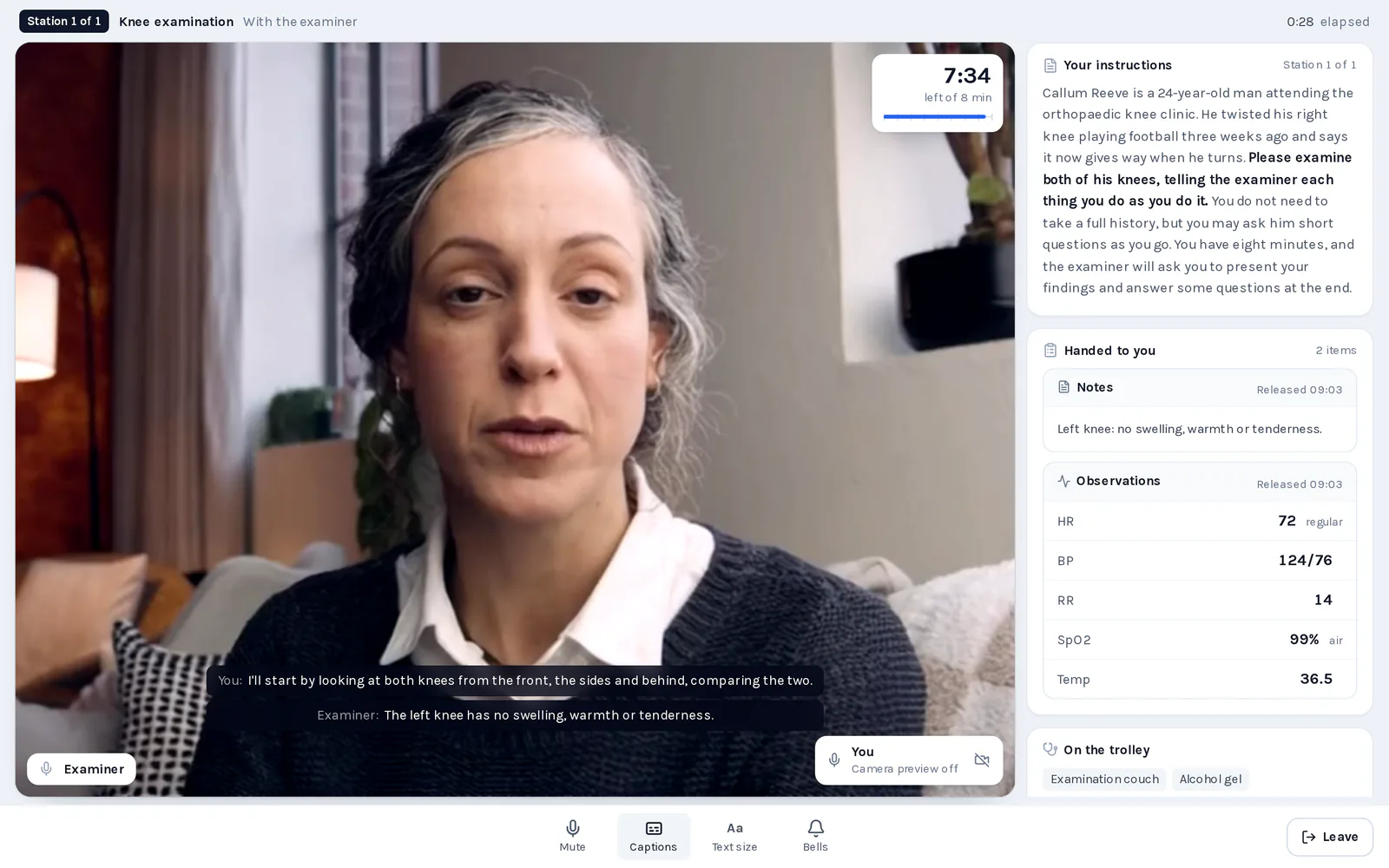
How do you want to practise?
Read the notice, run the clock, then mark yourself on the real sheet.
One plays the patient from the brief, one marks on their own phone.
Their marks land on your screen.
An AI examiner runs the station by voice. It cannot see your hands, so practise the technique itself on a friend.
Candidate instructions
The notice on the door
Mrs Yvonne Castleton, aged 57, is attending the one-stop breast clinic after finding a lump in her left breast three weeks ago. Please perform a breast examination, talking the examiner through each step as you do it. The examiner will tell you what you find. You do not need to take a full history, though you may ask her short questions. You have eight minutes. The examiner will ask you to present your findings and say what should happen next.
1 min reading, then 8 min in the station
On the trolley
- Couch with an adjustable backrest
- Curtain around the couch
- Sheet to maintain dignity
- Alcohol gel
- Tape measure
- Chaperone available
Your notes from reading time
Saved in this browser only.
Year 3 is where this sheet starts: 21 lines and 23 marks, most of them on systematic approach and professionalism.
Year 3 standard. Performs a complete, dignified breast and axillary examination in the correct order and describes a lump accurately.
2 critical lines. Miss one and the station is failed, however well the rest goes.
Communication 0/2Systematic 0/15Professionalism 0/5Patient safety 0/1
Patient’s brief
Everything the patient knows, including what they will only say if asked. Best read after you have run the station once.
Yvonne Castleton
You are the patient · 57 · woman
You are Yvonne Castleton, 57, a teaching assistant at a primary school. You found a lump in your left breast in the shower three weeks ago and your GP sent you to the one-stop breast clinic. You are frightened, because your mother died of breast cancer, but you cope by being brisk and practical and by making small dry jokes. You are modest and dislike being undressed in front of strangers, so you relax when things are explained before they happen and when you are covered up. You answer what you are asked in a sentence or two. You describe what you have noticed in your own words, never use medical terms for it, and leave the findings to the examiner. Never break character.
Hello. I will be honest with you, I have been dreading this all week. Just tell me where you want me and I will do as I am told.
- The missed mammogram. Your first answer is that you think you are up to date. You admit you ignored the last invitation only if you are asked again kindly, because you blame yourself for it.
- How frightened you are. You say you are fine and make a joke of it. You talk about your mother only if the candidate notices and asks what is worrying you most.
- The wine. Your first answer is the odd glass. You give the real amount only if asked again without judgement.
Shall I take my top off now, or do you want me to wait?
Do you want me sitting up or lying back?
You have gone quiet. Is everything all right?
Can I put the sheet back round me while you talk?
Run the station before you look
The answers are the most useful thing on this page once you have had a go, and the least useful before.
When the candidate asks for the chaperone to come in, or waits for the chaperone
A healthcare assistant comes in and stands beside the couch.When the candidate inspects the patient generally, from the end of the bed
She looks well and is breathing easily. She is sitting very still with her arms folded.Looks well, breathing easily. Sitting very still, arms folded.
When the candidate inspects both breasts with her arms by her sides
The breasts are the same size and shape. There are no scars, no redness and no thickened skin.At rest: same size and shape. No scars, redness or skin thickening.
When the candidate inspects the nipples or areolae
Neither nipple is pulled in. There is no discharge, crusting or rash.Nipples: neither pulled in. No discharge, crusting or rash.
When the candidate asks her to press her hands into her hips and inspects
A dimple appears in the skin of the upper outer left breast.Hands on hips: a dimple appears, upper outer left breast.
When the candidate asks her to raise her arms above her head and inspects
The skin of the upper outer left breast puckers inwards.Arms raised: skin puckers inwards, upper outer left breast.
When the candidate asks her to lean forward and inspects
Both breasts fall forward freely.Leaning forward: both breasts fall forward freely.
When the candidate lifts the breasts to inspect underneath them
There is no rash, scar or ulcer under either breast.Under the breasts: no rash, scar or ulcer.
When the candidate palpates the right breast
No lump is felt in the right breast.Right breast: no lump felt.
When the candidate palpates the left breast
There is a lump in the upper outer quadrant of the left breast, at two o'clock, four centimetres from the nipple. It is about three centimetres across, hard and irregular, and you cannot feel a clear edge. It is not tender.Left breast, upper outer quadrant, 2 o'clock, 4 cm from the nipple: 3 cm lump, hard, irregular, no clear edge, not tender.
When the candidate palpates behind the nipples
Nothing is felt behind either nipple.Behind the nipples: nothing felt.
When the candidate palpates the axillary tail
Nothing separate is felt in the axillary tail on either side.Axillary tails: nothing separate felt.
When the candidate tests whether the skin moves over the lump
The skin slides only a little over the lump, and dimples when you try to pinch it up.Skin slides only a little over the lump and dimples on pinching.
When the candidate tests whether the lump is fixed to the muscle or chest wall
The lump moves freely over the muscle and the chest wall beneath it.Lump moves freely over the muscle and the chest wall beneath it.
When the candidate inspects the axillae
There is no swelling, scar or skin change in either armpit.When the candidate palpates the left axilla
There is one firm, mobile node about one and a half centimetres across, high on the inner wall of the left axilla. It is not tender.Left axilla: one firm, mobile 1.5 cm node, high on the inner wall. Not tender.
When the candidate palpates the right axilla
No nodes are felt in the right axilla.Right axilla: no nodes felt.
When the candidate palpates the supraclavicular, infraclavicular or cervical nodes
No nodes are felt above or below either collarbone, or in the neck.No supraclavicular, infraclavicular or cervical nodes.
When the candidate inspects the arms for swelling
Neither arm is swollen.When the candidate palpates the abdomen or the liver
The liver edge is not felt.Liver edge not felt.
When the candidate palpates or percusses the spine
There is no tenderness over the spine.No spinal tenderness.
When the candidate percusses or auscultates the chest
The chest is resonant and breath sounds reach both bases.Chest resonant, breath sounds to both bases.
When the examination has been under way for several minutes
She asks you quietly whether it is cancer.When after she has asked whether it is cancer, answers her
She nods and says you can carry on.
- Introduces themselves and confirms your name and date of birth
- Explains that both breasts and both armpits will be examined and asks your permission
- Offers a chaperone and waits for the chaperone before you undress
- Lets you undress in private and gives you a sheet
- Asks whether anything is sore and asks you to point to the lump
- Warns you before touching and examines the normal side first
- Supports your arm while feeling under it, on both sides
- Covers you and lets you dress before talking about what was found
- Answers your question about cancer honestly, without brushing it off
Invasive carcinoma of the left breast with an involved axillary node, clinically T2 N1: a hard, irregular three centimetre lump in the upper outer quadrant with skin tethering, in a postmenopausal woman on combined HRT whose mother had breast cancer and who missed her last screening mammogram.
Please present your findings. · Year 3
I examined Mrs Castleton, a 57-year-old woman, with a chaperone present. She looked well. At rest the breasts were symmetrical with no scars, redness or nipple change, but when she pressed her hands into her hips and when she raised her arms there was dimpling of the skin over the upper outer quadrant of the left breast. On palpation there was a three centimetre lump at two o'clock, four centimetres from the left nipple. It was hard, irregular and poorly defined, not tender, tethered to the overlying skin, and not fixed to the pectoral muscle or the chest wall. The right breast was normal. In the left axilla there was a single firm, mobile node about one and a half centimetres across, and there were no supraclavicular or cervical nodes. I found no enlarged liver, spinal tenderness or chest signs to suggest distant spread. A hard, irregular, tethered lump with a node in the same axilla in a woman of 57 is breast cancer until proved otherwise, and she needs triple assessment today.
What should happen next for this patient? · Year 3
She needs triple assessment, and in a one-stop clinic that happens at this visit. The first part is the clinical assessment I have just done, with a history that covers her risk factors. The second is imaging: at her age that means mammograms of both breasts and an ultrasound of the lump and of the left axilla. In women under about 40, whose breasts are dense, ultrasound is the first test. The third is tissue: a core biopsy of the lump under ultrasound guidance with local anaesthetic, and needle sampling of the axillary node if it looks abnormal on the scan. Core biopsy is preferred to fine needle aspiration for a solid lump because it gives histology, grade and receptor status. Each part is scored from one to five, and a mismatch between them is discussed, never ignored. The results go to the breast multidisciplinary team meeting. Under the Faster Diagnosis Standard she should be told whether or not this is cancer within 28 days of referral, and she should leave today knowing who her breast care nurse is and when she will hear.
Suppose the biopsy confirms an invasive cancer. Outline her management. · Year 5
Her case goes to the breast multidisciplinary team with the histology, the grade and the oestrogen, progesterone and HER2 receptor status, which NICE asks for on every invasive cancer at diagnosis. The axilla is staged by ultrasound and needle sampling: if the node is proven to contain cancer she is offered axillary clearance, and if the axilla is clear she has a sentinel node biopsy at the time of surgery. Scans for distant spread are not routine in early disease; they are requested when the cancer is locally advanced, the nodes are heavily involved or she has symptoms. Surgery is either wide local excision followed by radiotherapy or mastectomy with the offer of reconstruction. Survival is equivalent, so where the size of the tumour allows it the choice is hers. Systemic treatment follows the biology: an aromatase inhibitor if the tumour is oestrogen receptor positive, because she is postmenopausal, chemotherapy according to risk, trastuzumab if it is HER2 positive, and a bisphosphonate if nodes are involved. Her hormone replacement should stop. Throughout she has a named breast care nurse.
What is your differential diagnosis, and which features put one diagnosis at the top? · Year 4
Breast cancer is at the top. The lump is hard, irregular and poorly defined, it tethers the skin, there is a firm node in the same axilla, and she is 57: the chance that a new lump is malignant rises steeply with age. The benign conditions I would keep on the list are a cyst, which is common around the menopause and in women taking hormone replacement, and is smooth, well defined and sometimes fluctuant; fat necrosis, which can copy a carcinoma exactly, with a hard irregular lump and skin tethering, usually after an injury or surgery; and a breast abscess or periductal mastitis, which would be hot, red and tender. A fibroadenoma is smooth, rubbery and very mobile and belongs to women in their twenties and thirties, so a new one at 57 would be unusual. A phyllodes tumour is rare and tends to grow quickly. None of these can be told apart from cancer reliably with the hands, which is why every discrete lump has imaging and a biopsy.
How does breast cancer spread, and what would you examine because of it? · Year 4
It spreads in three ways. Locally it grows into the overlying skin, which gives tethering, then fixation, peau d'orange and ulceration, and into the pectoral muscle and chest wall, which is why I tested how the lump moved with the muscle relaxed and tensed. Through the lymphatics it goes mainly to the axillary nodes, which are described in three levels by their relation to pectoralis minor, and also to the internal mammary and supraclavicular nodes, so I examined both axillae wall by wall with her arm supported and then the fossae above and below the clavicle. Through the blood it goes to bone, liver, lung and brain, so I would ask about bone pain and breathlessness, palpate the spine and the liver and examine the chest. Peau d'orange is itself a lymphatic sign: tumour blocks the dermal lymphatics and the skin swells between the tethered hair follicles. What I found today is a lump with skin tethering and one axillary node, and nothing to suggest distant disease.
What are the risk factors for breast cancer, and who is invited for breast screening? · Year 4
The strongest are being female and getting older. Next comes family history, particularly a first-degree relative diagnosed young, and inherited mutations such as BRCA1 and BRCA2. Lifetime oestrogen exposure matters: early menarche, late menopause, having no children or a first child after 30, and not breastfeeding each raise the risk a little. Combined hormone replacement therapy raises it while it is taken and for some years afterwards, and the combined pill has a small effect. Alcohol, obesity after the menopause and inactivity are the modifiable ones. Previous breast cancer, atypical hyperplasia, dense breasts and radiotherapy to the chest in youth, as for Hodgkin lymphoma, complete the list. In the UK the NHS Breast Screening Programme invites women from 50 up to their 71st birthday for mammography every three years, with the first invitation arriving by the age of 53; after that a woman can ask for screening herself. Screening is for women without symptoms. A woman with a lump is referred to the clinic whatever her last mammogram showed.
How it is marked
What this station is really testing
A breast examination is marked on two things at once, and the first of them has nothing to do with your hands. Before any finding is described the examiner has already ticked or crossed consent, the chaperone, where the patient undressed and how much of her was left uncovered while you talked. This is an intimate examination of a frightened woman who has found a lump, and a candidate who is slick with the technique but careless with her dignity does not pass. Offer the chaperone before she undresses, let her undress in private, uncover only what you are examining, and cover her again before you turn to the examiner.
Read the restShow less
The technical marks go missing in the same places every time. Candidates inspect with the arms at rest and stop, when tethering only shows once she presses her hands into her hips or lifts her arms. They go straight to the lump instead of starting on the normal side, and then call it "a lump" without a site, a size, a surface or any test of whether it is tethered to skin or fixed to muscle. And they forget that the examination does not end at the breast: the axilla is examined with the weight of her arm taken, wall by wall and on both sides, followed by the fossae above and below the clavicle.
In Year 3 you are expected to carry out the whole sequence gently and in order, and to describe what you find in words a surgeon could draw from. In Year 4 you should say which features make a lump suspicious, recognise that a firm axillary node changes the stage, look for distant spread and name triple assessment. In Year 5 you should also be able to answer her honestly when she asks whether it is cancer, without false comfort and without a diagnosis nobody yet has, and outline the path from core biopsy through the multidisciplinary meeting to surgery and adjuvant treatment.
Where the 23 marks are at Year 3
- Communication2
- Systematic approach15
- Professionalism5
- Patient safety1
2 critical lines. Miss one and the station is failed, whatever the total.
What a pass looks like in each year
Year 3
21 lines, 23 marks
The sheet starts here.
Performs a complete, dignified breast and axillary examination in the correct order and describes a lump accurately.
What lifts it to a clear pass
- Say the chaperone sentence before anything comes off. It is one line, and nothing later in the station makes up for leaving it out.
- Inspect in four positions: arms by the sides, hands pressed into the hips, arms above the head, then leaning forward.
- Start on the normal breast and use the flat of your fingers. Fingertips pinch normal breast tissue into something that feels like a lump.
- Take the weight of her arm before you feel the axilla, and do both sides.
Year 4
29 lines, 32 marks
Adds eight lines, seven on clinical reasoning and one on communication.
Recognises the features that make a lump suspicious, looks for nodal and distant spread, and names triple assessment.
What lifts it to a clear pass
- Learn the description as a fixed list: site by clock face and distance from the nipple, size, shape, surface, edge, consistency, tenderness, then tethering and fixity.
- Keep tethering and fixation apart. Tethering is a dimple that appears on movement; fixation is skin or muscle that will not move over the lump at all.
- When you find a node, say what it does to the stage instead of adding it to the end of a list.
- Offer the liver, the spine and the chest in one sentence, and say why.
Year 5
32 lines, 35 marks
Adds three lines, two on clinical reasoning and one on communication.
Tells the patient honestly what happens next and outlines management from biopsy to treatment, at the level of a foundation doctor in the breast clinic.
What lifts it to a clear pass
- Have an answer ready for "Is it cancer?" that neither reassures nor diagnoses: it needs tests today, cancer is one of the things they look for, and she will be told properly as soon as there is a result.
- Know why core biopsy has replaced fine needle aspiration for a solid lump: histology, grade and receptors from one sample.
- Be able to say how the axilla is staged: ultrasound and needle sampling first, sentinel node biopsy if that is clear.
- Tie treatment to biology. Receptors decide endocrine therapy and trastuzumab, and menopausal status decides between tamoxifen and an aromatase inhibitor.
A system you can run under pressure
Before you touch the patient
- Clean your hands, introduce yourself and confirm her name and date of birth, because professionalism is marked from the first second and this is the wrong patient to be casual with
- Explain that you need to look at and feel both breasts and both armpits and ask her permission, because consent to an intimate examination only counts if she knows what it involves
- Offer a chaperone before she undresses and wait for the chaperone to arrive, because the offer is expected for every intimate examination whatever the sex of the examiner
- Let her undress to the waist behind the curtain and give her a sheet, because she should be uncovered only while you are examining
- Ask whether anything is sore and ask her to point to the lump, because you examine the worrying area last and you need to know what she has felt
Inspection, sitting up
- Inspect both breasts with her arms by her sides for asymmetry, scars, skin dimpling, redness and nipple change, because the two breasts are compared with each other before anything else
- Ask her to press her hands into her hips, because tensing pectoralis major pulls on a tumour attached to the fascia and brings out a dimple
- Ask her to raise her arms above her head, because stretching the skin and the suspensory ligaments shows tethering that is invisible at rest
- Ask her to lean forward and lift each breast to see underneath, because a breast that does not fall freely is held to the chest wall and the fold beneath hides rashes and scars
Palpation, lying back at 45 degrees
- Lie her back at 45 degrees with her hand behind her head on the side you are examining, because this spreads the breast flat over the chest wall
- Start with the normal breast, because it shows you her normal texture and lets her get used to your hands
- Use the flat of your fingers in a fixed pattern that covers all four quadrants, the area behind the nipple and the axillary tail, because a pattern you always follow never leaves a gap
- Describe any lump by site, size, shape, surface, edge, consistency and tenderness, because a lump that is not described cannot be compared with the scan or followed up
- Test whether the skin moves over the lump and whether the lump moves on the muscle relaxed and tensed, because attachment to skin or muscle changes the operation and fixation to the chest wall changes the stage
- Ask about nipple discharge and, if she has had any, ask her to express it herself, because blood-stained discharge from a single duct needs investigating in its own right
Axillae and nodes
- Take the weight of her forearm on yours before you feel the axilla, because a relaxed pectoral muscle is the only way to reach the nodes
- Palpate the medial, anterior, posterior and lateral walls and then the apex on both sides, because the node groups lie against different walls and a single sweep misses most of them
- Palpate above and below both clavicles, because supraclavicular nodes mean disease beyond the axilla
Completion
- Cover her and let her dress before you say anything about the findings, because nobody takes in difficult news half undressed
- Offer to examine the liver, the spine and the chest, because breast cancer spreads to liver, bone and lung
- Summarise and say that every discrete lump needs triple assessment, because examination alone can never exclude cancer
- If she asks whether it is cancer, say that the tests today are looking for it and that nobody can tell her yet, because false reassurance and a premature diagnosis are both failures
The lines that carry marks
Explaining the examination and asking permission
I have been asked to examine your breasts today. I would need you to undress to the waist, and I will look at both breasts and then feel both breasts and both armpits. You can stop me at any point. Are you happy for me to go ahead?
Offering the chaperone
For an examination like this we always offer a chaperone, which means a member of staff in the room with us. Would you like me to ask one to come in?
Privacy while she undresses
I will step outside the curtain while you undress to the waist. There is a sheet on the couch to put round you. Tell me when you are ready.
Before palpating
Is either breast sore at the moment? And could you point with one finger to where you felt the lump?
Show the other 5Show fewer
Dynamic inspection
Could you press your hands into your hips for me, quite firmly? Thank you. Now lift both arms right up above your head.
Examining the axilla
I am going to feel under your arm now. Let your arm go heavy and rest it on mine, so that I am holding the weight of it.
She asks whether it is cancer
That is the question the tests today are here to answer, and I do not want to guess. There is a lump that needs a scan and a small sample taking, and cancer is one of the things we are checking for. The doctors in this clinic will go through the results with you in person as soon as they are back, and you will not be left waiting on your own.
Covering her at the end
Thank you, that is everything I need. Please get dressed, take your time, and then we will sit down and go through what happens next.
Summarising to the examiner
There is a three centimetre hard, irregular lump in the upper outer quadrant of the left breast, tethered to the skin but not fixed to the chest wall, with a firm mobile node in the left axilla. This is suspicious for breast cancer and she needs triple assessment today.
How candidates lose marks here
- Asking her to undress before a chaperone has been offered — offer first and wait for the chaperone to arrive, because the offer has to come before the exposure to mean anything.
- Inspecting only with her arms by her sides — add hands on hips and arms above the head, because tethering often shows only when the muscle or the skin is put on stretch.
- Going straight to the lump — examine the normal breast first, because you need to know what her normal tissue feels like and she needs to know what your hands will do.
- Feeling the axilla while she holds her own arm up — take the weight of the arm, because a tense pectoral muscle hides the nodes.
- Stopping at the breast — examine both axillae and the supraclavicular fossae, because nodal status is the most important thing the examination adds.
- Telling her it is probably nothing — say that it needs tests today and that cancer is one of the things being checked for, because false reassurance is what she will remember when the result comes back.
- Presenting while she is still undressed — cover her and let her dress first, because dignity is marked until the moment you leave.
Where to read more
- Suspected cancer: recognition and referral (NG12), breast cancerNICE · reference
- Early and locally advanced breast cancer: diagnosis and management (NG101)NICE · reference
- Intimate examinations and chaperonesGMC · reference
- Breast lump: when to get it checkedNHS · guide
- Breast screening (mammogram): who is invited and whenNHS · guide
- Breast screening: programme overviewGOV.UK · reference
- Signs and symptoms of breast cancerBreast Cancer Now · guide
Now sit it live