
Examination · Musculoskeletal
Shoulder examination OSCE mark scheme, Year 4
Look, feel and move the shoulder in every plane, then the special tests for the rotator cuff, impingement, the acromioclavicular joint and instability, finishing with function and the cervical spine.
Year 4 is where this sheet starts: 29 lines and 31 marks, most of them on systematic approach and clinical reasoning.
- 1:00 + 8:00 reading, then the room
- 6 examiner questions
- Sat from Year 4
- Free to practise, no account needed
- Reviewed
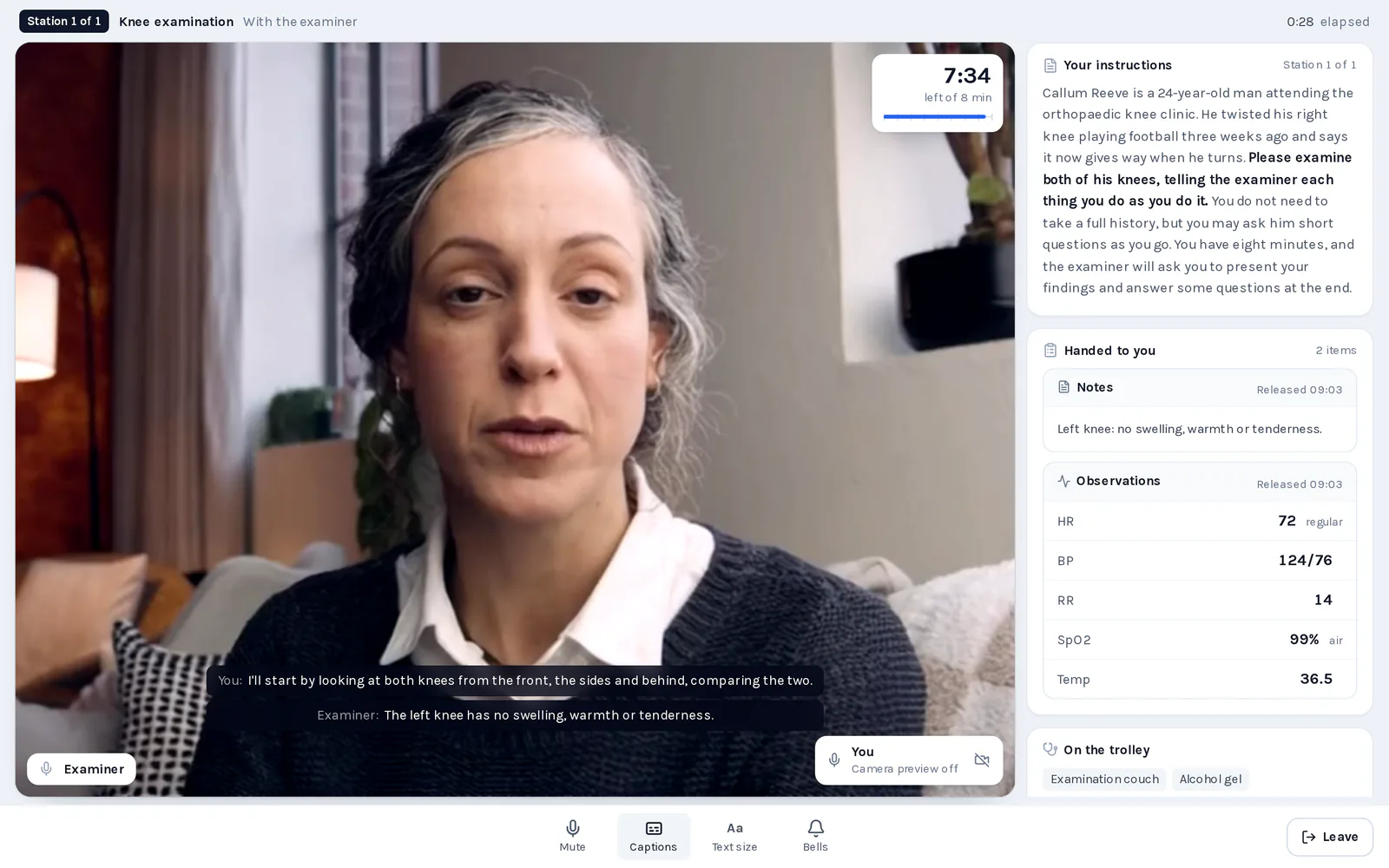
How do you want to practise?
Read the notice, run the clock, then mark yourself on the real sheet.
One plays the patient from the brief, one marks on their own phone.
Their marks land on your screen.
An AI examiner runs the station by voice. It cannot see your hands, so practise the technique itself on a friend.
Candidate instructions
The notice on the door
Mr Malcolm Rudd is a 55-year-old self-employed painter and decorator who has come to the orthopaedic outpatient clinic with three months of right shoulder pain, worse when he reaches overhead and when he lies on that side at night. Please examine his shoulders, telling the examiner each thing you do as you do it. You do not need to take a full history, but you may ask him short questions as you go. You have eight minutes, and the examiner will ask you to present your findings, give a differential diagnosis and answer some questions at the end.
1 min reading, then 8 min in the station
On the trolley
- Chair or stool that allows access from the front and behind
- Couch
- Goniometer
- Tape measure
- Alcohol gel
Your notes from reading time
Saved in this browser only.
Year 4 is where this sheet starts: 29 lines and 31 marks, most of them on systematic approach and clinical reasoning.
Year 4 standard. Performs a complete look, feel, move and special-test routine on both shoulders, names the structure each special test is aimed at, and offers a short differential.
1 critical line. Miss it and the station is failed, however well the rest goes.
Communication 0/3Systematic 0/18Clinical reasoning 0/5Professionalism 0/4Patient safety 0/1
Patient’s brief
Everything the patient knows, including what they will only say if asked. Best read after you have run the station once.
Malcolm Rudd
You are the patient · 55 · man
You are Malcolm Rudd, a 55-year-old self-employed painter and decorator who has been on the tools for nearly forty years. You are dry, blunt and practical, and you are faintly embarrassed to be sitting with your shirt off over a sore shoulder. You make jokes about getting old and play the night pain down. You are right-handed and it is the right shoulder, which is the whole trouble. You cooperate fully, doing exactly what you are asked, but you wince and draw breath when a movement catches, sometimes use your left hand to help the right arm up, and say when something is sore. You ask for a second before a really sore movement. You talk in trade words — ceilings, cutting in, the roller pole — never medical terms, and you never name what you think is wrong beyond wear and tear. When money or work comes up you go short and look away, then answer if the doctor is patient. Speak in the first person as the patient.
Morning, doctor. It is the right shoulder. I have put up with it for three months and it is beating me now.
- How bad the nights are. You say you sleep alright, and only if you are asked again about sleep do you admit the shoulder wakes you three or four times a night and you have finished a couple of nights in the armchair.
- Money and work. You say work is fine, and only if you are asked directly how it is affecting the business do you admit you have turned down two jobs and your son is doing the ceilings.
Do you want the shirt off, doctor?
Shall I lift it myself, or will you move it for me?
Do you want me to say when it starts catching?
Do you need me to lie down for any of it?
Run the station before you look
The answers are the most useful thing on this page once you have had a go, and the least useful before.
When the candidate asks for the observations
Heart rate 74, blood pressure 138 over 82, respiratory rate 14, saturations 98 per cent on air, temperature 36.5.HR 74 regular | BP 138/82 | RR 14 | SpO2 98% air | Temp 36.5
When the candidate looks at the patient in general, or at how he holds his arms
He sits comfortably, holding the right arm close to his side.Comfortable. Holds the right arm close to his side.
When the candidate inspects the shoulders from the front or the side
No scars, swelling or bruising. The outlines match, with no step over either acromioclavicular joint.Front and side: no scars, swelling or bruising. Same outline both sides, no step.
When the candidate inspects the shoulders from behind
The hollow below the spine of the right scapula is deeper than the left. Above the spine the two sides match. The scapulae sit level.Behind: deeper hollow below the spine of the right scapula. Above the spine equal. Scapulae level.
When the candidate feels the temperature of the shoulders, or feels for swelling
Both shoulders feel the same temperature, with no swelling.Same temperature both sides. No swelling.
When the candidate palpates the greater tuberosity, the acromion or the subacromial space, unless only on the left
On the right he is tender over the greater tuberosity and the front edge of the acromion.Right: tender over the greater tuberosity and the front edge of the acromion.
When the candidate palpates the acromioclavicular joint
Neither acromioclavicular joint is tender.Acromioclavicular joints: not tender.
When the candidate palpates the sternoclavicular joint, clavicle, coracoid, scapular spine, biceps tendon or another landmark
There is no tenderness there.Not tender.
When the candidate tests active abduction, unless only on the left
The left arm reaches 180 degrees. The right reaches 160, and he winces between 60 and 120.Active abduction: left 180. Right 160, winces between 60 and 120.
When the candidate watches the scapulae as the arms move, or tests for winging
The right scapula hitches up early in the middle of abduction. Neither scapula wings.Right scapula hitches early in mid-abduction. No winging.
When the candidate tests active flexion, unless only on the left
The right flexes to 165 degrees, sore at the top. The left reaches 180.Active flexion: right 165, sore at the top. Left 180.
When the candidate tests active extension or adduction
That is equal on both sides, and painless.Extension and adduction: equal, painless.
When the candidate tests active external rotation
External rotation is 60 degrees on both sides.Active external rotation: 60 degrees both sides.
When the candidate asks him to reach up or behind his back, unless only on the left
The left thumb reaches T7. The right reaches T10, and it hurts.Hand up the back: left thumb to T7, right to T10, sore.
When the candidate tests internal rotation without the hand behind the back, unless only on the left
The right turns in less than the left, and hurts at the end.Internal rotation: right less than left, sore at the end.
When the candidate asks him to put his hands behind his head or to his mouth
Both hands get there. The right is slower, and he winces.Both hands get there. Right slower, with a wince.
When the candidate moves the shoulder passively, or takes the weight of the arm, unless only on the left
Passively the right shoulder reaches 180 degrees of abduction and flexion. It is sore only at the top.Passive, right: abduction 180, flexion 180. Sore at the top only.
When the candidate tests passive external rotation, or says they repeat every movement passively
Passive external rotation is 60 degrees on both sides, with a soft end feel.Passive external rotation: 60 degrees both sides, soft end feel.
When the candidate feels for crepitus as the shoulder moves
There is no grating in either shoulder.No crepitus, either side.
When the candidate performs the empty can or full can test, or resisted abduction, unless only on the left
On the right he gives way early and it hurts. The left holds firm without pain.Right: gives way early, painful. Left: holds firm, no pain.
When the candidate tests resisted external rotation, unless only on the left
The right is weaker than the left, and uncomfortable.Resisted external rotation: right weaker than left, uncomfortable.
When the candidate performs the lift-off test, the belly-press test or resisted internal rotation
Power is full and equal, with no pain.Full, equal power. No pain.
When the candidate performs the Hawkins-Kennedy test or an impingement test, unless only on the left
On the right that brings on his usual pain at the point of the shoulder.Right: brings on his usual pain at the point of the shoulder.
When the candidate performs the Neer test, unless only on the left
On the right he winces as the arm passes shoulder height.Right: winces as the arm passes shoulder height.
When the candidate performs the scarf test or takes the arm across the body
Taking either arm across the chest causes no pain.Arm across the chest: no pain, either side.
When the candidate performs the apprehension test, with or without relocation
He stays relaxed and lets the arm go right back.Stays relaxed, lets the arm go right back.
When the candidate performs the sulcus test or pulls down on the arm
No hollow appears below the acromion on either side.No hollow below the acromion, either side.
When the candidate performs the drop arm test, unless only on the left
He lowers the right arm slowly and under control.Right arm lowered slowly, under control.
When the candidate performs Speed's test, Yergason's test, O'Brien's test or another biceps or labral test
That causes no pain.No pain.
When the candidate examines or screens the neck, or offers to
His neck moves fully, without bringing on the shoulder pain.Neck: full movement, does not bring on the shoulder pain.
When the candidate tests sensation in the arm or over the deltoid
Sensation is intact wherever you test.Sensation intact.
When the candidate feels the radial pulse or checks capillary refill
The radial pulse is present, with capillary refill under two seconds.Radial pulse present. Capillary refill under 2 seconds.
When the candidate tests power in the arm or hand, or grip
Elbow, wrist and grip power are full on both sides.Elbow, wrist and grip power full, both sides.
When the candidate examines or screens the elbow, or offers to
The right elbow moves fully and without pain.Right elbow: full, painless movement.
When the candidate examines, moves or tests only the left shoulder
The left shoulder is not tender, and moves fully with full power and no pain.Left shoulder: not tender, full movement, full power, no pain.
- Identity: the candidate confirms the patient name and date of birth before starting.
- Introduction: the candidate gives their own name and role.
- Consent: the candidate explains that both shoulders will be looked at, felt and moved, warns that some movements may be uncomfortable, and asks permission.
- Pain: the candidate asks which shoulder hurts and whether it is painful before touching it.
- Comfort: the candidate asks him to say if a movement is too sore and gives him a moment before the next one.
- Dignity and exposure: the candidate exposes both shoulders from the waist up, offers a chaperone or cover and keeps him covered between stages.
- Support: the candidate takes the weight of the arm during passive movement and checks that he is comfortable.
- Thanks: the candidate helps him dress, thanks him and performs hand hygiene.
Rotator cuff tendinopathy with subacromial impingement and a probable partial-thickness supraspinatus tear of the right shoulder — three months of insidious lateral shoulder pain with a mid-range painful arc, pain on overhead reach and at night, weakness of the empty can and resisted external rotation, a positive Hawkins-Kennedy test, a full passive range and no acromioclavicular, instability or cervical features.
Please present your findings. · Year 4
One line of summary, then the positives that matter and the negatives that exclude the alternatives. For example: this 55-year-old right-handed painter has a painful right shoulder with mild infraspinatus wasting and tenderness over the greater tuberosity and anterolateral acromion. Active abduction reaches 160 degrees with a painful arc between 60 and 120 degrees, while the passive range is full in every plane including external rotation. The empty can test is weak and painful and resisted external rotation is weak, but the lift-off test is normal. Hawkins-Kennedy is positive. Importantly, the acromioclavicular joint is not tender, the scarf test is negative, apprehension and sulcus tests are negative, the cervical spine is full and painless and the limb is neurovascularly intact. My diagnosis is rotator cuff tendinopathy with subacromial impingement, with weakness of supraspinatus and infraspinatus raising the possibility of a partial-thickness cuff tear.
What is the most likely diagnosis, and what else could it be? · Year 4
The most likely diagnosis is rotator cuff tendinopathy with subacromial impingement, which many clinicians now call rotator cuff related shoulder pain, and the weakness on the empty can test and on external rotation raises the possibility of a partial-thickness tear. The differential is a frozen shoulder, acromioclavicular joint disease, glenohumeral osteoarthritis, calcific tendinitis and pain referred from the neck. The passive range settles most of it, and specifically passive external rotation. In subacromial pain, active movement is limited by pain but the passive range is full or nearly full, and there is a painful arc through the middle of abduction with a soft end-feel, which is exactly what this man has. In adhesive capsulitis the capsule itself is contracted, so active and passive movement are equally restricted with a firm end-feel, and the loss follows a capsular pattern in which external rotation goes first and furthest, followed by abduction and then internal rotation. It is commonest between 40 and 65, is strongly associated with diabetes and with thyroid disease, and runs a painful phase, a stiff phase and a slow thawing phase over one to three years. Glenohumeral osteoarthritis also restricts the passive range in every direction, usually with crepitus, which is why a radiograph matters when the passive range is lost. Against the acromioclavicular joint, it is not tender, the scarf test is painless and the pain sits in the middle of the arc, not at the top. Against the neck, its movements are full and do not reproduce the pain.
Suppose he asks what is wrong with his shoulder and what can be done about it. What do you tell him, and how would you manage him? · Year 5
I would tell him in plain words that the tendons that lift the arm have become worn and sore and are catching when he reaches up, that the joint itself is not being damaged by use, and that this usually settles with the right exercises. Management is conservative and led by physiotherapy. Analgesia is simple: paracetamol, and a topical or short oral course of a non-steroidal anti-inflammatory drug if there are no contraindications, taken as a means of allowing exercise rather than as the treatment itself; oral ibuprofen has already given him heartburn, so a topical preparation suits him better. Activity modification matters and is genuinely difficult for a self-employed painter, so it is worth being concrete about overhead work, ladder height and taking regular breaks, and about not sleeping on that side. The core of treatment is a structured, progressive loading programme from a physiotherapist, with scapular control work, continued for at least six to twelve weeks before judging it. A subacromial corticosteroid injection is a reasonable adjunct when pain is blocking engagement with rehabilitation, but the benefit is short-lived, measured in weeks to a few months, it does not change the long-term outcome, and repeated injections are avoided because of the risk to tendon quality. I would review him at six to twelve weeks and reconsider imaging and referral if he has not improved. What would change the plan is an acute traumatic tear with sudden loss of active elevation, a hot swollen joint, a mass, or an arm fixed in internal rotation after a fit.
Which special tests are used at the shoulder, and which structure does each one examine? · Year 4
The empty can, or Jobe test, isolates supraspinatus: the arm goes to 90 degrees in the scapular plane, about 30 degrees forward of the coronal plane, with the thumb turned down, and I resist downward pressure. Resisted external rotation with the elbows tucked in at 90 degrees tests infraspinatus and teres minor. The Gerber lift-off tests subscapularis, with the hand behind the back lifted away from the lumbar spine against resistance; the belly-press is the alternative when the shoulder is too stiff to get the hand behind the back. Hawkins-Kennedy and the Neer manoeuvre both compress the cuff and the subacromial bursa under the coracoacromial arch and so test for impingement. The scarf test loads the acromioclavicular joint. The apprehension test with relocation looks for anterior instability, and the sulcus sign for inferior laxity. Individually these tests are only moderately accurate, so I would interpret them as a cluster alongside the range of movement and the site of tenderness rather than relying on any one of them.
Would you image this man, and if so with what? · Year 5
Not routinely at first presentation, because imaging rarely changes the plan for an atraumatic painful arc and degenerative cuff changes are extremely common in asymptomatic people over 50, so a scan risks labelling a shoulder rather than treating it. I would image if the diagnosis is uncertain, if there has been trauma, or if the symptoms have not responded to a proper course of rehabilitation. A plain radiograph, ideally an anteroposterior and an axillary or outlet view, is the first film: it shows glenohumeral or acromioclavicular arthritis, calcific tendinitis, a high-riding humeral head suggesting a large chronic cuff tear, and it excludes an unreduced posterior dislocation. Ultrasound is the usual next step for the cuff itself, is dynamic and inexpensive, and is accurate for full-thickness tears, though it is operator-dependent and less reliable for partial tears. MRI, or MR arthrography, is reserved for cases where surgery is being considered or where labral or instability pathology is suspected. In this man, three months of pain with weakness on two cuff tests would justify an ultrasound if he does not improve with physiotherapy.
When does a shoulder like this need a surgeon? · Year 5
Three broad situations. First, urgently, if this had been an acute traumatic full-thickness tear in a working-age patient — sudden severe pain after an injury with an inability to lift or hold the arm, a positive drop-arm test or true pseudoparalysis — because outcomes for repair are best when it is done early rather than after months of retraction and fatty infiltration. Second, electively, if a symptomatic cuff tear fails a proper course of physiotherapy, which usually means three to six months of genuine rehabilitation, in a patient whose function or work is limited and who is fit for surgery and for the prolonged rehabilitation afterwards. Third, if the diagnosis changes — instability, a labral tear, advanced glenohumeral arthritis, or something that is not the cuff at all. What I would not promise him is arthroscopic subacromial decompression for impingement without a tear: placebo-controlled trials, including the CSAW and FIMPACT trials, found no clinically important benefit over placebo surgery or over supervised exercise, which is why exercise therapy is now firmly the first line and surgery is not offered as a routine next step.
How it is marked
What this station is really testing
The shoulder is one of the musculoskeletal stations most likely to appear in a clinical-years OSCE, and the one candidates most often improvise. It has the largest range of any joint in the body and almost no bony stability, so everything holding it together is soft tissue — which is why this examination is really a hunt for which piece of soft tissue has failed. The marks sit in the routine: look from three sides, feel the landmarks, move actively, move passively, then the special tests, then function, then the joint above and the joint below.
Read the restShow less
The manoeuvre that separates candidates is passive movement. Restricted active movement on its own tells you very little, because a painful cuff, a stiff capsule and a weak deltoid all reduce it. The passive range is what sorts them out: a full passive range with pain through the middle of abduction points into the subacromial space, whereas passive external rotation that stops early, in a shoulder with an unremarkable radiograph, is a frozen shoulder until proved otherwise. Compare every movement with the other side, and watch the scapula while you do it. Marks also leak at both ends. At the start, candidates go straight to the sore shoulder without asking where it hurts or walking round to look from behind, which is where the only sign of chronicity is. At the end, they run out of time before the neck, the nerve supply, the function and a summary, and that is half a dozen marks.
In Year 4 you are expected to perform the routine cleanly, name each special test and say which structure it interrogates, and offer a short differential. In Year 5 you are expected to assemble the findings into a lesion, decide whether this man needs imaging at all, and know that the first line of treatment for almost every painful cuff is a physiotherapist rather than a surgeon. Say each step aloud as you do it, because the examiner can only mark what they hear you do.
Where the 31 marks are at Year 4
- Communication3
- Systematic approach18
- Clinical reasoning5
- Professionalism4
- Patient safety1
1 critical line. Miss it and the station is failed, whatever the total.
What a pass looks like in each year
Year 4
29 lines, 31 marks
The sheet starts here.
Performs a complete look, feel, move and special-test routine on both shoulders, names the structure each special test is aimed at, and offers a short differential.
What lifts it to a clear pass
- Rehearse the order out loud until it is automatic: front, side, behind; temperature then landmarks; active, then passive; then the special tests in groups.
- Always test both sides, and start with the good one — it gives you the normal for this patient and it earns trust before you move the painful shoulder.
- Record internal rotation as the vertebral level the thumb reaches, not as a number of degrees; it is the only rotation students routinely get wrong.
- Warn the patient before every painful manoeuvre and watch their face, not their arm, during the apprehension test.
Year 5
33 lines, 37 marks
Adds four lines, most of them on clinical reasoning and communication.
Assembles the signs into a named lesion, separates it from a frozen shoulder, decides whether imaging is needed and outlines a physiotherapy-led plan.
What lifts it to a clear pass
- Lead your presentation with the passive range — full passive external rotation is the sentence that takes adhesive capsulitis off the table.
- Be ready to say why you would not scan this man today, and what would make you change your mind.
- Know that a structured loading programme comes before an injection, and an injection before a surgeon, and be able to say why subacromial decompression is no longer routine.
- Have one sentence ready about his work: a self-employed painter who cannot reach overhead has an income problem as well as a shoulder problem, and a plan that ignores that will not be followed.
A system you can run under pressure
The sequence
- Introduce, consent, expose both shoulders from the waist up and sit or stand the patient where you can walk right around them — you cannot compare a side you cannot see
- Look from the front, the side and behind: scars, swelling, deformity, asymmetry, muscle bulk in the supraspinatus and infraspinatus fossae, and the resting position of the scapula — wasting of the cuff shows only from behind
- Feel: temperature first, then the bony landmarks in order — sternoclavicular joint, clavicle, acromioclavicular joint, coracoid, acromion, greater tuberosity, spine of the scapula — then the soft tissues, because where it is tender separates the joint on top from the space beneath it
- Move actively in every plane: flexion, extension, abduction, adduction, external rotation with the elbows tucked in, and internal rotation recorded as the vertebral level the thumb reaches — active movement shows what he can do and where it hurts
- Move passively, taking the weight of the arm and steadying the scapula, and compare the passive range against the active range — this is what separates a painful cuff from a stiff capsule
- Special tests, grouped by the question they answer: rotator cuff, impingement, acromioclavicular joint, instability — a group of tests answers a question that no single test can
- Finish with function, the neurovascular status of the limb, and the cervical spine and elbow — neck trouble is often felt at the shoulder
The special tests and what each one asks
- Jobe empty can — arm to 90 degrees in the scapular plane, thumb turned down, resisting downward pressure: supraspinatus
- Resisted external rotation, elbows tucked into the sides and flexed to 90 degrees: infraspinatus and teres minor
- Gerber lift-off, or the belly-press when the hand cannot get behind the back: subscapularis
- A painful arc between 60 and 120 degrees, with Hawkins-Kennedy or the Neer manoeuvre: subacromial impingement
- Scarf test — cross-body adduction — and a high painful arc in the last 10 to 15 degrees: the acromioclavicular joint
- Apprehension with relocation, and the sulcus sign: anterior and inferior instability
- No single test is diagnostic on its own; the cluster carries the weight, so perform them all and interpret them together
Sorting the painful shoulder at the bedside
- Subacromial pain: pain through the middle of the arc, near-full passive range, positive impingement tests, power limited mainly by pain
- Frozen shoulder: active and passive movement both restricted, external rotation lost first and worst, with a firm end-feel
- Acromioclavicular joint: tenderness over the joint itself, pain in the last few degrees of elevation, positive scarf test
- Glenohumeral osteoarthritis: global restriction with crepitus, usually with radiographic joint-space loss
- Referred cervical pain: shoulder movements full and painless, symptoms reproduced by neck movement, often with paraesthesia below the elbow
- Do not forget the sinister: an acute traumatic tear with pseudoparalysis, a fixed internally rotated arm after a fit or a shock, a hot swollen joint, or a mass
The lines that carry marks
Setting it up
Mr Rudd, I would like to look at, feel and move both of your shoulders. Some of the movements may be sore, so tell me and I will stop. Could you take your shirt off for me? Is that all right?
Before you touch him
Which shoulder is it, and is it sore at the moment? Point to where it hurts most. Are you right or left handed?
Narrating the inspection
I am looking from the front and the side for scars, swelling and asymmetry, and now from behind at the muscle bulk above and below the spine of each scapula.
Active, then passive
Lift both arms out to the side as high as they will go. Now relax, and let me take the weight of your right arm while I move it for you.
Show the other 4Show fewer
The empty can test
Arms out at shoulder height, a little in front of you, thumbs pointing at the floor. Hold them there and do not let me push them down.
Naming what you found
He has a painful arc on the right between about 60 and 120 degrees, and the passive range is full, including external rotation.
Presenting to the examiner
Mr Rudd is a 55-year-old right-handed painter with a painful arc on the right, a full passive range, tenderness over the greater tuberosity, a weak and painful empty can test, weak external rotation and pain on Hawkins-Kennedy. The acromioclavicular joint is not tender, the shoulder is stable and the neck is clear. This is rotator cuff tendinopathy with subacromial impingement, possibly with a partial supraspinatus tear.
Explaining it to him
The tendons that lift your arm have become worn and sore, and they catch when you reach up. The joint itself is not wearing out. Exercises with a physiotherapist are what works best, and most people do not need a scan or an operation.
How candidates lose marks here
- Examining only the painful shoulder, so there is no side-to-side comparison for wasting, range or power.
- Never moving the shoulder passively, which makes a painful cuff and a frozen shoulder indistinguishable.
- Performing the special tests as a list of party tricks without saying which structure each one is testing.
- Measuring internal rotation in degrees instead of by the vertebral level the thumb reaches.
- Forgetting to look from behind, and so missing the infraspinatus wasting that is the only sign of chronicity here.
- Leaving out the cervical spine, when neck pathology is one of the commonest causes of pain felt at the shoulder.
- Jumping to a scan and a surgeon when the evidence-based first step is analgesia, activity modification and a progressive loading programme.
Where to read more
- Shoulder pain — assessment and management in primary careNICE CKS · guide
- Shoulder pain — causes, assessment and treatmentPatient.info · reference
- Shoulder pain — what it is, exercises and self-careArthritis UK · guide
- Subacromial impingement — imaging appearancesRadiopaedia · reference
- Rotator cuff tear — ultrasound and MRI findingsRadiopaedia · reference
- Shoulder and brachial plexus injury — clinical assessment and managementRCEM Learning · guide
- Rotator cuff syndrome (StatPearls)NCBI Bookshelf · reference
Now sit it live