
The Methodist University Cape Fear Valley Health School of Medicine MD program
What you actually study, and where you will be
Methodist University Cape Fear Valley Health School of Medicine's MD is a 4-year program taught through case-based learning in an integrated curriculum, with patient contact from Year 1 and clinical rotations in Fayetteville and the Cape Fear Valley Health system (2027 entry). A new school whose first class of 64 began in July 2026 on the Cape Fear Valley Medical Center campus in Fayetteville, North Carolina. Courses in the Foundation phase, Years 1 and 2, are graded pass/fail and organized around clinical presentations, the symptoms and problems patients bring to a doctor. Clinical skills start in the first weeks, alongside a course on the region's health disparities. The program holds preliminary accreditation from the Liaison Committee on Medical Education (LCME). That status lets a new school accept applications for enrollment.
- Degree
- MD
- Length
- 4 years
- Teaching
- Integrated + Case-based learning
- Clinical contact
- Year 1
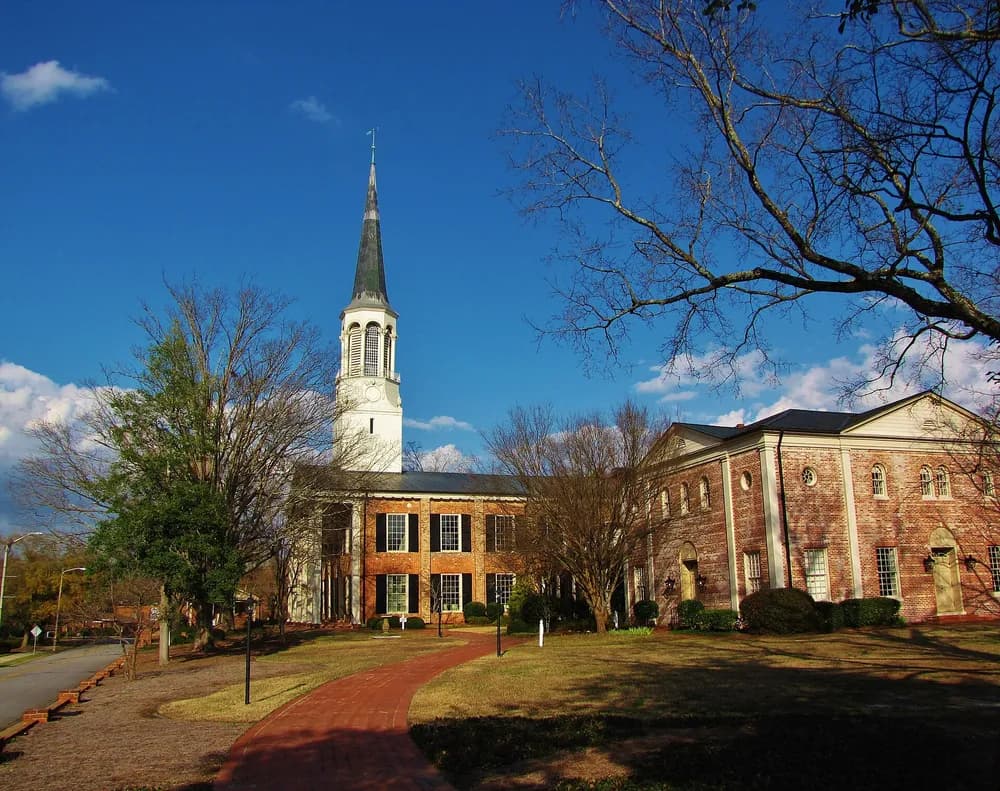

Photo: Gerry Dincher from Hope Mills, NC · CC BY-SA 2.0 · cropped
Photo: Kelliejojo · CC BY 3.0 · Photo: KMayner78 of English Wikipedia · CC BY-SA 3.0 · Photo: Apc106 · CC BY-SA 3.0
The Methodist University Cape Fear Valley Health School of Medicine MD program at a glance (2027 entry)
The Methodist University Cape Fear Valley Health School of Medicine (MU CFVH SOM) runs a four-year Doctor of Medicine (MD) program in Fayetteville, North Carolina. It is a partnership between Methodist University and the Cape Fear Valley Health system, and its building stands on the campus of Cape Fear Valley Medical Center, the system's flagship hospital. The school's mission is to train physicians who help reduce health disparities and improve health in southeastern North Carolina, or wherever they go on to practice.
The school is new. Its first class, the Class of 2030, started in July 2026 with 64 students. If you start in 2027, you join the second class, the Class of 2031, which will also have 64 students. The LCME, which accredits MD programs in the United States, lists the program as Preliminary, the stage before provisional and then full accreditation.
The curriculum runs in three phases. The Foundation phase, the pre-clerkship (pre-clinical) stage, runs through Years 1 and 2. You study the body system by system, in courses built around clinical presentations. To move on, you must pass Step 1 of the United States Medical Licensing Examination (USMLE), the exam series whose results are used for medical licensure in the United States. The Cornerstone phase is the clerkship stage. Clerkships are the core clinical rotations, where you learn on hospital and clinic teams under supervision. The Capstone phase, in Year 4, prepares you for residency, the specialty training that follows medical school.
Much of the program looks outward, to the region. The school notes that the eight counties Cape Fear Valley Health serves have some of the poorest health outcomes in North Carolina, which it links to a shortage of physicians. A course on the region's health disparities teaches you about the people of the area, service learning runs through all four years, and every student completes a required scholarly project.
| Degree | MD (Doctor of Medicine), four years |
|---|---|
| Class size | 64 students: the Class of 2030, and the Class of 2031 entering in 2027 |
| Main campus | School building on the Cape Fear Valley Medical Center campus, Fayetteville, NC |
| Curriculum phases | Foundation, Cornerstone and Capstone |
| Teaching style | Integrated organ-system courses built on clinical presentations, with case-based small groups |
| First patient contact | Year 1, with clinical skills from the first weeks |
| Clinical sites | Cape Fear Valley Health: eight hospitals and more than 90 ambulatory (outpatient) sites |
| Grading | Pass/fail in the Foundation phase; Honors, High Pass, Pass or Fail in clinical rotations |
| Step 1 timing | Step 1 course in spring of Year 2; pass Step 1 before clerkships |
| Accreditation | LCME Preliminary (directory updated October 14, 2026); next survey 2027-28 |
What makes the Methodist University Cape Fear Valley Health School of Medicine MD program different
A course named for the region's area code
Empowering the 910: Bridging Health Disparities takes its name from southeastern North Carolina's 910 area code. Running across Years 1 and 2 for 6.5 credits, it teaches you about the patients, communities and populations of the area the school serves. For the first class, the Year 1 calendar schedules it in three week-long blocks.
Third-year clerkships close to home
The school said in January 2026 that all third-year clerkships will be completed locally, within Cape Fear Valley Health. The same feature says that because the school sits on the health system's campus, you begin building relationships with residents and faculty from the start.
Family and emergency medicine as long threads
Family medicine and emergency medicine are longitudinal: they run alongside your other clinical courses rather than as single blocks. You work with one family medicine preceptor, a supervising physician, one half-day at a time over 32 weeks, seeing adults and children. Emergency medicine is 16 shifts spread across the ambulatory rotations, triaging and treating patients whose problem is not yet diagnosed.
Eight weeks each in community and transitional care
Two 8-week courses take you into care in the community: Community Medicine, in urgent care and the Cumberland Department of Public Health, and Care Transitions, in hospice, rehabilitation, skilled nursing and long-term care.
Procedures from the first semester
The school's December 2025 curriculum feature lists procedures you learn in the first semester: splinting fractures, giving injections, starting intravenous (IV) lines and using point-of-care ultrasound, a scan done at the bedside. The same feature adds that practice in giving naloxone, the drug that reverses opioid overdoses, and in Stop the Bleed bleeding control reinforces classroom teaching through patient scenarios.
How Methodist University Cape Fear Valley Health School of Medicine teaches medicine
The school calls its approach patient-forward. Learning is organized around the common clinical presentations and problems you are likely to meet in practice. Foundational, health systems and clinical sciences are connected through integrated courses. In the school's December 2025 example, a dermatology unit pairs a patient case with short lessons on the skin's anatomy and physiology, the microbes that affect it and drugs such as ointments and steroids. You analyze the symptoms, reach a diagnosis and plan treatment.
Each topic follows the same cycle. You prepare before class, so that class time goes on cases, clinical presentations, problem-solving and small-group work, with faculty questions that draw out your reasoning. Feedback and reflection follow, and you plan what to work on next. The school stresses reasoning over memorization: you explain how you reached a decision, not just pick an answer. Its October 2025 curriculum flyer describes lectures as minimal, though some courses blend formats, such as lectures, workshops and clinical skills in Principles and Foundations of Medicine.
Several threads run alongside the organ-system courses. Clinical skills, health systems science and Empowering the 910 continue through Years 1 and 2. From the spring of Year 1, Application and Assimilation revisits earlier systems through cases that cross several of them, so older material stays in use.
In the clinical phases, teaching moves into patient care. The school's December 2025 curriculum feature says clerkships and dedicated teaching sessions are deliberately coordinated, so both work toward the learning goals for that stage of training. The catalog's attendance rules list didactic sessions, conferences and simulations alongside clinical shifts.
The ways you will learn
| Small-group case sessions | Required sessions in the Foundation phase where a small group works through patient cases and clinical presentations, analyzing symptoms, weighing diagnoses and planning treatment while faculty probe your reasoning. |
|---|---|
| Clinical skills and simulation | Practice in the clinical skills laboratory and simulation spaces, including encounters with standardized patients, people trained to play patients, and procedure training. An assistant dean leads clinical skills and simulation, with directors of standardized patients, simulation education and ultrasound education. |
| Interprofessional education | Joint sessions with students from Methodist University's College of Health Sciences & Human Services, with several planned each semester. The first, in September 2026, used a simulated wound-care case for a patient with diabetes. Planned follow-ups cover assistive devices and why mobility matters. |
| Service learning | You complete 20 hours of service learning a year, 80 hours in all, with community partners, in non-clinical roles such as health education and outreach. In September 2026, students from the first class helped lead a fall-prevention event for more than 40 people at BetterHealth in Fayetteville. |
A typical week on the Methodist University Cape Fear Valley Health School of Medicine program
In the Foundation phase you are expected to be available from 8 a.m. to 5 p.m. on class days, and exam days can run from 8 a.m. to 8 p.m. Required sessions include small- and large-group learning, labs, clinical skills, small-group cases, simulation, early health system science experiences, scheduled service learning, advising and every assessment. Arriving more than 10 minutes late counts as an absence.
For wellness, you may take up to five absences a semester from required activities as personal time, through the excused-absence process, though usually not on major exam days. Once clinical work starts, attendance is daily. You follow your clinical site's schedule, which can include evenings, nights, weekends and holidays, and you may miss no more than eight days across Year 3.
When you first meet patients at Methodist University Cape Fear Valley Health School of Medicine
Your first patient contact comes in controlled settings. The school's December 2025 curriculum feature says clinical learning begins in the first month, with standardized patient encounters, simulation-based training and basic procedural skills. Because clinical experiences begin early in Year 1, the catalog asks for your medical history, a physical exam and proof of immunizations before you arrive.
Early health system science experiences are required sessions in the Foundation phase, and the school's flyer describes them as a look at how the partner health system and the community relate. In December 2025 the school's associate dean for research added that students work directly with community organizations and clinics from the first year.
Clerkships begin after the Foundation phase, once you have passed Step 1. On the 2026-27 catalog, the first is a 4-week Inpatient Internal Medicine rotation in the spring of Year 2, when longitudinal family medicine and emergency medicine also begin. The curriculum table on the school's website, as read in October 2026, shows a Bridge to Clerkships course in Year 2 and all clerkships in Year 3.
The Methodist University Cape Fear Valley Health School of Medicine curriculum, year by year
- Year 1
Foundation phase: principles, then the first systems
For the first class, Year 1 runs from orientation on July 20, 2026, to May 28, 2027. It opened with a week of Empowering the 910, then the five-week Principles and Foundations of Medicine. After that you study the body system by system: skin and the musculoskeletal system, blood, the heart and lungs, then the gut and kidneys.
- Principles and Foundations of Medicine (5 credits): anatomy, biochemistry, genetics, microbiology, immunology and pharmacology, taught through preventive health and patients with fever and sore throat.
- Fall organ-system courses: Dermatology and Musculoskeletal System (8.5 credits) and Hematology (6 credits). Each system course covers normal and abnormal structure and function, how disease develops and how it is treated.
- Spring: Cardiopulmonary Systems (11.5 credits), then the seven-week Gastrointestinal and Renal Systems course (7.5 credits), which also builds clinical and communication skills.
- Application and Assimilation starts in the spring and runs on into Year 2.
- Empowering the 910 continues in week-long blocks between other courses.
- Year 2
End of Foundation: Step 1 and the move to clinical work
The fall finishes the organ systems. The spring adds Behavioral Science, a protected Step 1 course and the Bridge to Cornerstone. Empowering the 910 and Application and Assimilation conclude, at 6.5 credits each. You must pass every Foundation course and Step 1 before moving into the Cornerstone phase.
- Reproductive/Human Life Cycle/Endocrine Systems (12.5 credits): human development from gestation to the end of life, and the reproductive and endocrine systems.
- Neuroscience (6.5 credits): the central nervous system and special senses. The 2026-27 catalog lists it under the fall of Year 2 and again under the fall of Year 3.
- Behavioral Science (3.5 credits): psychiatric and behavioral health conditions.
- USMLE Step 1 course (6 credits): protected study time with set assignments, academic support and focused review sessions. You write your own study plan and track your progress with recommended resources.
- Bridge to Cornerstone (1 credit): an introduction to clinical rotations and the clinical learning environment.
- On the 2026-27 catalog, this spring also brings Inpatient Internal Medicine (4 weeks caring for hospital patients with complex medical, psychological and social problems) and the start of longitudinal family and emergency medicine.
- Year 3
Cornerstone phase: clerkships
Year 3 combines 8-week integrated courses with 4-week inpatient rotations, while family medicine and emergency medicine run through the ambulatory courses. To move on you must pass every clerkship and a comprehensive Objective Structured Clinical Examination (OSCE), a practical exam of timed stations, each testing a clinical task. The website's table also places USMLE Step 2 Clinical Knowledge (CK), and preparation for it, in this year. Step 2 CK tests how you apply clinical knowledge.
- Integrated Ambulatory Medicine A and B (8 weeks each): internal medicine, its subspecialties and surgery in ambulatory care, with interleaved sessions so you follow patients and work with the same preceptors over time.
- Community Medicine (8 weeks): urgent care, the Cumberland Department of Public Health, community engagement and quality improvement, to show the barriers patients face in getting care outside hospitals and doctors' offices.
- Care Transitions (8 weeks): care after hospital discharge or outside the patient's home, in hospice, physical medicine and rehabilitation, a skilled nursing facility and a long-term adult care facility.
- Inpatient rotations of 4 weeks each: Maternal Child Health (obstetric care, gynecological problems and surgery, and newborns in an inpatient nursery), Psychiatry (acute psychiatric conditions and substance use) and Surgery.
- Family Medicine and Emergency Medicine, the longitudinal courses that began in Year 2, earn their 3 credits each in the spring.
- Acting Internship (4 weeks): also called a sub-internship, it gives you more responsibility, managing patients more independently to prepare for internship, the first year of residency. The 2026-27 catalog puts it in the spring of Year 3, though the website's table places it in Year 4.
- In the catalog, you see newborns in Maternal Child Health and children as well as adults in Family Medicine, while Pediatrics and Neurology are fourth-year electives. The website's table and the school's December 2025 and January 2026 features list both as third-year clerkships.
- Year 4
Capstone phase: electives and the move to residency
On the 2026-27 catalog, Year 4 is given to electives, the rotations you choose, listed as Electives (Away Rotations) at 28 credits in each term. Away rotations are electives you take at another institution. To finish you must pass the Acting Internship, selectives (choices from a set list), a minimum number of electives and Transition to Residency, which prepares you for your first day as a resident. The website's table adds residency interviews and graduation.
- Clinical electives in 13 specialties, each worth 4 credits, plus the Research Elective, both described below.
- Transition to Residency (3 credits) runs for three weeks in two parts: one week at the start of the capstone year and two at the end.
- Attendance: no more than three days of absence per 4-week rotation, however many residency interviews you have.
How you are assessed at Methodist University Cape Fear Valley Health School of Medicine
Foundation-phase courses are graded pass/fail. In the Cornerstone and Capstone phases, rotations are graded in four tiers: Honors, High Pass, Pass or Fail. Course and clerkship directors set the criteria for each tier with the Curriculum Committee's approval and publish them in the syllabus. Grade point averages are not reported on your transcript.
Assessment mixes formative and summative work. Formative assessments are lower-stakes practice: knowledge checks and quizzes, case-reasoning activities, reflection prompts and practice questions with feedback. Summative assessments decide progression: written exams, clinical skills and performance-based assessments, and course and clinical assessments. Exams run on ExamSoft, and One45 tracks your evaluations and competencies over time.
In the clinical years you also sit OSCEs and NBME shelf exams. NBME, which co-sponsors the USMLE with the Federation of State Medical Boards (FSMB), writes these subject exams: standardized tests of clinical knowledge in one specialty.
If you fail, the Medical Student Promotion and Professionalism Committee decides whether you may remediate, meaning redo the failed element. A pass after remediation is recorded as Remediated Pass, the highest grade then possible, including for a rotation's NBME subject exam. A third- or fourth-year rotation that is still failed must be repeated, and you must finish the program within six years of starting unless granted an exception.
The catalog requires two USMLE passes: Step 1 before you start the Cornerstone phase, and both Step 1 and Step 2 CK to graduate. For exams taken since January 26, 2022, Step 1 is reported only as pass or fail. In August 2026 the USMLE program announced a move to designated testing dates from January 2029, with Step exams offered less often each year. Its June 2026 announcement had named 2028.
On the current catalog, a student entering in 2027 would take the Step 1 course and sit Step 1 in about spring 2029. Step 2 CK, which the website's table places in Year 3, would follow in about 2029-30. Both would come after the January 2029 switch. This is a projection: the 2026-27 catalog governs the class that entered in 2026, and a catalog for 2027 entrants has not yet been published.
Methodist University Cape Fear Valley Health School of Medicine clinical rotations: where you will actually train
You are based in Fayetteville, in the school's building on the campus of Cape Fear Valley Medical Center, which opened in 1956. Supervised clinical learning takes place within Cape Fear Valley Health and related care settings. In January 2026 the school said all third-year clerkships will be completed locally, within this one health system.
Cape Fear Valley Health has eight hospitals and more than 90 ambulatory sites, and the founding dean describes it as a 1,000-physician system. The system also runs residency programs, among them emergency medicine, general surgery, internal medicine, obstetrics and gynecology, and psychiatry.
Methodist University's graduate housing is on its main campus, about 9 miles, or 15 to 20 minutes depending on traffic, from Cape Fear Valley Health. Off-campus housing information is available on request. University students can buy a discounted pass for Fayetteville Area System Transit (FAST) buses, but the school strongly encourages medical students to have their own transportation.
The school building is on the medical center campus. The rehabilitation center, directly behind the medical center, treats adults and children, and Highsmith-Rainey is the region's long-term acute care hospital.
- Cape Fear Valley Medical Center
- Cape Fear Valley Rehabilitation Center
- Cape Fear Valley Highsmith-Rainey Specialty Hospital
- Cape Fear Valley Behavioral Health Care
The health system's other four hospitals. Bladen County Hospital is the county's critical access hospital, serving rural residents.
- Cape Fear Valley Betsy Johnson Hospital, Dunn
- Cape Fear Valley Bladen County Hospital, Elizabethtown
- Cape Fear Valley Central Harnett Hospital, Lillington
- Cape Fear Valley Hoke Hospital, Raeford
Electives, selectives and away rotations at Methodist University Cape Fear Valley Health School of Medicine
The catalog lists 13 clinical electives of 4 credits each, open once you have completed the Foundation and Cornerstone phases. They cover anesthesia, cardiology, emergency medicine, family medicine, internal medicine, obstetrics and gynecology, orthopedics, pathology, pediatrics, neurology, psychiatry, radiology and surgery. The Research Elective is described under research below.
To graduate you need the school's designated minimum number of electives and selectives. Away rotations are often at a hospital where you might apply for residency.
In January 2026 the school also pointed to built-in audition opportunities on campus. Because Cape Fear Valley Health runs its own residency programs, a rotation there lets a residency program see your work, while you explore the specialty and build relationships.
Dual degrees and research years at Methodist University Cape Fear Valley Health School of Medicine
The school's research page lists a required scholarly project, so research is part of the program for everyone. The school's December 2025 research feature says the project focuses on health equity or community health. That feature frames research as advocacy: using data to understand health inequities across southeastern North Carolina and to speak up for underserved and rural communities.
The school's research page says the project builds critical thinking and an understanding of population health, the health of whole groups of people. It also lists access to large databases and research networks, and first-hand insight into health disparities and the social factors behind them. An assistant dean for scholarly affairs is the contact for research and scholarship.
For more research time, the Research Elective (0 to 8 credits) lets you contribute to or create a scholarly project under a faculty preceptor. You need the instructor's permission and CITI training, an online course in research ethics, before you start.
Facilities and support at Methodist University Cape Fear Valley Health School of Medicine
Where you will learn
The school's building at 3518 Village Drive, a 127,500-square-foot, $65 million facility with 200 rooms, opened to the first class in July 2026. It holds classrooms and learning centers, a virtual anatomy laboratory, a standardized clinical skills laboratory, community and multipurpose spaces, student lounges, common areas, conference rooms, and an entrance plaza and courtyard.
The school's October 2025 flyer also names a simulation center and ultrasound and imaging labs. The Information Commons, the medical library on the building's second floor, has a professional medical librarian for in-person and virtual research help, plus online e-books, journals, databases and point-of-care tools.
Support while you study
Every student joins one of nine learning communities, named after Fayetteville and the surrounding counties of Bladen, Columbus, Cumberland, Harnett, Hoke, Robeson, Sampson and Scotland. A learning community is a small group that links students across class years with faculty mentors, from your first day to Match Day, when residency places are announced. Within it, a pod of 6 to 8 students has its own faculty advisors.
Your advisors meet you one to one at least twice a semester and run group sessions on academic progress, careers and wellness. They guide you from the move into medical school through choosing a specialty and preparing for residency interviews. Learning communities also run wellness events, board exam study groups and volunteer projects.
Academic support comes from the Center for Academic & Professional Excellence (CAPE), part of the Office of Student Experience. It offers an optional one-week readiness course before you start. Through the year it runs seminars on studying, test-taking, time management and board preparation, plus peer tutoring and one-to-one coaching with Medical Education Learning Specialists.
An early-alert program, Navigate 360+, lets faculty and staff flag students who are struggling, and its app lets you book appointments and ask for help. For mental health, the school has its own counselor, plus Timely Care, available at any hour, and The Well on the main campus. Career advisors offer specialty exploration, CV reviews, mock interviews and residency preparation, alongside the Careers in Medicine program of the Association of American Medical Colleges (AAMC).
The school is next to Fort Bragg, and veterans and military-affiliated students and their families have access to resources and support tailored to them. The school states a zero-tolerance policy on mistreatment and runs a food pantry for students. Students lead more than 30 organizations, from specialty interest groups to the Medical Spanish Club and a Narrative Medicine Reading Group.
Is the Methodist University Cape Fear Valley Health School of Medicine program right for you?
This program may suit you if
- You want to train in and for southeastern North Carolina, with a course on its health disparities, service learning every year and third-year clerkships the school said in January 2026 will be completed locally.
- You learn well through cases: organ-system courses built around clinical presentations, small-group work and faculty who ask you to explain your reasoning.
- You value continuity: one family medicine preceptor across 32 weeks, and ambulatory courses where you follow the same patients and preceptors.
- You are curious about care beyond the hospital, from urgent care and public health to hospice, rehabilitation and skilled nursing.
- You would like a class of 64 and a pod of 6 to 8 students with its own faculty advisors.
Things to think about
- The school is new: the first class started in July 2026, so its clerkship years have not yet been taught. The website and catalog also differ on details such as when clerkships and the Acting Internship fall.
- Accreditation is at the LCME's preliminary stage, with the next survey listed for 2027-28. Ask the school how its remaining accreditation steps affect your class.
- The 2026-27 catalog makes pediatrics and neurology fourth-year electives, while other school pages list them as third-year clerkships. If either matters to you, ask which version will apply to your class.
- Clinical training takes place within Cape Fear Valley Health and related care settings. University graduate housing is about 9 miles from the health system, and the school strongly encourages medical students to have their own transportation.
- If the 2026-27 schedule carries over to students entering in 2027, both Step exams would come after the USMLE's January 2029 move to designated testing dates. From then, Step exams will be offered less often each year.
Methodist University Cape Fear Valley Health School of Medicine MD program — frequently asked questions
Applying to Methodist University Cape Fear Valley Health School of Medicine?
How to get into Methodist University Cape Fear Valley Health School of Medicine
Prerequisites, MCAT, AMCAS personal statement, secondaries and interview, step by step.
Open the guide →Methodist University Cape Fear Valley Health School of Medicine admissions profile
MCAT and GPA profile, acceptance rate, interview format and key dates.
See the profile →Compare Methodist University Cape Fear Valley Health School of Medicine with other schools
Put the teaching style, anatomy teaching and clinical sites next to another school.
Open the comparison →Prepare for the Methodist University Cape Fear Valley Health School of Medicine interview
Format breakdown, school-specific sample questions and prep tips from tutors who interviewed here.
Read the guide →Where this Methodist University Cape Fear Valley Health School of Medicine program guide came from
This guide was written from 44 official sources — Methodist University Cape Fear Valley Health School of Medicine's own program pages and curriculum documents, plus the accreditor and the hospitals and health systems the school trains students in where they publish detail — read on 2026-10-31, then checked claim by claim against those sources.
- Methodist University Cape Fear Valley Health School of Medicine: home page
- School of Medicine: Curriculum, with the curriculum progression table
- Methodist University Academic Catalog 2026-27 (Graduate): Medicine (M.D.), pages 133-149
- School of Medicine Academic Calendar, M1 year 2026-27
- Methodist University Academic Catalogs (which catalog year applies)
- School of Medicine: Teaching and Learning Framework
- School of Medicine: Assessment and Feedback
- School of Medicine: Research and Scholarship
- School of Medicine: Academic Affairs and the Information Commons
- School of Medicine: Academic Affairs team
- School of Medicine Facilities
- Welcome from the Founding Dean
- School of Medicine: Mission, Vision and Values
- School of Medicine: Community Impact (the need for a medical school)
- LCME: Accredited Programs directory, updated October 14, 2026
- LCME: Accreditation Process Overview (stages of accreditation)
- Why Choose the School of Medicine? Part 1: Patient Care (December 16, 2025)
- Why Choose the School of Medicine? Part 2: Scholarly Research (December 30, 2025)
- Why Choose the School of Medicine? Part 4: Caliber of Faculty (January 22, 2026)
- Class of 2030 Receives White Coats (September 11, 2026)
- MU Students Collaborate at IPE Event (September 21, 2026)
- School of Medicine Students Offer Fall Prevention Education (September 29, 2026)
- School of Medicine Admissions (Class of 2031 cycle)
- School of Medicine Admissions: Frequently Asked Questions
- School of Medicine: Student Experience
- School of Medicine: Learning Communities
- Center for Academic & Professional Excellence (CAPE)
- School of Medicine: Career Advising and Services
- School of Medicine: Mental Health Counseling
- School of Medicine: Learning Environment
- School of Medicine: Student Organizations
- Community Engagement at the School of Medicine
- Navigate 360+ at the School of Medicine
- School of Medicine curriculum flyer (October 2025)
- Cape Fear Valley Health: the School of Medicine and its hospitals
- Cape Fear Valley Health Residencies and Fellowships
- Cape Fear Valley Medical Center
- Cape Fear Valley Health: hospital locations
- Cape Fear Valley Rehabilitation Center
- Cape Fear Valley Highsmith-Rainey Specialty Hospital
- Cape Fear Valley Bladen County Hospital
- USMLE: Updated Timeline for Designated Testing Dates, transition in January 2029 (August 6, 2026)
- USMLE Designated Testing Dates Information Hub
- USMLE Step 1 Transition to Pass/Fail Only Score Reporting
Curricula are restructured between cycles. Anything here that decides your application — how anatomy is taught, a clinical campus assignment, a required research year — should be confirmed against the official page for your entry year.
Applying to Methodist University Cape Fear Valley Health School of Medicine?
We help US applicants with MCAT strategy, the AMCAS personal statement, secondary essays and interview prep — everything you need for a competitive Methodist University Cape Fear Valley Health School of Medicine application.