
The SUNY Upstate Medical University Norton College of Medicine MD program
What you actually study, and where you will be
SUNY Upstate Medical University Norton College of Medicine's MD is a 4-year program with an integrated curriculum, with patient contact from Year 1 and clinical rotations in Syracuse and the Binghamton area, New York (2027 entry). Upstate's MD opens with three pass/fail semesters in Syracuse: two foundation courses, then organ-system courses, plus a half-day in a doctor's office every other week from the first fall. Five weeks of study for Step 1 (the first licensing exam), a four-week elective block and a one-week Transition to Clerkship course follow. Clerkships (core clinical rotations) run from mid-March of year 2 to mid-March of year 3. About three quarters of the class do them in Syracuse and a quarter at the Binghamton campus, which uses community hospitals and practices.
- Degree
- MD
- Length
- 4 years
- Teaching
- Integrated
- Clinical contact
- Year 1

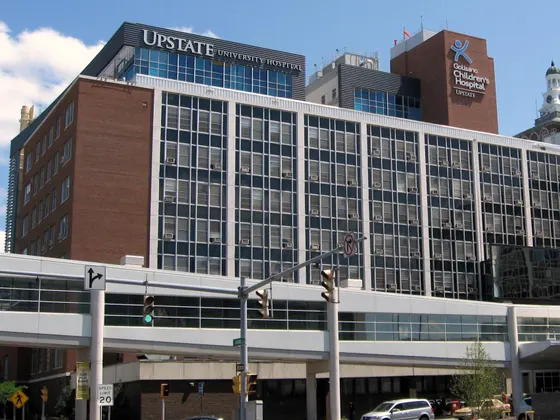

Photo: Alannafmanning · CC BY-SA 4.0 · cropped
Photo: DASonnenfeld · CC BY-SA 4.0 · Photo: Kai Brinker · CC BY-SA 2.0 · Photo: Easchiff · CC BY-SA 3.0
The SUNY Upstate Medical University Norton College of Medicine MD program at a glance (2027 entry)
SUNY Upstate Medical University's Alan and Marlene Norton College of Medicine (SUNY Upstate, or simply Upstate) runs a four-year MD program in Syracuse, New York. Upstate is part of the State University of New York. The Liaison Committee on Medical Education (LCME), which accredits MD programs in the United States, fully accredits the program, and its next LCME site visit is scheduled for March 2027.
The current curriculum began with the class that entered in 2023. Its pre-clerkship stage, called Phase 1, covers the science of medicine before full-time clinical work and lasts three semesters, from late July of year 1 to December of year 2. After two foundation courses, you study the body one organ system at a time, in a single pass, with the science and its clinical meaning taught together.
In January of year 2 you get five weeks to study for Step 1 of the United States Medical Licensing Examination (USMLE). Phase 2 then starts in mid-March with the required clerkships, in which you work on hospital and clinic teams in each core specialty. They end in mid-March of year 3, leaving more than a year for electives, residency applications and an acting internship, or sub-internship, where you work at the level of a first-year resident.
Everyone does Phase 1 in Syracuse. For the clerkship year about three quarters of the class stay there, based at Upstate University Hospital and its affiliated hospitals. The other quarter, about 40 students a year, move to the Binghamton Clinical Campus, about an hour south, where most teaching happens in community hospitals and private practices that Upstate does not own.
Students who already know their specialty can apply, once accepted, to the Three-Year Pathway (3YP), which leads to a residency at Upstate or at UHS (United Health Services) in Binghamton. Others can add an MBA, an MPH or a PhD. The catalog traces the college back to Geneva Medical College, founded in 1834, which admitted Elizabeth Blackwell, the first woman in the United States to graduate from medical school.
| Degree | MD in four years, or three on the Three-Year Pathway |
|---|---|
| Curriculum | Single-pass organ-system curriculum, first taught to the class entering in 2023 |
| Pre-clerkship campus | Syracuse, New York, for every student |
| Teaching style | Integrated organ-system courses with small groups, team-based learning and labs |
| Anatomy | Cadaver dissection, starting in the Musculoskeletal System course in year 1 |
| First patient contact | First fall: half a day every other week in an outpatient office |
| Clerkship year | Mid-March of year 2 to mid-March of year 3 |
| Clinical campuses | Syracuse for about three quarters of the class; Binghamton for about 40 students |
| Step 1 timing | Before clerkships; by early March 2029 for 2027 entrants, on current schedule |
| Grading | Phase 1 pass/fail; clerkships Honors, High Pass, Pass or Fail |
What makes the SUNY Upstate Medical University Norton College of Medicine MD program different
Half-days in a doctor's office from the first fall
The Longitudinal Clinical Preceptorship gives you one preceptor, a practicing clinician who teaches you in their outpatient office, for your first two semesters, then moves you onto an inpatient team in the third.
A community-based clerkship year in Binghamton
About a quarter of the class spend the clerkship year at the Binghamton Clinical Campus, mostly in UHS hospitals and Guthrie Lourdes Hospital. The syllabus and objectives match Syracuse, but family medicine is longitudinal: half a day a week, all year, with one physician.
Clerkships finished by mid-March of year 3
Since the 2023 redesign, the clerkship year starts and ends in mid-March, and the first class on this schedule finished ten weeks earlier than classes before it. That leaves more than a year for electives and the required acting internship before graduation in May of year 4.
Rural electives in every year
The Rural Medical Scholars Program, which applicants opt into, offers rural health electives in all four years, and other students can join with the director's approval. In the clerkship year, its Rural Medical Education (RMED) elective has you live and train in a small-town host community. Four core courses and a capstone earn a Rural Medicine Microcredential.
A three-year route into an Upstate or UHS residency
The Three-Year Pathway, launched in fall 2023, is for accepted students who already know their specialty. You apply to a single residency program, which, if you are accepted, commits to rank you in the Match, the national system that pairs graduates with residencies. Syracuse options span ten specialties, including emergency medicine, general surgery and pediatrics; Binghamton students can aim for UHS family medicine, internal medicine or psychiatry.
How SUNY Upstate Medical University Norton College of Medicine teaches medicine
Phase 1 opens with two foundation courses. Molecules, Cells & Microbes bridges college science to medicine, covering biochemistry, genetics, cell biology, microbiology and immunology. Foundations, Skin & Cancer introduces microscopic anatomy, general pathology and pharmacology, using the skin as its first organ system, and ends with how cancers arise and are treated.
From November of year 1 you take one organ system at a time, each in a course of four to seven weeks. A course covers the normal structure and function of its system, then its diseases, drugs and imaging, with clinical cases throughout. Clinical Neuroscience, Practice of Medicine, Foundations of Reasoning in Medicine and the Longitudinal Clinical Preceptorship run alongside for all three semesters.
Health Systems Science comes as six week-long sessions, two per semester, on ethics, equity and professionalism, health humanities, population health, epidemiology and biostatistics, health finance and delivery, and health law and advocacy. The 2023 redesign also increased active learning, and an August 2023 newsletter from Upstate's medical education office described faculty cutting passive lectures further. Six curricular threads run through the courses, among them diagnosis and patient safety.
In Phase 2 most teaching happens on clinical teams, backed by core lectures and online modules such as the WISE MD cases in surgery. Two short courses run across the clerkship year. In Clinical Bioethics, small groups discuss ethical problems from their own patients; Population Health for Physicians adds public health discussions and a tabletop emergency preparedness exercise.
The ways you will learn
| Interactive lectures and flipped classrooms | Interactive lectures present core science with clinical examples built in. In a flipped classroom, used in courses such as Respiratory System, you study the material beforehand and spend class time applying it. |
|---|---|
| Team-based learning | Structured problem-solving sessions in which you work through questions in teams. Clinical Neuroscience uses a modified version, combined with small-group discussion, clinical problem-solving and examination skills. |
| Simulated patient cases | In Foundations of Reasoning in Medicine, small groups work through a simulated patient encounter. At first you get the topic in advance; later the diagnosis is hidden, so you take the history and examination, build a differential diagnosis (the list of possible causes) and map out treatment. |
| Labs | Lab sessions can take place in a large classroom, the anatomy lab or the simulation center. |
| Standardized patients | In Practice of Medicine, clinicians teach interviewing, examination and communication in small groups, and you practice with standardized patients, people trained to act as patients. You also learn to present a patient in writing and aloud and to draft a first management plan. |
| Community Engaged Learning | It combines ongoing work with community partners and structured reflection, and Upstate distinguishes it from ordinary volunteering. The 2026-27 catalog lists at least 40 hours of it (30 in the 3YP) as a graduation requirement for students who entered from 2023 to 2025. |
A typical week on the SUNY Upstate Medical University Norton College of Medicine program
In Phase 1 most weeks belong to a single organ-system course, with the longitudinal courses fitted around it. In the 2026-27 first-year schedule, every Thursday at 8 a.m., except in a course's first week, brings a weekly formative assessment, a check designed to give you feedback on your progress. In the first two semesters, alternate weeks also hold your preceptorship half-day.
Upstate's 2025-26 Phase 1 calendar key labels every session. Small groups, team-based learning sessions, labs and required workshops are compulsory and are not recorded. Instructor presentations are recorded and compulsory only when marked as required, and some content comes as pre-recorded material or pre-work to finish before an in-person session.
How anatomy is taught at SUNY Upstate Medical University Norton College of Medicine
Upstate teaches anatomy with cadaver dissection. You begin dissecting in the Musculoskeletal System course, a six-week block that ran from early November to mid-December of year 1 in the 2026-27 schedule. It pairs dissection with radiology demonstrations, case-based sessions and clinically focused small groups, and ends with a written exam and a lab practical.
Anatomy then continues inside the later organ-system courses. Respiratory System, for example, includes gross anatomy lab sessions, and the Phase 1 calendar marks sessions as gross anatomy, microscopic anatomy or neuroanatomy. Applied Neuroanatomy, Respiratory System and Cardiovascular System also end with practical exams held in the lab.
If you enjoy anatomy, you can come back to the lab. The Teaching in Human Anatomy elective (1 to 5 credits, counted as a basic science selective) has you help first-years with their daily dissections and small-group sessions. The three-year Clinical Anatomy Instruction microcredential trains you in advanced dissection for your chosen specialty and in how to teach anatomy.
When you first meet patients at SUNY Upstate Medical University Norton College of Medicine
Clinical training starts within weeks. In the 2026-27 schedule, a Clinical Bootcamp and Longitudinal Launch Week came in late August, about a month after classes began, opening both Practice of Medicine and the Longitudinal Clinical Preceptorship. Practice of Medicine then continues in small groups with clinicians and adds clinical experiences in different parts of the health care system.
In the preceptorship's first two semesters you are assigned one preceptor and spend half a day every other week in their outpatient office. You take part directly in patient care and learn how doctors, nurses and support staff run a practice. In the spring you turn a question from one of these patients into a structured evidence-based medicine question in PICO form (patient, intervention, comparison, outcome). You then present your findings to a small group for a grade.
In your third semester the preceptorship moves into the hospital. You join a team on an inpatient unit, round with it and see patients before and after rounds, learning how the hospital runs. Full-time clinical work starts with the clerkships in mid-March of year 2.
The SUNY Upstate Medical University Norton College of Medicine curriculum, year by year
- Year 1 (late July to May)
Foundations and the first organ systems
For 2027 entrants, orientation is on July 22 and 23 and classes start on July 26. A summer course, MedSET (Medical Science Education Transition), is offered to incoming students from June 21. The year covers the two foundation courses and five organ-system courses, with the longitudinal courses running alongside.
- Transition to Medical School, a required introductory course for classes entering from 2026, which ran from late July to October in 2026-27 and covers onboarding, the curriculum, support services, wellbeing and professional identity.
- Molecules, Cells & Microbes (six weeks, split by other short blocks) and Foundations, Skin & Cancer (five weeks), in the 2026-27 schedule.
- Musculoskeletal System (six weeks, November to December), where dissection begins, then Applied Neuroanatomy (four weeks in January).
- Respiratory System (four weeks), Cardiovascular System (five weeks, after spring break) and Kidney & Urinary System (four weeks, to mid-May).
- Four Health Systems Science weeks, and a career and wellbeing resource week in September.
- Practice of Medicine standardized patient exams from November, and a diagnostic exam in late April.
- The summer after year 1 can be used for electives or research.
- Year 2 (late July to December)
The last organ systems
The third and final Phase 1 semester runs from late July to mid-December. It holds three long organ-system courses and two more Health Systems Science weeks, while the preceptorship moves onto an inpatient team.
- Endocrine and Reproductive Systems (seven weeks), including sessions on nutrition, vitamins and minerals.
- Gastrointestinal Systems and Nutrition (seven weeks), covering metabolism and nutrition across the stages of life.
- Blood and Lymphoreticular System (four weeks), from inherited and acquired blood disorders to leukemias, lymphomas and transfusion medicine.
- Health Systems Science weeks on health policy, finance and delivery, and on health policy, law and advocacy.
- Three more standardized patient exams, a diagnostic exam in October and a mid-December week of diagnostic exams and required activities.
- Year 2 (January to mid-March)
Step 1 study and the move to clerkships
The start of the spring semester is set aside for Step 1 and the move into clinical work. You sit Step 1 by a deadline in early March, set in the academic calendar, shortly before clerkships begin.
- Five weeks set aside for Step 1 study from early January (from January 4 in 2027).
- A four-week elective block from early February to early March.
- Transition to Clerkship, a required one-week course in March with live online lectures, modules and small groups for procedures, simulations and discussion.
- Clerkship year (mid-March of year 2 to mid-March of year 3)
The core clerkships
The year is split into ten blocks of about five weeks, with a three-week winter break, and your schedule track sets the order. In Binghamton, every track in the registrar's 2027-28 clerkship schedule opens with an Integrated Clerkship in block A, and its 2026-27 schedule follows the same pattern. An archived 2023-24 Binghamton schedule described that block as spanning all eight core specialties.
- Internal medicine: ten weeks on inpatient and outpatient teams and subspecialty services.
- Surgery and surgical subspecialties (seven weeks) and emergency medicine (three weeks), which share a ten-week block.
- Five weeks each of neuroscience (neurology and neurosurgery), obstetrics and gynecology, pediatrics and psychiatry.
- Family medicine: a five-week outpatient block in Syracuse, or half a day a week with one preceptor all year in Binghamton.
- One elective block, which can include a two-week career exploration elective in a field you would not otherwise see.
- Clinical Bioethics and Population Health for Physicians throughout, then the Clinical Skills Exam as you move into your final year.
- Year 3 (from mid-March) and year 4
Electives, acting internships and residency
The four-year schematic gives the rest of year 3 to USMLE Step 2 Clinical Knowledge (CK), the required acting internship and electives. Year 4 holds electives around residency interviews, Transition to Residency in February and graduation in early May.
- Step 2 CK by August 15 at the start of your final year.
- At least one four-credit acting internship at Upstate, within the 32 elective credits needed to graduate.
- A two-credit basic science selective, open once you have completed 15 credits of clerkships.
- Electives at either campus; Binghamton students can stay on there for the final year.
- Transition to Residency, with simulations and procedure sessions built around some of the Association of American Medical Colleges' (AAMC) Core Entrustable Professional Activities, the tasks a new resident should be trusted to do.
How you are assessed at SUNY Upstate Medical University Norton College of Medicine
All Phase 1 courses and electives are graded pass/fail. Each organ-system course ends with a written exam, and most add a practical exam. Clinical Neuroscience sets regular quizzes, and diagnostic exams come in late April of year 1 and in October and mid-December of year 2. Exams run on ExamSoft's Examplify software.
Clinical skills are tested with standardized patients. Practice of Medicine's standardized patient exams are graded either on a written patient note or on an oral case presentation. After the clerkship year you must pass the Clinical Skills Exam (CSE), a multi-station exam in the Clinical Skills Center covering communication, history-taking and examination, and clinical reasoning. Exams of this kind are often called OSCEs (Objective Structured Clinical Examinations).
Clerkships are graded Honors, High Pass, Pass or Fail, and Phase 2 electives can be graded the same way. Each clerkship sets its Honors and High Pass cutoffs from earlier years' results, and every clerkship grade comes with a written narrative. Most core clerkships also require you to pass a standardized patient exam.
Each clerkship ends with a subject exam, often called a shelf exam: a standardized test of the specialty from the National Board of Medical Examiners (NBME). The NBME co-sponsors the USMLE with the Federation of State Medical Boards. The pediatrics clerkship weights clinical performance at 40%, the NBME exam at 30% and a final standardized patient exam at 15%, with small weights for notes, logging and peer assessment.
Step 1 and Step 2 CK are part of the USMLE, whose results state medical boards use in licensing decisions. Step 1 covers the science behind medicine and, for exams taken from January 26, 2022, reports only pass or fail; Step 2 CK tests clinical knowledge. Upstate requires you to pass both to graduate. Students enrolled in, or graduates of, LCME-accredited MD programs like this one are eligible to sit both exams.
In August 2026 the USMLE program announced a move to designated testing dates from January 2029, with Step exams offered less often each year. Its June 2026 announcement had named 2028. On the current schedule, a student entering in 2027 would start Step 1 study in early January 2029 and sit Step 1 by early March 2029, shortly after the switch. Step 2 CK would follow by August 15, 2030. These are projections: the 2028-29 calendar, which will carry that class's Step 1 deadline, is not out yet.
- Step 1 comes before the clerkship year, by a deadline in each year's academic calendar: March 5, 2027 for the Class of 2029 and March 3, 2028 for the Class of 2030.
- Step 2 CK is due by August 15 at the start of your final year: August 15, 2026 for the Class of 2027 and August 15, 2027 for the Class of 2028.
- Upstate's Step 2 advising page notes that residency programs consider Step 2 scores, which take three to four weeks to arrive.
SUNY Upstate Medical University Norton College of Medicine clinical rotations: where you will actually train
For the clerkship year, about three quarters of the class stay in Syracuse and a quarter, about 40 students, go to Binghamton. During Accepted Student Week, in the spring before you enroll, you hear about the two clinical campuses and then fill in a campus preference form. Upstate takes preferences into account and announces assignments before the commit-to-enroll deadline, and they are binding.
Syracuse students rotate through three hospitals in Upstate's own health system: Upstate University Hospital, Upstate Golisano Children's Hospital and Upstate Community Hospital. They also work at the Syracuse VA (Veterans Affairs) Medical Center, Crouse Hospital, Hutchings Psychiatric Center and outpatient practices across central New York. University Hospital is a Level I trauma center and houses the Upstate Cancer Center, Upstate Stroke Center and Clark Burn Center.
Surgery students usually spend five weeks on general surgery services, which, depending on site, range from trauma, burns and transplant surgery to teams at Upstate Community Hospital and the VA. They add two weeks in a subspecialty such as orthopedics or urology. Crouse Hospital hosts electives in its intensive care unit and in anesthesiology, and acting internships in high-risk obstetrics and in its 57-bed Level IV neonatal intensive care unit.
In Binghamton, clerkships run through UHS Wilson Medical Center in Johnson City, UHS Binghamton General Hospital, UHS Chenango Memorial Hospital in Norwich and Guthrie Lourdes Hospital, plus family care and outpatient sites. Most clerkship time is at UHS hospitals, and emergency medicine is at Lourdes. Chenango Memorial is an option for surgery or obstetrics and gynecology, and many family medicine preceptors work for Endwell Family Physicians.
You need reliable transportation for the whole clerkship year, because public transport does not reach every site. In Binghamton you arrange your own housing; campus staff post apartment leads each year and give some reimbursement for moving costs. Binghamton students who take electives back in Syracuse may be eligible for up to eight weeks of free housing in Geneva Tower. The campus FAQ ties this to staying in Binghamton for at least 12 elective credits.
Students in the RMED elective spend part of the clerkship year in their host community, working with community-based physicians on office hours, inpatient rounds and night call. Syracuse-campus students in RMED do their family medicine clerkship there too, and you agree the site with the program director.
The VA is a 106-bed medical and surgical hospital where more than 650 students, residents and fellows train each year. Hutchings is a state psychiatric center run by the New York State Office of Mental Health. For the neuroscience clerkship, the neurology department lists University Hospital, University Hospital Clinical Campus and the VA hospital.
- Upstate University Hospital
- Upstate Golisano Children's Hospital
- Upstate Community Hospital
- Syracuse VA Medical Center
- Crouse Hospital
- Hutchings Psychiatric Center
UHS Wilson is a 280-bed Level II trauma, stroke and chest pain center, Binghamton General has 220 beds and Guthrie Lourdes has 197. Neurology also uses local practices such as Neuro Medical Care Associates.
- UHS Wilson Medical Center, Johnson City
- UHS Binghamton General Hospital
- UHS Chenango Memorial Hospital, Norwich
- Guthrie Lourdes Hospital
- Endwell Family Physicians
RMED students train with local, board-certified preceptors in small-town host communities.
Electives, selectives and away rotations at SUNY Upstate Medical University Norton College of Medicine
Electives are rotations or courses you choose. In the four-year pathway you need 32 elective credits to graduate, and a standard elective carries one credit per week. The 2026-27 catalog counts more than 170 electives in the Course Selection Book, offered at Upstate University Hospital, the Binghamton campus and affiliated sites. If what you want is not in the book, you can propose a unique elective, which needs approval before it starts; allow about six weeks. Up to 8 credits can come from the pre-clerkship years.
Some credits are set. Four must be an acting internship at Upstate, supervised by attendings, the fully trained physicians in charge of patient care. Two must be a basic science selective. No more than 20 required clinical elective credits may come from one department, with at least 12 from others.
Upstate's approved acting internships span most specialties, from pediatric intensive care and neonatology to trauma surgery and radiation oncology, with a neonatal-perinatal option in Binghamton. Many students add acting internships elsewhere, often called audition rotations, at programs where they may apply for residency.
Electives at other institutions are away rotations, and up to 12 extramural credits count toward graduation. You apply through VSLO (Visiting Student Learning Opportunities), usually in February and March. Options include other medical schools, the Centers for Disease Control and Prevention, the National Institutes of Health and underserved areas in the US or abroad. Some students take one the summer after year 1, and international electives also need an approved study abroad contract.
Final-year electives are chosen through an elective lottery in January of year 3. Binghamton students who stay on can take electives there such as infectious disease, dermatology, palliative care and a family medicine acting internship. Other options include Consortium for Culture and Medicine classes with Syracuse University and Le Moyne College, hospice volunteering, and microcredentials in areas such as climate and health or physician advocacy.
Dual degrees and research years at SUNY Upstate Medical University Norton College of Medicine
The MD/PhD program trains physician-scientists in no more than eight years. You do about 18 months of medical school and take Step 1; the 2026 transition timeline then has ten weeks of clerkships before the PhD starts in June. About four years of research follow, with weekly MD/PhD Grand Rounds and standardized patient sessions, before the last two years of clinical training. Lab rotations run in the summers before and after year 1, and stipends and tuition scholarships are provided.
The MD/MPH with Upstate's own public health program usually takes about five years, with most MPH coursework done in the program's first year, called Year Zero. You choose one of three concentrations: public health methods, global health and translational science, or population health for clinicians. The five-year MD/MBA with Syracuse University's Whitman School of Management starts with a year of MBA study and adds a practicum in the summer after year 1.
The Three-Year Pathway takes about 10 students a year, with entry points at the start and end of year 1. You join your chosen department in the summer after year 1, take Step 1 by late January of year 2 and start clerkships five weeks ahead of the four-year class. You need 19 elective credits rather than 32 and must pass Step 1 and Step 2 CK on the first attempt; MD/PhD and MD/MBA students are not eligible.
Two BS/MD tracks lead from a bachelor's degree into this MD. The Binghamton University track is for students in their first year there, and the Syracuse University track is for high school seniors. Each has five places a year.
The Office of Research for Medical Students helps you find mentors, funding and projects across more than 20 basic and clinical departments or off campus. Summer research is available between years 1 and 2, and many departments offer research electives in Syracuse and Binghamton. Binghamton-based projects, some remote, can start in your first semester through partnerships with UHS, Guthrie and Binghamton University.
The Medical Student Research Microcredential recognizes at least 240 hours of hypothesis-driven research that leads to a poster, talk or paper. Since 2026 it can also cover research done at another institution. The Department of Neuroscience and Physiology describes a one-year MS in Physiology for students who have taken Step 1. However, the 2026-27 catalog lists the graduate Physiology MS and PhD as not accepting applicants that year.
Facilities and support at SUNY Upstate Medical University Norton College of Medicine
Where you will learn
Upstate's academic campus sits at the edge of downtown Syracuse, across the street from Syracuse University. Its main building for basic science, labs and teaching is Weiskotten Hall, whose cornerstone President Franklin D. Roosevelt laid in 1934, when the college was still part of Syracuse University.
Clinical skills teaching uses the Simulation Department's two centers, on the same floor and joined by a hallway. The University Simulation Center in Weiskotten Hall handles procedures and manikin-based simulation, while the Clinical Skills Center in Setnor Hall is the main venue for exams with standardized patients. Between them they have 22 exam rooms for standardized patient encounters, a simulated operating room, six acute care suites, task-training and haptics rooms, and video recording throughout.
The Binghamton Clinical Campus occupies the fifth floor of Binghamton University's Health Sciences Building in Johnson City, a former Endicott-Johnson shoe box factory a few blocks from UHS Wilson. Classes, subject exams and interprofessional sessions usually take place there.
Support while you study
Career Advising, Professional Development and Personal Growth (CAPP) is a series of eight short courses spread over the four years (over three years for 3YP students). Drawing on the AAMC's Careers in Medicine program, it combines career and academic advising with wellbeing and professional identity, from understanding yourself to choosing a specialty and preparing for residency.
The Office of Educational and Career Success, set up in 2019, joins academic advising and career planning, with offices in Weiskotten Hall. Academic Support Services adds one-to-one academic counseling with an individual plan, peer tutoring, and workshops on study skills, test anxiety and strategic study for the USMLE, including panel discussions on Step 1.
In Binghamton, the campus Office of Student Affairs works with the Syracuse team on advising, from electives to residency planning, and helps you relocate and settle in. The campus lists its own counseling services, and the university's Student Counseling Center offers counseling to Upstate students.
Is the SUNY Upstate Medical University Norton College of Medicine program right for you?
This program may suit you if
- You want to work in a real outpatient practice from your first fall, with the same preceptor every other week.
- You would like to finish clerkships by mid-March of year 3 and keep the rest of the program for electives, acting internships and Step 2 CK.
- A community-based clerkship year in Binghamton appeals, with one family medicine preceptor for the whole year.
- You are drawn to small-town practice and want rural electives in every year, including part of the clerkship year lived in a small town.
- You already know your specialty and would commit early to one Upstate or UHS residency to finish in three years.
Things to think about
- You cannot simply pick your clinical campus: you state a preference, and the assignment is binding before you commit to enroll.
- You need reliable transportation for the whole clerkship year, and in Binghamton you arrange your own housing.
- Phase 1 is compact: three semesters, mostly of organ-system courses, then Step 1 study from January of year 2.
- On the current schedule a 2027 entrant would sit Step 1 shortly after the USMLE moves to designated testing dates in January 2029, when Step exams will be offered less often each year.
- The Three-Year Pathway ties you to one residency program early and requires passing Step 1 and Step 2 CK on the first attempt.
SUNY Upstate Medical University Norton College of Medicine MD program — frequently asked questions
Applying to SUNY Upstate Medical University Norton College of Medicine?
How to get into SUNY Upstate Medical University Norton College of Medicine
Prerequisites, MCAT, AMCAS personal statement, secondaries and interview, step by step.
Open the guide →SUNY Upstate Medical University Norton College of Medicine admissions profile
MCAT and GPA profile, acceptance rate, interview format and key dates.
See the profile →Compare SUNY Upstate Medical University Norton College of Medicine with other schools
Put the teaching style, anatomy teaching and clinical sites next to another school.
Open the comparison →Prepare for the SUNY Upstate Medical University Norton College of Medicine interview
Format breakdown, school-specific sample questions and prep tips from tutors who interviewed here.
Read the guide →Where this SUNY Upstate Medical University Norton College of Medicine program guide came from
This guide was written from 71 official sources — SUNY Upstate Medical University Norton College of Medicine's own program pages and curriculum documents, plus the accreditor and the hospitals and health systems the school trains students in where they publish detail — read on 2026-10-31, then checked claim by claim against those sources.
- Courses, Clerkships and Electives, Undergraduate Medical Education, SUNY Upstate
- SUNY Upstate Medical University Academic Catalog 2026-2027, Issue 1 (August 1, 2026)
- Undergraduate Medical Education, SUNY Upstate
- Class of 2029 four-year schematic (Rev. 03.11.25)
- 2026-2027 Phase 1 Semester 1 and 2 Academic Schedule
- 2026-2027 Phase 1 Semester 3 Academic Schedule
- Phase 1 Calendar Nomenclature 2025-2026
- 2026-27 SUNY Upstate Medical University Academic Calendar
- 2027-28 SUNY Upstate Medical University Academic Calendar (v1)
- 2027-2028 Syracuse Campus clerkship rotation schedule (Class of 2029)
- Binghamton 2026-2027 clerkship rotation schedule (Class of 2028, Registrar)
- Binghamton 2027-2028 clerkship rotation schedule
- 2023-2024 Binghamton Clinical Campus clerkship schedule (web archive copy, December 2024)
- 2026-27 Course Selection Book (Rev. 09.16.2026)
- Course Requirements, Class of 2027 (Registrar)
- Acting Internship Selectives (Registrar, updated March 2025)
- Clinical Campus Options, Norton College of Medicine
- Binghamton Clinical Campus, Norton College of Medicine
- Academics at Binghamton Clinical Campus
- Selection of Binghamton Students
- Staying in Binghamton for Your Final Year
- Life in Binghamton and Transitioning for Your Clerkship Year
- Student Affairs, Binghamton Clinical Campus
- Syracuse Clinical Campus, Norton College of Medicine
- Norton College of Medicine LCME Accreditation Overview
- LCME directory of accredited programs
- Medical School Information for MSPEs, Norton College of Medicine
- USMLE Step 2 advising, Norton College of Medicine
- Away Electives and Acting Internships, College of Medicine
- Clerkship Year Subject Exams, Undergraduate Medical Education
- Exam Policy and Procedures, Undergraduate Medical Education
- The Family Medicine Clerkship, Department of Family Medicine
- Surgery Clerkship and Subspecialties, Department of Surgery
- Neuroscience Clerkship Components, Department of Neurology
- Pediatric Clerkship, Department of Pediatrics
- 3 Year Program (3YP), Norton College of Medicine
- MD/PhD Program Curriculum Overview
- MD/PhD Transition Timeline (2026)
- MD/MPH Degree, Public Health and Preventive Medicine
- MD/MBA Program with the Syracuse University Whitman School of Management
- BS/MD Program, Norton College of Medicine
- Office of Research for Medical Students
- Medical Student Research Microcredential
- Microcredentials, Academic Affairs, SUNY Upstate
- MS in Physiology for MD Students, Department of Neuroscience and Physiology
- Rural Medical Scholars Program, Department of Family Medicine
- The RMSP Curriculum, Department of Family Medicine
- Applying to Rural Training Opportunities, Department of Family Medicine
- Community Engaged Learning Program, Norton College of Medicine
- Simulation Department, SUNY Upstate
- Academic Support Services, SUNY Upstate
- Advising and Career Development, Norton College of Medicine
- Student Counseling Center, SUNY Upstate
- UME Office Newsletter, May 2023
- UME Office Newsletter, August 2023
- UME Office Newsletter, November 2025
- Norton College of Medicine 2024 Annual Report
- About Upstate, SUNY Upstate Medical University
- About Upstate University Hospital
- About VA Syracuse Health Care
- Hutchings Psychiatric Center, NYS Office of Mental Health
- UHS Wilson Medical Center, Johnson City
- UHS Binghamton General Hospital
- UHS Chenango Memorial Hospital, Norwich
- UHS Academic Affairs and Medical Education
- Guthrie Lourdes Hospital
- USMLE Bulletin of Information: Eligibility
- USMLE Step 1 Transition to Pass/Fail Only Score Reporting (September 2021)
- USMLE: Transition to Limited Testing Dates Each Year (June 23, 2026, with August 2026 update)
- USMLE: Updated timeline for Designated Testing Dates, transition in January 2029 (August 6, 2026)
- USMLE Designated Testing Dates Information Hub
Curricula are restructured between cycles. Anything here that decides your application — how anatomy is taught, a clinical campus assignment, a required research year — should be confirmed against the official page for your entry year.
Applying to SUNY Upstate Medical University Norton College of Medicine?
We help US applicants with MCAT strategy, the AMCAS personal statement, secondary essays and interview prep — everything you need for a competitive SUNY Upstate Medical University Norton College of Medicine application.