
The New York Medical College MD program
What you actually study, and where you will be
New York Medical College's M.D. is a 4-year program with an integrated curriculum, with patient contact from Year 1 and clinical rotations in the Hudson Valley, New York City and six other states (2027 entry). NYMC's M.D. runs in three phases. Phase 1 is 18 months of integrated courses in Valhalla, most built around organ systems, with clinical skills practice from the first week. Clerkships, the core clinical rotations, start in April of year 2, after Step 1 of the United States Medical Licensing Examination (USMLE), at affiliates assigned by lottery. The final phase is organized around a specialty track you choose.
- Degree
- M.D.
- Length
- 4 years
- Teaching
- Integrated
- Clinical contact
- Year 1

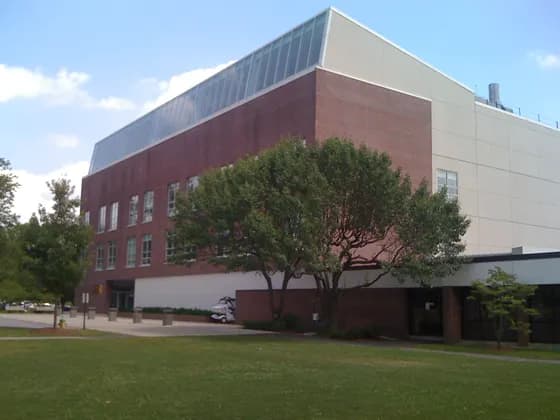


Photo: Johnathanly · CC BY-SA 4.0 · cropped
Photo: Somguy885 ( talk ) · Public domain · Photo: Flickr user Melissa Martin. · CC BY-SA 2.0 · Photo: Daniel Case · CC BY-SA 3.0
The New York Medical College MD program at a glance (2027 entry)
New York Medical College (NYMC) School of Medicine awards the M.D. after a four-year program on its campus in Valhalla, Westchester County, about 25 miles north of midtown Manhattan. Founded in 1860, NYMC has been part of Touro University since 2011. The Liaison Committee on Medical Education (LCME), which accredits MD programs in the United States, reaccredited the program in 2024 for the maximum eight years, through 2032.
The current curriculum began with the class that entered in 2022 and has three phases: Foundational Science, Core Clerkships and Advanced Practice. Phase 1, the pre-clerkship phase, lasts 18 months. Instead of separate subjects such as anatomy, histology and pharmacology, you take six integrated courses, four of them built around organ systems. Each covers the science, clinical skills and health systems side of its topic.
Clinical work starts early: from the first week you practice with standardized patients, trained actors who play patients. Phase 1 also includes required community service learning and a clinical preceptorship. Clerkships begin in April of year 2, after USMLE Step 1.
The campus is shared with Westchester Medical Center and Maria Fareri Children's Hospital, two of the three major clinical sites; the third is NYC Health + Hospitals/Metropolitan in East Harlem. Rotations spread across more than 30 affiliated hospitals and clinics in seven states, and lotteries decide where you go. In the final phase you follow a specialty track of your choice, building toward the residency you plan to apply for.
| Degree | M.D.; M.D./M.P.H. and M.D.-Ph.D. also offered |
|---|---|
| Program length | 4 years, plus an optional research year (ESAR) |
| Class size | 234 students in the class that entered in 2026 |
| Main campus | Valhalla, Westchester County, shared with Westchester Medical Center |
| Curriculum | Three phases: Foundational Science, Core Clerkships, Advanced Practice |
| Anatomy | Donated bodies in the 36-table Alumni Gross Anatomy Laboratory |
| First patient contact | Standardized patients from week 1; real patients during Phase 1 |
| Clerkships begin | April of year 2, at sites set by lottery |
| Step 1 (2027 entrants) | By about late March or early April 2029, on the current schedule |
| Grading | Phase 1 pass/fail; clerkships Honors, High Pass, Pass or Fail |
What makes the New York Medical College MD program different
Clerkships from April of the second year
Phase 1 fits the science into 18 months, so you finish the last organ-system course in February of year 2. You then sit the Comprehensive Basic Science Examination (CBSE), which mirrors Step 1, take Step 1 itself and start full-time clerkships in mid-April. NYMC says this is three months earlier than under its old curriculum, leaving more time to build clinical skills, complete scholarly projects and prepare for residency.
A final phase shaped by your specialty track
In Phase 3 you declare a specialty track, from emergency medicine or neurosurgery to pathology, radiology or undecided. Each track has two required rotations: a sub-internship, where you work much like an intern with closer supervision, and a selective such as critical care or radiology. Electives fill the rest, and Transition to Residency is taught by specialty.
A simulation center expanded in 2026
The Clinical Skills and Simulation Center finished a 2026 expansion to 27,000 square feet, laid out like a hospital with ward, operating room and birthing suites. You start there in your first week and come back for clinical skills exams and the course that prepares you for clerkships.
Affiliates in seven states, from East Harlem to Arizona
Lotteries place you among more than 30 affiliates. Most are in New York State, including NYC Health + Hospitals/Metropolitan in East Harlem. Others are in New Jersey, Connecticut, Rhode Island and Pennsylvania, with Mount Sinai Medical Center in Miami Beach and Yuma Regional Medical Center in Arizona added in 2024.
How New York Medical College teaches medicine
Basic scientists and clinicians build each integrated Phase 1 course together. In Cardiorespiratory, for example, one course covers the normal anatomy and physiology of the heart and lungs, the diseases that threaten them, the imaging and drugs used, and how to examine both.
Themes run through all three phases rather than sitting in one course. The 2026-27 catalog lists communication skills, clinical reasoning, cultural humility, evidence-based medicine, genetics, health systems science, interprofessional collaboration, medical ethics, medical imaging, nutrition, professionalism, racism and bias in medicine, and women's health. Health systems science is about how care is delivered: patient safety, quality improvement, high-value care, leadership and teamwork.
Short intersessions between Phase 1 courses make room for topics outside the main courses. The M.D. program page calls them health system science intersessions, and the 2025-26 calendar gave one January week to career, wellness and remediation.
From April of year 2 you learn mostly on clinical teams of attending physicians, residents, nurses and other professionals, in inpatient and outpatient settings. Under supervision you take histories, examine patients, write notes and begin to take responsibility for patients' evaluation and treatment.
The ways you will learn
| Large-group sessions | Live, interactive discussions, recorded videos, and panel discussions with patients, physicians and other health professionals. |
|---|---|
| Small-group and case-based sessions | Small groups work through clinical cases. In Brain and Behavior the neurology faculty also use team-based learning, where you prepare beforehand and apply it to problems as a team, and problem-based learning, where a group works from a patient scenario. |
| Laboratories and dissection | Laboratory exercises and cadaveric dissection, with anatomy taught in the Alumni Gross Anatomy Laboratory. |
| Standardized patients and simulation | Standardized patients help you practice history-taking, examination, breaking bad news and shared decision-making. Each encounter is recorded, scored on a checklist and followed by their verbal and written feedback. Manikins and task trainers are used for procedures such as intubation, suturing and catheterization. |
| Preceptorship and service learning | Required community service learning in Phase 1, and a second-year preceptorship with area physicians. |
| Clerkships | Supervised patient care with conferences, lectures, teaching rounds and individual feedback. |
A typical week on the New York Medical College program
The Phase 1 scheduling policy, updated in October 2026, sets the limits of a pre-clerkship week. Scheduled hours, which include in-person sessions and set self-directed time, average no more than six a day and never exceed 28 a week. Scheduled hours plus required pre-work, such as videos, readings or quizzes before a session, should average no more than 40 a week, and your own study comes on top.
The school day generally runs from 8 a.m. to 5 p.m. with an hour for lunch, and on average you get at least one free half day a week. At least half of scheduled hours use active learning, and no lecture lasts more than 90 minutes. Each major written exam follows a free study day with no new material, and mandatory in-person sessions generally start no earlier than 10 a.m. the day after an exam.
Attendance is required at small groups, labs, clinical skills and preceptor sessions, intersessions and any session marked mandatory, and the schedule flags which those are. The calendar gives no-class days for Jewish holidays such as Rosh Hashanah, Yom Kippur, Sukkot and Passover as well as federal holidays.
How anatomy is taught at New York Medical College
Gross anatomy starts in the first course, Fundamental Processes of Life, which covers the body's structure at the cellular and gross anatomic level. After that, anatomy is taught inside the organ-system courses, alongside the physiology, biochemistry and disease of each system, instead of as a separate subject.
You learn from donated bodies. The 2026-27 catalog lists cadaveric dissection among the program's teaching methods. Its technical standards, which every student must meet to progress and graduate, list performing anatomical dissections among the expected motor skills.
The Alumni Gross Anatomy Laboratory fills the top floor of the Medical Education Center: 8,500 square feet with 36 dissecting tables, network access at each table and a special ventilation system. Outside exam times it is open around the clock for study.
Each spring the first-year class holds the Convocation of Thanks for donors' families, with music, poetry and reflections. At the 2026 ceremony, first-year students spoke about the donors they had studied, and it ended with a tree planted on campus in the donors' honor. The 2026-27 calendar sets the next one for May 7, 2027. For extra study, the library offers Primal Pictures, a 3D anatomy program in which you can perform virtual dissections.
When you first meet patients at New York Medical College
Your first patients are simulated. From the first week you practice interviewing, communication and physical examination with standardized patients in the Clinical Skills and Simulation Center. The organ-system courses then add the examination skills for their systems, such as the neurological exam in Brain and Behavior.
Real patients also appear in Phase 1. The M.D. program page describes required community service learning and a longitudinal clinical preceptorship, with faculty mentoring you directly. NYMC's 2024 report on its preceptors calls the preclinical preceptor program the step where second-year students carry their skills from the classroom into practice. Area physicians host them in practices, hospitals and clinics.
The Transition to Phase 2 course, a week long on the 2026-27 calendar, adds simulation-based procedural training, communication practice with standardized patients and sessions on professionalism, teamwork, clinical reasoning and health systems. Clerkships then start in mid-April of year 2, marked by a Student Clinician Ceremony sponsored by the school's Gold Humanism Honor Society chapter.
The New York Medical College curriculum, year by year
- Phase 1, year 1
Foundations, then the first systems
Year 1 starts in late July with the week-long Transition to Medical School, which introduces support services, career advising and the curriculum. Three integrated courses follow, separated by short intersessions, and you receive your white coat at a ceremony in the fall. The calendar sets early June to mid-July aside as a summer enrichment period, when you can do funded research or start an Area of Concentration.
- Fundamental Processes of Life (22 credits, late July to mid-December): cells and gross anatomy, how the body works, health systems science, social determinants of health, and your first history-taking and examination skills.
- Introduction to Systems (13 credits, January to late March): two modules, Infectious Diseases/Host Defense and Heme/Neoplasia, introducing concepts used in every later systems course.
- Systems 1: Brain and Behavior (9 credits, late March to May): normal and abnormal neuroscience, behavioral science, racism and bias in medicine, ethics and research principles, plus the neurological examination.
- History of Medicine (1 credit) in the spring: medicine from the ancient world to modern times, including views of medicine outside the Western world.
- Phase 1, year 2
The last systems courses, the CBSE and Step 1
Year 2 opens in late July with the three remaining organ-system courses, which run to mid-February. You then sit the CBSE, a National Board of Medical Examiners (NBME) exam, and move into a dedicated Step 1 study period of five to six weeks. Step 1 must be taken before the Transition to Phase 2 course.
- Systems 2: Cardiorespiratory (12 credits, late July to late September): the heart and lungs.
- Systems 3: Renal/Reproduction/Endocrine (15 credits, late September to mid-December): the kidneys, the reproductive system and hormones.
- Systems 4: GI/MSK/Derm/Rheum (11 credits, January to mid-February): the digestive tract, the musculoskeletal system, skin and rheumatology.
- The preclinical preceptorship with an area physician.
- In the fall, the lotteries that set your clerkship order and sites, and an October 1 deadline if you are applying to the M.D.-Ph.D.
- Phase 2
Core clerkships, April of year 2 to March of year 3
The core clerkships run from mid-April of year 2 to late March of year 3. The seven longer clerkships each end with an NBME subject exam, or shelf exam, a national end-of-clerkship test, on their final Friday. You take Step 2 Clinical Knowledge (CK), the next USMLE exam, after the clerkships, by a deadline the calendar puts in late May. Taking it is required to enter Phase 3.
- Internal medicine (6 weeks), inpatient and outpatient, with a different subspecialty focus each week, such as gastroenterology and infectious disease or cardiology and rheumatology.
- Surgery (6 weeks) at affiliates in New York City and Westchester and Dutchess counties, including after-hours and weekend call and time with surgical subspecialties.
- Pediatrics (6 weeks), focused on newborn medicine and pediatric emergency medicine, and obstetrics and gynecology (6 weeks) in hospital and outpatient settings.
- Psychiatry, neurology and family medicine (4 weeks each). In family medicine you are matched with a preceptor in a private practice, community health center or affiliated residency program.
- Physical medicine and rehabilitation (PM&R; 2 weeks, pass/fail) and a 2-week Health System Science Intersession.
- Three 2-week electives and a 2-week Flex block, plus the Clinical Skills Competency Assessment, a multi-station standardized patient exam.
- The 2026-27 calendar also lists an 18-week longitudinal integrated clerkship (LIC), September 28, 2026 to February 12, 2027. In it, internal medicine, pediatrics and obstetrics and gynecology run at the same time instead of in separate blocks.
- Phase 3
Advanced practice in your specialty track
Phase 3 runs from the spring of year 3 to commencement in the spring of year 4. After the one-week Transition to Phase 3, which prepares you for more responsibility and for residency applications, your declared specialty track shapes your rotations. It includes the one-week Transition to Residency in the spring of year 4.
- Tracks: emergency medicine, family medicine, general surgery, internal medicine, neurosurgery, obstetrics and gynecology, orthopedic surgery, pathology, pediatrics, psychiatry, radiology, or undecided.
- A sub-internship in internal medicine, emergency medicine, obstetrics and gynecology, surgery, pediatrics, neurosurgery or orthopedics. The Department of Medicine says its internal medicine sub-internship involves rounding on patients daily, presenting on team rounds and doing procedures as appropriate.
- A track selective in emergency medicine, radiology and diagnostic medicine, critical care, pathology or psychiatry.
- Four-week electives at NYMC affiliates or away at other schools.
- Residency interviews, mostly in blocks you keep free, and never during required track rotations.
- Transition to Residency: simulation-based procedures and handoff training, case-based problem solving and residency preparation, organized by specialty track.
How you are assessed at New York Medical College
Phase 1 courses are graded pass/fail on your transcript, but passing has two parts. Medical knowledge needs an average of 70% across the course and at least 70% in each module. Patient care is judged with rubrics for history-taking, examination, communication, clinical reasoning, ethics and teamwork, through clinical skills exams, observed encounters, reflections, presentations and preceptor evaluations.
Written exams use questions in the style of the NBME, which co-sponsors the USMLE, plus short answers and short essays, delivered on exam software. Selected courses add laboratory practical exams, and the grading policy also lists a final community engagement presentation among the summative assessments. After major exams you get a Strengths and Opportunities report and the class average.
Phase 1 ends with the 5.5-hour CBSE, and your score sets what happens next. Scoring 51 to 54, you must show the school you have met its practice benchmarks, such as 70% on practice exams, before it verifies you for Step 1. Below 51 you need a dean's meeting and a study plan and cannot start clerkships until you pass Step 1; below 40 also means administrative leave.
Core clerkships are graded Honors, High Pass, Pass or Fail, except the pass/fail PM&R clerkship. The grade combines clinical performance, rated across 12 domains, with your shelf exam score. Exam scores at the 60th national percentile count as Honors level and the 35th as High Pass. Passing clinically but failing the exam gives a Conditional Pass and a retake.
You must pass USMLE Step 1 and Step 2 CK to graduate, and LCME accreditation is what makes the program's students eligible to sit them. Step 1 covers the basic sciences and has been reported only as pass or fail since January 26, 2022. In August 2026 the USMLE program announced a move to designated testing dates from January 2029, with Step exams offered less often each year. Its June 2026 announcement had named 2028.
On the current schedule, a student entering in late July 2027 would finish Phase 1 in about mid-February 2029. Their Step 1 deadline would be about late March or early April 2029, within a few months after the switch, and their Step 2 CK deadline about late May 2030. These projections follow the 2025-26 and 2026-27 calendars, which give study periods and deadlines rather than test dates.
- Rated clerkship work includes an observed history and physical, a written one, a mid-clerkship feedback session, a patient encounter log and three workplace-based assessments you ask supervisors to complete.
- The Clinical Skills Competency Assessment scores data gathering, physical examination, communication, clinical reasoning, data interpretation and treatment planning. Missing a benchmark brings weekly sessions with a mentor in the first months of Phase 3.
- You can retake NBME subject exams in up to two clerkships during Phase 2, in a two-week independent study elective, a vacation block or at the end of Phase 2.
- The school verifies you to sit each USMLE exam no more than twice, and two failures on the same exam can lead to dismissal.
- Transition courses are graded Credit or No Credit; Phase 3 track rotations and patient-care electives are graded Honors, High Pass, Pass or Fail.
New York Medical College clinical rotations: where you will actually train
Phase 1 keeps you in Valhalla, on a campus shared with Westchester Medical Center and Maria Fareri Children's Hospital. Both belong to the Westchester Medical Center Health Network (WMCHealth), which describes itself as a 1,700-bed system of nine hospitals on seven campuses across the Hudson Valley.
For Phase 2, a sequence lottery and a site lottery in the fall of year 2 set the order of your clerkships and where you do each one. Phase 3 required rotations are also assigned by lottery. Afterward you can swap a whole sequence, or trade a clerkship site with a willing classmate before the add/drop deadline. Requests for a different site need a reason such as a medical condition; travel to and from sites does not count.
NYMC's site list names more than 30 affiliates in seven states. Westchester Medical Center, Maria Fareri and NYC Health + Hospitals/Metropolitan in East Harlem are the major sites, and Metropolitan has been affiliated with the school since 1875, according to the catalog. The pediatrics department teaches at its two major affiliates, Metropolitan and Maria Fareri.
Two affiliates added in 2024 are far from campus. When the affiliations were announced, Mount Sinai Medical Center in Miami Beach was set up for clerkships in internal medicine, obstetrics and gynecology, psychiatry and surgery. Yuma Regional Medical Center, in a mostly rural part of southwestern Arizona, was set up for internal medicine, pediatrics, family medicine and surgery. Wherever you are, you follow your team's schedule rather than campus closures, and duty hours are capped at 80 a week, with at least one day a week free.
When NYMC described its first LIC cohort in 2019, those students were based mainly at CareMount Medical, now listed by NYMC as Optum, and at Northern Westchester Hospital in Mount Kisco.
Your base for Phase 1.
- Westchester Medical Center
- Maria Fareri Children's Hospital
- Westchester Institute for Human Development
Clinics include Optum (formerly CareMount Medical), Open Door, Refuah Health Center and Summit Health; the Montrose VA is listed for mental health care.
- WMCHealth MidHudson Regional Hospital, Poughkeepsie
- WMCHealth Good Samaritan Hospital, Suffern
- WMCHealth HealthAlliance Hospital, Kingston
- Northern Westchester Hospital, Mount Kisco
- Phelps Hospital Northwell Health, Sleepy Hollow
- Saint Joseph's Medical Center, Yonkers
- VA Hudson Valley Health Care System, Montrose
- Keller Army Community Hospital, West Point
- Nuvance Health, Hudson Valley
- Rome Memorial Hospital, Rome
Calvary is listed for hospice and palliative care and Terence Cardinal Cooke for chronic care. Clinics include Care for the Homeless, ODA in Brooklyn and Union Community Health.
- NYC Health + Hospitals/Metropolitan, East Harlem
- NYC Health + Hospitals/Lincoln, Bronx
- Lenox Hill Hospital, Manhattan
- James J. Peters VA Medical Center, Bronx
- Calvary Hospital, Bronx
- Terence Cardinal Cooke Health Care Center, Manhattan
- Richmond University Medical Center, Staten Island
- Hudson Regional Health: Secaucus, Bayonne, Hoboken and Heights (Jersey City) University Hospitals
- Saint Michael's Medical Center, Newark
- Saint Clare's Health, Denville
- St. Mary's General Hospital, Passaic
Nuvance Health and Summit Health also have Connecticut sites.
- Greenwich Hospital, Greenwich, Connecticut
- Landmark Medical Center, Woonsocket, Rhode Island
- Lower Bucks Hospital, Bristol, Pennsylvania
- Roxborough Memorial Hospital, Philadelphia
- Mount Sinai Medical Center, Miami Beach
- Yuma Regional Medical Center, Yuma
Electives, selectives and away rotations at New York Medical College
Phase 2 has three 2-week elective blocks, six weeks in all, for seeing specialties beyond the required clerkships, plus a 2-week Flex block for more career exploration or for well-being. These electives are graded Credit or No Credit. Department pages list third-year electives such as emergency medicine at Metropolitan, Good Samaritan or the James J. Peters VA, and emergency or addiction psychiatry.
Phase 3 is mostly electives. On the 2026-27 calendar it pairs two required track rotations with eight four-week electives, 40 weeks in all, though the catalog's copy of that calendar says seven. The electives can be clinical rotations across many specialties, online electives or research. Department lists for third- and fourth-year students run from cardiac electrophysiology and transplant surgery to child abuse pediatrics, neurocritical care and an epilepsy elective with EEG reading.
Away electives, taken at other schools' hospitals, are applied for in year 3. You use the Visiting Student Learning Opportunities (VSLO) service of the Association of American Medical Colleges (AAMC) or the host school's own application. Research electives need a request form approved by the associate dean for medical student research.
Dual degrees and research years at New York Medical College
NYMC offers three degree tracks: the M.D., the M.D./M.P.H. and the M.D.-Ph.D. You apply to either dual degree after you enroll.
The M.D./M.P.H. Generalist, with NYMC's School of Health Sciences and Practice, can be finished within the four years. The M.P.H. is 42 credits, but 12 transfer from your medical courses, leaving 24 required and 6 elective credits. Courses are online and asynchronous, so they do not clash with M.D. classes. Starting in the spring of year 1 is encouraged, and the program includes an applied practice experience tied to a clinical rotation and ends with a comprehensive exam.
The M.D.-Ph.D., with the Graduate School of Biomedical Sciences, is open only to current NYMC medical students who want a physician-scientist career. You apply by October 1 of year 2, and admission is confirmed once you complete Phase 1 and pass Step 1. Full-time graduate work in one of six disciplines, from biochemistry and molecular biology to physiology, usually takes three years, with a tuition scholarship and stipend. You return to clerkships only after defending your thesis, and both degrees are awarded together.
The Extended Study-Advanced Research (ESAR) path adds a year of mentored research, or in unusual cases two, taken between years 3 and 4 or after the Match. It is meant for students in good standing who want more research experience, for example for a competitive specialty, and the research can be at NYMC or another LCME-accredited school. Neurology also runs a one-year Clinical Neuroscience Research Fellowship after year 3 or 4.
Shorter research options sit alongside these. The summer research fellowship funds about 120 first-year students for at least four weeks of mentored research. Research electives run in Phases 2 and 3, and students present their work at the student-planned Medical Student Research Forum each December.
An Area of Concentration takes you deeper into one field, beyond the standard curriculum, and earns a certificate. It adds a foundational elective in the summer after year 1, seminars during the pre-clerkship phase and an advanced elective in year 4. A scholarly capstone, a paper ready to submit to a journal, is due in March of year 4. You can choose from 11 areas:
- Biomedical research
- Biomedical ethics
- Children's environmental health
- Drug development
- Global and population health
- Health equity leadership
- Health policy
- Health systems management
- Medical education
- Nutrition and culinary medicine
- Quality improvement
Facilities and support at New York Medical College
Where you will learn
The Clinical Skills and Simulation Center at 7 Dana Road finished an expansion in 2026 that added about 5,000 square feet, bringing it to 27,000. It has 22 standardized patient exam rooms with LearningSpace recording, six of them accessible for patients with disabilities. Suites are set up as a three-bed ward, labor and delivery beside a pediatric suite, critical care, an operating room and orthopedics, with surgical skills and ultrasound rooms.
Manikins range from premature infants to adults, including SimMan 3G Plus and Harvey cardiopulmonary simulators, with task trainers for central lines, lumbar punctures, airways and IV lines. After a standardized patient exam you log in to LearningSpace to complete a clinical reasoning exercise. In 2026 the center added advanced cardiac and pediatric life support courses, which were offered to the graduating Class of 2026.
Teaching rooms are in the Medical Education Center, opened in 2001, which has the 250-seat Nevins auditorium. Its nine module classrooms, divided into small-group rooms, hold up to 216 students. The Phillip Capozzi, M.D., Library has a main branch in the Basic Sciences Building, open 24/7 with your ID, and a Skyline branch, both with group study rooms. On-campus suite-style apartments house 310 single students.
Support while you study
Every student joins one of 11 houses in the House Advisory Dean Program, launched in 2014. A house has about 80 students, drawn equally from the four years, and an advisory dean you must meet at least once a semester for academic and career advice. You also get a peer mentor from the class above, and each house holds a social event each semester and an annual fundraiser.
Houses are named for people and landmarks in NYMC history, such as founder William Cullen Bryant and Susan Smith McKinney Steward, who graduated from New York Medical College for Women in 1870. Career advising follows the AAMC's Careers in Medicine framework across all four years, and in year 3 you must choose a career specialty advisor in your intended field.
The Office of Academic Excellence offers one-on-one coaching for coursework, Step 1, Step 2 CK and shelf exams, Step 1 and Step 2 CK Jumpstart programs, peer tutoring and writing help. A Student Academic Success Team tracks grades and professionalism concerns and asks your house dean or a support office to contact you if you seem to be struggling.
Counseling and psychiatric care from the Office of Student Mental Health and Wellness are free and confidential, and its clinicians play no part in grading you. Virtual care through TimelyCare runs from 7 a.m. to 11 p.m. every day, with on-demand support around the clock. Before orientation, a two-week, student-led Pre-Matriculation Program offers incoming students early academic sessions. In 2025 it added a clinical skills day in the simulation center and held a campus-wide wellness fair near the end.
Is the New York Medical College program right for you?
This program may suit you if
- You want clerkships early: Phase 1 ends in February of year 2 and full-time clinical work starts that April.
- You like learning by organ system, with clinical skills and health systems science built into each course rather than taught separately.
- You want a wide range of settings, from a public hospital in East Harlem to suburban, Hudson Valley and out-of-state affiliates.
- You want your final phase shaped around a specialty track, with a sub-internship and a selective chosen to fit your plans.
- You are interested in public health or research: an M.D./M.P.H. within four years, an M.D.-Ph.D., an ESAR year or an Area of Concentration capstone.
Things to think about
- Lotteries decide your clerkship order and sites across seven states, and travel to a site is not grounds for changing it.
- The Step 1 window is short: five to six weeks of study between the CBSE and the deadline, and a low CBSE score can delay clerkships.
- On the current schedule, 2027 entrants would face the Step 1 deadline within a few months after the USMLE's January 2029 move to designated testing dates.
- The M.D.-Ph.D. is open only to current NYMC medical students, who apply in year 2, so you would start in the M.D. alone.
- Clerkship grades depend partly on NBME shelf exams, with Honors-level exam scores set at the 60th national percentile.
New York Medical College MD program — frequently asked questions
Applying to New York Medical College?
How to get into New York Medical College
Prerequisites, MCAT, AMCAS personal statement, secondaries and interview, step by step.
Open the guide →New York Medical College admissions profile
MCAT and GPA profile, acceptance rate, interview format and key dates.
See the profile →Compare New York Medical College with other schools
Put the teaching style, anatomy teaching and clinical sites next to another school.
Open the comparison →Prepare for the New York Medical College interview
Format breakdown, school-specific sample questions and prep tips from tutors who interviewed here.
Read the guide →Where this New York Medical College program guide came from
This guide was written from 60 official sources — New York Medical College's own program pages and curriculum documents, plus the accreditor and the hospitals and health systems the school trains students in where they publish detail — read on 2026-10-31, then checked claim by claim against those sources.
- NYMC: Doctor of Medicine (M.D.) Program, the three phases
- NYMC: M.D. Program Clinical Years (core clerkships and advanced practice)
- NYMC School of Medicine Academic Catalog 2026-2027
- NYMC School of Medicine Academic Calendar 2026-2027
- NYMC School of Medicine Academic Calendar 2025-2026 (archived January 2026)
- NYMC SOM policy: USMLE Examination and Clinical Skills Competence Assessment Requirements
- NYMC SOM policy: Requirements for the Comprehensive Basic Science Examination
- NYMC SOM Grading Policy for Phase 1
- NYMC SOM Grading Policy for Phase Two and Phase Three
- NYMC SOM policy: Phase 1 Examination Content and Scheduling
- NYMC SOM policy: Scheduling of Phase One Classes (October 2026)
- NYMC SOM policy: Retake of NBME Subject Exams in Phase 2
- NYMC SOM policy: Duty Hours for Phase 2 and Phase 3
- NYMC SOM procedure: clinical site lotteries, swaps and alternate assignments
- NYMC SOM policy: Extended Study-Advanced Research (ESAR) Path
- NYMC SOM Policy on Student Attendance and Absence
- NYMC SOM Medical Student Supervision and Teaching Policy
- NYMC SOM Student Handbook 2026/27: Campus and Learning Environments
- NYMC: Affiliated Clinical Sites
- NYMC: M.D. Areas of Concentration
- NYMC: Clinical Skills and Simulation Center
- NYMC: M.D./M.P.H. Program
- NYMC: M.D.-Ph.D. Program
- NYMC: School of Medicine Advising and the House Advisory Deans Program
- NYMC: Medical Student Research
- NYMC: School of Medicine
- NYMC: School of Medicine Education and joint degrees
- NYMC: School of Medicine Admissions (program start date)
- NYMC: School of Medicine LCME Accreditation
- NYMC: Office of Academic Excellence
- NYMC: Alumni Gross Anatomy Laboratory
- NYMC: Body Bequeathal Program
- NYMC Library: Cell Biology and Anatomy interactive resources
- NYMC Department of Medicine: medicine clerkship and electives
- NYMC Department of Surgery: surgery clerkship and electives
- NYMC Department of Pediatrics: pediatrics clerkship and electives
- NYMC Department of Obstetrics and Gynecology: clerkship and electives
- NYMC Department of Psychiatry and Behavioral Sciences: clerkship and electives
- NYMC Department of Family and Community Medicine: clerkship and electives
- NYMC Department of Neurology: teaching, clerkship, electives and research programs
- NYMC Department of Emergency Medicine: electives and sub-internship
- NYMC news, September 2022: School of Medicine launches new curriculum
- NYMC news, August 2019: first longitudinal integrated clerkship cohort
- NYMC news, April 2026: Convocation of Thanks for body donors
- NYMC news, June 2026: Clinical Skills and Simulation Center renovation
- NYMC news, October 2026: Class of 2030 White Coat Ceremony
- NYMC news, April 2026: Class of 2028 begins clerkships
- NYMC news, August 2024: affiliation with Mount Sinai Medical Center, Miami Beach
- NYMC news, April 2024: affiliation with Yuma Regional Medical Center
- NYMC news, June 2024: preclinical preceptor program
- NYMC news, August 2025: Pre-Matriculation Program
- About WMCHealth, Westchester Medical Center Health Network
- WMCHealth: Maria Fareri Children's Hospital services
- WMCHealth: Physical Medicine and Rehabilitation residency (NYMC teaching on the Valhalla campus)
- LCME directory of accredited programs
- USMLE Designated Testing Dates Information Hub
- USMLE, August 2026: Designated Testing Dates transition will take place in January 2029
- USMLE: Examination Results and Scoring (Step 1 pass/fail)
- USMLE: About the United States Medical Licensing Examination (owned by the FSMB and NBME)
- NYMC: SOM VSLO Health Information (away electives through the AAMC VSLO service)
Curricula are restructured between cycles. Anything here that decides your application — how anatomy is taught, a clinical campus assignment, a required research year — should be confirmed against the official page for your entry year.
Applying to New York Medical College?
We help US applicants with MCAT strategy, the AMCAS personal statement, secondary essays and interview prep — everything you need for a competitive New York Medical College application.