
The Lewis Katz School of Medicine at Temple University MD program
What you actually study, and where you will be
Lewis Katz School of Medicine at Temple University's MD is a 4-year program with an integrated curriculum, with patient contact from Year 1 and clinical rotations in Philadelphia, Bethlehem, York, other Pennsylvania sites, New Jersey and Delaware (2027 entry). The Lewis Katz School of Medicine at Temple University teaches a four-year MD in three phases. About 18 months of integrated science and clinical skills lead to a study period for USMLE Step 1, the first national licensing exam. Core clinical rotations, called clerkships, start in April of second year, and the final year adds emergency medicine, critical care, intern-level work and electives you choose. You are based in North Philadelphia or at a regional campus: St. Luke's in Bethlehem or, as expected from August 2027, WellSpan in York.
- Degree
- MD
- Length
- 4 years
- Teaching
- Integrated
- Clinical contact
- Year 1
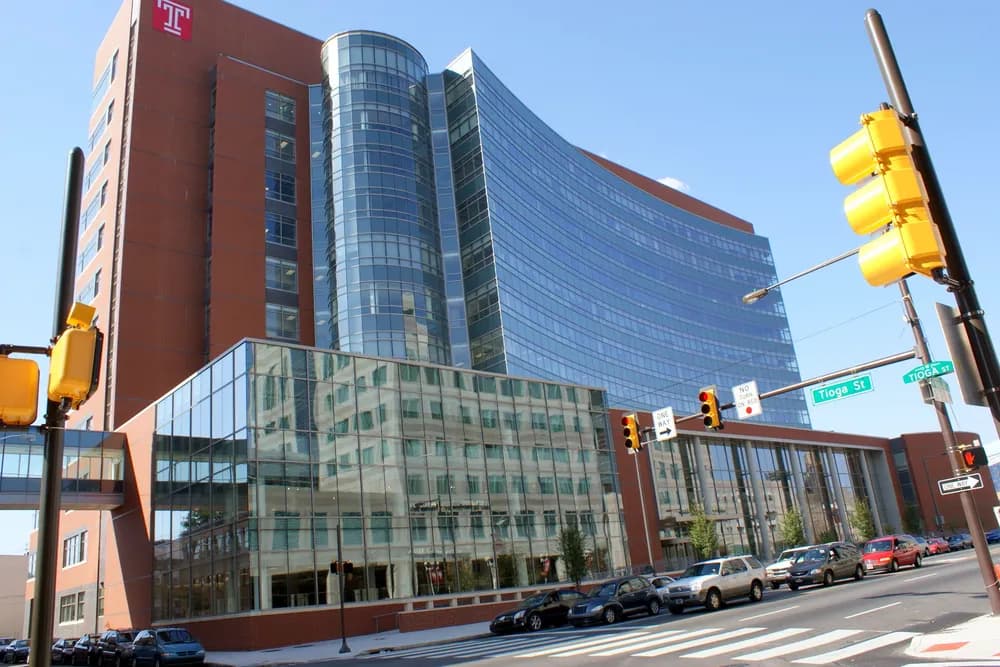
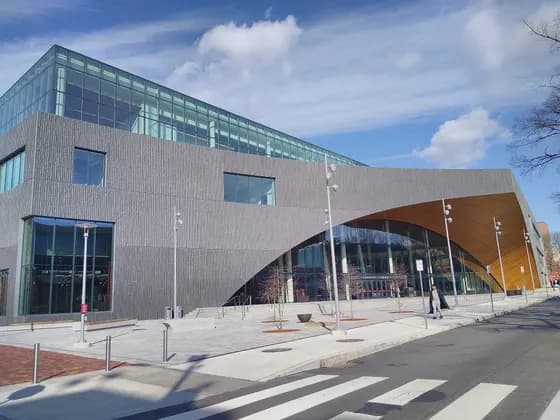

Photo: See below · CC BY-SA 3.0 · cropped
Photo: Jim.henderson · CC BY 4.0 · Photo: Famartin · CC BY-SA 4.0 · Photo: Daderot · Public domain
The Lewis Katz School of Medicine at Temple University MD program at a glance (2027 entry)
The Lewis Katz School of Medicine at Temple University (Temple Katz, also written LKSOM) awards the MD, a four-year, full-time degree. It began in 1901 as an evening medical college for working Philadelphians and took Lewis Katz's name in 2015. The main campus is in North Philadelphia. The university's Bulletin, its yearly catalog of programs and courses, says the school looks in particular for future doctors who will care for underserved patients.
The curriculum runs in three phases over four years. Phase 1 is the pre-clerkship (pre-clinical) stage of classroom, lab and clinical skills teaching, from August of first year to February of second year. Phase 2 is the clerkship year, when you rotate through the core specialties on clinical teams. Phase 3 is your fourth year, with more responsibility and more choice.
Science and clinical skills run side by side. Phase 1 is a single-pass organ systems course, which means it teaches each organ system once. In a course called Doctoring you practice interviews and exams with standardized patients, people trained to portray a patient. Every student also completes a scholarly project with a faculty mentor.
North Philadelphia students are based in the Medical Education and Research Building (MERB), across the street from Temple University Hospital. A smaller group spends all four years at the St. Luke's regional campus in Bethlehem. A third campus, with WellSpan Health in York, is expected to take its first class in August 2027.
The Liaison Committee on Medical Education (LCME) accredits MD programs in the United States. Its directory, updated November 2, 2026, shows the school with full accreditation and its next review survey in 2032-33. For an MD student, that accreditation is what makes you eligible to sit the United States Medical Licensing Examination (USMLE), the national exam series.
| Degree | MD |
|---|---|
| Program length | 4 years, full time, with a 6-year limit |
| Class size | 226 in the Class of 2030: 183 North Philadelphia, 43 St. Luke's |
| Campuses | North Philadelphia; St. Luke's, Bethlehem; WellSpan, York, expected from August 2027 |
| Teaching style | Integrated, single-pass organ systems course, with Doctoring for clinical skills |
| Anatomy | Cadaver dissection in Fundamentals 1, your first full course |
| First patient contact | Standardized patients from year 1; required rotations from April of second year |
| Clerkships start | April of second year, after the Transition to Phase 2 course |
| Step 1 timing | Study period from mid-February to mid-April of second year |
| Research | Faculty Mentored Scholarly Experience required to graduate |
What makes the Lewis Katz School of Medicine at Temple University MD program different
A required research project with a faculty mentor
The Faculty Mentored Scholarly Experience (FMSE) became a full graduation requirement with the Class of 2025. A faculty mentor guides your own project, such as clinical research, a case report, community-based work or medical education.
Preparation courses before each new stage
Four Transition courses open medical school, Phase 2 and Phase 3 and lead into residency, the specialty training after medical school. Four 3.5-day Intersessions come directly before groups of clerkships, with small-group cases and clinical skills work. The Bulletin names them Black, White, Silver and Red.
A safety-net teaching hospital across the street
In North Philadelphia your home building faces Temple University Hospital, the school's main clinical training site. It takes highly specialized referrals and also works as a safety-net hospital: in its 2023-24 community benefit report, 86 percent of patients had government coverage through Medicaid or Medicare. The Bulletin describes care for North Philadelphia neighbors as a tradition faculty pass on to students.
A choice of campus and class size
The Class of 2030 split into 183 students in North Philadelphia and 43 at St. Luke's, and WellSpan plans about 40 per class. You rank the campuses when you apply, and the campus in your acceptance letter is binding.
Seven Doctoring Colleges as your learning community
A learning community is a small group within your class that stays together over time. Katz has seven Doctoring Colleges, each named for a figure from the school's history, such as Agnes Montier, its first African American woman graduate, in 1912. Each gives you a consistent group of faculty and classmates.
Temple Emergency Action Corps and community clinics
Temple Emergency Action Corps (TEAC), a student-run group, trains you in disaster response. Its free, student-run Thrive clinic, open since 2018, gives weekly care at the One Day at a Time shelter in North Philadelphia. At St. Luke's, the Bulletin describes the HEARTS Clinic, which serves uninsured and underinsured patients on Bethlehem's Southside.
How Lewis Katz School of Medicine at Temple University teaches medicine
In Phase 1 you go through each body system once, learning how it is built, how it works, what goes wrong, how to diagnose it and how to manage the patient. The Fundamentals courses lay the base science, and the Systems courses build on it.
The school restructured Phase 1 in 2020-21 and shortened it by about six weeks. It also added more active learning: flipped classroom work, where you study the material first and use class time to apply it, along with simulation, case-based discussion and self-directed learning.
Some topics run through every stage as threads. Social determinants of health (living conditions such as income and housing that shape health), patient safety, quality improvement and bias in medicine start in Doctoring and return across the curriculum. The school says it is also expanding nutrition education, after mapping the nutrition content already in the program.
From Phase 2 you learn mainly on clinical teams. An April 2022 restructure added the Transition courses and Intersessions, so you prepare for each setting before you reach it. In Phase 3 you see undifferentiated patients in the emergency department, meaning people who arrive without a diagnosis. You also treat severe illness in critical care units and take an active part in working up and managing patients.
The ways you will learn
| Fundamentals teaching | WellSpan's curriculum page describes a mix of lectures, small-group discussions, case-based learning, lab and dissection sessions, and correlations that link imaging and lab tests to the science. |
|---|---|
| Doctoring | Small groups practice interviews and physical exams with standardized patients and standardized patient instructors, who give feedback. Large-group interactive sessions cover topics such as bias, structural racism and patient safety. |
| Simulation | Scenarios on patient simulators generally run in small groups, with a faculty instructor who observes and then leads a debrief. |
| Clerkships | Rotations on clinical teams. On Internal Medicine, for example, you join an inpatient team and work with residents, attending physicians (the senior doctors in charge), consultants and other staff. |
How anatomy is taught at Lewis Katz School of Medicine at Temple University
Anatomy comes first. Your opening course, Fundamentals 1: Human Structure, covers clinical anatomy and imaging, embryology, the microscopic structure of basic tissues and core cell physiology. The 2026-27 calendar runs it from August 10 to October 2, about eight weeks.
You learn by cadaveric dissection, which means working on a donated human body. The school's Technical Standards, which students must meet to progress and graduate, with or without reasonable accommodations, include taking part in cadaver dissection. WellSpan's curriculum page lists dissection sessions in the Fundamentals courses, and the 2026-27 Bulletin refers to the cadaver lab in Fundamentals 1.
A December 2024 school report described the Class of 2028 meeting their donors that August, in small groups at assigned tables in the fourth-floor anatomy labs, and learning through systematic dissection and examination. Students were told little about each donor beyond age, occupation and cause of death. That November, students organized Donor Remembrance Day, which honored 57 donors.
The Bulletin also lists Specialized Anatomy Review, a second-year elective on a body region you choose, which includes the chance to be a teaching assistant in the cadaver lab for first-years.
When you first meet patients at Lewis Katz School of Medicine at Temple University
The school describes learning alongside real patients from the start. In the required first-year Doctoring course you work with standardized patients, who learn a case based on a real patient, answer your questions and act out signs such as pain or difficulty walking. The school's standardized patient program dates from 1999.
Patient instructors are lay people trained to teach examination on their own bodies, so they can show you how to listen to the heart and lungs, feel the abdomen and test reflexes.
Point-of-care ultrasound, a handheld scanner used at the bedside, is introduced in Doctoring and built into the curriculum. In 2022 the school gave each first-year in the Class of 2026 a device. The Bulletin also lists an elective for more hands-on training and a clinical elective doing bedside scans in the emergency department.
Several options outside the required courses put you with real patients before clerkships. An Exploration of Narrative Medicine, one early elective, includes visiting patients in the hospital. In April 2026 Temple reported that first- through fourth-year students staff the free Thrive clinic with residents and attending physicians, taking histories and doing physical exams. The Global Medicine Program says a first international clinical experience often comes in the summer after first year.
Required rotations start in April of second year. The Technical Standards warn that clinical work can mean day, evening and night hours on weekdays and weekends. The 2016-17 handbook, which predates the current curriculum, capped assigned clinical duties at 80 hours a week, averaged over four weeks.
The Lewis Katz School of Medicine at Temple University curriculum, year by year
- Phase 1, year 1
Fundamentals, then the first Systems courses
You start with a week of Transition to Medical School, then about eight weeks of anatomy. Three more Fundamentals courses take you to late January, when the Systems courses begin. Doctoring runs from August to June. The dates below come from the 2026-27 calendar.
- Transition to Medical School (first week of August): professionalism, teamwork, study strategies, communication and well-being.
- Fundamentals 1: Human Structure (August to early October): anatomy, imaging, embryology and tissues.
- Fundamentals 2: Cellular Function (October to mid-November): biochemistry, genetics, and molecular and cell biology.
- Fundamentals 3: Host Defenses and Threats (mid-November to December): immunology, microbiology and infectious disease.
- Fundamentals 4: Basis of Disease and Treatment (January): pharmacology, biostatistics and pathology principles for the Systems courses.
- Systems 1: Neuroscience and Psychiatry (late January to late March): the nervous system, psychiatric illness and substance use disorders.
- Systems 2: Cardiovascular Medicine (April to early May) and Systems 3: Nephrology (May to early June).
- Doctoring 1 (August to June): patient interviews, physical exams and communication skills.
- Summer break from early June to early August, when many students start their scholarly project.
- Phase 1, year 2
The remaining Systems courses and Step 1 study
Second year finishes the organ systems by mid-February. Each Systems course covers development, tissue structure, function, disease, diagnosis and treatment. An exam from the National Board of Medical Examiners (NBME), a co-sponsor of the USMLE, closes this teaching, and about eight weeks follow for Step 1 study.
- Systems 4: Pulmonary (August to mid-September).
- Systems 5: Endocrine and Reproductive (mid-September to early November): hormones, the reproductive systems, and bone and cartilage.
- Systems 6: Gastroenterology and Nutrition (November to December): the gut, metabolism and the effects of nutrient deficiencies and excesses.
- Systems 7: Multi-Organ (January to mid-February): blood, the musculoskeletal system and skin, plus cases that draw on earlier courses.
- Doctoring 2 (August to early February): advanced interviewing, examination and communication skills.
- The NBME Comprehensive Basic Science Exam, a broad science test, at the end of Systems 7, then the USMLE Step 1 Study Period.
- Phase 2
The clerkship year
On the 2026-27 calendar, the Class of 2028's Phase 2 runs from April 13, 2026 to about April 23, 2027. The rotation lengths below come from the 2026-27 Bulletin.
- Transition to Phase 2: one in-person week on clinical skills, your role on the care team, the electronic health record and how you will be assessed.
- Four in-person Intersessions: Black (psychiatry and neurology), White (internal medicine and pediatrics), Silver (family medicine and your scholarly project) and Red (surgery and OB/GYN). They return to the curriculum threads most relevant to the clerkships ahead.
- Internal Medicine, 6 weeks: inpatient teams, common medical disorders and clinical reasoning.
- Surgery, 6 weeks: two services of three weeks each, in areas such as trauma, burns, transplant and vascular surgery. You train in sterile technique, catheter insertion and suturing, and a mid-clerkship session adds simulated laparoscopy, chest tube and emergency airway skills.
- Pediatrics, 5 weeks: inpatient and outpatient care, and examining infants, children and adolescents.
- Obstetrics and Gynecology, 5 weeks: obstetric, gynecologic and ambulatory (outpatient) settings. On the calendar, each Pediatrics or OB/GYN block is followed by about a week of vacation.
- Psychiatry, 4 weeks: mood, psychotic, substance use, anxiety and personality disorders.
- Neurology, 4 weeks: neurological histories and exams and localizing a lesion, in inpatient and ambulatory settings.
- Family Medicine, 4 weeks: mostly outpatient care of all ages, with an evidence-based medicine project and a home visit project.
- One required 4-week elective block, plus four weeks of scholarly work in Faculty Mentored Scholarly Experience 2.
- Phase 3
Fourth year: more responsibility, more choice
Phase 3 begins in late April, and the 2026-27 calendar divides it into 12 four-week blocks. You take on more responsibility and explore your interests.
- Transition to Phase 3: a week of advanced clinical skills, followed on the 2026-27 calendar by about a week of vacation.
- Emergency Medicine, 4 weeks, under direct faculty supervision. The department's page, written mainly for visiting students, describes 13 eight-hour shifts and three 2-hour simulation sessions.
- Sub-internship: you do the work of an intern, a first-year resident, with primary responsibility for assigned patients under direct supervision. Choose from medicine, surgery, pediatrics, family medicine, OB/GYN, neurosurgery, orthopedic surgery or urology.
- Critical care: one rotation in cardiac, medical, neurological, neonatal, pediatric, surgical or cardiothoracic intensive care. You follow patients, assist with procedures where you can and see assisted ventilation and palliative and end-of-life care.
- The Bulletin's sub-internship and critical care entries generally list a passing grade in all seven core clerkships as a prerequisite.
- Five 4-week elective blocks, and Faculty Mentored Scholarly Experience 3 if you have not yet met the scholarly requirement.
- Transition to Residency (March 29 to April 2 on the 2026-27 calendar): lectures, small groups and simulation on the skills you need as an intern.
- Graduation in May. A student entering in August 2027 belongs to the Class of 2031.
How you are assessed at Lewis Katz School of Medicine at Temple University
Two USMLE exams fall during medical school. Step 1 tests the science that underpins medicine and has been reported as pass/fail only since January 26, 2022. Step 2 CK (Clinical Knowledge) tests how you apply clinical knowledge and still gives a three-digit score.
The calendar sets aside time for Step 1. On the 2026-27 calendar, second-years sit the NBME Comprehensive Basic Science Exam on February 12, 2027. Their USMLE Step 1 Study Period then runs from February 13 to April 11, and Transition to Phase 2 starts on April 12.
In August 2026 the USMLE program announced a move to designated testing dates from January 2029, with Step exams offered less often each year. Its June 2026 announcement had named 2028. The change reaches students entering in 2027.
On the current schedule, a 2027 entrant would have a Step 1 study period from about mid-February to mid-April 2029, so Step 1 would fall within a few months after the switch. Step 2 CK would fall after the switch too, because clerkships would begin only in about April 2029. These dates are projected from the 2026-27 calendar, so check newer calendars as they appear.
In Phase 1, peer tutors run a review session before the final examination of each course. The Transition courses are pass/fail. The Bulletin lists a minimum grade of Pass (P) in the Fundamentals, Systems and Doctoring courses as the prerequisite for Transition to Phase 2.
Shelf exams are standardized NBME subject tests, usually taken at the end of a clerkship. The school's tutoring page mentions clinical subject exams in Phase 2, and the Bulletin says Emergency Medicine ends with an NBME exam. The university's Transcript Key, last revised in July 2020, predates both the 2020-21 Phase 1 redesign and the April 2022 Phase 2 restructure. It records the grading system for students entering from August 2010, honors-pass-fail in first and second years and honors-high pass-pass-fail in third and fourth years, so ask the school which applies to your class.
- The school's simulation institute uses standardized patients to train and evaluate you in interviewing and examining patients, in MD years 1, 2 and 3.
- WellSpan's page says students at all three campuses are evaluated with the same exams and other metrics.
- You must attest in writing that you meet the Technical Standards, with or without accommodations, before entering Phase 2 and again before Phase 3.
- The Bulletin sets a six-year time limit for the MD and requires full-time study. It also lists approved Independent Study for postponed exams, USMLE study or retakes, and deceleration, which means moving through courses at a slower pace.
Lewis Katz School of Medicine at Temple University clinical rotations: where you will actually train
Your campus is your base for clinical training, and you help choose it. You rank the campus options on the supplemental application, and the school says it makes every effort to honor your preferences. Your acceptance letter then names your campus, and that assignment is binding.
In North Philadelphia, Temple University Hospital, founded in 1892, is the main clinical training site, and doctors in 45 graduate medical education programs train there too. You can also rotate at other hospitals in Temple Health, the university's health system, and at St. Luke's, WellSpan and other affiliates. The Technical Standards say you must be able to travel to sites around the region.
Department pages show how far clerkships reach. Surgery lists Temple University Hospital's Main and Jeanes campuses, St. Luke's Hospital, Fox Chase, Main Line Health, Lancaster General and Grand View. OB/GYN lists Temple University Hospital, Holy Redeemer, Lancaster General, St. Luke's, Capital Health and Main Line Health. Family Medicine places you at one of more than 20 sites in Pennsylvania, New Jersey and Delaware.
St. Luke's has a stated class size of 40, and 43 students entered in 2026. You stay for all four years, and the medical education building is directly across the street from the hospital. The St. Luke's network runs hospitals and outpatient centers across eastern Pennsylvania and western New Jersey. Students can also rotate at Temple Health hospitals and WellSpan in the final phase.
WellSpan's York campus is planned for about 40 students per class for all four years, with the first class expected in August 2027 and due to graduate in May 2031. As of November 2026, WellSpan's page, under its LCME accreditation heading, says an application has been submitted to add the campus as a regional site. A 2027 entrant could be in that first class, so check where this stands before you rank it.
WellSpan says it teaches the same curriculum as the other campuses, and it has been a regional clinical campus for Drexel University College of Medicine for 12 years. A fourth campus, with AtlantiCare in Atlantic City, New Jersey, is planned for August 2029, so it is not an option for 2027 entrants.
Episcopal, two miles from Main, is the system's main site for behavioral health, including a psychiatric crisis response center. Jeanes offers academic-level care in a community hospital setting. Fox Chase is a cancer center. Temple Health moved all labor and delivery from the Main Campus to Temple Women & Families Hospital, at Wyoming and Castor Avenues, on September 3, 2025.
- Temple University Hospital, Main Campus
- Temple University Hospital, Episcopal Campus
- Temple University Hospital, Jeanes Campus
- Fox Chase Cancer Center
A 188-bed children's hospital in North Philadelphia, where students join pediatric care teams.
- St. Christopher's Hospital for Children
North Philadelphia students can also rotate here. The network has a Level I Trauma Center, the top tier of trauma care, and a center for women and babies at Anderson.
- St. Luke's Hospital campus, Bethlehem
- Anderson Campus, Easton
York Hospital has 593 beds, a Level I Trauma Center and more than 92,000 emergency visits a year. WellSpan students can rotate at Temple Health and St. Luke's hospitals in the final phase, and North Philadelphia students can take some third- and fourth-year clerkships here.
- WellSpan York Hospital
- WellSpan Surgery and Rehabilitation Hospital
- Apple Hill Surgery Center
- WellSpan Medical Group outpatient practices
The first five belong to Main Line Health. Grand View is a community hospital listed on the school's Clinical Learning Sites page.
- Lankenau Medical Center
- Bryn Mawr Hospital
- Paoli Hospital
- Riddle Hospital
- Bryn Mawr Rehabilitation Hospital
- Grand View Hospital, Sellersville
A teaching hospital with tertiary, or highly specialized, care, listed for the Surgery and OB/GYN clerkships.
- Lancaster General Hospital
Listed on the school's Clinical Learning Sites page.
- Capital Health Regional Medical Center, Trenton
- Capital Health Hopewell Medical Center, Pennington
Electives, selectives and away rotations at Lewis Katz School of Medicine at Temple University
During Phase 1 you can take electives in the humanities, clinical disciplines or research. They are optional and do not affect graduation requirements. The general first- and second-year elective runs for seven two-hour sessions, and student interest and faculty availability decide what is offered.
The Bulletin's early electives include Humans of North Philly, where you interview and photograph local residents with a photojournalist. Others are Artful Thinking, held in the galleries of the Pennsylvania Academy of Fine Arts, and Wilderness Medicine. The Bulletin keeps older courses on its lists, so a named elective may not run every year.
The 2026-27 Bulletin requires one 4-week elective block in third year, which you can split into two 2-week electives. Its Career Exploration electives give you a look at fields such as cardiology, palliative care, vascular surgery and child psychiatry.
In fourth year the 2026-27 Bulletin requires five 4-week elective blocks, clinical or non-clinical. Clinical choices include Addiction Medicine, Burn Surgery and the Emergency Psychiatry Crisis Response Center. Other choices include Advanced Topics in Health Justice and Literature and Medicine, both non-clinical, and a Doctoring Teaching Elective, where you teach clinical skills to other students.
Schedules in Phases 2 and 3 come from a course selection process the school calls a lottery, and the 2025-26 calendar gave second- and third-years a class meeting for it. Your residency career advisor must approve your elective choices, and Phase 2 and 3 deans or directors review your schedule before it is final.
Away rotations are electives at another institution, often in a specialty you are considering. The Bulletin lists a two-week third-year away elective that you arrange yourself, and fourth-year options such as Advanced Obstetrics and Gynecology - Away. Non-Graded Specialty Experience, at another US medical institution, shows as Credit or No Credit and does not count toward Phase 3 graduation criteria.
- The Global Medicine Program offers disaster and global medicine electives in the first two years, and work abroad with attending physicians in Africa, Asia, Central America and South America.
- The same program says third- and fourth-years can rotate at more than a dozen affiliated medical schools on five continents.
- International Medicine, listed in the Bulletin, is a non-clinical course comparing a foreign health system with the American one. It needs approval and does not count toward Phase 3 graduation criteria.
Dual degrees and research years at Lewis Katz School of Medicine at Temple University
Scholarly work is part of the MD, not an extra. FMSE is a structured project taken from first question to sharing the results. Many students start in the summer after first year, and others begin in Phase 2, when it becomes a formal course.
If you still have work to do in fourth year, FMSE 3 is a non-clinical course in which you are expected to submit an abstract or manuscript. Any remainder must be finished on your own time by Block 10. If you finish in Phase 2, Phase 3 Research gives you four weeks to move the work toward presentation or publication.
At the first FMSE Symposium in April 2025, Class of 2025 students presented on topics such as repeat emergency department visits and gene therapy in a mouse model. The student-founded Future Physician Research Symposium reached its seventh year in 2026.
For a longer research break, the Bulletin lists Independent Study Level 1: Academic Enrichment, which is approved time for research or other scholarly work. The school cites 15 research centers, in areas such as cancer, Alzheimer's and heart disease. WellSpan says it has nearly 300 studies under way and plans summer research for its students.
- MD/PhD: typically 7 to 8 years. You complete Phase 1 and four lab rotations, spend 3 to 4 years on doctoral research, then return for Phases 2 and 3. The school offers full tuition and a stipend to three students each year.
- MD/PhD research falls in five clusters: cancer biology and genetics; infectious disease and immunity; molecular and cellular biosciences; neuroscience; and organ systems and translational medicine.
- MD/MA in Health Justice and Bioethics: a core curriculum and thesis, with some MD courses counting toward the degree. It can run alongside medical school with no additional time and usually starts in fall of first year.
- MD/MBA, with Temple's Fox School of Business: online MBA courses at any time during medical school, with no additional time needed, after a five-day on-campus orientation.
- MD/Certificate in Narrative Medicine: small seminars in the pre-clinical and clinical years and a capstone project, adding 10 credits over four years.
- The university says students in the dual master's programs can enroll at any of the three campuses.
- Two routes link college and the MD. The Medical Scholars Program is an eight-year BA/MD with Washington & Jefferson College, and Temple's Accelerated Health Scholars earn their bachelor's degree after the first year of medical school.
Facilities and support at Lewis Katz School of Medicine at Temple University
Where you will learn
In North Philadelphia, a few miles from downtown, your home base is MERB, opened in 2009. It has 11 stories and 480,000 square feet, with classrooms, open research space and a 12,000-square-foot clinical skills and robotic simulation center.
Simulation runs through the William Maul Measey Institute for Clinical Simulation and Patient Safety, which the American College of Surgeons most recently reaccredited in 2023. Procedural trainers cover skills such as pelvic exams, arterial blood gas collection and ultrasound-guided central line insertion. Virtual reality trainers give haptic feedback, the physical feel of a procedure, and high-fidelity adult and infant simulators recreate clinical scenarios.
The Schneck Gross Anatomy Lab opened in 2009 and is named for Carson D. Schneck, who taught at the school for five decades. In York, the WellSpan building sits about 10 minutes from WellSpan York Hospital and two blocks from the Jersey College School of Nursing.
Support while you study
Every student at North Philadelphia and St. Luke's is assigned an academic coach on entry. Coaches are clinical faculty chosen through a formal application, and they work with you one-on-one and in groups through all phases.
Before Phase 2 you also get a residency career advisor, part of a structured advising system that began in 2023-24. These advisors give academic advice on clinical schedules.
Peer academic facilitators are second- to fourth-year students chosen by application and interview, then trained. They give one-on-one help with course content, study techniques and practice questions, and in Phase 1 they run group sessions, including weekly content reviews.
The Office of Student Support is in MERB, and its staff include a director of personal counseling and wellness. The school lists an associate dean of student support for each of the three campuses.
If you have a disability, the Office of Disability Resources and Services evaluates what accommodations you need. The school encourages you to ask early, because accommodations never apply retroactively.
Is the Lewis Katz School of Medicine at Temple University program right for you?
This program may suit you if
- You want to learn anatomy by dissecting a donated body, starting with your first full course.
- You want to train in North Philadelphia, at a safety-net teaching hospital across the street from your classes.
- You want a research project built into your degree, with a faculty mentor.
- You want to reach clerkships quickly: they start less than two years after you arrive.
- You want to choose between a class of about 40 at a regional campus and a class of about 180 in North Philadelphia.
Things to think about
- Your campus assignment is binding, so rank the options as if you will be based there for all four years.
- A 2027 entrant could join WellSpan's first class, so confirm the campus's status before you rank it.
- Clinical rotations can take you to affiliates around the region, and you must be able to travel to them.
- Phase 2 and 3 schedules go through a course selection lottery, so you may not get every first choice.
- For a 2027 entrant on the current schedule, Step 1 falls within a few months after the USMLE's January 2029 switch, so watch for changes to the school's calendar.
Lewis Katz School of Medicine at Temple University MD program — frequently asked questions
Applying to Lewis Katz School of Medicine at Temple University?
How to get into Lewis Katz School of Medicine at Temple University
Prerequisites, MCAT, AMCAS personal statement, secondaries and interview, step by step.
Open the guide →Lewis Katz School of Medicine at Temple University admissions profile
MCAT and GPA profile, acceptance rate, interview format and key dates.
See the profile →Compare Lewis Katz School of Medicine at Temple University with other schools
Put the teaching style, anatomy teaching and clinical sites next to another school.
Open the comparison →Prepare for the Lewis Katz School of Medicine at Temple University interview
Format breakdown, school-specific sample questions and prep tips from tutors who interviewed here.
Read the guide →Where this Lewis Katz School of Medicine at Temple University program guide came from
This guide was written from 67 official sources — Lewis Katz School of Medicine at Temple University's own program pages and curriculum documents, plus the accreditor and the hospitals and health systems the school trains students in where they publish detail — read on 2026-11-07, then checked claim by claim against those sources.
- Lewis Katz School of Medicine: MD Program
- Temple University Bulletin 2026-2027: Medicine MD
- Temple University Bulletin 2026-2027: home page
- Temple University: Katz MD Program Format
- Lewis Katz School of Medicine: Academic Calendar 2026-2027
- Lewis Katz School of Medicine: Academic Calendar 2025-2026
- Temple University Bulletin 2026-2027: School of Medicine (MEDS) courses
- Temple University Bulletin 2026-2027: Internal Medicine courses
- Temple University Bulletin 2026-2027: Surgery courses
- Temple University Bulletin 2026-2027: Pediatrics courses
- Temple University Bulletin 2026-2027: Obstetrics, Gynecology and Reproduction courses
- Temple University Bulletin 2026-2027: Psychiatry and Behavioral Science courses
- Temple University Bulletin 2026-2027: Neurology courses
- Temple University Bulletin 2026-2027: Family and Community Medicine courses
- Temple University Bulletin 2026-2027: Emergency Medicine courses
- WellSpan Health: Temple Katz at WellSpan curriculum
- WellSpan Health: Temple Katz at WellSpan academics
- WellSpan Health: Temple Katz at WellSpan home page
- WellSpan Health: clinical rotation sites
- WellSpan Health: about the WellSpan campus
- WellSpan Health: research opportunities
- Lewis Katz School of Medicine: Our Campuses
- Lewis Katz School of Medicine: Clinical Learning Sites
- Temple University: Katz MD Clinical Experience
- Lewis Katz School of Medicine: Admissions Interview (campus assignment)
- Lewis Katz School of Medicine: Special Admissions (BA/MD)
- Lewis Katz School of Medicine: How to Apply (Accelerated Health Scholars)
- Lewis Katz School of Medicine: Why Katz?
- Temple University: Why Katz School of Medicine?
- Lewis Katz School of Medicine: Advising and Counseling Resources
- Lewis Katz School of Medicine: Office of Student Support
- Temple University: Katz MD Dual Degrees
- Lewis Katz School of Medicine: MD/PhD Dual Degree
- Lewis Katz School of Medicine: Narrative Medicine Certificate
- Lewis Katz School of Medicine: Health Justice and Bioethics dual degree programs
- Katz news, April 2025: From Curiosity to Impact (Faculty Mentored Scholarly Experience)
- Katz news, September 2026: Future Physician Research Symposium
- Temple University: Katz MD Research and Facilities
- LCME: Accredited Programs directory, updated November 2, 2026
- USMLE: Updated Timeline for Designated Testing Dates, January 2029
- USMLE: Designated Testing Dates Information Hub
- USMLE: Transition to Limited Testing Dates Each Year Starting in 2028 (June 2026)
- USMLE: Examination Results and Scoring
- Katz news, December 2024: Students Honor the Donors
- Temple Now, March 2020: Spotlight on the Schneck Anatomy Lab
- Katz news, December 2019: Gift to the Schneck Anatomy Lab
- Lewis Katz School of Medicine: Surgery Clerkship
- Lewis Katz School of Medicine: Emergency Medicine Clerkship Program
- Lewis Katz School of Medicine: OB/GYN Clerkship Program
- Lewis Katz School of Medicine: Family and Community Medicine educational programs
- Lewis Katz School of Medicine: Clinical Simulation Center
- Lewis Katz School of Medicine: Clinical Simulation programs
- Lewis Katz School of Medicine: Standardized Patients
- Temple Now, February 2025: Temple and WellSpan agreement on a York campus
- Temple Now, April 2026: Temple and AtlantiCare agreement on a new campus
- Katz news, August 2026: White Coat Ceremony for the Class of 2030
- Katz news, August 2022: Full Powers (point-of-care ultrasound)
- Lewis Katz School of Medicine: Katz Nutrition Education Initiative
- Lewis Katz School of Medicine: Family and Community Medicine, About the Department
- Temple University, April 2026: 20 years of the Temple Emergency Action Corps
- Temple University Hospital Community Benefit Report 2023-2024
- Temple Health, July 2025: Labor and delivery moving to Temple Women & Families Hospital
- Temple Health: Temple Women & Families Hospital
- Temple University Registrar: Transcript Key, revised July 17, 2020
- Student and Faculty Handbook for the MD Education Program, 2016-2017 (dated source)
- Lewis Katz School of Medicine: Mission and Vision
- Lewis Katz School of Medicine: Technical Standards
Curricula are restructured between cycles. Anything here that decides your application — how anatomy is taught, a clinical campus assignment, a required research year — should be confirmed against the official page for your entry year.
Applying to Lewis Katz School of Medicine at Temple University?
We help US applicants with MCAT strategy, the AMCAS personal statement, secondary essays and interview prep — everything you need for a competitive Lewis Katz School of Medicine at Temple University application.