
The Brown Alpert Medical School MD program
What you actually study, and where you will be
Brown Alpert Medical School's MD is a 4-year program with an integrated curriculum, with patient contact from Semester 1 and clinical rotations in Providence, Warwick, Newport and community practices across Rhode Island (2027 entry). Integrated Medical Sciences, the basic science course sequence, runs alongside Doctoring, a clinical skills program in which you practice with standardized patients (people trained to play patients) and work with a community physician-mentor. Classes end in December of Year 2, followed by study for USMLE Step 1 (the first national licensing exam) and 44 weeks of clerkships, the required rotations in major specialties. Recent classes drew 40 to 45 percent of their students from Brown's eight-year Program in Liberal Medical Education, which students enter from high school.
- Degree
- MD
- Length
- 4 years
- Teaching
- Integrated
- Clinical contact
- Semester 1

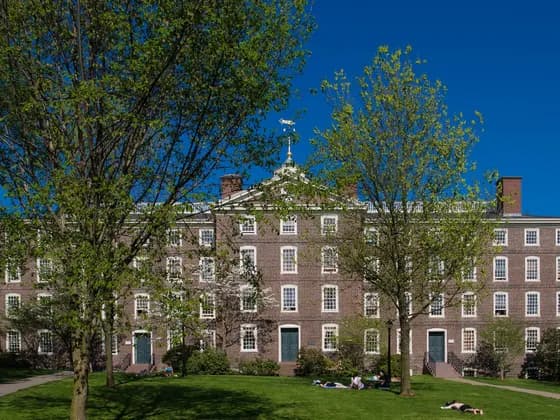


Photo: Kenneth C. Zirkel · CC BY-SA 4.0 · cropped
Photo: Kenneth C. Zirkel · CC BY-SA 3.0 · Photo: Frank Schulenburg · CC BY-SA 4.0 · Photo: Beyond My Ken · CC BY-SA 4.0
The Brown Alpert Medical School MD program at a glance (2027 entry)
The Warren Alpert Medical School of Brown University (Brown Alpert) awards the MD after a four-year program in Providence, Rhode Island. Two strands carry the early years: Integrated Medical Sciences (IMS) and Doctoring. Classroom teaching is based at 222 Richmond Street in the city's Jewelry District, a short walk from Brown's main campus.
You would enter the updated curriculum introduced for classes graduating from 2028. Years 1 and 2 form the pre-clerkship phase, the mainly classroom stage before full-time clinical work. It runs about 17 months, from August of Year 1 to December of Year 2. You then study for Step 1 of the United States Medical Licensing Examination (USMLE) and start Year 3 in mid-February.
Year 3 is the clerkship phase: seven core clerkships at affiliated hospitals and clinics. Year 4 is the post-clerkship phase, mostly electives you choose plus a sub-internship, where you act as a first-year resident. It also holds Step 2 Clinical Knowledge (CK), the next licensing exam, and prepares you for residency, the supervised specialty training after medical school.
Your class will be about 144 students. In MD'30, the class graduating in 2030, about 45 percent came through the Program in Liberal Medical Education (PLME). In MD'29 the share was about 40 percent. The school's MD'30 class profile gives an age range of 21 to 40.
| Degree | MD |
|---|---|
| Program length | 4 years (PLME students, admitted from high school, spend 8 years at Brown) |
| Class size | 144 students matriculated in the MD Class of 2030 |
| Main campus | 222 Richmond Street, Jewelry District, Providence, Rhode Island |
| Curriculum | Integrated Medical Sciences and Doctoring, then clerkships and electives |
| Anatomy | Cadaver dissection in Human Anatomy I and II, Year 1 |
| First patient contact | Semester 1: Doctoring I, with standardized and real patients |
| USMLE timing | Step 1 after pre-clerkship classes; Step 2 CK before November 1 of Year 4 |
| Grading, Years 1 and 2 | Satisfactory, Existing Deficiency (a fixable shortfall) or No Credit |
| Grading, Years 3 and 4 | Most clinical courses add Honors, for performance above the expected level |
| Clinical sites | Brown University Health, Care New England, Providence VA Medical Center, community practices |
What makes the Brown Alpert Medical School MD program different
A community physician mentor from your first semester
Doctoring places you with a physician-mentor at a community practice for 6 to 9 half-days per semester across its three courses. At the practice you watch how your mentor talks with patients and use the skills you learn in your small group. Your mentor evaluates you as part of the course.
An eight-year route that shapes each class
PLME, which students enter from high school, joins a Brown bachelor's degree, an A.B. or Sc.B., to the MD in one eight-year program. It is not accelerated: it leaves room for a broad liberal arts education. PLME students study alongside graduates of other colleges, and MD'30 drew on 57 colleges and universities.
A master's degree built into the four years
The Primary Care-Population Medicine program, with 16 openings, awards the MD and a Master of Science in Population Medicine. It is meant for students seriously considering primary care, and it has its own form of Year 3.
Scholarly Concentrations from aging to planetary health
This elective program gives you a faculty mentor and a long-term project in a field you choose, such as Health Informatics and AI or Medical Humanities and Ethics. There is no penalty for not joining.
Free clinics and patient navigation
Medical students from all four years work alongside nursing and pharmacy students at the Rhode Island Free Clinic. In the Student Navigator Program, first- and second-year students partner with a patient over time and help coordinate their care, learning from the patient as expert.
Ultrasound from the first semester
You start with an introductory module on the machine, then hands-on sessions tied to your courses through the pre-clerkship phase, from choosing a probe to explaining common abnormal findings. For classes graduating from 2028, the school is developing clerkship-year sessions and plans an assessment at the end of that year.
How Brown Alpert Medical School teaches medicine
IMS teaches the science through lectures and small groups. After a first semester of foundations it follows the body system by system, covering normal physiology and then the pathology and pharmacology of common diseases. Health Systems Science (HSS), part of IMS, adds the social and system factors that shape health care.
Doctoring teaches clinical skills and professional development in three courses over 15 months, with small groups led by medical faculty and by social and behavioral science faculty. It lines up with IMS where it can. While you study the nervous system in Brain Sciences, for example, you dissect the head in Human Anatomy II and learn the neurologic exam in Doctoring II.
The Integrated Clinical Curriculum (ICC), which began with curriculum changes in 2024, ties basic science, clinical science and HSS together through case scenarios. After pre-reading and practice questions, you work through team-based questions in small groups, then a faculty member guides a clinical case.
The ways you will learn
| Lectures and online modules | Lectures carry much of the IMS content, backed by self-paced online modules. In IMS, lecture attendance is strongly encouraged but not mandatory, except at required lectures such as guest lectures. |
|---|---|
| Small groups and team-based learning | Small groups have no more than 10 students and work through clinical cases or skills with faculty. In team-based learning, you prepare beforehand and solve problems with your team. Attendance is mandatory, as it is for all parts of Doctoring. |
| Standardized patients and OSCEs | You practice interviewing and examining standardized patients in a simulated exam room. Your skills are then tested in Objective Structured Clinical Examinations (OSCEs), practical exams in which you complete clinical tasks while being assessed. |
| Interprofessional workshops | First- and second-year students attend two workshops with nursing, pharmacy, physical therapy and social work students from the University of Rhode Island, Rhode Island College and Salve Regina University. Topics include access to care and the social determinants of health. |
| Learning on clerkships | You learn by caring for patients under residents and attending physicians, the senior doctors responsible for care, alongside teaching sessions run by each clerkship. |
A typical week on the Brown Alpert Medical School program
Your pre-clerkship week is shaped by a workload policy, last reviewed in December 2021 and still cited in the 2026-27 handbook. Apart from orientation week, required activities are limited to 20 hours a week, between 9am and 5pm on weekdays, with rare exceptions. Nothing is scheduled on weekends.
The same policy protects at least 20 unscheduled hours a week on average, and never fewer than 15, for independent study. In Year 2, the school's research pages describe Wednesdays as self-directed learning time, which you can use for a scholarly project. You also get one personal day per semester in IMS courses and two per semester in Years 3 and 4.
On clerkships you work full-time at your site and take on-call duty on scheduled nights and weekends. The school follows the work-hour rules of the Accreditation Council for Graduate Medical Education (ACGME). That means no more than 80 hours a week and one day off a week, both averaged over four weeks. A shift can run to 24 hours, plus up to four more for education or patient safety.
How anatomy is taught at Brown Alpert Medical School
Anatomy at Brown Alpert is taught by cadaveric dissection, meaning you cut and study donated human bodies yourself. There are two required Year 1 courses, Human Anatomy I in Semester 1 and Human Anatomy II in Semester 2, and lab attendance is mandatory. A 2022 Brown story describes an annual Ceremony of Gratitude, where students honor donors to Brown's Anatomical Gift Program and meet their families.
Human Anatomy I opens with lectures and online modules on how the body is organized, the nervous system and early embryology. Blocks on the thorax (chest), abdomen and pelvis follow. Each pairs lectures on structure, function and development with lab dissection, an imaging module linking the lab to X-ray and CT, and self-study of bones.
Human Anatomy II runs alongside other courses. During Brain Sciences you dissect the face, brain, eye socket, oral and nasal cavities, pharynx and larynx, with MRI and CT images of the head. During Supporting Structures you dissect the arms and legs in groups, with a focus on common clinical problems.
You sit four written and three lab practical exams in Human Anatomy I, and two of each in Human Anatomy II. You need at least 70 percent across the combined exams to pass. Two electives go further: Advanced Anatomy offers four three-hour dissection labs, and Advanced Surgical Anatomy, for second-year students, pairs dissection with teaching from surgeons.
When you first meet patients at Brown Alpert Medical School
You first meet patients through Doctoring I in Semester 1, which includes clinical skills practice with standardized and real patients. You also use those skills in real practice, alongside a community physician-mentor. You keep a Clinical Experience Log and write reflective field notes and patient case write-ups. Community-based service learning, on the social factors that shape health, is also part of Doctoring.
Optional programs add more contact: the Rhode Island Free Clinic takes 20 to 25 medical students a year and the Student Navigator Program about 40. Students also volunteer at Clinica Esperanza, a free clinic in Providence. In the MOMS elective, you are paired with an expectant mother, go to her prenatal visits and may attend the birth. Student groups include the Brown Human Rights Asylum Clinic, and the student-run Brown Vision Initiative gives free eye exams at the Free Clinic under a physician's supervision.
In the clinical years your hands-on role grows. You learn procedures such as drawing blood and placing IVs under close supervision. You may also enter patient orders as a learning exercise, which a supervising physician must review and countersign.
The Brown Alpert Medical School curriculum, year by year
- Year 1, Semester 1
Science foundations and first patients
Year 1 starts in August with six courses running together, including Human Anatomy I. They build the science for the later organ-system courses and introduce the clinical skills you will use with patients.
- Scientific Foundations of Medicine: five blocks on cell physiology, biochemistry, nutrition science, immunology, genetics, and introductory pharmacology and toxicology.
- Histopathologic Foundations of Disease: how healthy tissues and organs look under the microscope, and how classic diseases change them.
- Health Systems Science: causes of health disparities, health policy, epidemiology and biostatistics, research ethics, patient safety and quality improvement.
- Microbiology/Infectious Diseases: the parasites, viruses, fungi and bacteria that cause human disease, with wet labs and patient presentations.
- Doctoring I: the full medical interview, including a social and sexual history, vital signs, a brief heart and lung assessment, note writing and oral presentation.
- Year 1, Semester 2
Brain, body structure, hormones and blood
From January to May the focus turns to the nervous system, musculoskeletal system, hormones and blood, with Human Anatomy II alongside. By policy, the summer that follows is free for your own interests, research or independent study.
- Brain Sciences, across three blocks of Semester 2: neurobiology, neuropathology, psychiatry and neuropharmacology, with a simulation experience.
- Supporting Structures: orthopedics, rheumatology and dermatology, including a session on examining the skin.
- Endocrine Sciences, with a diabetes technology workshop.
- Hematology, including blood cancers and transfusion medicine.
- Doctoring II: neurologic, musculoskeletal and head, eyes, ears, nose and throat exams, counseling on topics such as nutrition, smoking and alcohol, and early clinical reasoning.
- Year 2
Organ systems, then Step 1 study
Classes run from August to December in Semester 3, the last classroom term, which moves through five organ systems. Dedicated Step 1 study follows, and in 2026 it ran for about six weeks.
- Cardiovascular: valve disease, heart failure, ischemic injury, arrhythmias and congenital conditions.
- Pulmonary: obstructive and restrictive lung disease, respiratory failure, lung infections and cancers, pulmonary hypertension and pulmonary embolism.
- Renal: glomerular and tubular injury, electrolyte abnormalities, and acute and chronic kidney disease, with team-based learning sessions.
- Gastroenterology: esophageal, ulcer, inflammatory bowel, biliary and liver disease and digestive cancers, with a patient panel and a dietary cooking class.
- Human Reproduction: sexually transmitted infections, reproductive cancers, problems with pregnancy and infertility, as preparation for the obstetrics and gynecology clerkship.
- Doctoring III: screening for intimate partner violence, delivering serious news and end-of-life conversations, plus genitourinary, gynecological and abdominal exams, focused exams and prescription writing.
- Year 3, throughout
Clinical Skills Clerkship
Year 3 starts in mid-February, about 18 months after you enroll. The Clinical Skills Clerkship runs through the whole phase in three parts, starting before your first rotation and ending after your last.
- Introduction: two weeks on each clerkship's skills, professionalism, wellness and procedures such as suturing and Advanced Cardiac Life Support.
- Longitudinal sessions about every six weeks, alongside your rotations.
- End-of-Clerkship-Phase OSCE: a required exam after the rotations, which also completes your Clinical Skills Clerkship grade.
- Year 3, rotations
Seven core clerkships
You work through 44 weeks of clerkships and 4 weeks of electives. In the 2026-27 calendar, the year runs to late March, with vacation in late May, late August and over the winter holidays. Each clerkship sets a log of minimum experiences, real or simulated. Rotation details come from the school's 2024-25 clerkship page, and their lengths match the 2026-27 handbook.
- Internal Medicine, 12 weeks: admitting and following acutely ill inpatients on the medicine teaching service, plus outpatient work with general and specialty internists. Its log asks for five chest X-ray and five EKG interpretations and a My Life My Story narrative project.
- Surgery, 6 weeks: mostly inpatient, with daily rounds, time in the operating room and outpatient work with a surgical attending.
- Obstetrics and Gynecology, 6 weeks: two weeks on labor and delivery, two in gynecologic surgery, one on night float, the overnight shift, and one in specialty clinics.
- Pediatrics, 6 weeks: caring for children on the inpatient teaching service and giving acute, chronic and preventive care in outpatient settings.
- Clinical Neuroscience, 8 weeks: four weeks of psychiatry at one site and four of neurology, split between two services. The handbook counts these as two of the seven core clerkships.
- Family Medicine, 6 weeks: ambulatory clinics, with patients from newborns to older adults and conditions such as diabetes, hypertension and depression.
- Year 4
Electives, sub-internship and residency preparation
Year 4 is largely built from rotations you choose with your mentors and advisors. You need at least 40 weeks of clinical electives, including the required pieces below, and you graduate in May once all requirements are met. This is also the year you apply for residency.
- A four-week sub-internship, in which you see patients first, propose an assessment and plan, present to the resident team and attending, and follow patients through their hospital stay.
- Six weeks of surgical, anatomic and acute care electives. A four-week surgery sub-internship can count toward these as well as the sub-internship requirement.
- Step 2 CK, with dedicated study time allocated in your schedule.
- Internship Prep Course, worth one week of credit, with online and in-person parts between December and March.
- Optional Advanced Clinical Mentorship: up to 12 weekly half-day sessions at a single outpatient site, for one week of credit.
- Residency interviews: during the busy interview months, the school expects interviewing students to take independent study instead of clinical rotations.
How you are assessed at Brown Alpert Medical School
Every pre-clerkship course is graded Satisfactory (S), Existing Deficiency (ED), No Credit (NC) or Incomplete (INC), so Years 1 and 2 have no Honors tier. ED is a temporary grade: you fell short in part of a course and can fix it with limited extra work. NC means a larger shortfall or a failed remediation. INC covers work you could not finish for reasons beyond your control.
IMS grades rest mainly on exam scores, with a pass mark of 70 percent. HSS and anatomy must each reach that mark on their exams, even if other parts of the course went well, and you get one remediation exam. Doctoring grades rest on small-group performance, OSCEs, case write-ups, field notes, community mentor sessions and service learning.
Most clinical courses in Years 3 and 4 add Honors. Several electives and all courses under four weeks stay Satisfactory or No Credit. A shelf exam is a subject test from the National Board of Medical Examiners (NBME). A clerkship grade generally combines sub-competency ratings with scores from that exam, an OSCE or similar skills test, and other graded work such as a case presentation.
Sub-competencies are specific, observable skills under six broad competencies, such as patient care and professionalism. For classes graduating from 2028, faculty rate them on a scale tied to expected behaviors and add written comments. You pass a shelf exam at or above the fifth-percentile score from national norms. On the 2024-25 clerkship page, clinical evaluations made up 50 to 75 percent of a clerkship grade and shelf exams 5 to 25 percent.
Step 1 tests the sciences basic to medical practice and has been reported as pass/fail only since January 2022. Step 2 CK tests how you apply clinical science to supervised patient care. You are expected to take Step 1 in the dedicated study period after classes end and before the Clinical Skills Clerkship; in 2026 that period ran from January 5 to February 13. Step 2 CK must be taken before November 1 of Year 4.
In August 2026 the USMLE program announced a move to designated testing dates from January 2029, with Step exams offered less often each year. A June 2026 announcement had named 2028, so the date has already moved once. On the current schedule, if you enter in 2027 you would finish Year 2 classes about December 2028, study from January 2029 and sit Step 1 by about mid-February, shortly after the switch. Your Step 2 CK deadline would fall about November 2030, after the switch.
- The USMLE program's FAQ lists 17 Step 1 and 14 Step 2 CK administrations for 2029, and says dates will be published more than a year ahead of each calendar year.
- Delaying Step 1 needs approval, on academic, medical or family grounds or on your Step advising team's advice. A delayed exam must be passed by June 1 of Year 4.
- To graduate you must pass Step 1, Step 2 CK and the End-of-Clerkship-Phase OSCE, and you may take each Step exam no more than three times.
- You must pass every part of a clerkship to pass it, and an ED or NC in any clinical rotation rules out Honors there.
- One ED or NC is noted for information only. A second brings consideration for Academic Warning, a third for Academic Probation and any more for dismissal.
- By policy, every required clerkship, and every pre-clerkship course of four weeks or more, gives you formal feedback by its midpoint. On clerkships, you meet the clerkship director, or a faculty member they assign, to review strengths and areas to improve.
- You must complete the MD within six years of enrolling, counting any approved leave or research time.
- The Liaison Committee on Medical Education (LCME) accredits MD programs in the United States. Its directory lists Brown Alpert with full accreditation and a next survey in 2028-29. For MD students, LCME accreditation is what makes you eligible to sit the USMLE.
Brown Alpert Medical School clinical rotations: where you will actually train
The school's Affiliated Hospitals page lists the Greater Providence and Warwick sites below and says they are all within a 15-minute drive of campus. Newport Hospital is not on that page, but the school lists it for clerkships, sub-internships and electives.
Most sites belong to two health systems. Brown University Health includes Rhode Island Hospital, Hasbro, The Miriam, Bradley and Newport. Care New England includes Butler, Women & Infants and Kent. Rhode Island Hospital is the principal teaching affiliate, and the school describes it as the state's largest hospital and the Level 1 Trauma Center for southeastern New England.
Your sites come from a secure online lottery based on your preferences, covering both clerkships and Year 4. Once schedules are set, you can ask for a change only for serious reasons, such as a conflict with an evaluator or a major life event.
Getting around takes some planning. The handbook warns that clinical rotations, including Doctoring visits, may be at sites that need a car. During business hours, the Brown shuttle stops at campus locations and the main entrance of Rhode Island Hospital.
The clerkship list below comes from the school's page for 2024-25, so check sites for your year. Family Medicine's home base is the Family Care Center in Pawtucket.
- Medicine and surgery: Rhode Island Hospital, The Miriam Hospital, Providence VA Medical Center, Kent Hospital and Newport Hospital.
- Pediatrics: Hasbro Children's Hospital and Women & Infants Hospital, plus Milford Hospital and St. Luke's Hospital.
- Obstetrics and gynecology: Women & Infants Hospital and Kent Hospital.
- Psychiatry and neurology: Butler, Providence VA Medical Center, Rhode Island Hospital, Bradley Hospital and The Miriam Hospital.
- Family medicine: the table names Kent Hospital.
The main cluster of sites, including HopeHealth, the school's main teaching partner for hospice and palliative medicine.
- Rhode Island Hospital
- Hasbro Children's Hospital
- The Miriam Hospital
- Women & Infants Hospital of Rhode Island
- Butler Behavioral Health
- Bradley Hospital
- Providence VA Medical Center
- HopeHealth
Care New England hospital, listed for several core clerkships.
- Kent Hospital
Brown University Health hospital, listed for medicine and surgery.
- Newport Hospital
- Family Care Center
The Department of Family Medicine reports more than 150 community faculty across these areas.
- Rhode Island
- Southeastern Massachusetts
- Eastern Connecticut
Electives, selectives and away rotations at Brown Alpert Medical School
Electives start early. Pre-clerkship electives are optional, and many are designed and led by students with a faculty advisor. The Fall 2026 catalog includes Essentials of Procedural Skills, Food and Health with Johnson & Wales University, Wilderness Medicine, and introductions to medical Arabic, medical Portuguese and American Sign Language.
Across Years 3 and 4 you need at least 84 weeks of clinical instruction, with at least 72 at Brown. The school's 2024-25 clerkship page still shows 80; the 2026-27 handbook sets 84 for classes graduating from 2028. At least 28 of your 40 Year 4 elective weeks must be at Brown-affiliated sites.
The clinical elective list runs by department. Titles include Healthcare for the Homeless Communities, Rural Family and Emergency Medicine, Child Abuse Pediatrics, Forensic/Correctional Psychiatry and Wilderness & Environmental Medicine. Emergency medicine is an elective here, not a core clerkship. It runs mainly at Rhode Island Hospital and The Miriam Hospital, with optional shifts at Hasbro Children's Hospital.
Sub-internships range from internal medicine to general surgery, plastic surgery and neurosurgery, and you can take more than one as space allows. You can also do independent study, a research project or supervised clinical work at Brown under a faculty sponsor, for up to 12 weeks across Years 3 and 4. Proposals are due at least five weeks before the start date.
Away rotations are electives at another institution, often taken as part of the residency selection process. You can take up to three four-week away rotations, or 12 weeks, before needing special permission. Most schools take applications through a service from the Association of American Medical Colleges (AAMC). An away sub-internship counts only if it meets Brown's guidelines.
Year 4 students can also apply for the international exchange, a rotation of about three to four weeks between January and April at a partner medical school. Current sites are in Austria, Brazil, China, Colombia, the Dominican Republic, Germany, Ghana, Israel, Italy, Japan, Kenya, Pakistan, South Korea and Taiwan. You rank three sites and write a short essay, and a Brown faculty liaison completes your evaluation.
Dual degrees and research years at Brown Alpert Medical School
The Primary Care-Population Medicine (PC-PM) program combines the MD with a Master of Science in Population Medicine (ScM). It adds a nine-course sequence and a thesis, covering research methods, quantitative methods, leadership and health systems. Most students should finish in four years, with the option of an extra year. You begin your thesis research in the summer after Year 1.
PC-PM students spend Year 3 in a longitudinal integrated clerkship (LIC), which weaves the core specialties together instead of teaching them in blocks. Its 44 weeks combine 30 weeks of outpatient half-days with mentors and 14 inpatient weeks. You follow a panel of about three to five patients at each mentor site into settings such as the operating room and delivery room.
The Warren Alpert Physician-Scientist MD/PhD and Advanced Training Program pairs the MD with a PhD in any graduate program in Brown's Division of Biology and Medicine. You apply through the American Medical College Application Service (AMCAS), and current Brown medical students and PLME students can also apply. The admissions FAQ says the school does not yet take part in the National Institutes of Health Medical Scientist Training Program (MSTP).
You complete the pre-clerkship phase and must pass Step 1 before starting PhD work, and later PhD years include a half-day of clinic every two weeks. You return for clerkships after defending your thesis, starting with the Clinical Skills Clerkship in February. You are expected to finish both degrees within eight years.
The school also lists a Master of Public Health option. Brown's one-year Accelerated MPH for Clinicians accepts medical students who have completed at least two years of medical school.
To join Scholarly Concentrations, you choose an area and a mentor in Year 1 and apply by February. An 8-to-10-week summer project follows, then work during Year 2 self-directed time and Years 3 and 4 electives. You present your project in February or March of Year 4, and completion is noted in your Medical Student Performance Evaluation (MSPE), the summary sent to residency programs.
- The school's concentration areas include Aging; Caring for Underserved Communities; Global Health; Health Informatics and AI; Medical Humanities and Ethics; Medical Technology, Innovation and Entrepreneurship; and Planetary Health.
- The admissions office says nearly 90 percent of students take part in clinical or basic science research. All summer award holders present at the Academic Symposium each November.
- Summer Research Assistantships support summer projects, from basic science to advocacy and medical humanities.
- The Basic and Translational Research Program, funded by the National Heart, Lung and Blood Institute, offers a nine-week summer project after Year 1 on heart, blood and lung disease.
- The Academic Scholar Program excuses you from classes for one semester to two years of approved research under Brown faculty. You cannot be enrolled in another degree program at the same time.
Facilities and support at Brown Alpert Medical School
Where you will learn
The medical school building at 222 Richmond Street has four floors. Built in 1928 as a jewelry factory, it later became offices and opened as the school's home in 2011. It holds lecture halls, case study rooms, the Herbert M. Kaplan Atrium and, on the third floor, the anatomy lab.
The Clinical Skills Simulation Center and the Standardized Patient Program support your Doctoring work, and clinical skills training and exams take place in the Clinical Skills Suites. Medical librarians offer one-on-one research consultations, from finding a topic to managing citations.
Support while you study
Before you start, you are matched with a Mary B. Arnold mentor, a faculty member who gives academic, personal and career advice across all four years. You first meet at orientation, then have one-on-one and group sessions through Year 1.
Older students help too. Al's Pals pairs incoming students with Year 2 mentors, and Study Smart is an optional series of study sessions organized by second-year students. Doctoring Peer Mentors, two to four per small group, give feedback on clinical skills and take part in mock OSCEs. Peer tutoring is free and runs year-round in all phases.
The Office of Academic Support advises on study strategies, time management and test taking, and manages disability accommodations. In first-semester IMS courses, the assistant dean for the pre-clerkship curriculum contacts you early if you score below 70 percent on any exam component. Doctoring coaches give one-on-one help to students at high risk of not meeting course requirements.
On clerkships, if you struggle on a shelf exam, you are connected with the Office of Academic Support or peer tutoring. For the USMLE, the school offers content review sessions, tutoring, student panels and planning meetings.
For well-being, group check-ins run through your Mary B. Arnold advising cohort in Year 1, with more possible at points such as Step 1 study. Counseling and Psychological Services has a therapist dedicated to medical students, and a Student Support Committee plans support for students who are struggling.
The Office of Career Development supports residency applications through CV and personal statement help, mock interviews and class meetings in Years 3 and 4. Its Careers in Medicine series offers about 10 to 15 specialty panels each semester for first- and second-year students.
Is the Brown Alpert Medical School program right for you?
This program may suit you if
- You want patient contact from your first semester.
- You want classroom courses without an Honors tier, and accept that Honors returns in clinical rotations.
- You want to learn anatomy by dissecting, with two full courses of lab work in Year 1.
- You are seriously considering primary care and want population medicine training through the MD-ScM.
- You want a mentored project outside the standard curriculum, in a field such as medical humanities, planetary health or medical technology.
Things to think about
- The pace picks up fast: in 2026, Step 1 study lasted about six weeks. On the current schedule you would sit Step 1 shortly after the USMLE switch in January 2029 and take Step 2 CK before November 1, 2030. Check your class calendar.
- Many of your classmates will have come through PLME and already know Brown well.
- Some clinical sites need a car, and the handbook tells students to plan for that.
- Sites come from a preference-based lottery, and later changes are limited to serious reasons.
Brown Alpert Medical School MD program — frequently asked questions
Applying to Brown Alpert Medical School?
How to get into Brown Alpert Medical School
Prerequisites, MCAT, AMCAS personal statement, secondaries and interview, step by step.
Open the guide →Brown Alpert Medical School admissions profile
MCAT and GPA profile, acceptance rate, interview format and key dates.
See the profile →Compare Brown Alpert Medical School with other schools
Put the teaching style, anatomy teaching and clinical sites next to another school.
Open the comparison →Prepare for the Brown Alpert Medical School interview
Format breakdown, school-specific sample questions and prep tips from tutors who interviewed here.
Read the guide →Where this Brown Alpert Medical School program guide came from
This guide was written from 72 official sources — The Warren Alpert Medical School of Brown University's own program pages and curriculum documents, plus the accreditor and the hospitals and health systems the school trains students in where they publish detail — read on 2026-11-07, then checked claim by claim against those sources.
- Brown Alpert: MD Curriculum
- Brown Alpert: Pre-Clerkship curriculum
- Medical Student Handbook, Academic Year 2026-2027 (published July 31, 2026)
- Exam Policy, effective February 17, 2026
- Medical School Graduation Policy, effective March 6, 2026
- Policy on Requesting Clinical Schedule or Site Changes, effective May 18, 2026
- Personal Day Policy, effective May 13, 2025
- Narrative Assessment Policy, effective February 19, 2026
- Policy on Medical Student Performance Evaluations, effective April 22, 2026
- Formative Feedback Policy, effective March 23, 2026
- Policy 08-00: pre-clerkship workload, student duty hours and on-call
- The Warren Alpert Medical School 2026-2027 Calendar
- The Warren Alpert Medical School 2025-2026 Academic Calendar
- Brown Alpert: Academic Calendar
- Brown Alpert: Integrated Medical Sciences
- Brown Alpert: Doctoring
- Brown Alpert: Doctoring I, II and III
- Brown Alpert: Clinical Skills Clerkship
- Brown Alpert: Pre-Clerkship Electives, Fall 2026 catalog
- Brown Alpert: Clerkship / Post-Clerkship (labelled for academic year 2024-2025)
- Brown Alpert: Sub-Internships
- Brown Alpert: Clerkship and Post-Clerkship Electives
- Brown Alpert: Independent Study
- Records and Registration: Independent Study Requests
- Records and Registration: Applying for Away Rotations
- Brown Alpert: Curriculum Initiatives
- Brown Alpert: Assessment and Evaluation
- Brown Alpert: Scholarly Concentrations Program
- Scholarly Concentrations: Application Process
- Brown Alpert: Student Research
- Brown Alpert: Summer Assistantships
- Brown Alpert: Basic and Translational Research Program
- Primary Care-Population Medicine: Longitudinal Integrated Clerkship
- Primary Care-Population Medicine: ScM Curriculum
- Primary Care-Population Medicine: Frequently Asked Questions
- MD/PhD Program Timeline
- MD/PhD Program Handbook (09/22/2026)
- MD/PhD Program: Frequently Asked Questions
- Brown School of Public Health: Accelerated MPH for Clinicians
- Brown Alpert Admissions: Degree Programs
- Brown Alpert: Degree Programs
- Brown Alpert Admissions: Curriculum
- Brown Alpert Admissions: Frequently Asked Questions
- Brown Alpert Admissions: Class Profile, MD Class of 2030
- Brown Alpert Admissions: Routes of Admission
- Brown University Bulletin 2026-27: The Warren Alpert Medical School
- Brown Alpert: Affiliated Hospitals
- Brown University Health
- Care New England Health System
- Department of Family Medicine: Medical Student Education
- Department of Emergency Medicine: Medical Students
- Brown Alpert: Community Engagement
- Student Affairs: Student Groups
- Student Affairs: Longitudinal Mentoring
- Student Affairs: Academic Support
- Brown Alpert: Career Development
- Center for Global Health Equity: International Medical Exchanges
- Brown Alpert Medical Education: People
- Brown Alpert: Medical Family Weekend, October 2026
- Brown Alpert: Maps and Directions
- News from Brown: Medical Education Building Facts and Figures, August 2011
- Brown University: 50 Years of Medicine, September 2022
- Brown University: Students honor anatomy donors and their families, June 2022
- Brown Alpert: History
- Brown Alpert: Accreditation
- Brown Alpert: Medical School Reaccreditation
- LCME: Accredited Programs directory
- USMLE: Designated Testing Dates Information Hub (August 6, 2026 announcement date)
- USMLE: Updated Timeline for Designated Testing Dates, Transition Will Take Place in January 2029
- USMLE: Transition to Limited Testing Dates Each Year Starting in 2028 (June 23, 2026, later updated)
- USMLE: Designated Testing Dates FAQs
- USMLE: Examination Results and Scoring
Curricula are restructured between cycles. Anything here that decides your application — how anatomy is taught, a clinical campus assignment, a required research year — should be confirmed against the official page for your entry year.
Applying to Brown Alpert Medical School?
We help US applicants with MCAT strategy, the AMCAS personal statement, secondary essays and interview prep — everything you need for a competitive Brown Alpert Medical School application.