
The MUSC College of Medicine MD program
What you actually study, and where you will be
MUSC College of Medicine's MD is a 4-year program taught through team-based learning in an integrated curriculum, with patient contact from Year 1 and clinical rotations in Charleston, Anderson and rural practices across South Carolina (2027 entry). MUSC's MD teaches science in Charleston through the fall of Year 2, in organ-system blocks that cover normal function and disease together, alongside dissection, team-based learning and early clinical experiences. After Step 1 of the national licensing exam, you spend about eight weeks on a scholarly concentration, a mentored project. Then you move into seven clerkships, the core clinical rotations, including a rural family medicine clerkship. A limited number of students do Years 3 and 4 on a primary care track in Anderson.
- Degree
- MD
- Length
- 4 years
- Teaching
- Integrated + Team-based learning
- Clinical contact
- Year 1

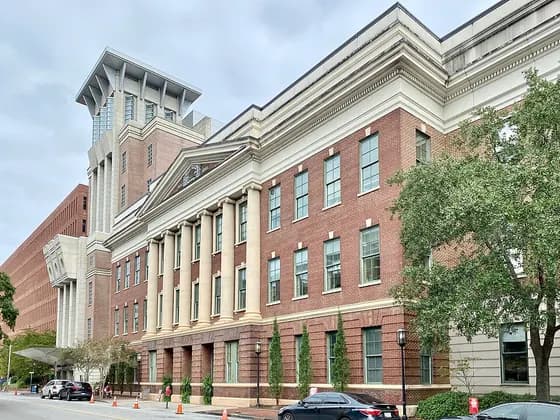
Photo: ProfReader · CC BY-SA 3.0 · cropped
Photo: w_lemay · CC BY-SA 2.0 · Photo: Bohao Zhao · CC BY 3.0 · Photo: NealVickers · CC BY-SA 4.0
The MUSC College of Medicine MD program at a glance (2027 entry)
The Medical University of South Carolina (MUSC) College of Medicine runs a four-year MD based in Charleston. The Bulletin, the university's academic catalog, dates the college to 1824 and calls it the first medical school in the southern US. The class that started in fall 2026 has 186 students. The program is accredited by the Liaison Committee on Medical Education (LCME), which accredits MD programs in the United States, and its next survey is listed for 2028-29.
The first phase is the preclerkship curriculum, the stage before full-time clinical rotations. It runs in organ-system blocks, with dissection, team-based learning, clinical skills and early clinical experiences alongside.
The current preclerkship curriculum is called Foundations. That name heads the school's preclerkship page and the calendar for the Class of 2030, who started in August 2026, and the policy index lists a separate grading policy for that class. The 2026-27 Bulletin also reorders Years 1 and 2 from the 2025-26 edition, joining the heart, lungs and kidneys in one spring course. Some pages still use the older name, FLEX. This guide follows the 2026-27 plan.
After Step 1 of the United States Medical Licensing Examination (USMLE), which tests how you apply foundational medical knowledge, you spend about eight weeks on a mentored scholarly concentration. Clerkships follow a two-week transition course in late April of Year 2. Year 3, the Immersion Phase, holds seven clerkships and two short selectives, rotations in specialties you choose. In Year 4, the Enrichment Phase, advanced rotations and electives of your choice prepare you for residency, the specialty training after medical school.
You will not be in Charleston for all of it. All third-year students spend six weeks in a family medicine practice through a rural clerkship. A limited number of students do Years 3 and 4 at the MUSC AnMed Clinical Campus in Anderson. Day to day, expect classroom and lab work with exams every few weeks for your first 16 months, then a schedule that changes with each rotation.
| Degree | MD |
|---|---|
| Program length | 4 years, 232 credits over 11 semesters; 3-year pathway for eligible students |
| Class size | 186 first-year MD students in fall 2026 |
| Main campus | Charleston, South Carolina; Anderson for the AnMed track in Years 3 and 4 |
| Curriculum | Foundations: integrated organ-system blocks with team-based learning |
| Anatomy | Dissection in the Human Anatomy Lab, with anatomy practical exams |
| First patient contact | Year 1: early clinical experiences tied to each block |
| Clinical sites | MUSC hospitals, Charleston VA, AnMed, rural family medicine practices statewide |
| Step 1 timing | About February to April of Year 2, on the current schedule |
| Grading | All required courses must be passed; no GPA or class rank |
What makes the MUSC College of Medicine MD program different
A required rural family medicine clerkship
The six-week clerkship centers on outpatient care and the patient-physician relationship. The South Carolina Area Health Education Consortium (AHEC) supports it through four regions, and its coordinators introduce you to the community and help you arrange patient home visits.
Years 3 and 4 on a primary care track
A limited number of students take the Primary Care Parallel Track at the MUSC AnMed Clinical Campus in Anderson. It teaches the same third- and fourth-year curriculum in a community hospital system.
Dedicated weeks for a mentored scholarly project
Once Step 1 is done, you work on a mentored project in one of four concentrations and present it at the FLEX Fair. The research track alone lists more than 30 areas.
A senior mentor for all four years
You are paired with someone aged 65 or over in the Charleston area and visit them at home. The goal is to improve how future doctors care for older patients.
A three-year route into an MUSC residency
Eligible students can apply for the Accelerated Medical Pathway, which meets graduation requirements in three years and leads into a participating MUSC residency. Research courses that continue through clinical rotations replace the scholarly concentration block.
A new building scheduled for your first year
The new College of Medicine building is scheduled to open in late 2027. At 186,000 square feet, it is planned as the college's first dedicated home in more than 100 years.
How MUSC College of Medicine teaches medicine
Preclerkship teaching runs in organ-system blocks. Within a block you study how a system normally works and what goes wrong with it, so health and disease are not separate subjects. Six core sciences run through the curriculum, from molecules to organ systems: biochemistry and nutrition, genetics, physiology, pathology, pharmacology and immunology. Gross anatomy and embryology, and cell biology and histology, add human structure and development.
Clinical preparation is longitudinal, meaning it continues across blocks instead of appearing once. Clinical skills, evidence-based medicine and behavioral sciences all work this way. The school's list of core elements adds ultrasound and procedures training, a health systems curriculum, the patient-centered medical home (primary care organized around a coordinated team), telehealth and advocacy.
From Year 3 the balance flips. You learn by caring for patients under supervision in inpatient, outpatient, emergency, surgical, primary care and specialty settings. Classroom time shrinks to short threads in ethics, geriatrics and clinical topics, and departments add their own teaching, such as an average of 20 contact hours in the psychiatry clerkship.
The ways you will learn
| Team-based learning | This heads the school's list of preclerkship core elements. In the usual format, you prepare before class, then work through problems with a small team and compare answers with the rest of the class. |
|---|---|
| Clinical Skills courses | A three-credit course runs in each of your first four semesters. Small groups, workshops and skills labs cover history taking, communication with patients and colleagues, oral presentations, clinical reasoning, physical examination, medical documentation and professionalism. |
| Standardized patients | These are people trained to portray a patient in a standardized way, so your clinical performance can be assessed accurately. You practice interviewing, examination and diagnosis with them at low risk in the Center for Clinical Assessment, Teaching and Simulation (CCAT). |
| Simulation | Clerkships include team simulation. In OB/GYN and psychiatry your group works through an unstable patient scenario, and neurology runs a simulator session on emergencies and procedures. |
| Interprofessional learning | IP Foundations and TeamSTEPPS is a one-credit teamwork course in your first fall, and an interprofessional concentration course follows in spring. Required IP Day each January puts first- and second-year students from all six MUSC colleges into mixed groups. |
| Vertical Integration Grand Rounds | A monthly, case-based conference linking basic science to clinical medicine, for first- through fourth-year students. A clinical student leads it under a Department of Medicine faculty member. |
A typical week on the MUSC College of Medicine program
In the fall of Year 1, a block lasts about six weeks. On the Class of 2030 calendar each one has an interim exam about two weeks in and a block exam on a Thursday at the end, with the next block starting the following Monday.
On the Charleston campus, the OB/GYN clerkship shows how a clinical week can look. You spend about two weeks each on antepartum care (patients admitted during pregnancy), labor and delivery, and gynecology. Antepartum and gynecology run Monday to Friday. Labor and delivery is either all day shifts, 7am to 6pm Monday to Friday, or all night shifts, called night float, 5pm to 8am Sunday to Wednesday.
Tuesdays start with the department's required Grand Rounds at 7:30am, then a Student Learning Team from 9 to 11am, working through case scenarios with faculty. You also spend one half-day a week in a mentor clinic at an MUSC Women's Health clinic. Students on the AnMed track take OB/GYN in Anderson, on a schedule set there.
In Charleston, psychiatry adds evening and weekend duty. You take three on-call shifts, on one long weekday, one short weekday and one weekend, plus two weekend days of rounding with your team, except on the Consultation-Liaison Team. A planned absence needs at least six weeks' notice, and you get one half-day of personal time in the first three weeks.
On the Year 3 and 4 calendars you are guaranteed Thanksgiving, the day after and Winter Break. All other dates may be used by rotations at each department's discretion. Absences go through separate preclerkship and clinical request forms.
How anatomy is taught at MUSC College of Medicine
You learn anatomy by dissection in the Human Anatomy Lab. Each table works as a dissection team and shares one copy of Netter's Atlas and one of Grant's Dissector, which stay in the lab. Your equipment must be ready by Week 2 of Block 1: dissection instruments, a three-quarter-length white lab coat, non-latex gloves and a clipboard, with scrubs recommended.
Gross anatomy and embryology are taught together, from embryonic development through adult anatomy. Anatomy is examined in practical exams. The Class of 2030 calendar shows an anatomy practical in February and one in each of the two summer blocks. The Class of 2029 calendar, the latest to show Year 2, adds practicals in the fall of Year 2, including neuroanatomy.
When you first meet patients at MUSC College of Medicine
Patient contact starts in Year 1. Early clinical experiences run through the preclerkship phase, in the hospital, the community and simulation, and help you apply the basic science of each block. The Bulletin says they include real patients as well as simulation. Your first fall course includes early clinical exposure to health disparities.
The Senior Mentor Program runs through all four years. Two students are paired with each mentor and meet in the mentor's home at least twice a year, in a non-clinical setting. Preclerkship assignments include reflective papers, a nutrition analysis and a review of medication use. Year 3 adds a fall risk assessment and a life review, and Year 4 an advance directive.
CARES, a nonprofit student-run organization, exposes students to patient care early in training. MUSC professional students have operated it since 2005, with supervision from volunteer licensed providers, offering free primary care to uninsured adults in Mount Pleasant.
CARES also runs a primary care clinic at the Navigation Center and street medicine outreach in the Charleston area for people without homes. Its Pediatric Prevention Clinic works with the Charleston County School District to give free vaccinations to uninsured or underinsured children. Its rural outreach provides health care and tackles needs such as food insecurity.
Full-time patient care starts with the clerkship year. By the Year 4 externship you work at the level of an intern, the name for a first-year resident.
The MUSC College of Medicine curriculum, year by year
- Year 1
Health and disease, then the organ systems
Year 1 runs from August through the following July across fall, spring and summer terms. You begin with the science behind health and disease, then study the organ systems. Anatomy lab, Clinical Skills 1 to 3 and early clinical experiences run alongside.
- Fall: Foundations of Health (8 credits) covers biochemistry, cell biology, genetics, histology and pharmacology, plus patient-centered communication and evidence-based medicine.
- Fall: Foundations of Disease (9 credits) covers cell injury and repair, immunology, microbiology, cancer biology and major drug classes, with psychological and social influences on disease.
- Fall: Autoimmunity and Hematology (8 credits) covers immune, skin and blood disorders, including transfusion medicine and the basics of chemotherapy.
- Spring: Cardiovascular, Pulmonary, Renal Systems (16 credits) teaches the heart, lungs and kidneys together, through problems such as heart failure and shock. You practice listening to the heart and assessing breathing.
- Summer: Gastrointestinal System (10 credits) runs from the mouth to the colon, with the liver, pancreas, nutrition and the gut-brain axis.
- Summer: Reproductive/Endocrine System (8 credits) covers hormones, reproduction, pregnancy and menopause.
- Summer: Ethics and Biostatistics (3.5 credits) combines statistics and epidemiology, medical ethics and health systems science, such as quality improvement and patient safety.
- The Class of 2030 calendar ends the year in late July with a Summer Synthesis and a cumulative National Board of Medical Examiners (NBME) exam, tentatively dated, then a two-week break.
- Year 2, fall
Movement, the brain and behavior
This is your last term of organ-system courses, ending with a capstone course that prepares you for clerkships.
- Musculoskeletal (8 credits): functional anatomy, biomechanics, gait analysis and imaging, applied to trauma, inflammatory joint disease, metabolic bone disorders and soft tissue injuries.
- Central Nervous System (13 credits): neuroanatomy, the head and neck, the neurological exam, and conditions such as stroke, seizures and movement disorders.
- Cognition and Behavioral Health (4.5 credits): psychiatric disorders, dementia and aging, sleep, diagnostic interviewing, the mental status exam and suicide risk assessment.
- Clinical Skills 4 (3 credits) completes the four-part course.
- The Class of 2029 calendar places a Comprehensive Basic Science Self-Assessment Exam in late November of this term.
- Year 2, spring
Step 1, your concentration and the move to clerkships
Spring has no organ-system courses. You prepare for and take Step 1, complete two scholarly concentration courses and start the transition to clinical work. The exact order depends on your Step 1 track, which sets your exam deadline.
- USMLE Step 1 Board Review (2 credits): question banks, practice exams and Center for Academic Excellence workshops. You submit an individual study plan and take exams to show you are ready. Students who meet specific indicators join structured tutoring and review sessions.
- Scholarly concentration (two courses, 5.5 credits each): on the Class of 2029 calendar, consecutive four-week blocks after Step 1 on the earlier tracks, leading to the FLEX Fair.
- You complete your required service learning core in this period, which pairs community service with preparation and reflection.
- Transition to Clinical Medicine (1 credit): two mandatory weeks from late April, using case-based learning, lectures and simulation. You also learn the electronic medical record, documentation, and personal and patient safety policies.
- On the Class of 2029 calendar, the two later Step 1 tracks start clerkships at Block 2 in late June, after finishing their concentration. The earlier tracks start Block 1 in May.
- Year 3 (Immersion Phase)
Seven clerkships and two selectives
After Transition to Clinical Medicine, the year runs through eight six-week blocks from May, about 21 months after you start. You can take the clerkships in any sequence. Each clerkship page sets objectives and a list of required clinical encounters.
- Internal Medicine, 8 weeks: six inpatient and two ambulatory (outpatient), caring for adults with a range of conditions. Required skills include a cardiopulmonary point-of-care ultrasound (POCUS) exam, a bedside heart and lung scan.
- Surgery, 6 weeks: diagnosing surgical disease and supporting patients before, during and after surgery. You take part in an open operation and a minimally invasive procedure, and evaluate a surgical wound. The urology department describes a three-week urology course taken during the surgery clerkship.
- Pediatrics, 6 weeks: general pediatric wards, the pediatric emergency department, the newborn nursery and outpatient settings.
- OB/GYN, 6 weeks: pregnancy, preventive and gynecologic care, including gynecologic cancers. Residents teach a suturing class, and faculty observe your pelvic and breast exams and your obstetric and sexual histories.
- Psychiatry, 6 weeks: a primary team assignment plus a half-day ancillary experience each week for five weeks, in settings from an autism program to a posttraumatic stress disorder clinic. You attend one electroconvulsive therapy session.
- Neurology and Rehabilitation Medicine, 6 weeks: three weeks on an inpatient service, two in outpatient clinics and one on a rehabilitation service at Roper Hospital. Most students spend a day on Day Float, which evaluates acute neurologic emergencies such as stroke.
- Family Medicine Rural Clerkship, 6 weeks: primary care skills in an assigned practice, with training in population health and continuous quality improvement.
- Two 2-week selectives for career exploration.
- Running alongside: Ethics in Clinical Care 3A and 3B, Geriatric Medicine 3A and 3B, and the mandatory one-week Topics in Clinical Medicine course in November.
- Year 4 (Enrichment Phase)
Getting ready for internship
After a mandatory orientation in May and a short break, four-week rotation blocks start in June. The plan of study also places Clinical Competency Exam 3 (CCX 3), a required evaluation of 8 to 10 simulated patient interactions, in the summer after the clerkship year.
- Externship, 4 weeks: also called a sub-internship. You choose from more than 30 across specialties and work at the level of an intern, with supervision. That means handing patients over to colleagues, writing orders for signature, preparing discharge summaries, calling consults and helping obtain informed consent.
- Critical Care Elective, 4 weeks: offered across five specialties. You join intensive care teams and learn mechanical ventilation, shock, bedside ultrasound and end-of-life care. You observe, assist with or perform procedures such as central lines under direct supervision.
- Essentials of Emergency Medicine: six 9-hour shifts over four weeks, for two weeks of credit, mixing day, evening and overnight shifts with weekly teaching sessions.
- Electives, 24 weeks: at MUSC or other institutions.
- Internship 101, 2 weeks: the required capstone in late March and early April, preparing you for the first year of residency. Radiology faculty contribute lectures and an informed consent exam.
- Running alongside: Ethics in Clinical Care 4A and 4B, and Geriatric Medicine 4.
How you are assessed at MUSC College of Medicine
All required courses must be passed to graduate, and the program calculates no grade point average and produces no class rank. The Class of 2030 calendar shows interim assessments and final exams in each block, anatomy practicals and NBME exams in April and July. Each term is followed by extra exam dates that the calendar marks for use only if needed.
Clinical skills are assessed in small groups, labs, hospitals and clinics, and in Objective Structured Clinical Exams (OSCEs), where you work through timed, observed tasks, often with standardized patients. Clinical competency exams, CCX 2 and CCX 3, run in the CCAT and give feedback that helps you prepare for national boards.
The Bulletin's Medical Scientist Training Program page sets out clinical grading. Core clerkships are honors, pass or no pass, and selectives are pass or no pass. Year 4 rotations are pass, no pass or honors, and Internship 101 is pass or no pass. The psychiatry department's page lists Honors, High Pass, Pass and No Pass for its clerkship.
Psychiatry combines three parts: an NBME shelf exam (a national subject test at the end of a clerkship), an OSCE and a clinical performance evaluation from your attending, the senior physician supervising you. Honors there needs 91% or higher on the shelf, a passed OSCE and 2.8 or higher on the evaluation.
USMLE Step 1 has been reported as pass/fail since January 26, 2022, and Step 2 CK (Clinical Knowledge) comes next, reported on a three-digit scale. The program's LCME accreditation makes you eligible to take them. In August 2026 the USMLE program announced a move to designated testing dates from January 2029, with Step exams offered less often each year. The date had already moved once: the June 2026 notice said 2028. The USMLE's FAQ lists 17 Step 1 and 14 Step 2 CK administrations for 2029.
On the current schedule, a 2027 entrant would start Step 1 review in January 2029 and take the exam in about February to April 2029, within a few months after the switch. That projection comes from the Class of 2029 calendar, the latest to show Year 2. Clerkships would then begin in spring 2029, so Step 2 CK would come after the switch.
- Class of 2029 calendar: review starts January 4, 2027 on Tracks 1, 2A and 2B, with Step 1 deadlines of February 14, February 28 and March 14.
- On the same calendar, Track 3 opens with Academic Remediation, starts review on February 1 and has an April 11 deadline.
- The psychiatry OSCE gives you 20 minutes to interview a standardized patient, 20 minutes for a write-up and 20 minutes to review a recording of your interview and critique it.
- The OB/GYN clerkship has an OSCE on its last Wednesday and an NBME exam on its last Friday.
MUSC College of Medicine clinical rotations: where you will actually train
Where you go depends on the clerkship. For students based in Charleston, the OB/GYN page puts most of the clerkship on the downtown campus, with outpatient time at a Women's Health clinic around the metro area. Psychiatry uses the MUSC Institute of Psychiatry and the Ralph H. Johnson VA Medical Center. Neurology mixes MUSC and VA wards with subspecialty clinics, some off campus, and the neurology department's page puts every student's rehabilitation week at Roper Hospital.
The Family Medicine Rural Clerkship takes you further. AHEC coordinators in four regions contact you in the weeks before you start, and some visit you at your site. AHEC arranges housing when it is needed and available and helps you settle in. In some areas you can work on established community projects.
The MUSC AnMed Clinical Campus in Anderson, between Atlanta and Charlotte, is the school's regional campus, and MUSC and AnMed have been partners since 2015. Applicants state their interest in the secondary application or contact the campus dean. You must first be accepted to the College of Medicine, then compete for a limited number of places per incoming class. Students there keep full access to Charleston support systems.
The Anderson track adds a primary care layer. In Year 3 you manage chronic illness for your own group of patients at the Anderson Free Clinic, supervised by a core group of clinicians called preceptors. The Essentials of Primary Care course meets on Friday afternoons, and the track adds longitudinal professor rounds, a wellness curriculum and service learning.
Named on the OB/GYN and psychiatry pages. Ashley River Tower appears in catalog entries for individual courses.
- Main Hospital (Medical University Hospital)
- Shawn Jenkins Children's Hospital
- Hollings Cancer Center
- Rutledge Tower
- Ashley River Tower
- Ralph H. Johnson VA Medical Center
- Institute of Psychiatry
OB/GYN clinics run in the first five and downtown. Neurology uses MUSC North Charleston, MUSC East Cooper in Mount Pleasant, MUSC West Ashley and MUSC Children's After Care.
- Mount Pleasant
- Daniel Island
- James Island
- North Charleston
- Summerville
- West Ashley
For students on the Primary Care Parallel Track, along with various outpatient physician offices.
- AnMed Medical Center
- AnMed North Campus
- AnMed Behavioral Health
- AnMed Rehabilitation Hospital
- Patrick B. Harris Psychiatric Hospital
- Anderson Free Clinic
These four regional centers support students on the Family Medicine Rural Clerkship.
- Lowcountry AHEC, Walterboro
- Mid-Carolina AHEC, Lancaster
- Pee Dee AHEC, Florence
- Upstate AHEC, Greenville
Every student's rehabilitation week in the neurology clerkship, per the neurology department's page.
- Roper Hospital
These sites appear in catalog entries for individual courses.
- MUSC Health Florence
- East Cooper Hospital, Mount Pleasant
- Encompass Health Rehabilitation Hospital of Charleston
- Roper Rehabilitation Hospital
Electives, selectives and away rotations at MUSC College of Medicine
Your two Year 3 selectives last two weeks each, and the Careers in Medicine team can advise you on which to pick. Year 3 also has an optional one-week Intersession Week in August, and departments list one-week intersession selectives.
Year 4 has 24 weeks of electives, at MUSC or other institutions. A rotation elsewhere is called an away rotation, and the Bulletin says these may be at LCME-accredited medical schools or approved sites around the state or country. You can also apply for a design-your-own clinical elective, a longitudinal research elective or the four-week Developing Scholarly Skills elective.
Global health electives run in Year 4. Four-week options include Dar es Salaam, Tanzania, with Muhimbili National Hospital and the Jakaya Kikwete Cardiac Institute, and OneWorld Health sites in Masindi, Uganda, and El Viejo, Nicaragua. Through Child Family Health International you can take a 2- or 4-week elective in countries such as Ghana, India and Argentina, or a virtual elective. The college offers global health travel scholarships for fourth-year rotations.
At AnMed you choose from 40 electives of two or four weeks, including rural medicine and wilderness medicine.
Dual degrees and research years at MUSC College of Medicine
Students on the four-year plan complete a scholarly concentration in Year 2, after Step 1. The two courses carry 11 credits. Whichever track you pick, you design and carry out a project, assess the results and present a structured abstract and a poster or talk at the FLEX Fair. The MD page reports that 91% of students take part in research with faculty.
The Medical Scientist Training Program (MSTP) is the combined MD/PhD, partially supported by a National Institutes of Health training grant. The Bulletin's plan runs over eight years, at 415.5 credits or more. You follow the medical curriculum for about 18 months, take Step 1, rotate through research labs and finish your PhD before returning for the third year of medical school. Accepted students who meet academic requirements generally receive tuition, health insurance and stipend support.
The MD/MSCR adds a Master of Science in Clinical Research for students already enrolled, and most finish in five years. The 38 MSCR credits include biostatistics, clinical trials and grant writing, and the earliest entry point is spring of Year 1.
The Accelerated Medical Pathway lets eligible students meet graduation requirements in three years, at 210 credits, and move into a participating MUSC residency. After the shared preclerkship curriculum you complete all clerkships, 4 weeks of selectives, a pathway selective and tailored courses in the final phase. The pathway page says eight MUSC residency programs take part. Its table lists seven, with 0 to 1 up to 0 to 3 positions each: emergency medicine, family medicine, internal medicine, OB/GYN, pathology, pediatrics and psychiatry.
- Research: a project with a faculty mentor in the clinical or basic sciences, with a co-authored publication as one desired outcome. Tracks include artificial intelligence and data science, cardiology, neuroscience and surgery.
- Global Health: mini-lectures, case discussions and workshops on topics such as water and sanitation and maternal and child health, plus a field study.
- Health Humanities: literature, visual arts, music, theater and narrative medicine, with service learning opportunities.
- Physician as Teacher: online modules on medical education, a microteaching session and evaluating a faculty teaching session, with a project in educational research or new learning tools.
Facilities and support at MUSC College of Medicine
Where you will learn
Until the new building opens, you share classrooms and study spaces across campus with students from MUSC's five other colleges. The new College of Medicine building is going up at the corner of Bee and President Streets and reached its topping-out milestone on August 14, 2026. Planned features include active learning spaces, large classrooms, and study and wellness spaces.
Clinical skills are taught and tested in the CCAT, in the Colbert Education Center and Library. The center's page dates its last full update to 2011 and describes 8,500 square feet with 10 examination rooms, matching observation rooms and three small classrooms.
The MUSC Healthcare Simulation Center, in the Colbert Library Building, lets you experience representations of real healthcare events in a safe environment.
AnMed students have their own simulation lab, with skill-specific models and ultrasound training mannequins, and classroom sessions in the Dr. Stoney Abercrombie Medical Education Suite at AnMed North Campus.
Support while you study
Each student is assigned an academic coach, a preclerkship faculty member who is your first point of contact. Your coach receives updates on your block exams, reviews your first practice exam, meets you after each block exam in your first year and can help with goal setting and study strategies.
Every first-year student joins a COM TEAM peer group of nine, with second-year leaders and two faculty preceptors, and leaders run lunch meetings through your first semester. A separate program, Assistance for Resilience and Confidence (ARC), offers one-on-one help from trained peers on issues such as remediation exams, Step 1 preparation and returning from leave.
The Center for Academic Excellence and Writing Center offers one-on-one help with learning strategies and high-stakes exams, plus peer-led Supplemental Instruction for some courses. Counseling and Psychological Services (CAPS) provides confidential short-term therapy and medication management. Its records are separate from academic records, and its providers do not grade students or decide on promotion.
The Student Wellness Program encourages a personal wellness plan at the start of Year 1, and runs monthly discussions on topics such as burnout and annual financial literacy workshops.
Careers in Medicine is a longitudinal career planning course. You complete required self-assessments in the preclerkship years. In the fall of Year 3 you are assigned a clinical advisor, matched to your preferred specialty where possible, and you must meet that advisor during Years 3 and 4.
You can report mistreatment or concerns about the learning environment to named deans and course directors, or through a named or anonymous online form. A Learning Environment Review Committee reviews reports.
Is the MUSC College of Medicine program right for you?
This program may suit you if
- You want to learn anatomy by dissection, with practical exams through the preclerkship terms.
- You want hands-on experience of primary care in South Carolina through the required Family Medicine Rural Clerkship.
- You want dedicated weeks in Year 2 for a mentored project, in research or one of three other concentrations.
- You are drawn to primary care in a community hospital system, and the Anderson track appeals.
- You would value getting to know one older adult across all four years through the Senior Mentor Program.
Things to think about
- The rural clerkship may take you away from Charleston for six weeks, and AHEC housing depends on need and availability.
- A 2027 entrant starts before the new building opens, so expect to share classrooms and study space across campus at first.
- Year 1 runs through the summer, with a two-week break before Year 2.
- Your Step 1 timing is projected from an older class's calendar while USMLE testing dates are changing, so check final dates as they appear.
- AnMed places are limited, and the three-year pathway suits you only if you want a participating MUSC residency.
MUSC College of Medicine MD program — frequently asked questions
Applying to MUSC College of Medicine?
How to get into MUSC College of Medicine
Prerequisites, MCAT, AMCAS personal statement, secondaries and interview, step by step.
Open the guide →MUSC College of Medicine admissions profile
MCAT and GPA profile, acceptance rate, interview format and key dates.
See the profile →Compare MUSC College of Medicine with other schools
Put the teaching style, anatomy teaching and clinical sites next to another school.
Open the comparison →Prepare for the MUSC College of Medicine interview
Format breakdown, school-specific sample questions and prep tips from tutors who interviewed here.
Read the guide →Where this MUSC College of Medicine program guide came from
This guide was written from 78 official sources — Medical University of South Carolina College of Medicine's own program pages and curriculum documents, plus the accreditor and the hospitals and health systems the school trains students in where they publish detail — read on 2026-11-07, then checked claim by claim against those sources.
- Doctor of Medicine program page, MUSC College of Medicine
- Preclerkship Curriculum (Foundations)
- Clinical Curriculum: Immersion and Enrichment Phases
- Academic Bulletin 2026-27: Doctor of Medicine plan of study
- Academic Bulletin 2025-26 (archived): Doctor of Medicine plan of study
- Academic Bulletin 2026-27: College of Medicine
- Academic Bulletin 2026-27: College of Medicine course descriptions
- Academic Bulletin 2026-27: Interprofessional course descriptions
- Academic Bulletin 2026-27: Medical Scientist Training Program
- Academic Bulletin 2026-27: Doctor of Medicine and Master of Science in Clinical Research
- Academic Bulletin 2026-27: Doctor of Medicine - Accelerated
- Required Clerkships overview
- Family Medicine Rural Clerkship
- Internal Medicine Clerkship
- Neurology and Rehabilitation Medicine Clerkship
- Obstetrics and Gynecology Clerkship
- Pediatrics Clerkship
- Psychiatry Clerkship
- Surgery Clerkship
- Required Core Courses, Year 4
- Critical Care Elective objectives
- Essentials of Emergency Medicine
- Externships
- Psychiatry department: clerkship, grading and selectives
- Neurology department: Neurology and Rehabilitation Clerkship
- OB/GYN department: clerkship sites and schedule
- Family Medicine department: rural clerkship and AHEC regions
- Department of Medicine: medical students
- Radiology department: curriculum participation
- Urology department: medical students
- Academic calendars index
- Foundations Class of 2030 calendar
- FLEX Class of 2029 calendar
- Year 3 academic calendar, AY2027-2028
- Year 4 academic calendar, AY2027-2028
- Application timeline: start-of-year dates
- MUSC AnMed Clinical Campus
- Primary Care Parallel Track at MUSC AnMed Clinical Campus
- Application process: applying to the MUSC AnMed Clinical Campus
- Accelerated Medical Pathway
- FLEX Phase Pathways: scholarly concentrations
- Global Health Track
- Health Humanities Track
- Physician as Teacher Track
- Research Track
- Service Learning Hub
- Medical Scientist Training Program page
- MD and Master of Science in Clinical Research page
- Anatomy Equipment
- Senior Mentor Program
- Center for Clinical Assessment, Teaching and Simulation
- MUSC Healthcare Simulation Center
- A New College of Medicine Building
- MUSC news release, August 14, 2026: topping out of the new College of Medicine building
- Office of Assessment, Evaluation and Quality Improvement
- College of Medicine Facts and Figures
- Student Life and Student Affairs
- Student Wellness, academic coaching and peer mentoring
- Incoming Medical Student Information
- Careers in Medicine: Explore
- Careers in Medicine: Decide
- Student Mistreatment Reporting and Learning Environment
- College of Medicine policies, procedures and guidelines index
- Absence and Illness Information
- Step 1 Exam page
- Center for Academic Excellence and Writing Center
- Counseling and Psychological Services
- Counseling and Psychological Services: About CAPS
- South Carolina Area Health Education Consortium
- Center for Global Health: College of Medicine student opportunities
- Mary P. Mauldin Interprofessional Day
- CARES Medical Clinic, MUSC Health
- USMLE Designated Testing Dates Information Hub
- USMLE announcement: Updated Timeline for Designated Testing Dates, January 2029
- USMLE announcement, June 23, 2026: Limited Testing Dates Each Year Starting in 2028
- USMLE Designated Testing Dates FAQs
- USMLE Examination Results and Scoring
- LCME directory of accredited programs
Curricula are restructured between cycles. Anything here that decides your application — how anatomy is taught, a clinical campus assignment, a required research year — should be confirmed against the official page for your entry year.
Applying to MUSC College of Medicine?
We help US applicants with MCAT strategy, the AMCAS personal statement, secondary essays and interview prep — everything you need for a competitive MUSC College of Medicine application.