
The USC Greenville School of Medicine MD program
What you actually study, and where you will be
USC Greenville School of Medicine's MD is a 4-year program with an integrated curriculum, with patient contact from Year 1 and clinical rotations in Greenville and surrounding Upstate South Carolina counties (2027 entry). USC Greenville's MD opens with five weeks of emergency medical technician (EMT) training and state certification. About 18 months of systems-based modules follow, taught alongside a weekly small-group course in clinical reasoning and skills. Clerkships, the core clinical rotations, begin in March or May of year 2 at Prisma Health–Upstate hospitals and practices in Greenville and nearby counties. Lifestyle medicine runs through all four years, and a separate three-year track for future family physicians leads straight into a Prisma Health residency.
- Degree
- MD
- Length
- 4 years
- Teaching
- Integrated
- Clinical contact
- Year 1
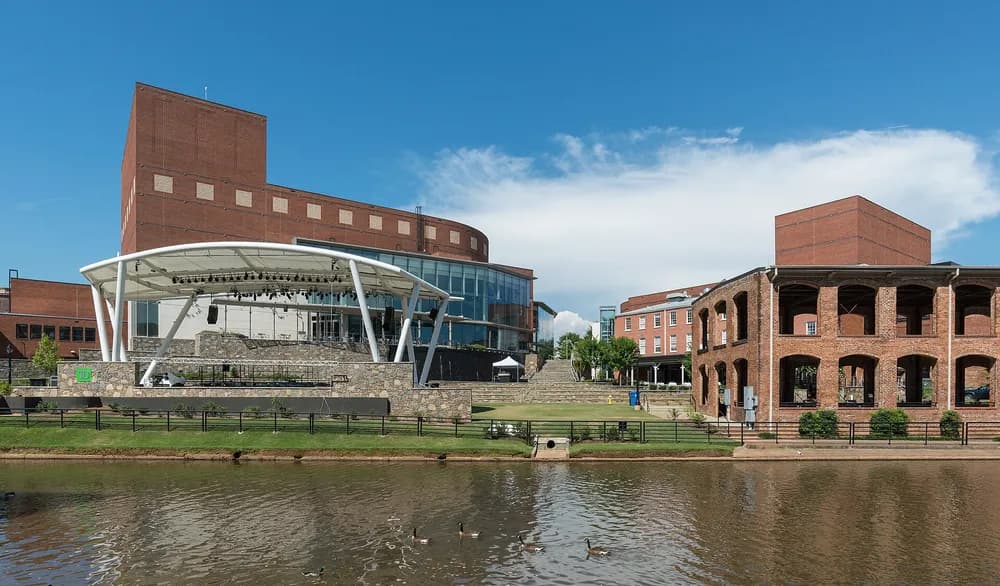

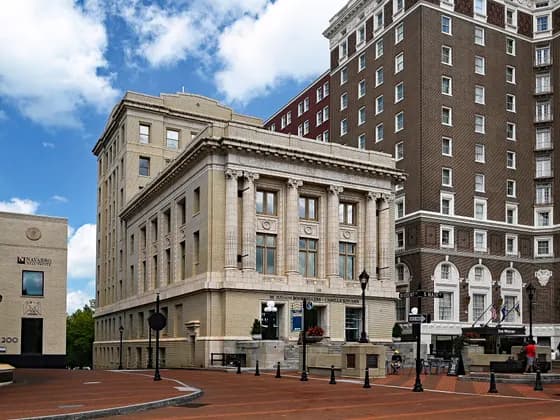

Photo: DXR · CC BY-SA 4.0 · cropped
Photo: P. Hughes · CC BY-SA 4.0 · Photo: P. Hughes · CC BY-SA 4.0 · Photo: Thomson200 · CC0
The USC Greenville School of Medicine MD program at a glance (2027 entry)
The University of South Carolina School of Medicine Greenville (USC School of Medicine Greenville, or USC SOMG) awards the MD after a four-year program. Students set on family medicine can also be selected, once admitted, for the three-year Primary Care Accelerated Track (PCAT). The school opened in July 2012 with a charter class of 48, founded by the University of South Carolina and Greenville Health System, which became Prisma Health in 2017. It is accredited separately from USC's medical school in Columbia.
The integrated, systems-based curriculum, refreshed in fall 2023, opens with five weeks of EMT training. Two Foundations modules and a run of organ-system modules follow, each joining science to disease, diagnosis and treatment. This pre-clerkship (pre-clinical) phase lasts about 20 months, until late February of year 2.
Integrated Practice of Medicine (IPM), a course that runs through all four years as IPM I to IV, puts clinical reasoning and skills beside the science. Lifestyle medicine is a theme in every year. After year 2 coursework you sit Step 1 of the United States Medical Licensing Examination (USMLE), the national licensing exam series. Clerkships then start in March or May of year 2 across Prisma Health–Upstate, the school's health system partner.
Year 4 is built around the specialty you plan to enter and includes the Match, the national process that places graduates into residency, the specialty training that follows medical school. The class is about 110 students.
The Liaison Committee on Medical Education (LCME) accredits MD programs in the United States. Its directory, updated November 13, 2026, lists the program with full accreditation and a next survey in 2028-29.
| Degree | MD (Doctor of Medicine) |
|---|---|
| Program length | 4 years, or 3 on the Primary Care Accelerated Track |
| Class size | About 110; 110 first-year students entered in July 2026 |
| Main campus | Greenville Memorial Hospital campus, Greenville, South Carolina |
| Teaching style | Integrated organ-system modules with weekly IPM cases and skills sessions |
| First patient contact | Year 1: EMT training, then monthly ambulance and emergency department shifts |
| Anatomy | Cadaveric dissection in the year 1 musculoskeletal module; labs in years 1–2 |
| Clinical sites | Prisma Health–Upstate hospitals and practices, Greenville and nearby counties |
| Grading | Pre-clerkship satisfactory/unsatisfactory; core clerkships letter-graded, except emergency medicine |
| Step 1 timing | After year 2 coursework, by the end of February or April |
What makes the USC Greenville School of Medicine MD program different
EMT certification before your first science module
Every student starts with a five-week, 200-hour EMT course that leads to South Carolina EMT certification. Shifts on ambulances and in the emergency department then show you patients in their own homes and in emergencies, building communication, focused assessment, documentation and patient safety skills from year 1.
Lifestyle medicine in all four years
Nutrition, physical activity, stress, relationships, sleep and harmful substances run as a thread through every year, first for your own health and then for counseling patients about chronic disease. Partners include the YMCA of Greenville and Oconee Counties and Greenville Technical College's culinary center. A 2026 university announcement says the school holds Platinum-level certification from the American College of Lifestyle Medicine.
A clinical mentor and a small team from year 1
In IPM I and II you meet every week in a team of eight or nine with a clinical mentor from Prisma Health–Upstate. Each week pairs a case, worked up from that week's science lectures, with a clinical skills session. Bedside ultrasound is built into all four years to sharpen your physical examination.
Clerkships from March of year 2
On the 2027-28 calendar, Multiorgan Systems, the last module, ends on February 25 and the March-start Step 1 deadline is February 27, so March starters sit Step 1 within days of finishing coursework. A May start leaves March and April for Step 1 study or research. A post-clerkship phase of about 14 months follows.
A three-year MD linked to family medicine residency
Launched in July 2024, PCAT lets students committed to family medicine finish the MD in three years and move straight into a three-year Prisma Health family medicine residency. The residency position is linked through a National Resident Matching Program (NRMP) waiver, so you do not apply or interview for other residencies. A full tuition scholarship comes in exchange for four years of primary care with Prisma Health after residency.
How USC Greenville School of Medicine teaches medicine
The curriculum is organized by body system. After EMT, Foundations of Medicine I covers the biochemical, molecular and genetic basis of health and disease. Foundations of Medicine II adds cell biology, immunology, histology, microbiology, introductory pathology and pharmacology, plus population health, biostatistics and epidemiology. Each organ-system module then teaches normal anatomy and physiology, disease, diagnostic testing and imaging, and treatment together, including how lifestyle affects that system.
IPM spans all four years, and IPM I and II each run in two halves, a and b. In years 1 and 2, social, behavioral, ethical and public health issues are threaded through its weekly case and skills sessions. In the clinical years it becomes short courses of one to four weeks on diagnosis, management and more advanced practice, preparing you for residency.
From March or May of year 2, most learning happens on clinical teams supervised by residents and attending physicians. Each clerkship lists the patient types and procedures you must see or perform, and at what level of responsibility. You log them in OASIS, the school's scheduling and evaluation system, and your progress is checked at a mid-rotation feedback session.
The ways you will learn
| Module lectures | The biomedical science modules include lectures, which may be recorded on Panopto, and graded in-module quizzes. Multiorgan Systems mixes live and recorded sessions with self-directed learning and large- and small-group active learning. |
|---|---|
| Case of the Week | Each week your IPM team takes a clinical case, identifies the problem, forms hypotheses, builds a differential diagnosis and explains the science behind it, using evidence to support your reasoning. Small-group faculty give you verbal feedback every week. |
| Clinical skills sessions | Weekly sessions built on that week's science, covering history taking and physical examination in year 1 and widening in year 2 to lab and imaging interpretation and diagnostic and therapeutic procedures. Skills are tested in an objective structured clinical examination (OSCE), a set of timed patient encounters, at the end of IPM Ib (May of year 1) and IPM IIa (December of year 2). |
| Simulation and procedure workshops | In IPM III and IV, procedure workshops and simulated case scenarios end with a faculty debrief. |
| Clerkship teaching | On internal medicine, for example, you are assigned newly admitted patients, take their histories, examine them and write daily notes and orders under supervision. Teaching rounds, lectures, conferences and grand rounds run alongside, and on surgery you are expected to scrub in on operations. |
A typical week on the USC Greenville School of Medicine program
In the pre-clerkship phase, required activities average 28 hours a week, not counting the EMT module; PCAT students have six more. There is generally no new material the day before an exam, except in Multiorgan Systems, and no required weekend classes. You are expected to study on your own beyond the required hours.
A week holds module sessions plus an IPM case session and an IPM skills session. IPM attendance is required at every level, and each module sets its own attendance rules in its syllabus. A weekly formative exam, designed to guide your learning, opens on Friday at noon and normally stays open until Wednesday morning, with a feedback report within two business days of closing. EMT shifts and service learning are offered on weekends, and peer tutors run weekly large-group review sessions for the modules.
How anatomy is taught at USC Greenville School of Medicine
Anatomy is taught through two lab courses, and the school building has a 120-seat gross anatomy laboratory. Anatomy I runs from January to April of year 1 alongside the spring modules, and Anatomy II through the fall of year 2 alongside the fall modules. The 2026-27 bulletin says the Musculoskeletal, Dermatology and Rheumatology module uses cadaveric dissection, correlated with radiologic findings, to study normal anatomy and how disease changes it.
The school's Willed Body Program receives donated bodies for its students and Prisma Health–Upstate professionals to study, and donors' bodies are kept in the school building. Weekly anatomy boot camps give formative feedback, and the lab courses include practical exams. In Brain and Behavior, lab work links brain structures to clinical, radiologic and pathologic findings.
In year 4 you can choose the Advanced Studies in Clinical Anatomy elective to revisit a region relevant to your career while helping to teach anatomy, from small-group lab supervision to running practice exams.
When you first meet patients at USC Greenville School of Medicine
Clinical work begins with the EMT module, straight after orientation. It is the minimum 200-hour course South Carolina requires, covering emergency care for people who fall suddenly ill or are injured. It ends with the National Registry of Emergency Medical Technicians (NREMT) skills and written exams, which lead to South Carolina EMT certification.
Once certified, you work 12 hours a month as an EMT on ambulances, in the emergency department and at community events, as a requirement of IPM I and II. You keep patient logs and reflect on how your cases connect with IPM.
Each year a Disaster Day, run with Prisma Health–Upstate, caps first-year EMT training. First- and second-year students lead the response to a staged disaster with mock patients, alongside prehospital and hospital clinicians, Clemson University nursing students and law enforcement. After Hurricane Helene in 2024, more than 160 students used this training at a 24-hour emergency medical needs shelter, giving nearly 2,000 hours.
Service learning, which can include EMT shifts, is also part of IPM I and II. Beyond that requirement, students lead Root Cause, a monthly health and public services fair in Dunean, the community next to the school. They also volunteer at the Greenville Free Medical Clinic, triaging patients and taking vital signs.
The USC Greenville School of Medicine curriculum, year by year
- Year 1 (M1)
EMT, Foundations and the first organ systems
The school calls the four years M1 to M4. On the 2027-28 calendar, year 1 runs from July to July: a week of orientation, five weeks of EMT, then Foundations and the first organ-system modules, with IPM all year. Classes end in late May and an eight-week summer follows.
- EMT from mid-July to mid-August, then Foundations of Medicine I (about four weeks) and II (about seven weeks).
- Hematology and Oncology, November to early December: blood cells, lymph nodes and spleen, bleeding and clotting, and cancer treatment.
- Musculoskeletal, Dermatology and Rheumatology; Cardiovascular; Pulmonary; and Renal, January to May, with Anatomy I from January to April.
- IPM Ia from July to December and IPM Ib from January to May, ending with the IPM Ib OSCE in late May.
- Optional summer work: research through SOARinG, the school's summer research program, or non-credit experiences in culinary medicine, medical Spanish or substance use disorder and recovery.
- Year 2 (M2), July to February
The remaining systems and Step 1
On the 2027-28 calendar, year 2 coursework runs from late July to late February. The fall brings three organ-system modules with Anatomy II. January and February bring Multiorgan Systems, which revisits every discipline and system through patients with several problems at once. Step 1 comes next.
- Gastrointestinal/Hepatic (about five weeks), then Endocrine and Reproductive (about six weeks), taught as one module for classes entering since July 2026.
- Brain and Behavior, October to December: the nervous system, vision and hearing, dementia and Parkinson's disease, psychiatry and behavioral science.
- Anatomy II and IPM IIa through the fall, with the IPM IIa OSCE in mid-December, then IPM IIb in January.
- Comprehensive Basic Science Exams (CBSE), practice tests used to judge Step 1 readiness, in November and February.
- M3 orientation at the end of February, with a second part in early May.
- Clerkships (from March or May of year 2)
Seven core clerkships
The clerkship year is six eight-week blocks. Internal medicine, surgery and neurology/psychiatry each fill a block; pediatrics, obstetrics and gynecology, and family medicine each take six weeks of one, paired with two weeks of emergency medicine or an elective.
- Internal medicine: two weeks on an inpatient ward team, including one 24-hour shift, and a hospitalist week at a satellite hospital. You also spend a week in community practice and two weeks on subspecialty electives such as cardiology or nephrology.
- Surgery: two weeks of acute care surgery, trauma and night float (night duty) at Greenville Memorial Hospital, two weeks at a community hospital and two two-week subspecialty rotations such as vascular, urology or neurosurgery.
- Neurology/psychiatry: three weeks of psychiatry, including a selective week on a service you choose, such as child and adolescent psychiatry; four weeks of neurology; and a final week of integration and exams.
- Family medicine and obstetrics and gynecology set aside their final week for assessments and wrap-up sessions; emergency medicine is eight 8-hour shifts over two weeks.
- IPM III, one week in January: quality and risk, medical-legal issues, advanced diagnostics, panels of patients from underserved communities, procedural skills and CV preparation for residency applications.
- Most clerkships end with a National Board of Medical Examiners (NBME) subject exam, known as a shelf exam, plus an OSCE, an oral exam or a technical skills test.
- Under the attendance policy effective May 2025, you get four flex days in the clerkship year to take off for any reason. In the post-clerkship year you get two personal days plus five residency interview days.
- Post-clerkship (spring of year 3 to May of year 4)
A specialty track and the Match
You plan your fourth year with an advisor at the end of year 3 and join a track for your chosen specialty. On the 2027-28 calendar the phase opens in March with orientation and the Comprehensive Clinical Science Exam (CCSE), a readiness exam for USMLE Step 2 Clinical Knowledge (CK). It then runs in four-week blocks until convocation in Greenville and commencement in Columbia in early May.
- A four-week acting internship, also called a sub-internship, in which you carry patient responsibilities close to a first-year resident's.
- Twelve weeks of selectives tied to your specialty, including two to four weeks of critical care, plus 12 weeks of electives.
- Blocks from March to August double as study time and blocks from late September to January as residency interview time; a February block allows for second-look visits to programs.
- IPM IV: two core weeks of skills review, procedures and competency checks before Match week, when every fourth-year must be in Greenville. Two specialty weeks follow it, such as knot tying and suturing for future surgeons.
- A final April block for make-up shifts or bonus electives, with no required acting internships.
- PCAT (three years)
The Primary Care Accelerated Track
PCAT students take the same EMT and biomedical modules, IPM and seven core clerkships as the four-year class, compressed into three years with a family medicine focus. The track has 142 credit hours against 160 for the four-year MD, and six more required hours a week in the pre-clerkship phase.
- Extra clinical training and family medicine workshops during the EMT weeks.
- A longitudinal family medicine clerkship one afternoon a week through the 18 months of modules, which the 2025-26 handbook says includes a community preceptorship and time with the residency programs.
- Internal medicine and pediatrics clerkship time in the summer after year 1, four and three weeks on the 2026-27 PCAT calendar, with more of each after Step 1.
- Step 1 by the deadline for a March clerkship start, then the remaining clerkships, a family medicine acting internship, selectives including ICU time and a longitudinal radiology course.
- Step 2 CK by December of the final year, graduation in May, then residency in Greenville, Seneca or Greer.
How you are assessed at USC Greenville School of Medicine
EMT, the biomedical modules and all four IPM courses are graded Satisfactory or Unsatisfactory, with 69.45 percent the passing score in the modules and in IPM I and II. IPM Ib and IIb can also earn a Pass with Honors designation. The school still keeps a cumulative weighted average and class rank, posted after years 1, 2 and 3. It feeds eligibility for Alpha Omega Alpha, the national medical honor society, and the Medical Student Performance Evaluation (MSPE), the school's letter that goes with residency applications.
Pre-clerkship modules are examined with computer-based multiple-choice exams in ExamSoft, plus anatomy lab practicals. If you fall short in a module, you get an Incomplete and retake the failed parts, under the grading and promotion policies effective July 2026. Passing the retake records a Satisfactory, but the remediation is noted in your MSPE. Under the promotion committee's guidelines, failing modules worth 12 or more credit hours in year 1 means repeating the year, and 9 or more in year 2 means repeating the year or dismissal.
Core clerkships, apart from emergency medicine, receive letter grades of A, B+, B, C+, C or F under the same grading policy. You must pass the clinical evaluation, and the six- and eight-week clerkships add a written knowledge exam and a practical skills exam that must each be passed. A shelf score below the national 5th percentile earns an Incomplete; pass the remediation and it becomes a C, but Incompletes in three clerkships, even remediated ones, mean repeating the year or dismissal. Emergency medicine, electives, selectives and PCAT clerkships are Satisfactory or Unsatisfactory.
To graduate you must pass USMLE Step 1, Step 2 CK, which tests clinical medicine, and the school's Clinical Performance Exam (CPX). The CPX, called the Clinical Practice Exam in some policies, is a clinical skills exam built on patient encounters. Step 1 covers the science behind medicine and has been reported only as pass or fail since January 26, 2022. You get at most three attempts at Step 1 and three at Step 2 CK, and all requirements must be finished within six years of starting.
In August 2026 the USMLE program announced a move to designated testing dates from January 2029, with Step exams offered less often each year. A June 2026 announcement had set the change for 2028.
On the current schedule, projected from the 2027-28 calendars, a July 2027 entrant finishes year 2 coursework in late February 2029 and sits Step 1 by the end of February or April. That puts Step 1 within a few months after the switch. Step 2 CK, taken in the March-to-August 2030 study blocks at the start of the post-clerkship (M4) phase, comes after it too.
- Exam timing: two minutes a question in fall of year 1, 1 minute 45 seconds after winter break and 1 minute 30 seconds in year 2, with summative module exams capped at four hours. Multiorgan Systems, EMT and the anatomy practicals follow their own rules.
- Step 1 approval: all year 2 courses passed, a target score on at least two school-approved practice exams, at least one of them a CBSE, and a set share of UWorld practice questions completed.
- Step 1 timing: by the end of February for a March clerkship start, or by the end of April for a May start. You can start clerkships while awaiting your result, but promotion to the clerkship phase needs a pass.
- If you have not met the criteria to sit Step 1 before the May start, you are placed on a leave of absence for academic difficulty.
- Step 2 CK: after all clerkship-year (M3) coursework and the CCSE at the end of the clerkship year. The school expects your score to be available when residency applications open.
- CPX: held near the end of clerkships; you must pass it before the school certifies you for the Match.
USC Greenville School of Medicine clinical rotations: where you will actually train
The school's 2026-27 course catalog in OASIS lists every core clerkship at Prisma Health–Upstate, and the school's at-a-glance page counts more than 1,200 clinical faculty through the partnership. A main teaching site is Greenville Memorial Hospital, a level one trauma center and tertiary care hospital on the same campus as the school. Prisma Health–Upstate runs its own residency programs, and residents teach on most clerkships.
Several rotations take you beyond Greenville. The catalog lists emergency medicine shifts in Greenville Memorial's adult and pediatric emergency departments and at six community emergency departments, from Simpsonville to Seneca and Laurens. About half the family medicine clerkship is spent at a site in Oconee, Laurens, Spartanburg or Greenwood county.
Psychiatry runs mainly at Prisma Health sites including Patewood and Greer, or at community mental health centers, with electroconvulsive therapy experience at Baptist Easley Hospital. Pediatrics centers on the inpatient service, the Center for Pediatric Medicine and the newborn nursery, with time in community pediatric practices.
The 2025-26 handbook says you submit schedule preferences for years 3 and 4 in OASIS, and you enroll in courses there with the Office of Medical Education. If you have a prior personal or family relationship with someone at a site, you must ask for another site at least four weeks before the rotation. You can also ask for another assignment after mistreatment. Duty hours are capped at 80 a week, averaged over four weeks, with one day in seven free.
A main site for core clerkships, from surgery's trauma weeks to emergency medicine shifts.
- Greenville Memorial Hospital
Community emergency departments for emergency medicine shifts. Greer also has psychiatry sites and a family medicine residency and acting internship.
- Hillcrest, Simpsonville
- Greer Memorial Hospital, Greer
- North Greenville, Travelers Rest
Emergency medicine shifts, electroconvulsive therapy experience in the psychiatry clerkship, and a fourth-year internal medicine ICU elective.
- Baptist Easley Hospital
Emergency medicine shifts, family medicine clerkship sites, a family medicine residency and acting internship in Seneca, and a fourth-year Oconee surgery elective.
- Oconee Memorial Hospital, Seneca
Emergency medicine shifts and family medicine clerkship sites.
- Laurens County Hospital, Laurens
Family medicine clerkship sites.
Electives, selectives and away rotations at USC Greenville School of Medicine
Electives begin in the clerkship year, which includes two two-week electives. The 2026-27 OASIS catalog lists third-year options at Prisma Health–Upstate such as anesthesiology, pediatric emergency medicine, medical toxicology, sports medicine, rural family medicine, lifestyle medicine, dermatology, radiation oncology, orthopedics, ophthalmology and several pediatric subspecialties.
In year 4 you fill your specialty track from a long catalog. The 2026-27 list offers acting internships in emergency medicine, family medicine (Greenville, Seneca or Greer), inpatient and hospitalist medicine, psychiatry, high-risk obstetrics and gynecologic oncology. Pediatric options cover the wards and the neonatal and pediatric ICUs, and surgical ones acute care surgery, trauma and neurosurgery. Critical care courses include cardiovascular, medical, neurological and surgical ICUs and an internal medicine ICU at Baptist Easley Hospital.
Non-clinical and longitudinal electives include wilderness medicine, culinary medicine, medical Spanish, medical humanities, genetics, and teaching and simulation in medical education. A free medical clinic elective adds ten evening shifts at the Greenville Free Medical Clinic and a project. Rural options include rural family medicine, rural emergency medicine and an Oconee surgery elective.
Away rotations, electives taken at another institution, are open at LCME- or Accreditation Council for Graduate Medical Education (ACGME)-accredited institutions, and the catalog lists them in nearly every department. You must be in good standing to apply. The 2025-26 handbook says you are responsible for any liability insurance a host requires beyond the school's coverage, and that PCAT's condensed final year has no away rotations.
Dual degrees and research years at USC Greenville School of Medicine
The school has no approved dual-degree programs, according to an August 2024 change recorded in its promotion policy, so it offers no combined MD/PhD, MD/MPH or MD/MBA. To earn another degree, or take an NIH-funded or other externally funded research fellowship, you apply for an Academic Enrichment leave of absence with proof of acceptance. Under the policy effective July 2026 this leave does not count toward the six-year limit for finishing the MD, and leaves normally last at most 12 consecutive months.
Research is optional. The school's student research policy says the curriculum has no research requirement, so no dedicated research time is set aside. You become eligible after your first semester if you are in good standing and have a mentor who holds an MD, PhD, DrPH or equivalent. Projects can be at the school, at Prisma Health–Upstate or with partners such as Furman, Clemson and USC's Arnold School of Public Health.
SOARinG, short for Student Opportunities for Academic Achievement through Research in Greenville, runs in the summer between years 1 and 2. You spend six to eight weeks on a mentored project, attend a seminar series and journal club, and present a poster or talk at the annual Student Research Symposium. Applications are due each February, and most participants receive a stipend.
Registering for the M2 Research Elective puts summer research on your transcript: at least 120 hours over about eight weeks, a proposal, a presentation and an abstract. The 2026-27 bulletin also lists a spring-break field research elective in developmental physiology in Panacea, Florida, a non-credit leadership concentration called LEAD, and fourth-year research electives in Greenville or away. The school reimburses 20 to 50 students a year to present at national and international conferences.
PCAT students must finish their three years without a break: asking for a research year moves you to the four-year track and ends the PCAT scholarship.
Facilities and support at USC Greenville School of Medicine
Where you will learn
Teaching is based in the Health Sciences Education Building, a three-story, 90,000-square-foot building at 607 Grove Road on the Greenville Memorial Hospital campus. The 2025-26 handbook lists a 186-seat lecture hall, a 140-seat learning studio, a multidisciplinary lab for up to 200, the gross anatomy laboratory and 14 small-group rooms. The Medical School Library Commons is open to students 24 hours a day.
The Prisma Health Simulation Center – Greenville is on the school's second floor and the third floor of the Clemson University School of Nursing. The 2025-26 handbook describes 35,000 square feet of simulation and clinical skills space, which also houses the Willed Body Program. The Society for Simulation in Healthcare accredited it in 2012 and again in 2017.
Every student gets an iPad for all four years. Apps teach heart sounds before you listen to patients, and you also use the iPad for ultrasound training, 3D anatomy models and the Epic electronic health record. The school pairs iPads with Butterfly iQ ultrasound probes. You are also offered membership in the Prisma Health Life Center on the hospital campus, with an indoor pool and running track, and in YMCA of Greenville facilities.
Support while you study
The Colleges Program is a four-year learning community coordinated by the Office for Student Affairs, organized into five colleges: Hinton, Hunter, Osler, Preston and Von Hofe. Under the 2025-26 handbook, success coaches, educational specialists assigned to students, meet you through the year, monitor grades and arrange extra help or referrals.
Career counselors are physicians on the clinical faculty who guide you through the Association of American Medical Colleges (AAMC) Careers in Medicine plan; the 2025-26 handbook sets two required meetings a year. Near the end of year 3, the handbook says, you get a list of specialty advisors to guide residency applications and how you rank programs for the Match. The Student Achievement and Strategic Success (SASS) office adds learning strategists and peer tutoring, one-on-one or in groups.
Counseling comes through Prisma Health's Employee Assistance Program, whose licensed counselors take no part in medical education, and a psychiatrist who does not teach medical students sees students there. Primary care is through Prisma Health practices. Under the 2025-26 handbook, visits to the Team Member Care Center, for acute but non-emergency needs, are covered by the student health fee. Faculty who treat you must not grade you.
Is the USC Greenville School of Medicine program right for you?
This program may suit you if
- You want hands-on emergency care early: EMT training in your first weeks, state certification, then monthly ambulance and emergency department shifts.
- Prevention and lifestyle interest you, and you would like nutrition, exercise, sleep and stress taught in every year, with culinary medicine available.
- You learn well in a small team, working a case each week with a clinical mentor alongside the science.
- You would like to start clerkships in March of year 2, with nearly all rotations inside one health system around Greenville.
- You are sure about family medicine in South Carolina and would welcome a three-year MD that leads into a Prisma Health residency.
Things to think about
- Pre-clerkship courses are pass/fail, but the school keeps a weighted average and class rank, and most core clerkships carry letter grades.
- Step 1 follows year 2 coursework. On the current schedule, a 2027 entrant sits it within a few months after the USMLE's January 2029 switch to designated testing dates.
- There are no approved dual degrees, according to an August 2024 policy note, so another degree means taking a leave of absence.
- Some rotations are well outside Greenville, including about half of family medicine.
- PCAT is a firm commitment: you choose family medicine when you apply, and leaving the track ends the scholarship and may mean repaying tuition.
USC Greenville School of Medicine MD program — frequently asked questions
Applying to USC Greenville School of Medicine?
How to get into USC Greenville School of Medicine
Prerequisites, MCAT, AMCAS personal statement, secondaries and interview, step by step.
Open the guide →USC Greenville School of Medicine admissions profile
MCAT and GPA profile, acceptance rate, interview format and key dates.
See the profile →Compare USC Greenville School of Medicine with other schools
Put the teaching style, anatomy teaching and clinical sites next to another school.
Open the comparison →Prepare for the USC Greenville School of Medicine interview
Format breakdown, school-specific sample questions and prep tips for this interview.
Read the guide →Where this USC Greenville School of Medicine program guide came from
This guide was written from 82 official sources — University of South Carolina School of Medicine Greenville's own program pages and curriculum documents, plus the accreditor and the hospitals and health systems the school trains students in where they publish detail — read on 2026-11-12, then checked claim by claim against those sources.
- Medical Education, USC School of Medicine Greenville
- Curriculum, USC School of Medicine Greenville
- Pre-Clerkship phase
- Clerkship phase
- Post-Clerkship phase
- Integrated Practice of Medicine
- EMT Training and Certification
- Lifestyle Medicine
- Primary Care Accelerated Track (PCAT)
- Full four-year curriculum schedule (PDF, modified March 2026)
- PCAT curriculum schematic (PDF, as of June 18, 2026)
- 2026-2027 Academic Bulletin: The School of Medicine - Greenville
- 2026-2027 Academic Bulletin: Degree Requirements and Course Descriptions
- 2026-2027 Academic Bulletin: Greenville Medicine (GMED) course descriptions
- 2026-2027 Academic Bulletin: Internal Medicine (MEDI) course descriptions
- 2026-2027 Academic Bulletin: Surgery (SURG) course descriptions
- 2026-2027 Academic Bulletin: Obstetrics and Gynecology (OBGY) course descriptions
- 2026-2027 Academic Bulletin: Pediatrics (PEDI) course descriptions
- 2026-2027 Academic Bulletin: Emergency Medicine (EMED) course descriptions
- 2026-2027 Academic Bulletin: Neuropsychiatry (NPSY) course descriptions
- 2026-2027 Academic Bulletin: Family and Preventive Medicine (FPMD) course descriptions
- 2026-27 Academic Calendar, M1 (class entering July 2026)
- 2026-27 Academic Calendar, M3
- 2027-28 Academic Calendar, M1
- 2027-28 Academic Calendar, M2
- 2027-28 Academic Calendar, M3
- 2027-28 Academic Calendar, M4
- PCAT 2026 First Year (M1) Academic Calendar
- PCAT 2025-2028 Academic Calendar
- Student Handbook, Academic Year 2025-26
- Policy ACAF 2.00: Grading System (effective July 2026)
- Policy ACAF 3.05: USMLE and Clinical Performance Exam (effective July 2026)
- Policy ACAF 4.00: Student Evaluation, Remediation, Promotion and Appeal (effective July 2026)
- Policy ACAF 1.00: M1 and M2 Student Attendance (effective May 2025)
- Policy ACAF 1.03: Integrated Practice of Medicine Attendance
- Policy ACAF 1.01: Clerkship and Post-Clerkship Student Attendance (effective May 2025)
- Policy ACAF 3.00: Academic Workload and Duty Hours
- Policy ACAF 3.06: Request an Alternative Clinical Site
- Policy ACAF 3.02: Required Clinical Experiences
- Policy ACAF 2.02: Good Standing
- Policy ACAF 4.02: Leave of Absence and Withdrawal
- Policy ACAF 2.04: Formative Feedback
- Policy ACAF 7.02: Length of Exam
- Policy ACAF 7.06: Clinical Skills Examination
- Policy RSCH 1.01: Student Research Eligibility
- OASIS course catalog: third-year courses, 2026-2027
- OASIS course catalog: fourth-year courses, 2026-2027
- OASIS: Internal Medicine Clerkship, 2026-2027
- OASIS: Surgery Clerkship, 2026-2027
- OASIS: Family Medicine Clerkship, 2026-2027
- OASIS: Pediatrics Clerkship, 2026-2027
- OASIS: Obstetrics and Gynecology Clerkship, 2026-2027
- OASIS: Psychiatry/Neurology Clerkship, 2026-2027
- OASIS: Emergency Medicine Clerkship, 2026-2027
- OASIS: Integrated Practice of Medicine 3, 2026-2027
- History of the School of Medicine Greenville
- School of Medicine Greenville at a Glance
- Admissions frequently asked questions
- Class of 2030 receives white coats (July 12, 2026)
- Dr. Phyllis MacGilvray appointed dean (April 30, 2026)
- Answering the call: EMT training and Disaster Day (August 24, 2026)
- Student Resources, including academic calendars and the Colleges Program
- Life on Campus
- Peer Success Programs
- Career Services
- Health and Wellness
- Counseling Services
- Community Engagement
- Root Cause community health fair
- Research at the School of Medicine Greenville
- Student Research Opportunities and SOARinG
- Student Research Support
- Summer Learning Opportunities
- Apple Distinguished School: iPads and technology
- Willed Body Program
- Residency and Fellowships at Prisma Health
- Registrar: course enrollment through OASIS
- LCME directory of accredited programs (updated November 13, 2026)
- USMLE Designated Testing Dates Information Hub
- USMLE: transition to designated testing dates will take place in January 2029 (August 6, 2026)
- USMLE to transition to limited testing dates starting in 2028 (June 23, 2026)
- USMLE examination results and scoring
Curricula are restructured between cycles. Anything here that decides your application — how anatomy is taught, a clinical campus assignment, a required research year — should be confirmed against the official page for your entry year.
Applying to USC Greenville School of Medicine?
We help US applicants with MCAT strategy, the AMCAS personal statement, secondary essays and interview prep — everything you need for a competitive USC Greenville School of Medicine application.