Early clinical plan · Australia

Early clinical OSCE stations. Safe, fluent technique.

76 stations, marked on clean, safe technique. This is where every mark sheet starts.

  • 76 stations in scope
  • 135 lines that fail a station on their own
  • Free to study, no account needed
  • Sit it live: 1 credit, –
Chest pain historyWhere the sheet starts
17 more lines on this sheetRunning total3/25
Where the chest pain history sheet starts. Tick a line and the total adds up. Open the station

Start here

The early-clinical plan

Five stations to start with, one of each type, the way a real circuit mixes them. Then the rest, a type at a time.

The starter circuit

5 stations 43 min with reading time

One of each station type, from five body systems: the shape of a real circuit.

  1. Chest pain history1:00 + 8:00History taking CardiovascularMr Trevor Malone, 58, has presented to the emergency department with chest pain that began this morning. Take a focused history.
  2. Respiratory examination1:00 + 8:00Examination RespiratoryThis 68-year-old woman has presented to her GP clinic with breathlessness on walking to the local shops and a cough most mornings. Examine her respiratory system, talking the examiner through each step as you do it.
  3. Chest X-ray interpretation1:30 + 8:00Data interpretation ImagingMr Trevor Halloran, 68, has been sent in to the emergency department by his GP with four days of fever, a productive cough and right-sided pleuritic chest pain. His chest X-ray is up on the screen, and the examiner holds his observations and other results. Present the film systematically to the examiner and describe your findings.
  4. Explaining a diagnosis1:00 + 8:00Communication EndocrineMr Darren Vella, 52, is a self-employed electrician from Penrith who attended the GP clinic because he had been feeling tired and thirsty. His HbA1c was 8.9 per cent (74 mmol/mol), repeated two weeks later at 8.9 per cent (74 mmol/mol). He has come back today to be told the result. You are the GP registrar. Please explain the diagnosis to him and agree an initial plan.
  5. Peripheral intravenous cannulation1:00 + 5:00Practical skills ProceduresMr Alan Reid, 74, has been admitted under the general medical team from the emergency department with a community-acquired pneumonia and has intravenous antibiotics charted on his NIMC. Please insert a peripheral intravenous cannula, talking the examiner through each step as you do it and saying why.
Start with Chest pain history

Free. No account needed.

  • Run it with friends, free

    One of you sits the station, one plays the patient from their brief, and one marks on their own phone from a QR code. One clock for all of you.

    Run it with friends
  • Or sit the whole circuit live

    The same five stations back to back, by voice, with an AI patient or examiner. Each sheet comes back marked at the early-clinical standard.

    Sit the whole circuit live, 3 credits

What early clinical covers, type by type

Read the guide for a type, then drill its stations. Every station here opens at the early-clinical standard.

The standard

What changes when you walk out of the skills lab

Nothing in an early-clinical OSCE is harder than what you practised on a manikin. What changes is that the whole sequence now has to happen once, in order, in front of an examiner holding a marking sheet, with a real person on the bed in a ward bay or an ED cubicle and a bell at the end.
Chest pain historyWhere the sheet starts
17 more lines on this sheetRunning total3/25
Where the chest pain history sheet starts. Tick a line and the total adds up. Open the station
The early-clinical standardFirst clinical year

What a passing candidate does at the early-clinical stage

  • A slick introduction: name, role, consent, hand hygiene and the patient identified by name, date of birth and record number
  • A complete, well-ordered history or examination sequence performed within the time, with nothing skipped under pressure
  • Findings presented back clearly, in a structure the examiner can follow
  • Normal distinguished from abnormal, and obvious findings named correctly
  • Patient comfort, dignity, cultural safety and exposure managed without being prompted

How the examiner probes

Examiners at this stage rarely probe beyond “what did you find?” and “what would you do next?” — they are watching the sequence and the safety steps.

Global ratingClear failBorderlinePassGood passExcellent
  1. One take, and no restart

    In tutorials you could stop and go again. In the exam the tick is awarded for what the examiner watched you do the first time, so the step you remember on the way out of the room scores nothing. Rehearse the running order until it survives being nervous — on the BLS station that order is DRSABCD exactly as the ANZCOR flowchart has it, and the examiner marks the sequence, not the effort.

  2. The introduction carries marks of its own

    Name, role, what you would like to do, permission to go ahead, hand hygiene at the right moments, and the patient identified with three approved identifiers — name, date of birth and record number — are separate ticks before any clinical work begins. On the procedural stations, confirming identity and consent before you touch the patient is a critical-fail item: miss it and the station is failed however good the rest was.

  3. You are examining a person, not a model

    Positioning at 45 degrees, exposure managed for dignity, asking about pain before you press, offering a chaperone where it is appropriate, and covering the patient back up. These are marked separately from the manoeuvres themselves, and they are the first things candidates drop when they fall behind the clock — in an ED cubicle with the curtain half open, just as in a GP clinic.

  4. Every station ends with you presenting

    You close by summarising to the examiner in a structure they can follow — who the patient is, the positive findings, the relevant negatives — the same shape as the first half of an ISBAR handover. At the early-clinical stage you are not yet expected to commit to a diagnosis. You are expected to stop, turn round and present rather than trail off after the last manoeuvre.

AI OSCE simulator

Then sit one live, at the early-clinical standard

Read the notice at the door and go in at the bell. An AI patient answers only what you ask; on an examination, data or skills station an AI examiner tells you what you find.
  • Every station on this page can be sat live, by voice.
  • The sheet comes back marked at the early-clinical standard, with your own words beside each line.
  • A microphone cannot see your hands, so practise the technique itself on a friend.
Sit a station live

1 credit a station, –

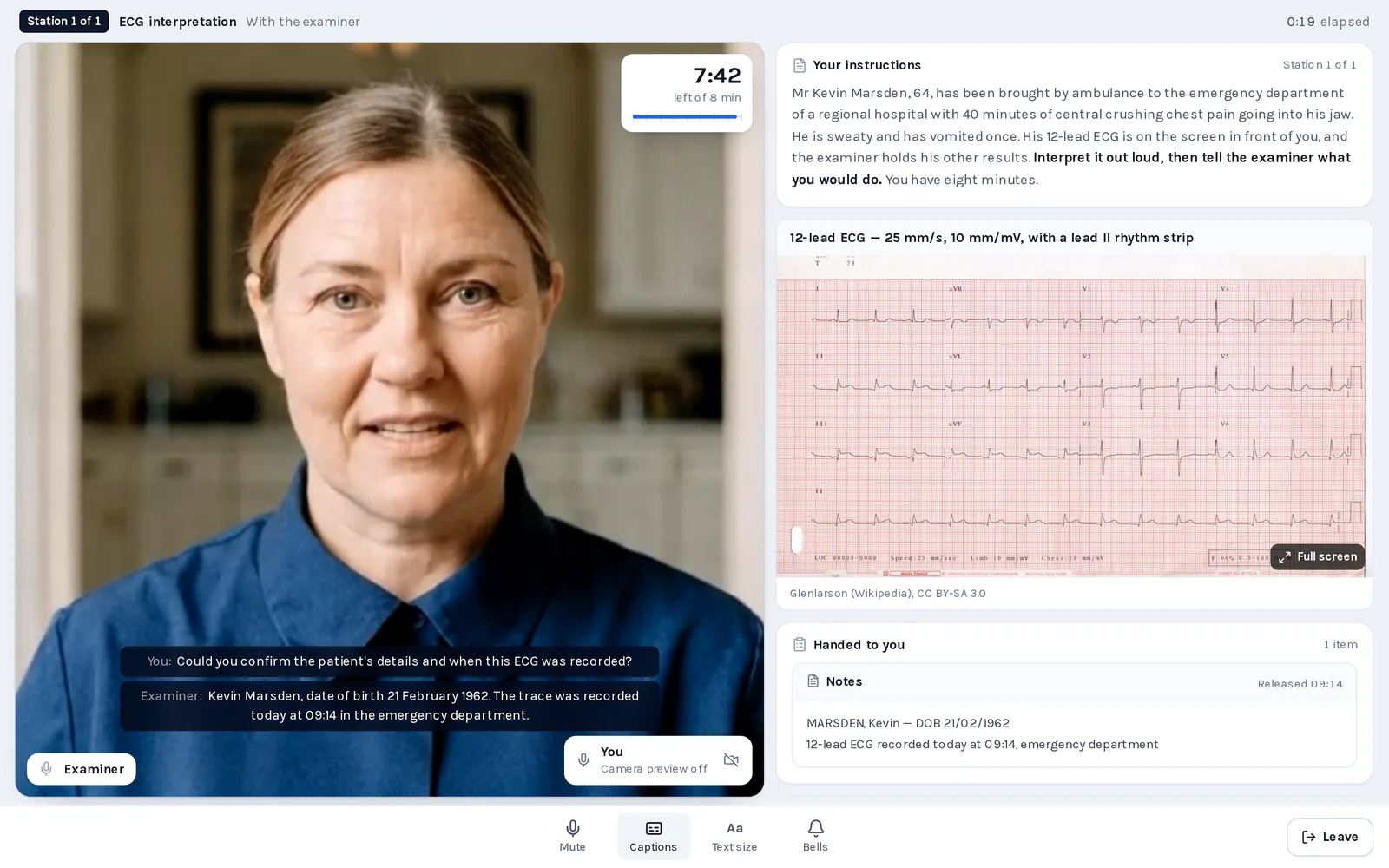
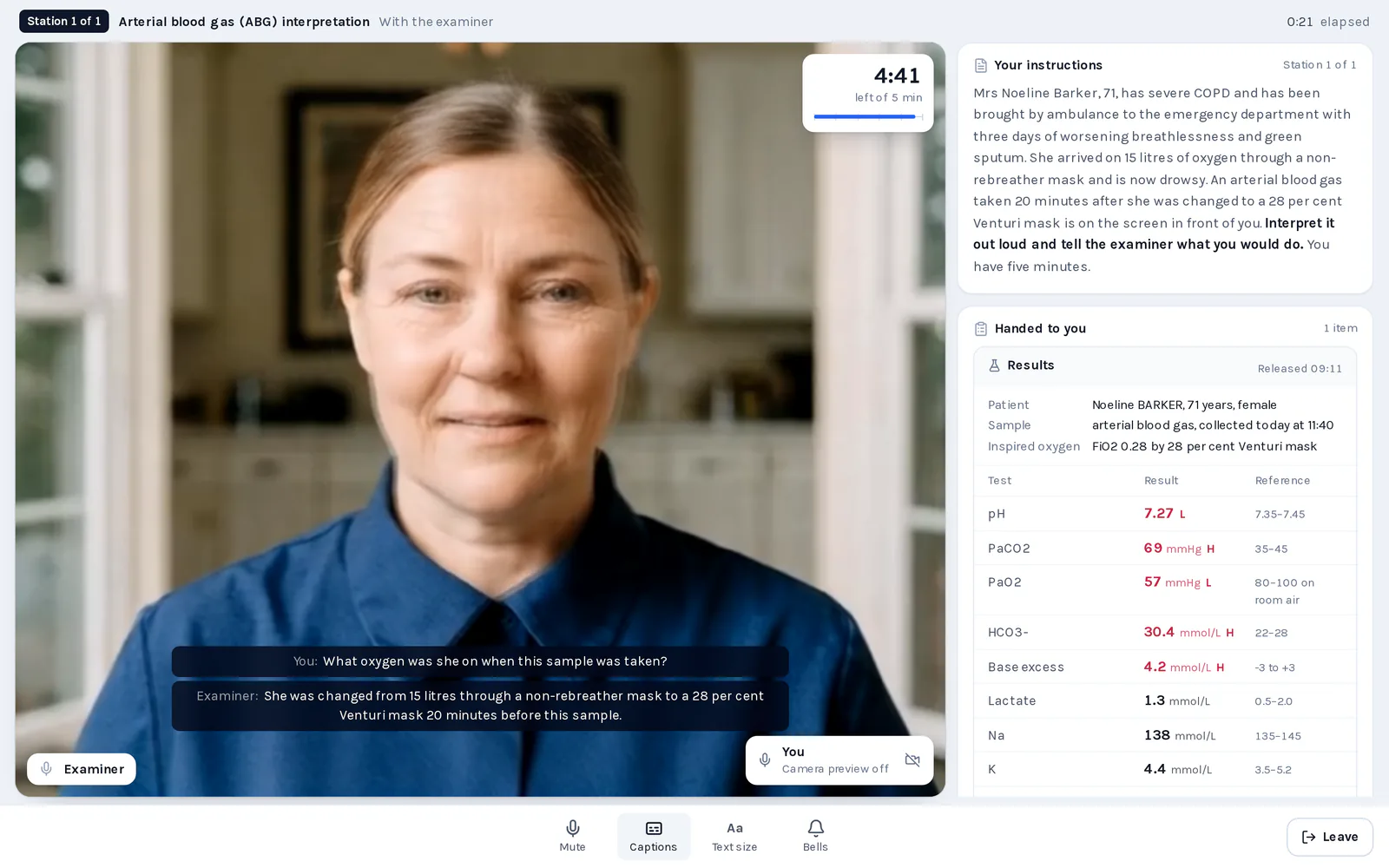
AI OSCE station · AustraliaReal screen
A live AI OSCE history station from the Australian library: the patient, a man with chest pain, is answering a question on screen with captions. The examiner sits in the corner, a clock shows the time left, and the candidate's desk holds the instructions and a sheet of scrap paper with notes.

Real screen
The same AI OSCE history station from the Australian library on a phone: the patient fills the screen, with the examiner's chair, the clock and the controls around him.
The patient, on your phone
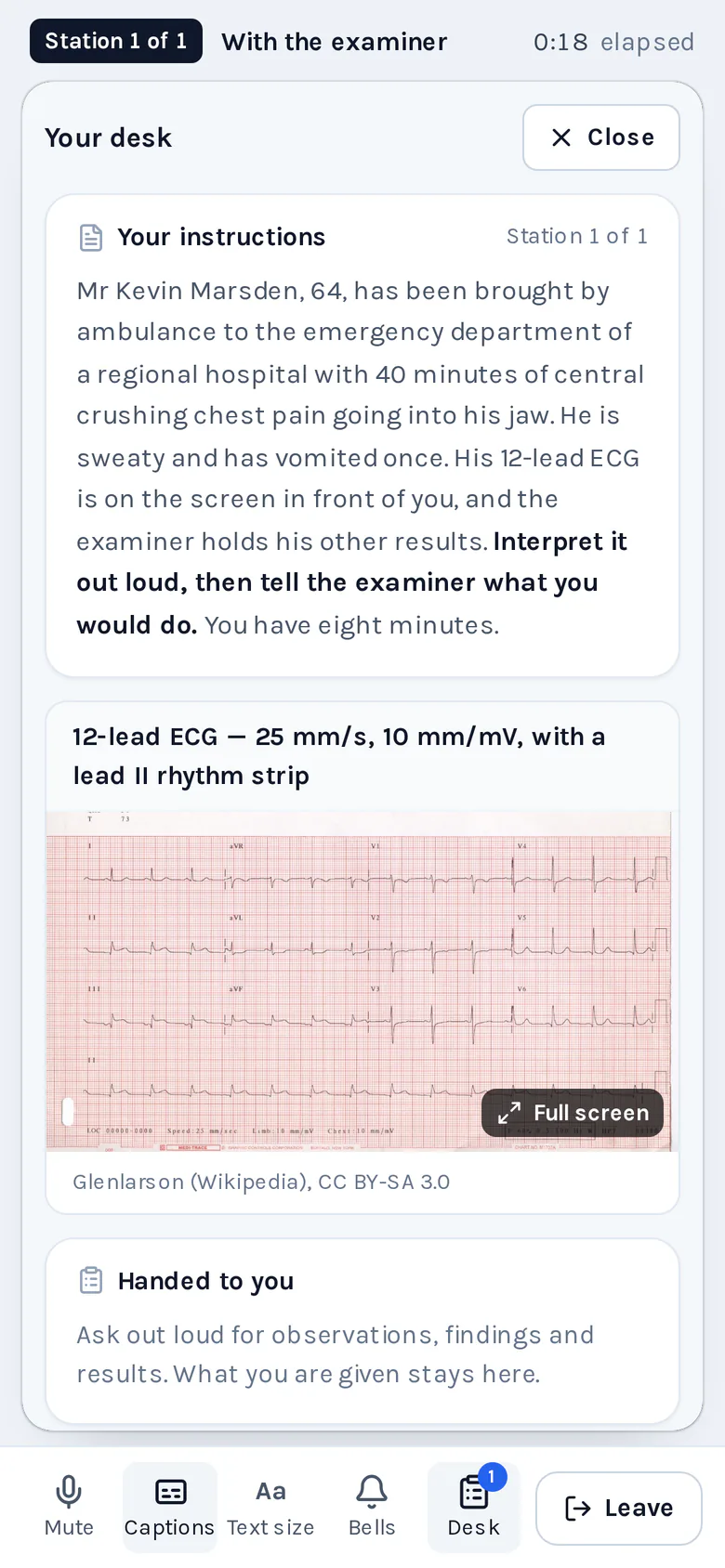
The candidate's desk on a phone during an AI OSCE data station from the Australian library: the instructions, the ECG and the space for what the examiner hands over.
Your desk, one tap away
Real screens of a live station, one of each kind. How the live room works

Start the early-clinical circuit tonight

Open the first station, run it out loud against the clock and tick your own sheet. It is free and needs no account.