Final year plan · Australia

Final year OSCE stations. Act as a new intern.

Final year adds 6 stations to the 165 from the earlier stages, and every sheet now asks for management, escalation and safety-netting.

  • 171 stations in scope
  • 6 new at the final-year stage
  • 418 lines that fail a station on their own
  • Free to study, no account needed
  • Sit it live: 1 credit, –
Chest pain historyNew at the final-year stage
29 more lines on this sheetRunning total3/40
What final year adds to the chest pain history sheet. Tick a line and the total adds up. Open the station

Start here

The final-year plan

Five stations to start with, one of each type. Then the sheets that change most at the final-year stage, a type at a time.

The starter circuit

5 stations 46 min with reading time

One of each station type: sheets that ask for more at the final-year stage.

  1. Falls history1:00 + 8:00History taking Care of the elderly From Mid clinicalMrs Joan Whitcombe, 82, has been brought into the emergency department by her daughter after a fall at home last night. Radiographs of her right hip and left forearm show no fracture and her observations are stable. Please take a focused falls history.
  2. Diabetic foot examination1:15 + 8:00Examination Endocrine From Mid clinicalMr Vince Karagiannis is a 66-year-old man with type 2 diabetes of twelve years who has come to his GP clinic for the foot check in his annual diabetes cycle of care. Please examine both of his feet, talking the examiner through each step as you do it.
  3. Pleural fluid results1:30 + 8:00Data interpretation Results New at the final-year stageRaymond Kerr, 68, was admitted four days ago with pneumonia and is still febrile. His chest X-ray now shows a right pleural effusion, and a diagnostic pleural aspiration was done under ultrasound this morning. The pleural fluid results, with paired blood results, are in front of you, and the examiner has the rest of his notes. Please talk the examiner through the results, say what you think is going on and what you would do now.
  4. Handling a complaint1:00 + 8:00Communication Professionalism From Mid clinicalMr Vaughn Steadman, 47, attended the emergency department a fortnight ago after coming off his mountain bike onto his outstretched right hand. His wrist radiographs were reported as showing no fracture and he was discharged with a splint and advice to take simple analgesia. He returned to the clinic today because the pain never settled. Repeat imaging this morning shows a fracture through the waist of the right scaphoid, and the original films have since been reviewed and the fracture is visible on them. He has asked to speak to a doctor and has said that he wants to make a complaint. You are the intern on the clinic team. Please speak with him.
  5. Acutely unwell with a fever1:00 + 8:00Practical skills Emergency medicine From Mid clinicalMrs Shirley Tranter, 82, has just been brought to the emergency department by ambulance. Her daughter, who is at the bedside, found her muddled at home this morning and says she feels hot. You are a medical student with the ED team and a registered nurse is working with you. Assess Mrs Tranter from A to E and start her treatment, talking the examiner through each thing you do, ask for and prescribe.
Start with Falls history

Free. No account needed.

  • Run it with friends, free

    One of you sits the station, one plays the patient from their brief, and one marks on their own phone from a QR code. One clock for all of you.

    Run it with friends
  • Or sit the whole circuit live

    The same five stations back to back, by voice, with an AI patient or examiner. Each sheet comes back marked at the final-year standard.

    Sit the whole circuit live, 3 credits

Final year, type by type

Read the guide for a type, then drill its stations. Every station here opens at the final-year standard.

The standard

What changes from mid clinical to final year

No new station types appear in final year. The same stations come back and every one of them is marked out of more, and the extra marks are all in what you would actually DO about your findings — said out loud, in priority order, at the standard of an intern on their first cover shift.
Chest pain historyNew at the final-year stage
29 more lines on this sheetRunning total3/40
What final year adds to the chest pain history sheet. Tick a line and the total adds up. Open the station
The final-year standardLast year of the degree

What a passing candidate does at the final-year stage

  • A management plan stated out loud in intern terms: immediate actions, investigations, escalation, disposition
  • Escalation done properly — a MET call where the obs warrant it, an ISBAR handover to the registrar, and documentation
  • Safety-netting and follow-up arranged: what the patient should watch for, when to come back, who follows them up
  • Communication marked to the same standard as clinical skill: plain language, checking understanding, honesty, cultural safety
  • Fluency under time pressure — the whole station, not most of it

How the examiner probes

The viva is a management viva: “you are the intern — what do you do now, and who do you call?”

Global ratingClear failBorderlinePassGood passExcellent
  1. Reasoning is no longer the finish line

    At the mid-clinical stage you finished on “this is an inferior STEMI”. In final year you have to keep going: aspirin 300 mg, analgesia with an antiemetic, oxygen only if saturations fall below 94 per cent, and the cath lab called for primary PCI within 90 minutes of first medical contact — or fibrinolysis started where that is not achievable, which in regional Australia it often is not.

  2. You are marked on what you would NOT do

    The final-year tier of the ECG station carries a critical mark for withholding nitrates when there is right ventricular involvement with hypotension, and giving a cautious fluid bolus instead. Knowing the standard bundle is mid clinical. Knowing when the standard bundle would harm this particular patient is the intern standard.

  3. Escalation is assessed as a skill in its own right

    A MET call the moment the observations breach the calling criteria, and a structured ISBAR handover to the registrar — who you are, the situation, the background, your assessment and what you are asking for, with the time of onset and what you have already done — appear across the acute stations. Working steadily on alone without calling anybody is not caution; it fails the station.

  4. The conversation weighs as much as the clinical work

    Explaining what you think is happening in plain language, checking understanding, anticipating the complications you would watch for, and safety-netting in words the patient would actually use are all final-year items — as is what happens after discharge: the GP follow-up, the medications and what they cost on the PBS, the letter that has to go out. The last marks on the chest-pain history are for telling him what happens next and telling him to call 000 if the pain comes back.

AI OSCE simulator

Then sit one live, at the final-year standard

Read the notice at the door and go in at the bell. An AI patient answers only what you ask; on an examination, data or skills station an AI examiner tells you what you find.
  • Every station on this page can be sat live, by voice.
  • The sheet comes back marked at the final-year standard, with your own words beside each line.
  • A microphone cannot see your hands, so practise the technique itself on a friend.
Sit a station live

1 credit a station, –

AI OSCE station · AustraliaReal screen
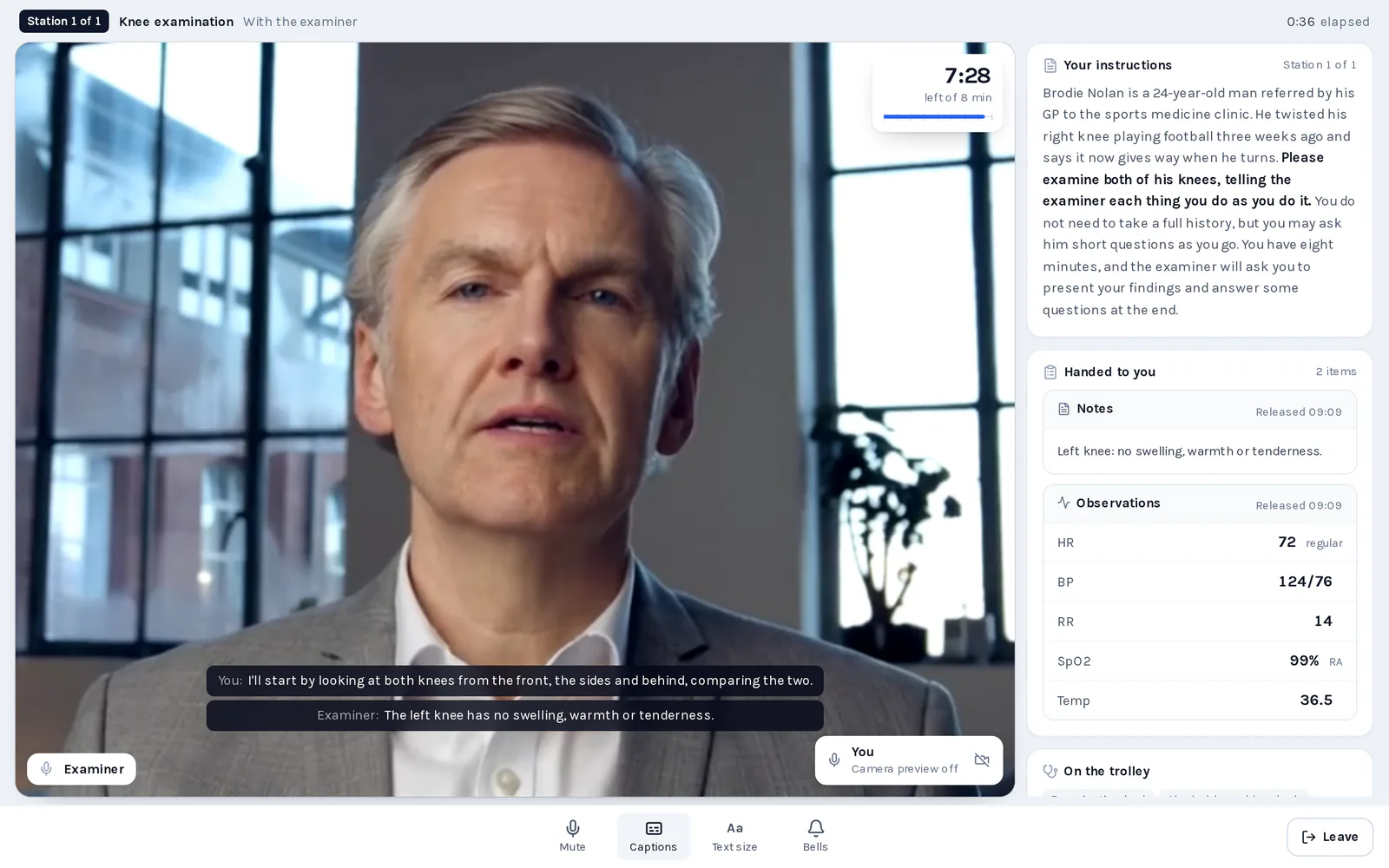
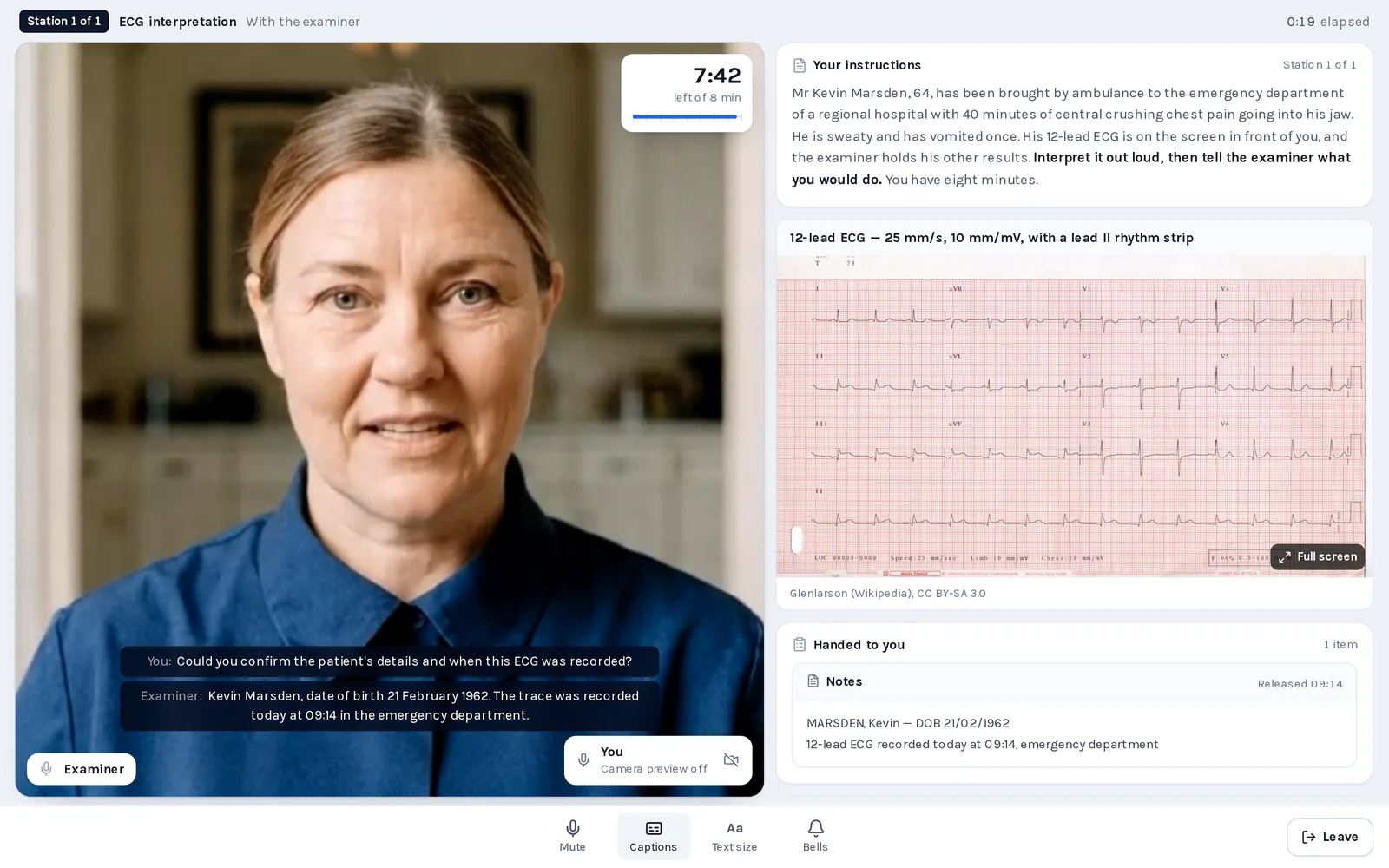
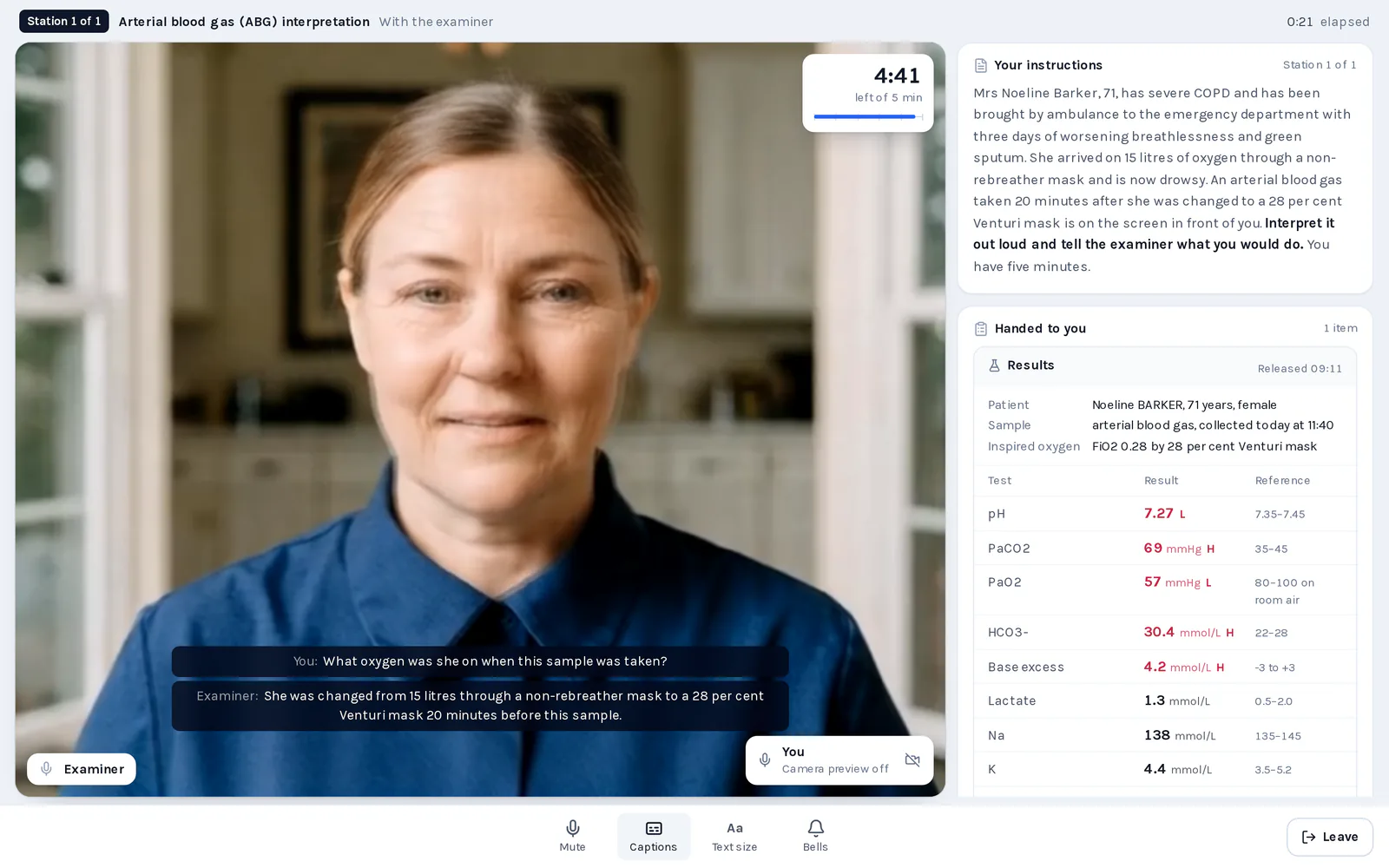
A live AI OSCE history station from the Australian library: the patient, a man with chest pain, is answering a question on screen with captions. The examiner sits in the corner, a clock shows the time left, and the candidate's desk holds the instructions and a sheet of scrap paper with notes.

Real screen
The same AI OSCE history station from the Australian library on a phone: the patient fills the screen, with the examiner's chair, the clock and the controls around him.
The patient, on your phone
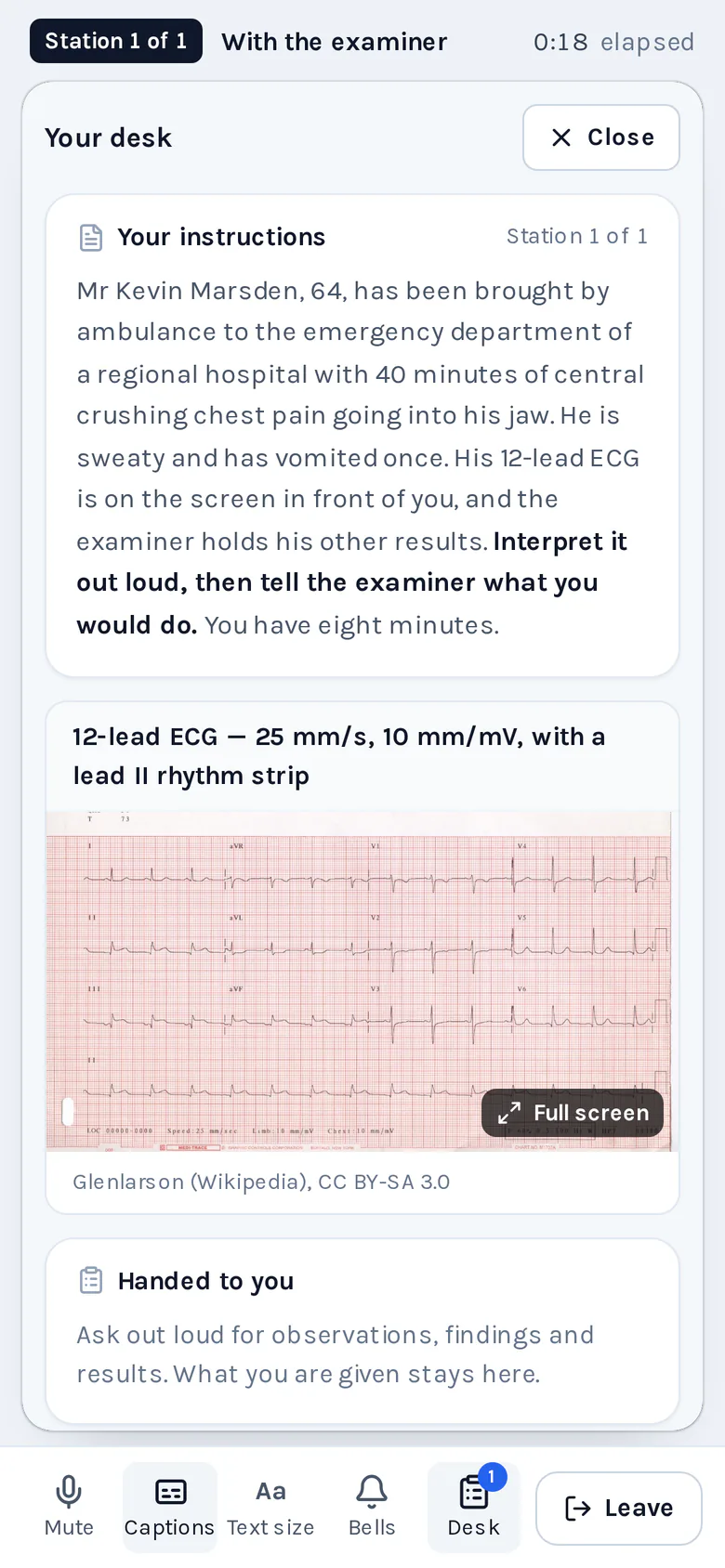
The candidate's desk on a phone during an AI OSCE data station from the Australian library: the instructions, the ECG and the space for what the examiner hands over.
Your desk, one tap away
Real screens of a live station, one of each kind. How the live room works

Start the final-year circuit tonight

Open the first station, run it out loud against the clock and tick your own sheet. It is free and needs no account.