
Data interpretation · Bloods
Blood gas: vomiting teenager OSCE mark scheme, mid clinical
A venous gas and a bedside ketone in a vomiting 17-year-old: reading them in order, making the diagnosis and turning it into a safe first two hours.
Mid clinical is where this sheet starts: 18 lines and 25 marks, most of them on clinical reasoning and patient safety.
- 1:30 + 8:00 reading, then the room
- 5 examiner questions
- Sat from mid clinical
- Free to practise, no account needed
- Reviewed
How do you want to practise?
Read the notice, run the clock, then mark yourself on the real sheet.
You present to a friend, who runs the clock and marks on their own phone.
Their marks land on your screen.
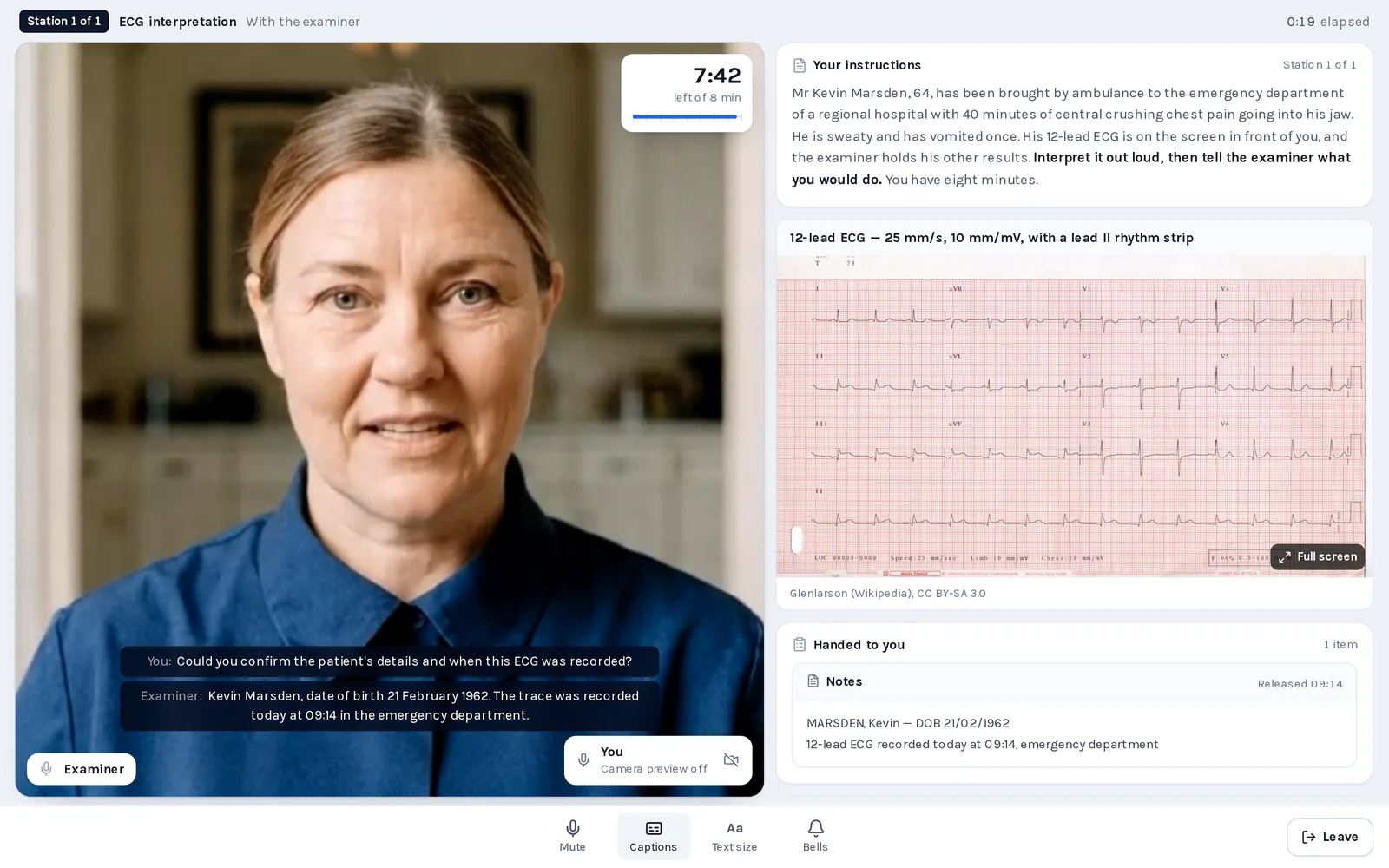
The image or results are on your screen and an AI examiner listens, by voice, while you present them.
Candidate instructions
The notice on the door
Ellie Gartside, 17, was brought by her mother this evening to the emergency department of a Melbourne hospital that sees adults and children, with a day of vomiting and abdominal pain. A venous blood gas and a bedside blood ketone taken at triage are in front of you, and the examiner has the rest of her notes. Please talk the examiner through the results, say what you think is going on and how you would treat her. The examiner will then ask you some questions. You have eight minutes.
90 sec reading, then 8 min in the station
On the trolley
- Venous blood gas printout with bedside ketone
- Pen and paper
Your notes from reading time
Saved in this browser only.
Mid clinical is where this sheet starts: 18 lines and 25 marks, most of them on clinical reasoning and patient safety.
Mid clinical standard. Reads the gas fluently, diagnoses ketoacidosis, works out which protocol applies and why, and starts fluid, potassium and insulin safely by that protocol.
3 critical lines. Miss one and the station is failed, however well the rest goes.
Communication 0/2Systematic 0/3Clinical reasoning 0/11Professionalism 0/1Patient safety 0/8
Run the station before you look
The answers are the most useful thing on this page once you have had a go, and the least useful before.
When the candidate asks to confirm the patient's name or details, or whose gas this is
The gas is labelled Ellie Gartside, aged 17, UR number 553021. It was collected today at 19:20.When the candidate asks for the venous blood gas result
Venous pH 7.13, carbon dioxide 25 millimetres of mercury, bicarbonate 8.2, base excess minus 19.4, lactate 1.9. Sodium 133, potassium 4.9, chloride 100, glucose 27.8, haemoglobin 152. Bedside blood ketone 5.6.Patient: Ellie GARTSIDE, female, 17 years, UR number 553021 Sample: venous blood gas, collected today at 19:20; bedside blood ketone at 19:15 Venous pH 7.13 (7.32 - 7.42) Venous pCO2 25 mmHg (41 - 51) Venous pO2 39 mmHg (30 - 45) HCO3- 8.2 mmol/L (22 - 28) Base excess -19.4 mmol/L (-3 to +3) Lactate 1.9 mmol/L (0.5 - 2.0) Na+ 133 mmol/L (135 - 145) K+ 4.9 mmol/L (3.5 - 5.2) Cl- 100 mmol/L (95 - 110) Glucose 27.8 mmol/L (4.0 - 7.8 random) Hb 152 g/L (115 - 165) Bedside blood ketone (beta-hydroxybutyrate) 5.6 mmol/L (below 0.6)
When the candidate asks for the history
Three weeks of thirst, passing a lot of urine and losing weight. Since yesterday, vomiting and abdominal pain. She has no known diabetes.History: 3 weeks of thirst, polyuria and weight loss; vomiting and abdominal pain since yesterday. No known diabetes. No regular medicines. No known drug allergies.
When the candidate asks which team will admit her, or about the hospital policy for her age
In this hospital, patients under 18 are admitted under the paediatric team.When the candidate asks for her weight
She was weighed on arrival at 52 kilograms.When the candidate asks for the observations
Heart rate 122, blood pressure 108 over 66, respiratory rate 28 and deep, saturations 99 per cent on room air, temperature 36.9. Central capillary refill 2 seconds. GCS 15.HR 122 regular | BP 108/66 | RR 28 (deep) | SpO2 99% on room air | Temp 36.9 °C Central capillary refill 2 s | GCS 15
When the candidate asks for the examination findings
She looks dry, with dry lips and sunken eyes. Her breathing is deep. Her abdomen is soft and mildly tender all over.When the candidate asks whether she has passed urine
She passed urine in the department 20 minutes ago.When the candidate asks for the laboratory blood results
Sodium 133, potassium 4.8, urea 7.9, creatinine 92. White cells 15.2, CRP 6. HbA1c 12.9 per cent, 118 millimoles per mole.Sample: laboratory bloods, collected today at 19:25 Na 133 mmol/L (135 - 145) | K 4.8 mmol/L (3.5 - 5.2) | Urea 7.9 mmol/L (3.0 - 8.0) | Creatinine 92 umol/L (45 - 90) WCC 15.2 x10^9/L (4.0 - 11.0) | CRP 6 mg/L (below 5) | HbA1c 12.9 % (4.0 - 6.0) | HbA1c 118 mmol/mol (20 - 42)
When the candidate asks for a urine dipstick
Urine dipstick: glucose 4 plus, ketones 4 plus, no nitrites and no leucocytes.When the candidate asks for a pregnancy test
No hCG is detected in her urine.When the candidate asks for an ECG
Sinus tachycardia at 120. The T waves are not peaked.When the candidate asks for a repeat gas after treatment has started
Two hours into treatment: pH 7.19, bicarbonate 11.0, potassium 4.2, glucose 21.5. The blood ketone is 4.6.Sample: repeat venous gas, 2 hours into treatment Venous pH 7.19 (7.32 - 7.42) | HCO3- 11.0 mmol/L (22 - 28) | K+ 4.2 mmol/L (3.5 - 5.2) | Glucose 21.5 mmol/L (4.0 - 7.8) | Ketone 4.6 mmol/L (below 0.6)
Talk me through these results. · Mid clinical
This is a venous gas for Ellie Gartside, a 17-year-old with three weeks of thirst, polyuria and weight loss and a day of vomiting and abdominal pain, collected at 19:20 today. Because it is venous I will not interpret the oxygen. The pH is 7.13, an acidaemia. The bicarbonate is 8.2 with a base excess of minus 19.4, so this is a metabolic acidosis, and the carbon dioxide of 25 millimetres of mercury is respiratory compensation from her deep breathing. The anion gap is 133 minus the sum of 100 and 8.2, about 25, so it is raised, and a lactate of 1.9 cannot explain it. The bedside ketone is 5.6 and the glucose is 27.8. With acidosis, ketones of 3 or more and a glucose above 11, this is diabetic ketoacidosis, almost certainly a first presentation of type 1 diabetes. By the Royal Children's Hospital grading, a pH below 7.2 or a bicarbonate below 10 is moderate. Her potassium of 4.9 is in range but will fall with insulin. My next question is which team will admit her.
What would you do in the first two hours? · Mid clinical
I would assess her with an ABCDE approach, put in two cannulae, attach a cardiac monitor and call the paediatric registrar, because under-18s with ketoacidosis are admitted under the paediatric team here, so the paediatric protocol applies, which in Victoria is the Royal Children's Hospital guideline. She weighs 52 kilograms. She is tachycardic, but her central capillary refill is 2 seconds, so she does not need the 10 mL/kg bolus, which is reserved for tachycardia with delayed central capillary refill. With dry lips and fast breathing, and no signs of shock despite her sunken eyes, she fits moderate dehydration, so I would start 0.9% sodium chloride at the moderate rate in the weight table, 155 millilitres an hour, which replaces the deficit over 48 hours with maintenance, with 40 millimoles of potassium chloride per litre because her potassium is below 5.5 and she has passed urine. One hour after the fluids start, I would begin insulin at 0.1 units per kilogram per hour, 5.2 units an hour, with no bolus. She needs hourly glucose and ketones, frequent neurological observations, a repeat gas with electrolytes at two hours, and the paediatric diabetes team told about a new diagnosis.
Her potassium is 4.9. What would you do about her potassium, and why? · Mid clinical
She still needs potassium in her fluids, because the 4.9 is misleading. In ketoacidosis potassium moves out of the cells with the acidosis and the lack of insulin, while the osmotic diuresis and the vomiting have been losing it in the urine and gut for days, so the whole-body stores are depleted whatever the plasma level shows. Once insulin starts, potassium moves back into the cells and the plasma level falls, sometimes fast, and hypokalaemia can cause dangerous arrhythmias. The Royal Children's Hospital guideline therefore uses fluid containing 40 millimoles of potassium chloride per litre once the potassium is 5.5 or less and she is passing urine, increasing to a maximum of 60 if needed to keep it in range. If she were anuric, or her potassium were above 5.5, potassium would wait until that had improved. If it were below 3.0, it would be replaced before the insulin started. She has passed urine and her level is 4.9, so potassium goes in now, with a cardiac monitor and a recheck within an hour of starting insulin, then every two to four hours.
Suppose four hours into treatment she complains of a headache, becomes irritable and her heart rate falls to 58. What do you do? · Final year
This is cerebral injury until proven otherwise, and treatment cannot wait for a scan. Headache and irritability are early signs, and a falling heart rate is a late one, so she needs treatment now. I would call the consultant and intensive care, or the retrieval service, immediately, nurse her head up, reduce the fluid infusion rate by one third, and give hyperosmolar therapy: mannitol 20 per cent, 0.5 grams per kilogram intravenously over 20 minutes, which is 26 grams for her, or 3 per cent sodium chloride, 3 millilitres per kilogram over 15 minutes, which is about 156 millilitres. If there is no response within 15 minutes, I would discuss repeat doses with the intensive care specialist. I would check her glucose to exclude hypoglycaemia, and repeat her neurological observations frequently, watching for a falling conscious level, abnormal breathing or pupil changes. Clinically significant cerebral injury usually develops within the first 12 hours, which is why her neurological observations matter so much tonight. Imaging comes once she is stable, to look for other intracranial events.
Suppose she had been admitted under the adult medical team instead. What would change in her treatment? · Final year
She would then be treated by that hospital's adult DKA protocol, followed completely, rather than by the paediatric one. The details differ between hospitals, so I would take every number from the local protocol, but the pattern tends to be the same. Adult protocols give the first fluid faster, in fixed volumes over the first hours rather than a deficit spread evenly over 48 hours, so she would receive considerably more fluid early. They tend to start a weight-based insulin infusion without the paediatric one-hour wait, once the potassium is known. Potassium is added according to the measured level from the protocol's own table, and glucose is added as the blood glucose falls while the insulin continues. Because she is 17, slight and has a first presentation with marked acidosis, I would still give fluid cautiously, watch her neurology closely, and ask the paediatric or adolescent diabetes team for advice, since cerebral injury is a risk in young people whichever protocol is used. What I would not do is pick parts of each protocol.
How it is marked
What this station is really testing
The gas on this station is not hard to read, and the examiner knows it. A venous pH of 7.13, a bicarbonate of 8.2, a ketone of 5.6 and a glucose of 27.8 in a teenager with three weeks of thirst is diabetic ketoacidosis at first presentation of type 1 diabetes, and you should say so within a minute. The station is about what happens next, because a 17-year-old sits on the boundary between two protocols that treat the same numbers very differently. Reading the gas fluently and then writing up a litre of saline over an hour by habit is the commonest way to lose the station.
Read the restShow less
In Australia the boundary is set by each hospital and state rather than by one national rule. Perth Children's Hospital, for example, applies its paediatric DKA protocol from birth to 18 years, while some adult hospitals manage 16 and 17-year-olds under their adult protocols. So the first question is which team will admit her, and the second is to follow that team's protocol completely rather than mixing two. Here she is going to the paediatric team, so the paediatric protocol applies, which in Victoria is the Royal Children's Hospital guideline: rehydration at a rate from its weight table that replaces the deficit over 48 hours with maintenance, a 10 mL/kg bolus only for tachycardia with delayed central capillary refill, potassium in the fluids once she is passing urine, and an insulin infusion started an hour after the fluids, with no bolus.
The reason for the difference is cerebral injury, the key life-threatening complication of DKA in children and young people. It usually develops within the first 12 hours, and a first presentation with severe acidosis and dehydration carries a higher risk. You must know its early signs, headache, irritability, lethargy and vomiting that worsens after treatment starts, and its treatment, mannitol or hypertonic saline without waiting for a scan. In the mid clinical year the diagnosis, the protocol choice with its reason and safe fluid, potassium and insulin are a pass. In the final year add the rate for her weight, the change to glucose-containing fluid, cerebral injury and the new-diagnosis plan.
Where the 25 marks are at Mid clinical
- Communication2
- Systematic approach3
- Clinical reasoning11
- Professionalism1
- Patient safety8
3 critical lines. Miss one and the station is failed, whatever the total.
What a pass looks like at each stage
Mid clinical
18 lines, 25 marks
The sheet starts here.
Reads the gas fluently, diagnoses ketoacidosis, works out which protocol applies and why, and starts fluid, potassium and insulin safely by that protocol.
What lifts it to a clear pass
- Diagnose within the first minute: pH, bicarbonate, ketone and glucose, matched to the criteria.
- Ask which team will admit her before you prescribe anything. For a 17-year-old, that answer decides the protocol.
- Say the paediatric order out loud: rehydration from the weight table over 48 hours, potassium once she is passing urine, insulin an hour later with no bolus.
- Ask for her weight. Every number on this station depends on it.
Final year
24 lines, 32 marks
Adds six lines, most of them on clinical reasoning and patient safety.
Uses the rate for her weight, grades the severity, plans glucose-containing fluid and monitoring, and can recognise and treat cerebral injury.
What lifts it to a clear pass
- Know where the rate comes from: the weight table covers maintenance and the deficit over 48 hours, so 155 mL an hour at 52 kg for moderate dehydration.
- Know the cerebral injury doses: mannitol 0.5 g/kg over 20 minutes or 3 per cent saline 3 mL/kg over 15 minutes.
- Know what an adult protocol would have done differently, so you can explain why it is not used for her.
- Think beyond tonight: the diabetes team, a family who have just learned she has type 1 diabetes, and her registration with the National Diabetes Services Scheme.
A system you can run under pressure
Step 1 — read the gas and make the diagnosis
- Confirm the name, the hospital number and the time, and that the sample is venous — the oxygen tension on a venous gas says nothing about her lungs
- pH and bicarbonate first — the Royal Children's Hospital criteria use a venous pH below 7.3 or a bicarbonate below 18 for the acidosis
- Read the carbon dioxide — low in an acidaemic patient means respiratory compensation, and a rising value later means she is tiring
- Calculate the anion gap, sodium minus the sum of chloride and bicarbonate — a raised gap with a lactate near normal points to ketones
- Match the ketone and the glucose — a blood ketone of 3 or more with acidosis and a glucose above 11 completes the diagnosis
Step 2 — decide which protocol applies
- Ask which team will admit her — age cut-offs for paediatric care differ between hospitals and states, and the admitting team's protocol is the one to follow
- Follow one protocol completely — mixing adult fluid volumes with paediatric potassium or insulin timing is how errors happen
- Grade two things separately — the Royal Children's Hospital grades the ketoacidosis by the worse of pH and bicarbonate, but picks the column in its fluid table from the clinical degree of dehydration, and most children can start on the mild or moderate rate
- Weigh her — the paediatric rates and insulin dose are calculated from her measured weight, and an estimate is the start of most fluid errors
Step 3 — the paediatric protocol in practice
- A 10 mL/kg bolus of 0.9% sodium chloride over 30 minutes only if she is tachycardic with delayed central capillary refill, then a reassessment
- Rehydration at the rate in the weight table, which covers maintenance and the deficit over 48 hours — at 52 kg, 155 mL an hour for moderate dehydration
- Potassium chloride 40 mmol/L in the fluids once the potassium is 5.5 or less and she is passing urine, up to 60 mmol/L if needed
- Insulin infusion at 0.1 units/kg/hour for most patients, no bolus, started one hour after the intravenous fluids begin
- When the glucose reaches 15, change to 0.9% sodium chloride with 5% glucose and potassium, and raise the glucose to 10% before ever reducing the insulin
Step 4 — watch for cerebral injury
- Early signs: headache, irritability, lethargy and vomiting that worsens after treatment starts
- Later and very late signs: depressed consciousness, incontinence, thermal instability, then bradycardia, rising blood pressure and abnormal breathing
- Treat at once with mannitol 20 per cent 0.5 g/kg over 20 minutes or 3 per cent sodium chloride 3 mL/kg over 15 minutes, without waiting for imaging
- Reduce the fluid rate by a third, nurse her head up, involve the consultant and intensive care or the retrieval service, and discuss further doses if there is no response in 15 minutes
The lines that carry marks
Opening the presentation
This is a venous gas for Ellie Gartside, 17, UR number 553021, collected at 19:20 with a bedside ketone at 19:15.
Making the diagnosis
A pH of 7.13, bicarbonate of 8.2, ketone of 5.6 and glucose of 27.8: this is diabetic ketoacidosis, probably a first presentation of type 1 diabetes.
Asking the deciding question
Before I chart anything, which team will she be admitted under? At 17 that decides whether the adult or the paediatric protocol applies.
Naming the protocol
She is going to the paediatric team, so I will follow the Royal Children's Hospital protocol all the way through rather than mixing it with an adult one.
Show the other 4Show fewer
Charting fluid
Her central capillary refill is 2 seconds, so no bolus; 0.9% saline at 155 millilitres an hour with 40 millimoles of potassium per litre.
Timing the insulin
The insulin infusion starts an hour after the fluids, at 0.1 units per kilogram per hour, with no bolus.
Watching for cerebral injury
I want frequent neurological observations, and anyone who hears her complain of a headache should call me straight away.
Handing over
Ellie Gartside, 17, 52 kilograms, moderate DKA at first presentation: pH 7.13, bicarbonate 8.2, ketone 5.6, potassium 4.9. I have started paediatric-protocol fluids with potassium and plan insulin at 0.1 units per kilogram per hour after the first hour. Please come and see her.
How candidates lose marks here
- Writing up a litre of 0.9% saline over an hour out of adult habit, without asking which team will manage her.
- Mixing the protocols — adult fluid volumes with paediatric potassium, or the reverse.
- Starting the insulin infusion at the same time as the fluids, or giving an insulin bolus.
- Being reassured by a potassium of 4.9 and leaving it out of her fluids.
- Calculating fluids on an estimated weight when she has been weighed.
- Not knowing the early signs of cerebral injury, or waiting for a CT before treating it.
- Stopping the insulin when the glucose falls, instead of adding glucose to the fluids.
Now sit it live