
Practical skills · Procedures
Blood pressure measurement: lying and standing OSCE mark scheme, early clinical
Measure a manual blood pressure on an older man admitted after a fall, lying and then standing, talked through to the examiner: the cuff, the arm, the pulse, the sounds, what you do while he is on his feet, and what the three readings mean.
Early clinical is where this sheet starts: 26 lines and 32 marks, most of them on systematic approach and patient safety.
- 1:00 + 10:00 reading, then the room
- 5 examiner questions
- Sat from early clinical
- Free to practise, no account needed
- Reviewed

How do you want to practise?
Read the notice, run the clock, then mark yourself on the real sheet.
You present to a friend, who runs the clock and marks on their own phone.
Their marks land on your screen.
An AI examiner runs the station by voice. It cannot see your hands, so practise the technique itself on a manikin.
Candidate instructions
The notice on the door
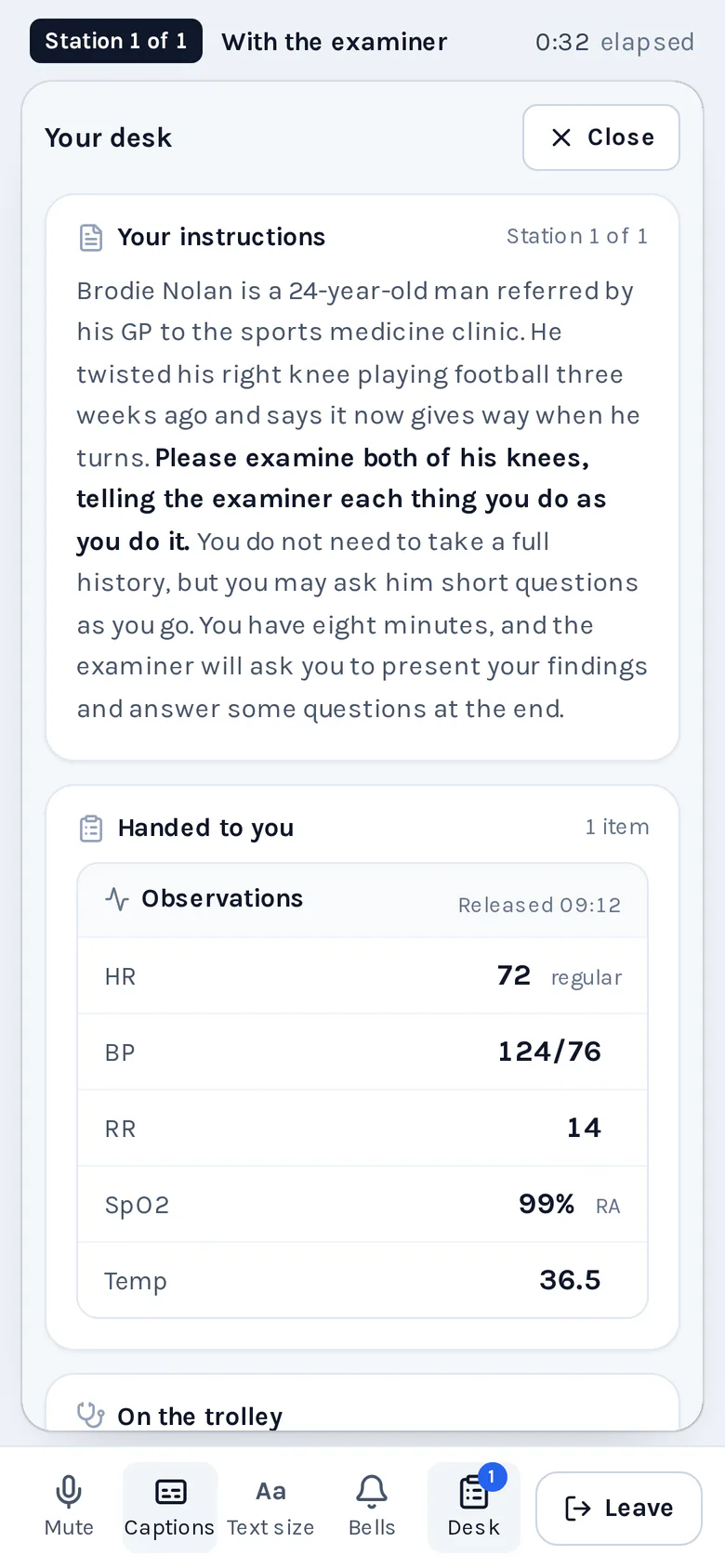
Mr Keith Dawson, 79, was admitted to the medical ward yesterday after a fall at home. The ward’s automatic machine keeps showing an error when it is used on him, and the nurse in charge has asked for a lying and standing blood pressure. Please measure his blood pressure with the manual sphygmomanometer, first lying and then standing, talking the examiner through each thing you check, say and do, and why. There is nothing to touch: the examiner will tell you what you see, feel and hear. You have ten minutes. Towards the end the examiner will ask you for your readings and what they mean.
1 min reading, then 10 min in the station
On the trolley
- Aneroid sphygmomanometer
- Cuffs in three sizes: small adult, adult and large adult
- Stethoscope
- Watch with a second hand
- Chair beside the bed
- Alcohol-based hand rub and equipment wipes
- Observation chart and pen
Your notes from reading time
Saved in this browser only.
Early clinical is where this sheet starts: 26 lines and 32 marks, most of them on systematic approach and patient safety.
Early clinical standard. Produces three trustworthy readings with the right cuff on a supported arm, keeps the patient safe while he stands, recognises the drop and tells someone.
1 critical line. Miss it and the station is failed, however well the rest goes.
Communication 0/4Systematic 0/12Clinical reasoning 0/6Professionalism 0/2Patient safety 0/8
Run the station before you look
The answers are the most useful thing on this page once you have had a go, and the least useful before.
When the candidate asks the patient to state his name and date of birth
He says Keith Dawson, the twelfth of May nineteen forty-seven.When the candidate checks the ID band
The ID band reads Keith Dawson, twelve five nineteen forty-seven, medical record number six zero two two four eight.ID band: DAWSON, Keith | DOB 12/05/1947 | MRN 602248
When the candidate explains the measurement and asks for his consent
He says go ahead.When the candidate asks how long he has been lying down
He has been lying on the bed for twenty minutes.When the candidate asks about caffeine, smoking or exercise beforehand
He had a cup of tea three hours ago, does not smoke and has not exercised.When the candidate asks whether he is in pain
He says he has no pain.When the candidate asks whether he needs the toilet
He says he does not need the toilet.When the candidate asks whether he gets dizzy or light-headed when he stands up
He says he comes over light-headed most mornings when he gets out of bed.When the candidate asks whether he can stand on his own, or how he walks
He says he can stand on his own and walks with a stick.When the candidate looks at his arms or chooses an arm
There is a cannula in the back of his left hand with a drip running. The right arm is free.When the candidate asks him whether there is any reason not to use either arm
He says no, apart from the drip.When the candidate checks the sphygmomanometer
The needle rests at zero and the tubing is intact.When the candidate checks the size of the cuff against his arm
The cuff attached is the small adult size. Its bladder reaches about halfway round his upper arm.When the candidate changes to a larger cuff
The bladder of the new cuff reaches almost all the way round his arm.When the candidate feels the radial or brachial pulse
The pulse is about eighty a minute. The beats come at uneven intervals with no pattern.When the candidate inflates the cuff while feeling the radial pulse, with him lying
The pulse disappears at one hundred and fifty.When the candidate listens over the brachial artery while deflating the cuff, with him lying
The sounds appear at one hundred and forty-eight and disappear at eighty-four.When the candidate stands him up
He stands, holding the bed rail with his left hand.When the candidate asks how he feels just after standing
He says he is a bit light-headed.When the candidate takes the first blood pressure reading after he stands
The sounds appear at one hundred and twenty-two and disappear at seventy-four.When the candidate takes a second standing reading, or measures at about three minutes of standing
The sounds appear at one hundred and twelve and disappear at sixty-eight. He says everything is going grey and his knees feel weak.When the candidate sits or lies him back down
After half a minute he says the feeling has gone.When the candidate asks what medicines he takes or looks at the medication chart
The chart lists ramipril, indapamide and tamsulosin, all given this morning.When the candidate tells the nurse in charge or the doctor about the readings
The nurse in charge says she will ask the doctor to see him.
Please give me your readings and tell me what they show. · Early clinical
Lying, after more than five minutes of rest, his blood pressure was 148 over 84 in the right arm with an adult cuff. Standing, it was 122 over 74 in the first minute and 112 over 68 at three minutes, when he felt faint and I sat him down. So his systolic falls by 36 and his diastolic by 16, with symptoms. The international consensus definition of orthostatic, or postural, hypotension is a sustained fall of at least 20 systolic or 10 diastolic within three minutes of standing. The Heart Foundation guideline asks for a standing reading after at least two minutes where postural hypotension is suspected, and hospital lying and standing procedures, such as the one from the New South Wales Clinical Excellence Commission, ask for readings in the first minute and at three minutes. He meets the definition clearly. In a man admitted after a fall that is likely to be part of why he fell. I would tell the nurse in charge and his doctor now, make sure he has his call bell and knows to ask for help before he gets up, chart all three readings with the position, time and symptoms, and ask for his medicines to be reviewed. His pulse was also irregular, which may be why the automatic machine failed, and that needs an ECG.
What can make a manual blood pressure reading falsely high or falsely low? · Early clinical
Most errors read high. The commonest is a cuff that is too small: the bladder should reach round at least 80 per cent of the upper arm. An arm hanging below the level of the heart reads high, and so does an arm the patient is holding up himself. Talking, pain, anxiety, a full bladder, recent caffeine, smoking or exercise, and no rest beforehand all raise it, as does a cuff put on over a thick sleeve. Readings come out low with a cuff that is too large or an arm raised above the heart. Letting the pressure fall too quickly makes the systolic read low and the diastolic read high, because the needle has moved on before the next beat. If I do not estimate the systolic by palpation first I can start listening inside an auscultatory gap and record a systolic that is far too low. Then there is the observer: rounding to the nearest ten, and relying on a single reading. The equipment matters as well: a gauge that does not rest at zero, or leaking tubing. With an irregular pulse the pressure changes from beat to beat, so I deflate slowly and repeat the reading.
What are the likely causes of a postural drop in a man like this, and what should be done about it? · Mid clinical
Medicines come first, because they are the commonest cause and the easiest to change. I would read his medication chart for antihypertensives, diuretics and alpha-blockers given for the prostate, such as tamsulosin, and also nitrates, antidepressants, antipsychotics, levodopa, opioids and sedatives. Second is volume depletion: poor intake, vomiting or diarrhoea, diuretics or bleeding, so I would look at his fluid balance and ask for urea, electrolytes and creatinine and a full blood count. Third is autonomic failure, from diabetes, Parkinson's disease or alcohol. Acute illness and several days in bed add to all of these. Because his pulse is irregular he needs an ECG. The priorities are to find and remove the cause, to reduce the risk of another fall, and to refer on if symptoms persist once the causes have been dealt with. In practice I would tell his team today and ask the resident and the ward pharmacist to review the three likely drugs: whether each is still needed, at what dose, and at what time of day. Meanwhile he has falls precautions and help to mobilise, and the lying and standing readings are repeated until they have settled.
Why should the pulse be felt before a blood pressure is measured, and what do you do if it is irregular? · Mid clinical
For three reasons. First, automatic oscillometric machines work out the pressure from a run of regular pulse waves, and with an irregular rhythm such as atrial fibrillation they can give an error or a wrong number. The Heart Foundation hypertension guideline says to palpate the radial or brachial pulse before measuring with an automated device, and if the pulse is irregular to measure manually by auscultation over the brachial artery. Second, I need the radial pulse anyway to estimate the systolic by palpation, which protects against an auscultatory gap. Third, the pulse is an observation in its own right, and an irregular pulse found by chance has to be acted on. When it is irregular the pressure varies from beat to beat, because the filling time varies. So one reading cannot be trusted: I deflate slowly, repeat the measurement and average the readings. Then I ask for a 12-lead ECG to find out whether this is atrial fibrillation. If it is, he needs an assessment of his stroke risk and a decision about anticoagulation under the Australian atrial fibrillation guideline, as well as a look for a cause such as infection, thyroid disease or heart failure.
Suppose his pressure still falls on standing after his medicines have been reviewed. How is postural hypotension managed? · Final year
By treating whatever cause remains and then by simple measures before drugs. I would make sure reversible causes have been dealt with: volume depletion corrected, anaemia and electrolyte problems looked for, and any remaining culprit drug reduced, stopped or moved to night-time. Then education. He should get up in stages, sitting on the edge of the bed for a minute before standing, and sit down at once if symptoms start. Clenching the calves or crossing the legs before and after standing helps, and so does drinking enough and avoiding alcohol, large meals and hot baths. Sleeping with the head of the bed raised and wearing compression stockings or an abdominal binder help some people. Salt intake is only increased where heart failure and hypertension allow. If he remains symptomatic he is referred to a specialist, usually a geriatrician or a falls and syncope clinic. A specialist may start fludrocortisone or midodrine, and both can cause high pressure when lying down, so lying pressure is monitored. If he also needs treatment for hypertension, his standing pressure and his symptoms have to guide how far it is lowered.
How it is marked
What this station is really testing
Blood pressure is the most often measured and most often mis-measured number in medicine, and this station asks you for three readings that somebody can act on. The examiner is not listening for whether you can pump up a cuff. They are listening for the things that make the number wrong before you begin: a cuff too small for the arm, an arm hanging below the heart, a patient who has not rested, a pulse nobody felt. Each of those moves the reading by as much as a tablet does, and none of them shows on the chart afterwards. So say what you check and why: the bladder of the cuff against his arm, the arm supported level with his heart, and the pulse at the wrist before anything is inflated.
Read the restShow less
Say the manual method in full, because in a talk-through it has not happened until you do. Feel the radial pulse and inflate until it disappears, which gives you an estimate and protects you from the silent gap that can follow the first sounds. Go 30 above that, listen over the brachial artery and let the needle fall at two to three millimetres per beat. The first repeating sound is the systolic and the point where the sounds vanish is the diastolic, read to the nearest two. Then the second half: he has lain for at least five minutes, he stands, and you measure in the first minute and again at three. Before he stands, find out whether he can do it safely. While he stands, ask how he feels. If he tells you he is going to faint, the measurement is over and he sits down.
The readings then have to become a sentence. A fall of 20 or more in the systolic, or 10 or more in the diastolic, is a postural drop, and in a man admitted after a fall somebody needs to hear about it today. In the early clinical year, three correctly measured readings, a patient kept safe on his feet, the drop recognised and the nurse or doctor told is the standard. In the mid clinical year, explain what an irregular pulse does to the measurement, keep the arm at heart level when he stands, look for the cause on the medication chart and put falls precautions in place. In the final year, be able to say how the drop is investigated and managed, and what an irregular pulse found by chance now requires.
Where the 32 marks are at Early clinical
- Communication4
- Systematic approach12
- Clinical reasoning6
- Professionalism2
- Patient safety8
1 critical line. Miss it and the station is failed, whatever the total.
What a pass looks like at each stage
Early clinical
26 lines, 32 marks
The sheet starts here.
Produces three trustworthy readings with the right cuff on a supported arm, keeps the patient safe while he stands, recognises the drop and tells someone.
What lifts it to a clear pass
- Hold the cuff against the arm before you wrap it. Saying "the bladder covers most of the arm" takes two seconds.
- Always feel the pulse first, then use it to estimate the systolic. Both steps are marks and both are habits.
- Give each reading as two numbers and a position: "lying, 148 over 84".
- Subtract out loud. "That is a fall of 36" is the sentence the examiner is waiting for.
Mid clinical
30 lines, 36 marks
Adds four lines, most of them on clinical reasoning and systematic approach.
Explains the sources of error, handles the irregular pulse, and turns the result into a cause to look for and a patient to make safe.
What lifts it to a clear pass
- Know which errors read high (small cuff, arm low, talking, no rest) and which read low (large cuff, arm high).
- Hold his forearm up at heart level when he stands. It is the step most often forgotten.
- Ask for the medication chart before the examiner asks you why his pressure falls.
- Leave him with the call bell and one instruction: ring before you get up.
Final year
32 lines, 38 marks
Adds two lines, all on clinical reasoning.
Manages the finding as a junior doctor would: a medication review, a search for volume loss and autonomic causes, a plan for the irregular pulse, and treatment judged on the standing pressure.
What lifts it to a clear pass
- Have a list of culprit drugs beyond antihypertensives: alpha-blockers, nitrates, antidepressants, antipsychotics, levodopa.
- Know the non-drug measures and say that midodrine or fludrocortisone is a specialist decision.
- An irregular pulse found on the ward is not a footnote: ask for the ECG.
- In someone with a postural drop, how far the blood pressure is lowered has to take the standing reading into account.
A system you can run under pressure
Before the cuff goes on
- Confirm his name and date of birth against the ID band and explain what you are doing, including that the cuff will feel tight and that you will ask him to stand — observations charted for the wrong patient are acted on for the wrong patient
- Check he has been lying down for at least five minutes — the lying reading is the baseline, and a baseline taken straight after moving is too high or too low to compare
- Ask about caffeine and smoking in the last two hours, about recent exercise, and whether he is in pain or needs the toilet — all of them raise the reading
- Ask whether he gets dizzy when he stands, and whether he can stand on his own — the first tells you what to expect and the second tells you whether you need help
Cuff, arm and pulse
- Choose the arm: avoid a cannula with an infusion, a fistula, lymphoedema or the side of breast or axillary surgery — a cuff inflated over a running drip stops it and can damage the vein
- Check the cuff: the bladder should reach round at least 80 per cent of the upper arm — too small a cuff over-reads and too large a cuff under-reads
- Bare the arm and place the centre of the bladder over the brachial artery, with the lower edge about two centimetres above the elbow crease — a sleeve pushed up tight acts as a tourniquet
- Support the arm so that the cuff is level with his heart — below the heart the reading is falsely high, above it falsely low, and an arm he holds up himself reads high
- Feel the radial pulse for rate and rhythm first — automatic machines are unreliable with an irregular pulse, which is when a manual reading is needed
The manual reading
- Inflate the cuff while feeling the radial pulse and note where it disappears — this estimate stops you missing the top of the pressure through an auscultatory gap
- Deflate, then inflate to 30 above the estimate with the stethoscope over the brachial artery — over-inflating hurts and raises the pressure you are trying to measure
- Let the pressure fall at two to three millimetres per beat, or slower — faster than that and the systolic reads low and the diastolic high
- Systolic is where repeating sounds first appear and diastolic is where they disappear, each to the nearest 2 mmHg — rounding to the nearest ten is the commonest observer error
- Ask him not to talk, and do not talk to him, while you listen — talking raises the reading
Lying, then standing
- Take the first reading after at least five minutes lying — the comparison is with rest
- Before he stands, make sure it is safe: shoes or grip socks, his stick, a chair or the bed behind him, you within reach, and a second person if he is unsteady — this test is done on people who fall
- Measure in the first minute of standing and again at three minutes — some patients drop at once and others only after a few minutes
- Keep his arm supported at heart level while he stands — an arm hanging by his side reads higher and can hide the drop
- Ask about dizziness, light-headedness, blurred vision and weakness, and watch his colour — symptoms are part of the result
- If he feels faint, sit or lie him down at once — you already have your answer, and a reading is never worth a fall
What the numbers mean
- A sustained fall of 20 or more systolic, or 10 or more diastolic, within three minutes of standing is a postural drop by the international consensus definition — say the size of the fall, not only the readings
- Tell the nurse in charge and the doctor now, and make him safe: call bell, help to stand, rising in stages — the result changes how he is looked after tonight
- Look at the medication chart: antihypertensives, diuretics and alpha-blockers are the usual causes — it is the cause most easily put right
- Chart all three readings with position, time, arm and symptoms — "BP 148/84" alone loses the finding
The lines that carry marks
Explaining
I would like to measure your blood pressure while you are lying down and then again when you stand up. The cuff will squeeze your arm quite tightly for a few seconds each time. Is that all right?
Before he stands
Can you normally stand up on your own? Do you ever feel dizzy when you do? I will be right beside you, the bed is behind you, and if you feel faint tell me straight away and we will sit you down.
The cuff
This cuff is too small for his arm: the bladder only reaches halfway round. I am changing it for the adult cuff, which covers more than 80 per cent.
The pulse
His pulse is about 80 and irregularly irregular, which is probably why the automatic machine fails, so I will measure by listening and deflate slowly.
Show the other 4Show fewer
The manual reading
I inflate until the radial pulse disappears, at about 150. I let it down, then go up to 180, listen over the brachial artery and deflate at two to three millimetres per beat.
Standing
Up you get, slowly. Keep hold of the rail. I am holding your arm up level with your heart and measuring now, and again at three minutes. How are you feeling?
When he feels faint
Let us sit you straight back down. That is all I need. Take a moment, and tell me when the feeling has passed.
Reporting it
Mr Dawson in bed four: lying 148 over 84, standing 122 over 74 at one minute and 112 over 68 at three, when he nearly fainted. That is a fall of 36 systolic. He had ramipril, indapamide and tamsulosin this morning, and his pulse is irregular. Could the doctor review him?
How candidates lose marks here
- Using whatever cuff is on the machine — hold it against the arm first, because a cuff that is too small gives a falsely high reading.
- Skipping the pulse — feel it before you inflate, because an irregular pulse explains the machine's error and palpation gives you the estimate.
- Dropping the needle quickly to save time — two to three millimetres per beat, or the systolic reads low.
- Standing him up without asking how he gets about — he was admitted after a fall, so decide whether you need help before he is on his feet.
- Letting his arm hang by his side for the standing readings — support it at heart level, or the reading is falsely high and the drop is hidden.
- Waiting out the full three minutes while he tells you he is going to faint — sit him down. The drop is already proven.
- Charting three numbers and walking away — work out the fall, say it and tell the nurse in charge.
Where to read more
- Guideline for the diagnosis and management of hypertension in adults (2016), table 4.1 on measuring clinic blood pressureNational Heart Foundation of Australia · reference
- Hypertension clinical information and guidelinesNational Heart Foundation of Australia · guide
- Preventing falls and harm from falls in older people: best practice guidelines for Australian hospitalsAustralian Commission on Safety and Quality in Health Care · reference
- How to measure a lying and standing blood pressure (BP) as part of a falls assessmentClinical Excellence Commission, NSW Health · checklist
- Australian clinical guidelines for the diagnosis and management of atrial fibrillation (2018)National Heart Foundation of Australia and CSANZ · reference
- Blood pressure measurement resources for health professionalsHypertension Australia · guide
- Low blood pressure (hypotension)healthdirect · guide
Now sit it live