
Data interpretation · Bloods
Clotting results on warfarin OSCE mark scheme, mid clinical
A very high INR in an older woman on warfarin who has hit her head: reading the clotting screen, deciding whether she is bleeding, acting on it and finding out why it happened.
Mid clinical is where this sheet starts: 16 lines and 22 marks, most of them on clinical reasoning and systematic approach.
- 1:30 + 8:00 reading, then the room
- 6 examiner questions
- Sat from mid clinical
- Free to practise, no account needed
- Reviewed
How do you want to practise?
Read the notice, run the clock, then mark yourself on the real sheet.
You present to a friend, who runs the clock and marks on their own phone.
Their marks land on your screen.
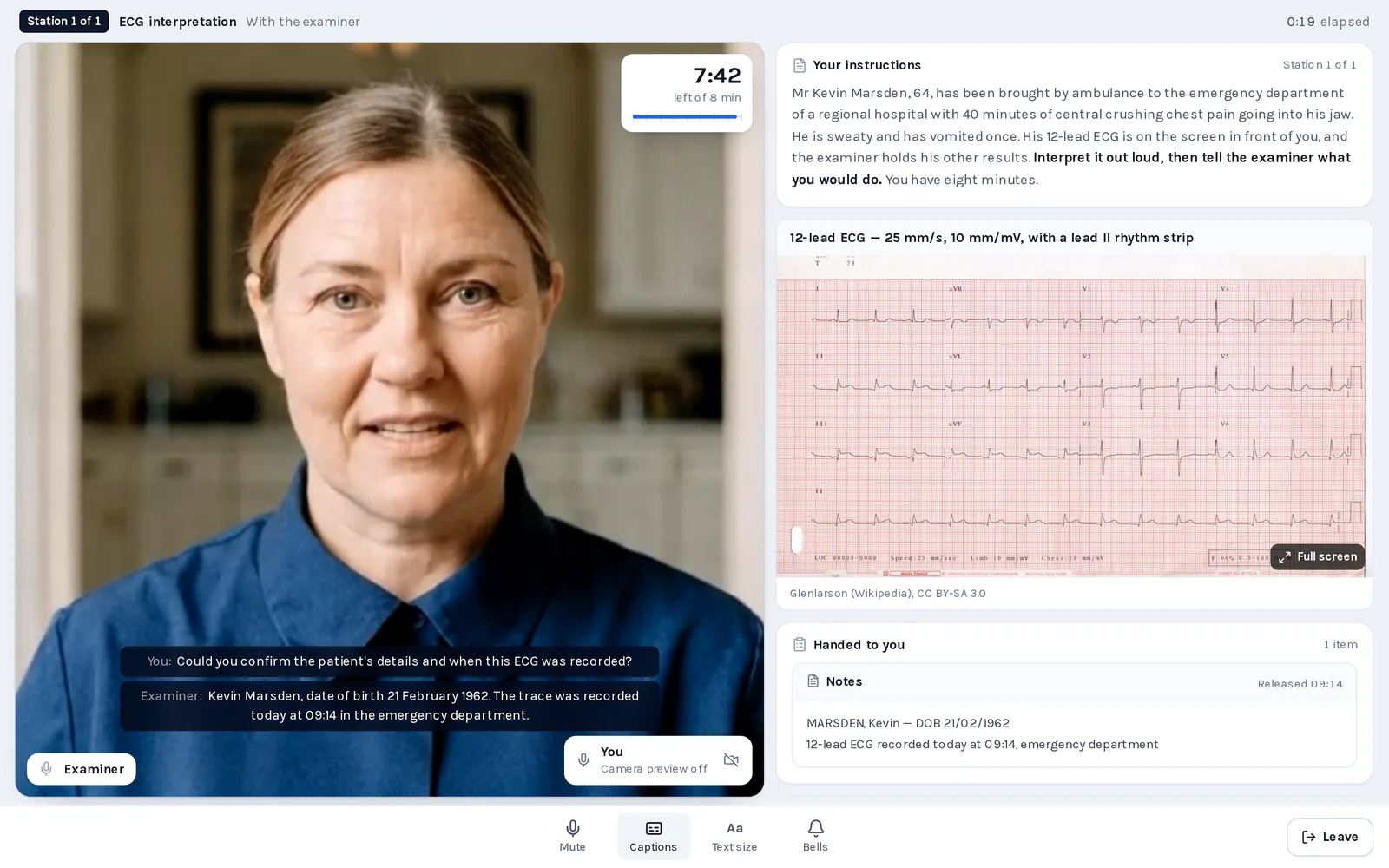
The image or results are on your screen and an AI examiner listens, by voice, while you present them.
Candidate instructions
The notice on the door
Beverley Nolan, 81, takes warfarin and was brought to the emergency department this morning after a fall at home in which she hit her head. Her blood results, including a coagulation screen, are in front of you, and the examiner has the rest of her notes. Please talk the examiner through the results, say what you think is going on and what you would do now. The examiner will then ask you some questions. You have eight minutes.
90 sec reading, then 8 min in the station
On the trolley
- Pathology results
- Pen and paper
Your notes from reading time
Saved in this browser only.
Mid clinical is where this sheet starts: 16 lines and 22 marks, most of them on clinical reasoning and systematic approach.
Mid clinical standard. Reads the whole coagulation screen against her target, asks for an urgent CT, reverses the bleed with concentrate and intravenous vitamin K, and finds the interacting antibiotic.
3 critical lines. Miss one and the station is failed, however well the rest goes.
Communication 0/2Systematic 0/4Clinical reasoning 0/10Professionalism 0/1Patient safety 0/5
Run the station before you look
The answers are the most useful thing on this page once you have had a go, and the least useful before.
When the candidate asks to confirm the patient's name or details, or whose results these are
The results are for Beverley Nolan, date of birth 23 February 1945. The bloods were collected today at 10:30.When the candidate asks for the blood results or the coagulation screen
Prothrombin time 98.5 seconds, INR 8.9. APTT 38.4. Fibrinogen 3.4. Haemoglobin 118, white cells 9.8, platelets 254. Sodium 137, potassium 4.6, urea 9.4, creatinine 104. Bilirubin 12, ALT 18, ALP 86, albumin 34.Patient: Beverley NOLAN, female, DOB 23/02/1945 Sample: venous blood, collected today at 10:30, reported 11:20 Prothrombin time 98.5 s (10.0 - 13.0) INR 8.9 (0.9 - 1.2) Target INR on warfarin 2.5 (2.0 - 3.0) APTT 38.4 s (25.0 - 36.0) Fibrinogen 3.4 g/L (1.5 - 4.0) Hb 118 g/L (115 - 165) WCC 9.8 x10^9/L (4.0 - 11.0) Platelets 254 x10^9/L (150 - 400) Na 137 mmol/L (135 - 145) K 4.6 mmol/L (3.5 - 5.2) Urea 9.4 mmol/L (3.0 - 8.0) Creatinine 104 umol/L (45 - 90) Bilirubin 12 umol/L (below 20) ALT 18 U/L (below 35) ALP 86 U/L (30 - 110) Albumin 34 g/L (35 - 50) Group and hold: sample received
When the candidate asks why she takes warfarin, her usual dose or her previous INR
Warfarin for atrial fibrillation, 3 milligrams a day, with a target INR of 2.5. Her last INR, three weeks ago at her GP clinic, was 2.4.Anticoagulation: warfarin 3 mg daily for atrial fibrillation; target INR 2.5 (range 2.0 - 3.0), managed by her GP. Last INR 2.4, three weeks ago.
When the candidate asks about new or recently changed medicines
Six days ago an after-hours home-visit doctor started clarithromycin 500 milligrams twice a day for a chest infection. Nobody checked her INR after that.When the candidate asks for her full medicines list or about over-the-counter remedies
Warfarin, clarithromycin, bisoprolol 2.5 milligrams and ramipril 5 milligrams. Nothing bought over the counter, and no aspirin.When the candidate asks how she has been eating or about her diet
She has eaten very little for about a week while she has been unwell.When the candidate asks how the head injury happened, about the fall, or about loss of consciousness or amnesia
She tripped on the stairs at 08:30 and hit the right side of her head on the banister. She cannot remember the fall itself.When the candidate asks about vomiting
She vomited once in the ambulance.When the candidate asks about headache
She has a headache over the right side of her head.When the candidate asks for the observations or the GCS
Heart rate 88 and irregular, blood pressure 162 over 84, respiratory rate 16, saturations 95 per cent on room air, temperature 37.1. GCS 15.HR 88 irregular | BP 162/84 | RR 16 | SpO2 95% on room air | Temp 37.1 °C GCS 15 (E4 V5 M6)
When the candidate asks about focal neurological signs or the pupils
Her pupils are equal and react to light. There is no weakness in any limb.When the candidate asks about the head examination or the scalp
There is a 4 centimetre swelling above the right ear. There is no bruising behind the ears or around the eyes.When the candidate asks for a CT head or its report
A CT head was done at 11:05. The provisional report reads: 6 millimetre acute subdural haematoma over the right frontoparietal convexity. No midline shift. No skull fracture.When the candidate asks about bleeding elsewhere, such as blood in the urine or stool
She has had no blood in her urine or stool, and no nosebleeds.When the candidate asks for her weight
She weighs 58 kilograms.When the candidate asks about allergies
She has no known drug allergies.When the candidate asks for a repeat INR after prothrombin complex concentrate has been given
Thirty minutes after the prothrombin complex concentrate, the INR is 1.3.
Talk me through these results. · Mid clinical
These are the bloods for Beverley Nolan, an 81-year-old on warfarin for atrial fibrillation, collected at 10:30 today after a fall in which she hit her head. Her INR is 8.9 against a target of 2.0 to 3.0, with a prothrombin time of 98.5 seconds, so she is markedly over-anticoagulated. The APTT is only slightly prolonged at 38.4, which is common at this INR, and her fibrinogen and platelets are normal, so there is no sign of disseminated intravascular coagulation or a platelet problem: this is warfarin excess on its own. Her bilirubin, ALT and ALP are normal, so liver disease is unlikely to be the cause, though her albumin is a little low. Her haemoglobin of 118 is my baseline. Her urea and creatinine are raised, which may be dehydration from a week of poor intake. My concern is that an INR of 8.9 with a head injury is an intracranial bleed until proven otherwise, so I want a CT head now.
What would you do now? · Mid clinical
I would assess her with an ABCDE approach, check her GCS and pupils, and call my registrar. She needs a CT head now: she is over 65, anticoagulated with an INR of 8.9 and cannot remember the fall. The CT shows a 6 millimetre acute subdural haematoma, which makes this a critical-organ bleed on warfarin. Following the 2024 THANZ recommendations, I would withhold the warfarin and give four-factor prothrombin complex concentrate, Beriplex, at 50 IU per kilogram, which is 2,900 IU at her weight of 58 kilograms, with 5 to 10 milligrams of intravenous vitamin K at the same time. Fresh frozen plasma is not needed with a four-factor concentrate. I would recheck the INR 20 to 30 minutes later and involve haematology if it has not corrected. I would discuss her with the neurosurgical team, start frequent neurological observations, and stop the clarithromycin that probably caused this. I would also look for any other bleeding and keep her group and hold sample current.
Why has her INR risen to 8.9? · Mid clinical
Her INR was stable at 2.4 three weeks ago, so something has changed, and there are two likely reasons. The first is the clarithromycin started six days ago. Antibiotics are among the drugs that most commonly alter warfarin metabolism, and macrolides such as clarithromycin inhibit the liver enzymes that clear it, so its effect rises within days of starting, especially when nobody checks the INR, as happened here. The second is that she has eaten very little for a week while unwell. Less vitamin K in the diet means fewer clotting factors made, and an acute infection itself tends to push the INR up. I would also think about anything else that could contribute: a change in her warfarin dose or a mistake with her tablets, other interacting medicines, including over-the-counter and complementary medicines, alcohol, liver disease, which her normal liver tests make unlikely, and heart failure with hepatic congestion. Not every interaction raises the INR: St John's wort weakens the effect of warfarin and lowers it. The fix is to stop the clarithromycin, choose a less interacting antibiotic if she still needs one, and tell her GP, who manages her INR.
Suppose her CT had shown no bleed. How would you manage the INR? · Final year
Without a bleed, the reversal is gentler, because I want her INR back in range without making her clot. The THANZ advice for patients who are not bleeding is unchanged from the 2013 Australasian consensus. At an INR of 4.5 to 10 with no bleeding, warfarin is withheld, the reasons for the high INR are sought, and vitamin K is usually unnecessary. If her risk of major bleeding is high, vitamin K 1 to 2 milligrams by mouth or 0.5 to 1 milligram intravenously can be considered, with an INR within 24 hours and warfarin resumed at a lower dose as the INR approaches the target range. Above 10, the advice is 3 to 5 milligrams of vitamin K by mouth or intravenously. A fall with a head injury at 81 would make me treat her as higher risk, so I would give a small dose of vitamin K and admit her for observation rather than send her home anticoagulated, with clear advice to her family about headache, vomiting and drowsiness, and a plan for her next INR checks.
When, if ever, should she go back on an anticoagulant? · Final year
That decision belongs later and to several people, and I would not promise her either answer today. On one side is her stroke risk from atrial fibrillation. At 81 with hypertension her risk without anticoagulation is substantial, and a stroke would be devastating. On the other side is a fresh subdural haematoma and a history of falls. The neurosurgical team need to be satisfied the haematoma is stable or resolving, often with a repeat scan, before anyone restarts anticoagulation, and the timing is a specialist decision. If anticoagulation does restart, the question is also which drug: a direct oral anticoagulant carries a lower risk of intracranial bleeding than warfarin and avoids the INR swings that caused this, though it needs her kidney function taken into account, and her creatinine is raised today. I would also want a falls assessment, a review of whether anything else is making her fall, and her own wishes and understanding at the centre of the decision, documented so it is not lost between teams.
How could this have been prevented? · Final year
The interaction was predictable. When clarithromycin was prescribed to someone on warfarin, the prescriber should have checked for interactions, considered an antibiotic with less effect on warfarin if one was suitable, and arranged an extra INR test within a few days. The 2013 Australasian consensus advises testing the INR more often after starting, stopping or changing a medicine that interacts with warfarin. An after-hours doctor may not see the full record, which is why patients on warfarin are taught to mention it whenever a new medicine is offered, and why the community pharmacist checking the prescription is a second safety net. A week of poor eating during an illness should also prompt an earlier INR check with her GP. At a system level, this is worth reporting through the incident management system so the service can learn from it, without blaming an individual. Finally, she has fallen while anticoagulated, so a falls assessment, checking her vision, medicines, blood pressure on standing and home hazards, is part of preventing the next bleed.
How it is marked
What this station is really testing
A clotting screen on someone taking warfarin is quick to read and easy to under-treat. The examiner expects the INR against her target in the first breath, then the rest of the screen used for what it is for: a prolonged prothrombin time with a normal fibrinogen and platelet count is warfarin excess on its own, while a low fibrinogen, low platelets or deranged liver tests would point somewhere else. Then comes the question that decides the station, which is whether she is bleeding. An INR of nearly 9 in a woman of 81 who has hit her head is an intracranial bleed until a CT says otherwise, and the scan is the one request you cannot leave out.
Read the restShow less
Once the scan shows blood, this is a critical-organ bleed. The 2024 recommendations of the Thrombosis and Haemostasis Society of Australia and New Zealand, which Lifeblood publishes for clinicians, give four-factor prothrombin complex concentrate (Beriplex) at 50 IU/kg for a life-threatening or critical-organ bleed with an INR of 1.5 or more, with 5 to 10 mg of intravenous vitamin K, and a repeat INR 20 to 30 minutes later. Fresh frozen plasma is not needed alongside a four-factor concentrate. The concentrate works within minutes and wears off within hours, while vitamin K takes hours to work and lasts, which is why they are given together.
The last marks are for the cause. Warfarin control does not drift to 8.9 by itself: something changed, and here it is a course of clarithromycin started six days ago and a week of eating very little. Candidates lose marks by treating the number and never asking about new medicines, or by reaching for vitamin K tablets and a repeat INR tomorrow while a subdural haematoma grows. In the mid clinical year, a correct reading, an urgent CT, concentrate with intravenous vitamin K and the interaction are a pass. In the final year add the dose by weight, the neurosurgical referral, the observations and the decision about restarting anticoagulation.
Where the 22 marks are at Mid clinical
- Communication2
- Systematic approach4
- Clinical reasoning10
- Professionalism1
- Patient safety5
3 critical lines. Miss one and the station is failed, whatever the total.
What a pass looks like at each stage
Mid clinical
16 lines, 22 marks
The sheet starts here.
Reads the whole coagulation screen against her target, asks for an urgent CT, reverses the bleed with concentrate and intravenous vitamin K, and finds the interacting antibiotic.
What lifts it to a clear pass
- Say the INR against the target in your first sentence: 8.9 against 2.0 to 3.0.
- Ask whether she is bleeding before you plan anything. Here the answer is in her head.
- Ask for the CT before you finish reading the biochemistry. It is the one request on this station that cannot be missed.
- Pair the concentrate with intravenous vitamin K every time. One works fast, the other lasts.
- Ask what has changed in her medicines. An INR does not jump from 2.4 to 8.9 by itself.
Final year
26 lines, 32 marks
Adds ten lines, most of them on clinical reasoning and patient safety.
Doses the reversal by weight, rechecks the INR at 20 to 30 minutes, involves neurosurgery and frames the later decision about anticoagulation.
What lifts it to a clear pass
- Ask for her weight. At 58 kilograms, 50 IU/kg of Beriplex is 2,900 IU.
- Say when you will recheck the INR after the concentrate and what you will do if it is still high.
- Know the difference without a bleed: at an INR of 4.5 to 10 the THANZ advice is to withhold warfarin, with vitamin K usually unnecessary unless the bleeding risk is high.
- Do not promise anyone that warfarin will or will not restart. That decision comes later, with neurosurgery and with her.
A system you can run under pressure
Step 1 — whose result, and what is the target?
- Check the name, date of birth and the time of the sample — two patients on warfarin in one department is common, and the reversal decision rests on this number
- Know why she takes warfarin and her target — most indications aim for an INR of 2.0 to 3.0, while a mechanical mitral valve aims for 2.5 to 3.5, and the target sets what over-anticoagulated means
- Ask for the last INR and when it was done — a sudden rise from a stable 2.4 means something has changed in the last few weeks
- Ask whether she is bleeding before you plan anything — the same INR is managed completely differently with and without a bleed
Step 2 — read the whole clotting screen
- Prothrombin time and INR first — warfarin lowers factors II, VII, IX and X, and the INR is the prothrombin time standardised for warfarin monitoring
- APTT next — a mild prolongation is common at a very high INR, but a markedly long APTT should make you ask about heparin or another cause
- Fibrinogen and platelets — normal values make disseminated intravascular coagulation and a platelet problem unlikely, so the defect is the warfarin alone
- Liver tests and albumin — liver disease raises the INR and reduces the response to vitamin K, so it changes both the cause and the treatment
- Haemoglobin as a baseline — a normal value does not exclude a bleed that has just started, but a falling one later tells you it is continuing
Step 3 — is she bleeding, and where?
- Take the head injury history — mechanism, loss of consciousness or amnesia, vomiting and headache — because they decide how fast she is scanned
- Examine the neurology — GCS, pupils and focal signs — because a falling GCS changes the urgency of everything
- Ask for the CT head now — age over 65, amnesia for the fall and anticoagulation each raise the risk of an intracranial bleed, and an INR of nearly 9 removes any reason to wait
- Look for other bleeding too — urine, stool, gums and bruising — because the INR affects every vascular bed, not only the head
Step 4 — reverse it, and find the cause
- Critical-organ bleeding on warfarin: omit the warfarin and give four-factor prothrombin complex concentrate, Beriplex 50 IU/kg, with the weight capped at 100 kg
- Give intravenous vitamin K, 5 to 10 mg, at the same time — the concentrate lasts hours, and without vitamin K the INR climbs again
- Check the INR 20 to 30 minutes after the concentrate — partial correction needs more, and haematology can advise
- Find the cause — new antibiotics such as clarithromycin, poor intake, illness, liver disease or a dosing error — and fix it before warfarin is ever restarted
- Plan the next steps with others — neurosurgery for the haematoma, and a later shared decision about whether anticoagulation can restart
The lines that carry marks
Opening the presentation
These are the bloods for Beverley Nolan, date of birth 23 February 1945, collected at 10:30 today.
Reading the INR
Her INR is 8.9 against a target of 2.0 to 3.0, so she is markedly over-anticoagulated.
Reading the rest of the screen
The fibrinogen and platelets are normal and the APTT is only slightly long, so this is warfarin excess on its own.
Asking for the scan
She is 81, on warfarin with an INR of 8.9, and cannot remember the fall. I would like a CT head now, please.
Show the other 4Show fewer
Reversing
This is a critical-organ bleed on warfarin, so I would withhold the warfarin and give Beriplex 50 units per kilogram now, with 10 milligrams of intravenous vitamin K.
Finding the cause
Has anything changed in her medicines recently? Clarithromycin is a well-known cause of a rising INR.
Rechecking
I would recheck the INR 20 to 30 minutes after the concentrate and talk to haematology if it has not corrected.
Handing over
Beverley Nolan, 81, on warfarin for AF, INR 8.9 after clarithromycin, fall with a 6 millimetre acute subdural, GCS 15. I have withheld the warfarin and am giving Beriplex and IV vitamin K. Please review her, and I would like to discuss her with neurosurgery.
How candidates lose marks here
- Treating the INR as a number to bring down tomorrow with vitamin K tablets, without asking whether she is bleeding.
- Leaving the CT head until the INR is corrected, or forgetting to ask for it at all.
- Reaching for fresh frozen plasma first, or adding it routinely to a four-factor concentrate.
- Giving the concentrate without intravenous vitamin K, so the INR rises again within hours.
- Reading the INR and never asking what changed in her medicines or her eating.
- Ignoring the APTT, fibrinogen and platelets, which are what tell you the problem is the warfarin alone.
Now sit it live