
Practical skills · Procedures
Peak flow and inhaler technique OSCE mark scheme, early clinical
Teach a young man with asthma to use a peak flow meter and a pressurised inhaler with a spacer, talked through to the examiner: what you explain, what you ask him to show you, the mistakes he makes on his first attempt, and what he takes home.
Early clinical is where this sheet starts: 26 lines and 33 marks, most of them on communication and systematic approach.
- 1:00 + 8:00 reading, then the room
- 5 examiner questions
- Sat from early clinical
- Free to practise, no account needed
- Reviewed

How do you want to practise?
Read the notice, run the clock, then mark yourself on the real sheet.
You present to a friend, who runs the clock and marks on their own phone.
Their marks land on your screen.
An AI examiner runs the station by voice. It cannot see your hands, so practise the technique itself on a manikin.
Candidate instructions
The notice on the door
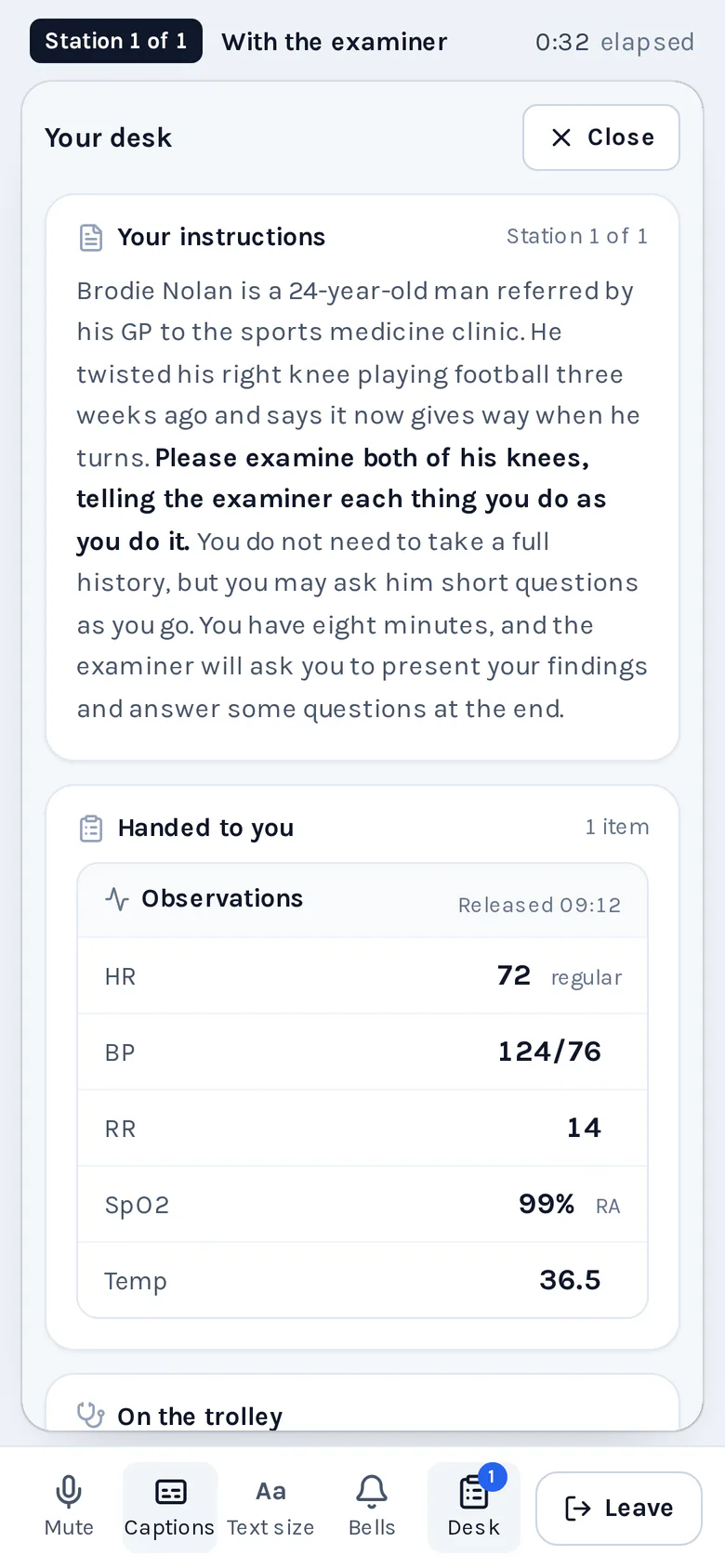
Mr Lachlan Burke, 24, has had asthma since childhood and was treated in the emergency department for a flare-up eight days ago. Today, at his follow-up at the GP clinic, the practice nurse has given him a peak flow meter and a spacer for his steroid preventer puffer, which is a pressurised metered dose inhaler. She has asked you to teach him to use both. Please talk the examiner through what you explain, what you ask him to do and what you check, and why. There is nothing to touch: when you ask Mr Burke to do something, the examiner will tell you what he does and says. You have eight minutes. Towards the end the examiner will ask you about inhaler technique and about the spacer.
1 min reading, then 8 min in the station
On the trolley
- Peak flow meter with disposable mouthpieces
- His steroid preventer puffer (pressurised metered dose inhaler)
- Spacer with a mouthpiece
- Peak flow diary and pen
- Tissues
- Alcohol-based hand rub
Your notes from reading time
Saved in this browser only.
Early clinical is where this sheet starts: 26 lines and 33 marks, most of them on communication and systematic approach.
Early clinical standard. Teaches both devices clearly, watches him use each one, spots and corrects the errors, records the best of three and explains the mouth rinse and which inhaler is which.
1 critical line. Miss it and the station is failed, however well the rest goes.
Communication 0/10Systematic 0/10Clinical reasoning 0/6Professionalism 0/1Patient safety 0/6
Run the station before you look
The answers are the most useful thing on this page once you have had a go, and the least useful before.
When the candidate asks him to confirm his name and date of birth
He says Lachlan Burke, the eighth of March two thousand and two.When the candidate explains what they will cover and asks whether that is all right
He says yes, please.When the candidate asks what he already knows, or how he has been using his inhaler
He says nobody has ever shown him. He sprays the inhaler straight into his mouth.When the candidate asks how his breathing is today
He says it is fine today, apart from a cough at night.When the candidate checks or picks up the peak flow meter
It is new, with a clean mouthpiece. The pointer is sitting halfway up the scale.When the candidate asks him to try the meter for the first time, without mention of resetting the pointer
He leaves the pointer where it is and blows out long and gently, as if blowing out candles. The pointer stays halfway up the scale.When the candidate asks him to try the meter for the first time, once told to reset the pointer
He sets the pointer to zero and blows out long and gently, as if blowing out candles. It reads one hundred and sixty.When the candidate asks him to blow again without correcting anything
He does the same again, and the reading is no higher.When the candidate corrects his peak flow technique and asks him to blow again
He resets the pointer, takes a full breath and gives one short, hard blast. It reads four hundred and ten.When the candidate asks him for two more blows
Four hundred and thirty, then four hundred and twenty.When the candidate asks what his best or usual peak flow is
He says about five hundred and twenty when he is well.When the candidate checks the inhaler
It is his steroid preventer, in date. The counter shows one hundred and twelve doses left.When the candidate checks the spacer
It is new, with a mouthpiece. The valve moves freely.When the candidate asks him to show them or try the inhaler and spacer, for the first time
He fits the inhaler without shaking it, presses it twice and takes one fast breath in. The spacer whistles.When the candidate asks him to use the inhaler and spacer again without correcting anything
He does it the same way, and the spacer whistles again.When the candidate corrects his inhaler technique and asks him to do it again
He does it again the way you have just told him.When the candidate asks whether he rinses his mouth after the steroid inhaler
He says no. His voice has been hoarse for a few weeks.When the candidate asks what other inhalers he has, or how often he uses his reliever
He has a blue salbutamol puffer and has needed it most days for the past month.When the candidate asks him to explain the inhaler steps back in his own words, after teaching them
He says: shake it, one puff at a time, breathe in slowly, hold, then rinse and spit.When the candidate asks whether he has any questions
He asks whether this is the puffer to take when he gets wheezy.When the candidate asks whether he has a written asthma action plan
He says he has never had one.
What are the commonest errors people make with a pressurised inhaler and a spacer, and how do you correct each one? · Early clinical
The first is not shaking the inhaler, so the dose is uneven: shake before every puff. The second is firing two or more puffs into the spacer at once, which makes the particles clump and stick to the wall, so less is inhaled: one puff, breathe it in, then the next. The third is breathing in too fast, which throws the drug onto the throat. Some spacers whistle when that happens, and the fix is a slow, steady breath until the lungs are full. The fourth is no breath hold: five to ten seconds, or as long as is comfortable, lets the drug settle. If someone cannot manage a single breath and hold, four normal breaths in and out through the spacer is the alternative. Then there are the practical ones: leaving the cap on, a poor seal round the mouthpiece, waiting too long between pressing and breathing, an empty or out-of-date inhaler, and a plastic spacer rinsed and wiped dry so that static holds the drug on the plastic. With a steroid inhaler, forgetting to rinse and spit. The way to find any of these is to watch the person do it against a checklist. The National Asthma Council puts it as "watch, do not just ask", because most people who believe their technique is right are mistaken.
Why is he asked to rinse his mouth after this inhaler, and what does the spacer add? · Early clinical
His preventer is an inhaled corticosteroid, and part of every dose lands in the mouth and throat instead of the lungs. There it can cause oral thrush, a sore throat and a hoarse voice. Rinsing, gargling and spitting after each dose removes it. The spacer deals with the same problem from the other end. A pressurised inhaler releases its dose as a fast jet, and without a spacer most of it hits the back of the throat unless the press and the breath are timed exactly. The spacer holds the cloud for a moment so that it can be breathed in slowly. More reaches the lungs, less is left in the mouth, and he no longer has to coordinate pressing and breathing. That is why the National Asthma Council says a spacer should be used with an inhaled corticosteroid puffer whenever possible. It needs looking after. He washes it about once a month in warm water with dishwashing detergent, does not rinse it, and lets it air dry without wiping, because rinsing and rubbing build up static. He checks it every 6 to 12 months for cracks and a faulty valve. His hoarse voice fits months of spraying a steroid at his throat, and I would expect it to settle with the spacer and the rinse. If it did not, he should come back.
How should he use his peak flow readings at home, and when should a reading make him seek help? · Mid clinical
The number that matters is his own best. Today his best of three was 430, and he says he blows about 520 when well, so he is at roughly 83 per cent: not surprising a week after a flare-up, but not back to normal. At home he uses the same meter, in the same posture, at the same times each day, takes the best of three and charts it with his symptoms and reliever use. A few weeks of readings shows his pattern and confirms his personal best. The readings then feed a written asthma action plan agreed with his GP, which says what reading or what symptoms mean he should change his treatment or be seen the same day, and what means an emergency. Those thresholds are set for him and written down. Symptoms outrank numbers: if he finds it hard to breathe or cannot talk normally, or his reliever is not working, he calls triple zero (000) and starts asthma first aid, which is four separate puffs of his blue reliever through the spacer with four breaths for each, repeated after four minutes. The Australian Asthma Handbook says adults can monitor peak flow at home if they wish, with thresholds for action in the plan, but it is not used in the clinic to assess lung function: that is what spirometry is for.
Where does peak flow fit in diagnosing and reviewing asthma in an adult? · Final year
Behind spirometry in both. The Australian Asthma Handbook confirms asthma from a history of typical symptoms together with objective evidence that expiratory airflow varies too much, and the best test is spirometry by a trained operator with bronchodilator responsiveness testing: an increase in FEV1 of at least 200 mL and at least 12 per cent after the bronchodilator. If a delay to spirometry cannot be avoided, a peak flow diary is the fallback. The patient records the highest of three blows every morning on waking and every afternoon at about four o'clock for two to four weeks, the mean daily variation is calculated, and a daily variation above 10 per cent supports the diagnosis. Serial peak flow readings are also part of investigating suspected work-related asthma. For review, the Handbook says not to use peak flow in the clinic to assess lung function, because spirometry is more reliable and picks up poor lung function in people who do not feel it. Adults can keep a peak flow record at home if they wish, and the thresholds for action then go into their written action plan. Whatever it is used for, the reading is only as good as the technique, which is why it is taught and watched.
Suppose he tells you he has needed his blue inhaler most days for a month. Once his technique is right, what else should happen? · Final year
That is poorly controlled asthma, and he has just had a flare-up, so he is at risk of another. Before any medicine is changed the Australian Asthma Handbook asks us to assess adherence and inhaler technique, and to look for triggers and for other conditions that cause the same symptoms, such as allergic rhinitis. Technique we have found. Adherence I would ask about without judgement, and I would ask about smoking and vaping, his home and his work. Correcting his technique may be enough on its own, because until today little of his preventer was reaching his lungs. If he is still not controlled on a regular low-dose steroid inhaler with salbutamol as needed, the Handbook's recommended options use a combined steroid and formoterol inhaler as the reliever: budesonide-formoterol taken as needed at the first level, and at the next level low-dose maintenance-and-reliever therapy, in which one inhaler is taken regularly and also used for relief. Either would replace both his present inhalers, and the choice is his GP's to make with him. He also needs a written asthma action plan, which he has never had, and his technique watched again at the next visit. I would tell the practice nurse or GP today what I found and not leave it for his next routine review.
How it is marked
What this station is really testing
Most people with asthma do not use their inhalers properly, and most have never had their technique watched. That is the reason this station exists. A steroid inhaler fired at the back of the throat treats the throat. So the examiner is not listening for a recital of steps. They are listening for a clinician who finds out what Mr Burke does now, shows him the right way in words he can follow, and then watches him do it. The third part is where the marks are, because his first attempt will go wrong in ordinary, predictable ways and you are expected to see them.
Read the restShow less
Take the two devices one at a time. For peak flow: pointer to zero, standing or sitting upright, the biggest breath he can take, lips sealed round the mouthpiece, then one blast, as hard and as fast as he can, three times, and the best of the three written down. A long, steady breath out is the usual mistake and gives a number far below the truth. For the inhaler: cap off, shake, into the spacer, lips sealed round the mouthpiece, a gentle breath out, one puff, then a slow, deep breath in over three to five seconds and a hold of five to ten seconds, or four normal breaths in and out if he cannot hold. One puff at a time, another shake, and then the second. A whistle from the spacer means he is breathing in too fast. Afterwards he rinses his mouth and spits, because this inhaler contains a steroid.
Then make it last beyond the room. Ask him to tell you the steps back, answer his question, and make sure he knows which inhaler is for every day, which is for symptoms, and what to do when his breathing or his numbers get worse. In the early clinical year, clear teaching of both devices, his errors spotted and corrected, the best of three recorded and the mouth rinse explained is the standard. In the mid clinical year, relate his reading to his personal best, explain what the spacer is for and how to look after it, and make sure he leaves with a written action plan. In the final year, be able to say where peak flow sits beside spirometry, what asthma first aid is, and what the Australian Asthma Handbook offers a patient who is still using his reliever most days.
Where the 33 marks are at Early clinical
- Communication10
- Systematic approach10
- Clinical reasoning6
- Professionalism1
- Patient safety6
1 critical line. Miss it and the station is failed, whatever the total.
What a pass looks like at each stage
Early clinical
26 lines, 33 marks
The sheet starts here.
Teaches both devices clearly, watches him use each one, spots and corrects the errors, records the best of three and explains the mouth rinse and which inhaler is which.
What lifts it to a clear pass
- Say "show me" twice in this station: once for the meter and once for the inhaler.
- Learn the peak flow sentence: "pointer to zero, big breath, tight seal, one hard fast blast, three goes, write down the best".
- When the spacer whistles, say so. It is the device telling you he breathed in too fast.
- End on the practical points: rinse and spit, preventer every day, blue puffer for symptoms.
Mid clinical
31 lines, 38 marks
Adds five lines, most of them on clinical reasoning and systematic approach.
Puts the reading in context against his personal best, explains what the spacer does and how to care for it, and makes sure he leaves with a written action plan and a review.
What lifts it to a clear pass
- Ask for his best reading before you comment on today's. 430 means one thing against 450 and another against 520.
- Know the two breathing methods for a spacer and when you would choose each.
- Ask how often he uses his reliever. It is the quickest measure of control you have.
- Offer something he can look at later: a written plan, a leaflet or a video.
Final year
33 lines, 40 marks
Adds two lines, all on clinical reasoning.
Uses the consultation as an asthma review: recognises poor control, knows where peak flow sits beside spirometry and how its variability is defined, knows asthma first aid, and can say what the Australian Asthma Handbook would change.
What lifts it to a clear pass
- Know where peak flow fits in Australia: spirometry for diagnosis and review, a diary when spirometry is delayed, and home monitoring for adults who want it.
- Know asthma first aid by heart: sit him upright, give four separate puffs of his blue reliever through the spacer with four breaths for each, and wait four minutes. If he is worse or no better, call triple zero now and keep giving four puffs every four minutes until the ambulance arrives. If he is better but still not breathing normally, give four more puffs, and call triple zero if he is not breathing normally within a few minutes.
- Before any step up: adherence, technique, triggers. Then know what the step is.
A system you can run under pressure
Start with what he does now
- Introduce yourself, confirm who he is and say what you will cover — two devices in eight minutes needs a plan he can follow
- Ask what he already knows and how he takes his inhaler at the moment — you are correcting a habit, and you cannot correct what you have not heard
- Check the devices: the right inhaler, in date, doses left on the counter, a spacer that fits it — an empty inhaler used perfectly delivers propellant
- Explain why each device matters to him — a reason is what makes someone do it at home
Peak flow
- Fit a clean mouthpiece and slide the pointer to zero — a pointer left where it was records the last blow, not this one
- Stand, or sit upright, and do it the same way every time — a slumped chest cannot empty fast, and readings are only comparable if the posture is
- Hold the meter level with fingers clear of the scale — a finger on the pointer is the easiest way to get a low reading
- Take the deepest breath possible and seal the lips round the mouthpiece — air leaking round the sides does not move the pointer
- Blow as hard and as fast as possible, one short blast — peak flow is reached in the first fraction of a second, so a long gentle breath out misses it
- Three blows, pointer back to zero each time, and record the highest — the best effort is the true reading
Inhaler and spacer
- Cap off, check nothing is in the mouthpiece, shake, and fit the inhaler upright into the spacer — shaking mixes the drug with the propellant
- Sit or stand upright, put the mouthpiece between the teeth without biting, close the lips round it and breathe out gently — a good seal keeps the dose in the spacer until he breathes it in
- Press the canister once, then straight away breathe in slowly and deeply over three to five seconds — a fast breath throws the drug against the throat, which is what a whistling spacer is telling you, and a delay lets it settle on the spacer wall
- Hold the breath for about five to ten seconds, or as long as is comfortable — the particles need time to settle in the small airways
- If he cannot manage a single breath and hold, four normal breaths in and out through the spacer after each puff — the valve keeps the dose in the chamber between breaths
- One puff at a time: shake again and repeat every step for the next one — two puffs fired together stick to each other and to the spacer wall
Watch, correct, watch again
- Ask him to show you each device himself — telling is not teaching until you have seen it done
- Name what he did well, then the one or two things to change — a list of six faults is not remembered
- Have him repeat it until it is right — the last attempt is the one he takes home
- Ask him to say the steps back in his own words — it shows you what he understood, which is not always what you said
Before he leaves
- Rinse, gargle and spit after every dose of the steroid inhaler — it prevents oral thrush and a hoarse voice
- Preventer every day whether he feels well or not; reliever for symptoms — people stop the inhaler that does not seem to do anything, and it is the one keeping them out of hospital
- Peak flow morning and evening, best of three, in a diary with his symptoms — a pattern is worth more than a single number
- A written personal action plan, what to do if his readings fall or his reliever stops lasting, and triple zero (000) for an attack — symptoms count even when the peak flow looks fine
The lines that carry marks
Opening
I would like to go through two things with you: the peak flow meter, and then your preventer puffer with this spacer. First, can you tell me how you take the inhaler at the moment?
Explaining peak flow
This measures how fast you can blow air out of your lungs. When your airways are narrower the number drops, often before you feel worse, so it gives you and us an early warning.
Teaching the blow
Slide the pointer back to zero. Stand up, take the biggest breath you can, close your lips tightly round the mouthpiece and blow out as hard and as fast as you can. One short blast, like blowing a pea through a straw.
Correcting the peak flow
That was a good big breath. Two things to change: push the pointer back to zero first, and make it a short, sharp blast, not a long breath out. Have another go.
Show the other 5Show fewer
Teaching the inhaler
Cap off, give it a good shake and push it into the end of the spacer. Lips round the mouthpiece, breathe out gently, press once, then breathe in slowly and deeply and hold for five to ten seconds if you can.
Correcting the inhaler
You sealed your lips well. Shake it before each puff, press only once each time, and breathe in more slowly: that whistle means it was too fast. Shake it again before the second puff. Show me again.
The mouth rinse
This inhaler contains a steroid, and some always lands in your mouth. Rinse with water, gargle and spit it out every time. It stops you getting thrush and should help that hoarse voice.
Answering his question
No. This is your preventer: you take it every day, even when you feel fine, and it will not help quickly if you are wheezy. Your blue puffer is the one for symptoms. If you need it again within four hours, contact your doctor the same day. If it is not working, or you are struggling to breathe or talk, call triple zero and start asthma first aid.
Checking back
I have said a lot. Can you talk me through how you will take the inhaler tonight, so that I know I explained it properly?
How candidates lose marks here
- Describing the technique and never asking him to do it — say "show me", because the errors only appear when he tries.
- Accepting a long, slow blow into the peak flow meter — it has to be one short, hard blast, or the reading is far too low.
- Forgetting the pointer — it goes back to zero before every blow.
- Letting two puffs go into the spacer together — one puff, breathe, wait, shake, then the next.
- Leaving out the mouth rinse — it is a steroid inhaler, and he already has a hoarse voice.
- Correcting him with a list — pick the faults that matter, fix them and watch again.
- Finishing without telling him which inhaler is for an attack — he has just asked you, and the wrong answer is dangerous.
Where to read more
- Inhaler technique for people with asthma or COPD: information paper and checklists (2026)National Asthma Council Australia · guide
- Inhaler technique checklistsNational Asthma Council Australia · checklist
- How-to videos: using your inhaler and spacerNational Asthma Council Australia · video
- Australian Asthma HandbookNational Asthma Council Australia · reference
- Educating adults and adolescents to self-manage asthma, including written action plansAustralian Asthma Handbook · reference
- Asthma first aidNational Asthma Council Australia · guide
- Asthma information, peak flow charts and the 1800 ASTHMA helplineAsthma Australia · guide
Now sit it live