
Data interpretation · Results
Pleural fluid results OSCE mark scheme, final year
A diagnostic pleural aspirate in a man who is not getting better from pneumonia: Light's criteria with the paired bloods, what the pH decides, and what has to happen next.
Final year is where this sheet starts: 24 lines and 29 marks, most of them on clinical reasoning and patient safety.
- 1:30 + 8:00 reading, then the room
- 6 examiner questions
- Sat from final year
- Free to practise, no account needed
- Reviewed
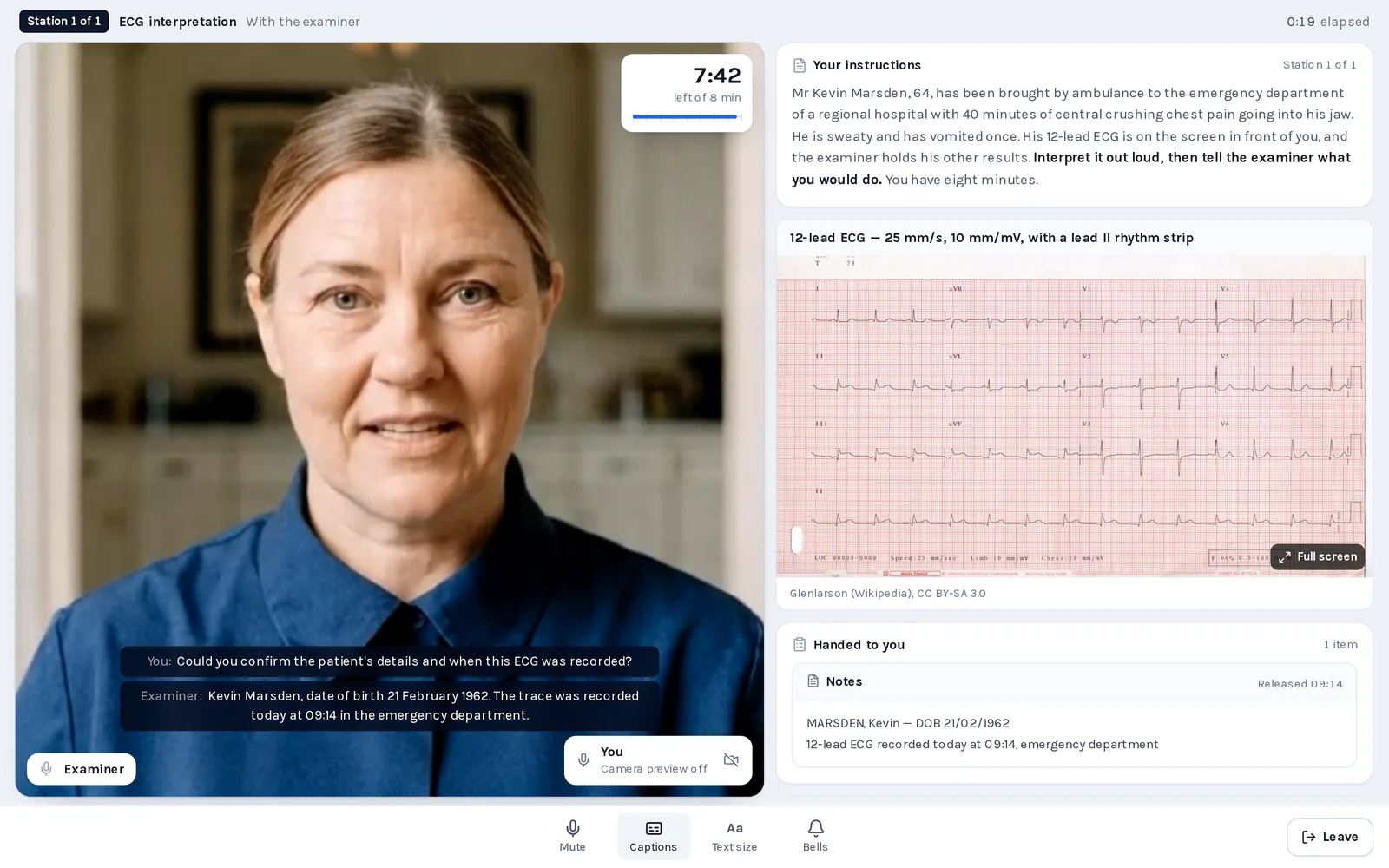
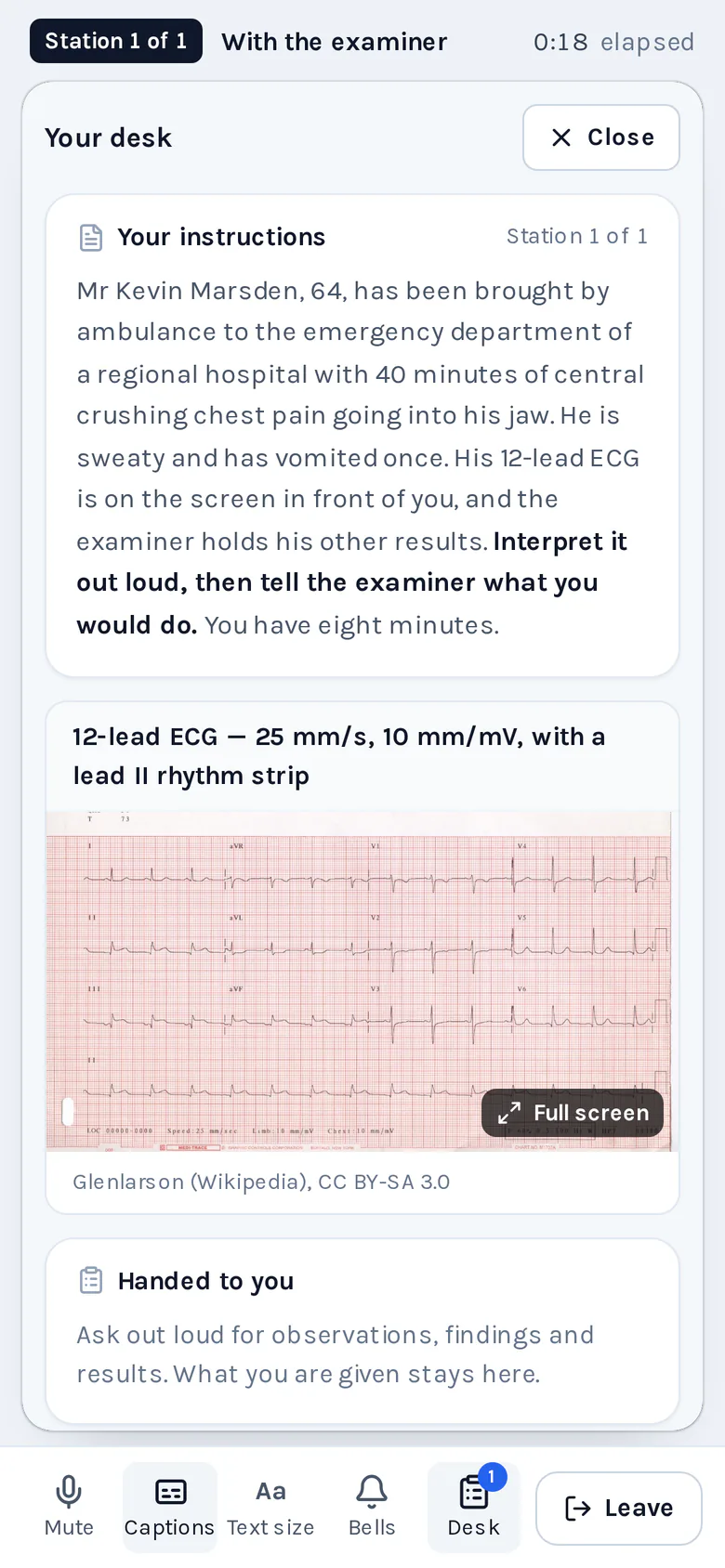
How do you want to practise?
Read the notice, run the clock, then mark yourself on the real sheet.
You present to a friend, who runs the clock and marks on their own phone.
Their marks land on your screen.
The image or results are on your screen and an AI examiner listens, by voice, while you present them.
Candidate instructions
The notice on the door
Raymond Kerr, 68, was admitted four days ago with pneumonia and is still febrile. His chest X-ray now shows a right pleural effusion, and a diagnostic pleural aspiration was done under ultrasound this morning. The pleural fluid results, with paired blood results, are in front of you, and the examiner has the rest of his notes. Please talk the examiner through the results, say what you think is going on and what you would do now. The examiner will then ask you some questions. You have eight minutes.
90 sec reading, then 8 min in the station
On the trolley
- Pleural fluid report with paired blood results
- Pen and paper
Your notes from reading time
Saved in this browser only.
Final year is where this sheet starts: 24 lines and 29 marks, most of them on clinical reasoning and patient safety.
Final year standard. Applies Light's criteria with numbers, acts on the pH with a drain today, adds anaerobic cover, names the mimics of a low pH and knows the next steps when drainage fails.
3 critical lines. Miss one and the station is failed, however well the rest goes.
Communication 0/2Systematic 0/2Clinical reasoning 0/19Professionalism 0/1Patient safety 0/5
Run the station before you look
The answers are the most useful thing on this page once you have had a go, and the least useful before.
When the candidate asks to confirm the patient's name or details, or whose results these are
The report is for Raymond Kerr, date of birth 3 August 1958. The fluid was collected today at 09:50.When the candidate asks for the pleural fluid results
Turbid fluid, not pus. pH 7.04. Protein 44, LDH 1,680, glucose 1.8. Many neutrophils, and Gram-positive cocci in chains. Serum protein 66, serum LDH 268, plasma glucose 6.4.Patient: Raymond KERR, male, DOB 03/08/1958 (68 years) Sample: pleural fluid, right diagnostic aspiration under ultrasound, collected today at 09:50; paired blood at 09:55 Appearance: turbid, straw-coloured, not frank pus pH measured on: blood gas analyser at 10:00 PLEURAL FLUID (RANGES FOR NORMAL PLEURAL FLUID) pH 7.04 (7.60 - 7.64) Protein 44 g/L (10 - 20) LDH 1,680 U/L (below 125) Glucose 1.8 mmol/L (4.0 - 7.8) Cells: many neutrophils Gram stain: Gram-positive cocci in chains Culture (plain pot and blood culture bottles): to follow Cytology: sent PAIRED BLOOD Serum total protein 66 g/L (60 - 80) Serum LDH 268 U/L (120 - 250) Plasma glucose 6.4 mmol/L (4.0 - 7.8)
When the candidate asks for the history or how his admission has gone
Admitted four days ago with right lower lobe pneumonia. He is on day 4 of intravenous ceftriaxone and azithromycin and is still having fevers up to 38.9.When the candidate asks about his background, smoking or alcohol
He smokes 10 cigarettes a day, drinks about 24 standard drinks a week and has poor dentition. He has no other illnesses.When the candidate asks for the observations
Temperature 38.7, heart rate 104, blood pressure 122 over 70, respiratory rate 22, saturations 94 per cent on 2 litres via nasal prongs.Temp 38.7 °C | HR 104 regular | BP 122/70 | RR 22 | SpO2 94% on 2 L/min via nasal prongs
When the candidate asks for the blood results or inflammatory markers
White cells 18.6. CRP 264, against 280 on admission. Urea 7.4, creatinine 98, albumin 29.Sample: venous bloods, today 09:55 WCC 18.6 x10^9/L (4.0 - 11.0) | CRP 264 mg/L (below 5) | CRP on admission 280 mg/L (below 5) Urea 7.4 mmol/L (3.0 - 8.0) | Creatinine 98 umol/L (60 - 110) | Albumin 29 g/L (35 - 50)
When the candidate asks for the chest X-ray
Right lower zone consolidation with a right pleural effusion, larger than on admission. No pneumothorax.When the candidate asks for the thoracic ultrasound findings
A right pleural effusion 6 centimetres deep at the base, with thin septations. A safe pocket was marked for the aspiration.When the candidate asks how the pH sample was taken or analysed
It was drawn into a blood gas syringe with the heparin expelled and no air left in it, and run on the gas analyser ten minutes later. The local anaesthetic was given through a separate needle.When the candidate asks about anticoagulants, coagulation or platelets
He takes no anticoagulant or antiplatelet. His INR is 1.1 and his platelets are 312.When the candidate asks about allergies
He has no known drug allergies.When the candidate asks for the blood cultures
The blood cultures taken on admission have grown nothing.When the candidate asks for the cytology
Cytology has been sent and is not yet reported.
Talk me through these results. · Final year
These are pleural fluid results for Raymond Kerr, a 68-year-old on day 4 of antibiotics for right lower lobe pneumonia who is still febrile, from a diagnostic aspiration under ultrasound this morning, with paired bloods. The fluid is turbid but not frank pus, so the pH matters, and it was run on a gas analyser without anaesthetic or heparin. By Light's criteria it is an exudate: the protein ratio is 44 over 66, about 0.67, the LDH ratio is 1,680 over 268, about 6.3, and the pleural LDH is far above two-thirds of the serum upper limit. The pH is 7.04, at or below the threshold of 7.2, so he has a high risk of a complicated parapneumonic effusion. The glucose of 1.8 and the LDH of 1,680 support that, the fluid is full of neutrophils, and the Gram stain shows Gram-positive cocci in chains, which confirms pleural infection. My conclusion is pleural infection, a complicated parapneumonic effusion, which needs a chest drain today.
What would you do now? · Final year
He needs a chest drain today. I would refer him to the respiratory team, check that he takes no anticoagulant and that his coagulation and platelets are acceptable, which they are, and ask for a small-bore drain, 14F or smaller, under ultrasound guidance, with his consent. The fluid should go for culture in blood culture bottles as well as a plain pot, and the cytology is pending. His antibiotics need anaerobic cover: ceftriaxone and azithromycin do not reliably provide it, so I would add metronidazole, agreeing the regimen with microbiology and Therapeutic Guidelines, and narrow it when the culture returns. I would review whether he still needs the azithromycin. He will need two to six weeks of antibiotics in total, guided by his response. I would add thromboprophylaxis, ask the dietitian to see him because his albumin is 29, and monitor his temperature, drain output and CRP. His RAPID score is about 3, medium risk, which I would use when talking to him about what to expect.
Suppose the aspirate had been frank pus. What would change? · Final year
Frank pus is empyema, and that is diagnostic of pleural infection on its own, so I would not need a pH at all. The pH is asked for when the aspirate is not frank pus, because pus already answers the question the pH is asked. Empyema needs a chest drain, so the decision would be the same but even more certain. Pus changes some of the details as well. It scores 0 rather than 1 for purulence on the RAPID score, because non-purulent fluid carries the worse outlook in that score. Thick pus may drain less well through a small tube, so I would expect a lower threshold for intrapleural tPA and DNase if the collection did not clear, and an earlier conversation with the thoracic surgeons if he did not improve. The antibiotics would still need anaerobic cover, and the culture of the pus would guide narrowing them.
Suppose the drain stops draining on day 3 and the ultrasound still shows a collection. What then? · Final year
First I would check that the drain is patent, not kinked or blocked, and correctly sited, and flush it if local practice allows. A collection that persists while his inflammatory markers are not falling is poor progress, and the 2023 British Thoracic Society pathway then asks for a CT chest and a surgical opinion. If the drain is working but a collection remains, the guideline recommends considering intrapleural tissue plasminogen activator with DNase. The regimen is tPA 10 milligrams with DNase 5 milligrams twice daily for 3 days, and a lower tPA dose of 5 milligrams can be used, particularly where bleeding risk is higher, such as in someone on anticoagulation that cannot be stopped. I would take his consent first, because there is a risk of pleural bleeding. Single-agent tPA or DNase should not be used, and streptokinase is not recommended. Saline irrigation is an option if he could not have tPA and DNase or surgery. If he still did not respond, I would ask the thoracic surgeons to reconsider surgery, because a minority of patients with pleural infection end up needing it.
What else can give a low pleural fluid pH? · Final year
Some conditions mimic a parapneumonic effusion with a low pH and loculations, notably rheumatoid effusions, which typically have a very low glucose, and effusions from advanced malignancy or mesothelioma, which matters in Australia given the legacy of asbestos exposure. Tuberculous effusions can have a low pH and glucose, though they are usually lymphocytic rather than neutrophilic. Oesophageal rupture gives a very acidic, infected effusion, often after vomiting, and a fungal pleural infection, especially in someone without known immunocompromise, should prompt a search for its source, including an oesophageal leak. Before believing any low pH, I would also think about the sample itself: local anaesthetic or heparin in the syringe lowers the pH and can make a simple effusion look complicated, while residual air in the syringe or a delay before analysis raises it and can hide a complicated one. That is why the pH must be measured immediately on a blood gas analyser. Here the clinical picture, the neutrophils and the Gram stain all point to infection.
How long will he need antibiotics, and what decides it? · Final year
Usually between two and six weeks. That range is used according to the clinical response, because shorter courses may lead to earlier relapse, but no study has yet been powered to show the best length, so the response decides it. In practice I would give intravenous antibiotics while he is in hospital and switch to suitable oral treatment once his fever has settled, his drain has done its job and his inflammatory markers are falling, continuing orally after discharge. The culture result shapes the choice. If the fluid or blood grows pneumococcus, which is usually a single organism, the antibiotics can be narrowed; streptococci from the anginosus group or anaerobes keep anaerobic cover in place. If oral treatment is not possible because of resistance or allergy, a hospital-in-the-home service giving intravenous antibiotics is the alternative. I would follow him up in clinic with a chest X-ray to confirm the effusion has resolved, and arrange a CT if it has not.
How it is marked
What this station is really testing
A pleural fluid report is two questions asked in order. The first is what kind of fluid this is, and Light's criteria answer it with the paired blood sample: the fluid is an exudate if the pleural to serum protein ratio is above 0.5, the pleural to serum LDH ratio is above 0.6, or the pleural LDH is above two-thirds of the upper limit of normal for serum. Candidates lose marks by quoting the criteria without dividing anything. The second question, in a patient with pneumonia, is whether the effusion needs draining, and the 2023 British Thoracic Society pleural guideline answers it with the pH, measured at once on a blood gas analyser whenever the aspirate is not frank pus.
Read the restShow less
A pH of 7.2 or less means a high risk of a complicated parapneumonic effusion or pleural infection, and a chest drain should go in if ultrasound shows a safe pocket. Between 7.2 and 7.4 the risk is intermediate, and an LDH above 900 IU/L tips the balance towards a drain, especially with fever, a large effusion, a glucose of 4.0 or less, septation or pleural enhancement. At 7.4 or above, immediate drainage is not indicated. The examiner also wants to hear that the pH can be wrong: local anaesthetic or heparin in the syringe lowers it, while air and delay raise it. A low pH with a positive Gram stain removes any doubt: this is pleural infection, and a positive stain is a stronger finding than any number on the card.
The management marks are for the drain, the antibiotics and what happens when the drain is not enough. The guideline recommends a small-bore chest tube of 14F or smaller as the first drain, antibiotics that cover anaerobes from the start and continue for two to six weeks according to response, and intrapleural tPA with DNase when drainage stops but a collection remains. In Australia the antibiotic choice comes from Therapeutic Guidelines and microbiology, and ceftriaxone on its own does not reliably cover anaerobes. A final-year pass applies Light's criteria with numbers, acts on the pH with a drain today, adds anaerobic cover, names the mimics of a low pH, and knows the next step if the drain stops working.
Where the 29 marks are at Final year
- Communication2
- Systematic approach2
- Clinical reasoning19
- Professionalism1
- Patient safety5
3 critical lines. Miss one and the station is failed, whatever the total.
What a pass looks like at each stage
Final year
24 lines, 29 marks
The sheet starts here.
Applies Light's criteria with numbers, acts on the pH with a drain today, adds anaerobic cover, names the mimics of a low pH and knows the next steps when drainage fails.
What lifts it to a clear pass
- Divide out loud. Light's criteria are marked when you calculate them from the paired blood, not when you recite them.
- Say the pH and the threshold together: 7.04, at or below 7.2, so a chest drain today.
- Ask how the pH was measured. Local anaesthetic and heparin lower it, air and delay raise it.
- Look at what he is already on. Ceftriaxone and azithromycin leave anaerobes uncovered.
- Know tPA 10 mg and DNase 5 mg twice daily for 3 days, for a collection left behind after drainage stops.
A system you can run under pressure
Step 1 — the sample and the context
- Check the name, date of birth and the time of the aspiration — two aspirates on one ward are not unusual, and one of them may be leading to a drain
- Set the result against the illness — day 4 of antibiotics for pneumonia, still febrile, with a growing effusion is pleural infection until shown otherwise
- Look at the fluid first — frank pus is empyema and needs a drain without a pH, while turbid fluid needs the pH measured at once
- Ask how the pH was measured — on a blood gas analyser, with no local anaesthetic or heparin in the syringe, no air and no delay, because each error moves the pH
Step 2 — transudate or exudate
- Divide the pleural protein by the serum protein — above 0.5 is exudative
- Divide the pleural LDH by the serum LDH — above 0.6 is exudative
- Compare the pleural LDH with two-thirds of the upper limit of normal for serum LDH — above it is exudative
- One criterion is enough for an exudate — infection, malignancy, pulmonary embolism and autoimmune pleuritis are the common causes, while heart failure, cirrhosis and hypoalbuminaemia give transudates
Step 3 — does it need a drain?
- pH 7.2 or less: high risk of complicated parapneumonic effusion or pleural infection — insert a chest drain if ultrasound shows a safe pocket
- pH above 7.2 and below 7.4: intermediate risk — measure the LDH and consider a drain if it is above 900 IU/L, especially with fever, a large effusion, a glucose of 4.0 or less, septation or pleural enhancement
- pH 7.4 or above: low risk, no immediate drain, but keep reviewing and repeat the aspiration if he does not improve
- Without a pH, a pleural glucose below 3.3 mmol/L points the same way as a low pH
- A positive Gram stain or culture, or frank pus, makes the diagnosis of pleural infection on its own
Step 4 — treat and plan ahead
- A small-bore chest tube, 14F or smaller, inserted under ultrasound guidance, after checking coagulation and anticoagulants
- Antibiotics with anaerobic cover from the start, chosen from Therapeutic Guidelines with microbiology — adding metronidazole is the usual way to cover anaerobes alongside ceftriaxone
- Two to six weeks of antibiotics according to response, intravenous first and then oral
- Intrapleural tPA 10 mg with DNase 5 mg twice daily for 3 days if drainage stops and a collection remains, with consent because of the bleeding risk
- Nutrition, thromboprophylaxis and an early respiratory opinion — and a thoracic surgical opinion if he does not respond
The lines that carry marks
Opening the presentation
These are pleural fluid results for Raymond Kerr, date of birth 3 August 1958, from a diagnostic aspiration at 09:50 today, with paired bloods.
Checking the pH
Can I check the pH was run on a blood gas analyser, without local anaesthetic or heparin in the syringe?
Applying Light's criteria
The protein ratio is 44 over 66, about 0.67, and the LDH ratio is 1,680 over 268, over 6, so this is an exudate by Light's criteria.
Acting on the pH
The pH is 7.04, at or below 7.2, so he needs a chest drain today.
Show the other 4Show fewer
Naming the diagnosis
With a low pH, a low glucose, a very high LDH and Gram-positive cocci on the stain, this is pleural infection, a complicated parapneumonic effusion.
Fixing the antibiotics
He is on ceftriaxone and azithromycin, which leave anaerobes uncovered, so I would add metronidazole after talking to microbiology.
Planning ahead
If the drain stops and a collection remains, the next step is intrapleural tPA with DNase, and a surgical opinion if that fails.
Referring
Raymond Kerr, 68, day 4 of treatment for pneumonia, still febrile, with an exudative right effusion: pH 7.04 and Gram-positive cocci. I think this is pleural infection and he needs a drain today. Could you review him?
How candidates lose marks here
- Reciting Light's criteria without calculating the ratios from the paired blood results.
- Continuing antibiotics alone and watching the effusion when the pH is 7.04.
- Trusting a pH without asking how it was measured.
- Calling turbid fluid empyema, or measuring the pH of frank pus.
- Leaving anaerobes uncovered, or giving antibiotics for only a few days.
- Sending him for surgery before a chest drain has been tried.
Now sit it live