
The University of Maryland School of Medicine MD program
What you actually study, and where you will be
University of Maryland School of Medicine's MD is a 4-year program with an integrated curriculum, with patient contact from Year 1 and clinical rotations in Baltimore-area hospitals, plus rural Maryland options (2027 entry). The Renaissance Curriculum, launched in 2020, opens with about 20 months of integrated organ-system courses taught through lectures, small groups, team-based learning and cadaver labs, plus the Practice of Medicine clinical skills course. After Step 1 you start a 48-week clerkship year in late April of year 2. It runs mostly at the University of Maryland Medical Center (which includes the Shock Trauma Center), the Baltimore VA and other affiliated area hospitals. The final year brings sub-internships, electives, Transition to Residency and a graduation clinical skills exam.
- Degree
- MD
- Length
- 4 years
- Teaching
- Integrated
- Clinical contact
- Year 1

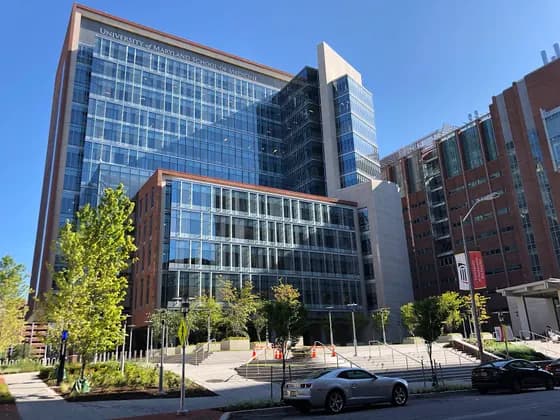


Photo: Baltimore Heritage · CC0 · cropped
Photo: Alx bio · CC BY-SA 4.0 · Photo: AgnosticPreachersKid · CC BY-SA 4.0 · Photo: Xiaokui Qin · CC BY-SA 4.0
The University of Maryland School of Medicine MD program at a glance (2027 entry)
The University of Maryland School of Medicine (UMSOM) runs a four-year Doctor of Medicine (MD) program on the University of Maryland, Baltimore campus in downtown Baltimore. Chartered in 1807, it describes itself as the first public medical school in the United States. The admissions office lists 175 places in the class that entered in 2026. The Liaison Committee on Medical Education (LCME), which accredits MD programs in the United States, lists the program as fully accredited, with its next survey in 2031-32.
Teaching follows the Renaissance Curriculum, which began in August 2020. Its first part, the pre-clerkship (pre-clinical) phase, lasts about 20 months. It is integrated and systems-based: each course, such as Brain & Behavior, teaches how one body system works and what goes wrong with it side by side, with anatomy labs threaded through the courses.
Patient contact starts in year 1 through Practice of Medicine, a course that runs through all four years. In years 1 and 2 it brings weekly small groups with a clinician preceptor, practice with standardized patients (people trained to portray patients) and 25 hours of service learning in Baltimore. You take USMLE (United States Medical Licensing Examination) Step 1, the first of three national licensing exams, before clerkships start in late April of year 2.
Clerkships are the core clinical rotations, and the 48-week clerkship year holds eight of them, mostly at the University of Maryland Medical Center (UMMC) and other Baltimore-area hospitals. The final year adds sub-internships (four-week rotations where you work at or near the level of a first-year resident, under supervision), electives and a four-week Transition to Residency course.
| Degree | MD (Doctor of Medicine), four years, starting in early August |
|---|---|
| Curriculum | Renaissance Curriculum, launched in August 2020 |
| Class size | 175 places in the class that entered in 2026 |
| Campus | University of Maryland, Baltimore, in downtown Baltimore |
| Teaching style | Integrated organ-system courses: lectures, small groups, team-based learning, labs |
| Anatomy | Anatomy labs through years 1 and 2, including cadaver dissection |
| First patient contact | Year 1, through Practice of Medicine and standardized patients |
| Clerkships start | Late April of year 2 |
| Step exams | Step 1 before clerkships; Step 2 CK after core clerkships, in year 4 |
| Grading | Four-tier Honors to Fail and two-tier Satisfactory/Fail scales |
| Main clinical sites | UMMC, Shock Trauma and the Baltimore VA, plus partner hospitals |
What makes the University of Maryland School of Medicine MD program different
Trauma surgery at the Shock Trauma Center
Every core surgery clerkship includes two weeks on a trauma service and work in the trauma resuscitation unit. The surgery department places the trauma weeks at the R Adams Cowley Shock Trauma Center. In the final year you can return for sub-internships in Shock Trauma surgery or intensive care, or take a neurotrauma elective.
Clerkships start in the spring of year 2
The Renaissance Curriculum shortened the pre-clerkship phase so you reach clinical work sooner. The school says the earlier start leaves more time to make an informed career choice and to build experience for the specialty you choose.
A mentored research project for every student
Foundations of Research and Critical Thinking (FRCT) teaches research methods in your first course, then you complete a project with a faculty mentor, usually in the summer after year 1. The top 10% of projects earn a Certificate of Outstanding Achievement in Research.
Service learning in Baltimore
Practice of Medicine includes 25 hours of service learning over years 1 and 2 with community partners across Baltimore, especially West Baltimore. Options include science mentoring for gifted third graders in Baltimore City Public Schools, STEM teaching with the Ingenuity Project and supporting patients alongside an interdisciplinary care team. You log your hours and write a reflective essay at the end of each year.
Rural-MD Scholars on the Eastern Shore
The Rural-MD Scholars Program prepares students to practice on Maryland's rural Eastern Shore. It aims to recruit ten a year, and nine joined the class that entered in 2025. It starts with a summer program at the University of Maryland Eastern Shore, then adds a two-year rural health elective, rural physician mentors, Eastern Shore clerkships and a fourth-year ambulatory rotation there.
How University of Maryland School of Medicine teaches medicine
Each pre-clerkship course is taught jointly by basic science and clinical faculty: Brain & Behavior, for example, draws on neurology, neuroscience, anatomy, pharmacology, pathology, anesthesiology, pediatrics and psychiatry. Lectures are optional, but each course marks some sessions, such as small groups, as mandatory. Participation, which can include team-based learning quizzes, counts for up to 15% of a course grade.
Some subjects run through every course. Embedded content leads, faculty who follow one theme across the curriculum, oversee threads such as anatomy, radiology, pharmacology, nutrition, health disparities and planetary health. Nutrition, for instance, starts in your first course and includes learning to take a nutritional history from dietitians.
In the clinical years you learn mainly on hospital teams and in clinics, and most clerkships add lectures, conferences or weekly teaching sessions. Practice of Medicine continues with an Introduction to Clerkships and four day-long sessions on topics such as interprofessional care and career planning.
The ways you will learn
| Lectures | Large-group teaching of the core science for each organ system. |
|---|---|
| Team-based learning | You prepare in advance, take a short individual readiness quiz, then solve problems with your team. Most first- and second-year courses use it. |
| Small groups and clinical correlations | Small-group case discussions, plus clinical correlations where clinicians link the science to real conditions. Life Cycle adds a longitudinal group case study. |
| Anatomy and pathology labs | Anatomy labs in the Reid Anatomy Teaching Facility and pathology labs in courses such as Brain & Behavior. |
| Practice of Medicine small groups | Weekly small groups with a clinician preceptor, with written feedback on each case write-up and a narrative assessment at the end of each Practice of Medicine course. |
| Standardized patients and simulation | Video-recorded practice with standardized patients in years 1 and 2, simulation and ultrasound in Multisystem, and simulation in the MASTRI (Maryland Advanced Simulation, Training, Research and Innovation) Center during the obstetrics and pediatrics clerkships. |
A typical week on the University of Maryland School of Medicine program
School policy keeps required pre-clerkship activities to weekdays between 8 a.m. and 5 p.m. and caps them at 30 hours a week, with Introduction to Medical School the one exception. Most required classes and small groups run from 8 a.m. to noon, with occasional afternoon sessions.
You should also get at least 15 hours a week of unscheduled daytime, on average, for self-directed study. Practice of Medicine adds a weekly small group and, from October of year 1, three to four hours a month of service learning. The summer between years 1 and 2 has no mandatory activities unless you must remediate a course.
Exams come every few weeks: on the tentative 2027-28 calendar, Foundations has exams on August 27, September 24 and October 22, and exams can run until 5 p.m. On clerkships, duty hours are capped at 80 a week averaged over four weeks, with at least one day in seven free.
How anatomy is taught at University of Maryland School of Medicine
Anatomy is spread across the pre-clerkship courses rather than taught as one course at the start. Your first course, Foundations, opens with a Foundations of Anatomy unit, and the first anatomy assessment comes at the end of August. You then return to the lab in later courses, so you learn each system's anatomy alongside its physiology and disease.
Labs combine dissection with imaging and models. Brain & Behavior and Digestion & Hormones include anatomy labs, and Skin, Bones & Musculature in year 2 includes dissection in the cadaver lab, with an anatomy assessment in late November.
The Maurice N. Reid, MD '99 Anatomy Teaching Facility, in the Bressler Research Building, reopened in October 2024 after its first renovation since it was built in 1973. It has 52 dissection tables under surgical-quality lighting, each with a touch-screen computer for electronic atlases, plus a reading room for medical images, 3-D graphics packages and anatomical models. Medical students use it in all four years.
When you first meet patients at University of Maryland School of Medicine
Your first patient-facing practice is in Practice of Medicine I in year 1. In weekly small groups a clinician preceptor coaches you through patient encounters, interviews, physical exams and oral presentations. You also work with standardized patients and with physical exam teaching associates, people trained to teach examination. Year 1 covers the medical interview and the neurological, head, eyes, ears, nose and throat, and abdominal exams.
Year 2 adds the cardiac, lung, musculoskeletal and genitourinary exams. Your encounters are video-recorded so you can review them with feedback from faculty and the standardized patients. Practice of Medicine also includes longitudinal clinical sessions with faculty, and you may be placed at an off-campus site for it.
Electives can add earlier clinical work. In the Combined Accelerated Program in Psychiatry, which dates from 1970, you interview patients and shadow across levels of psychiatric care in years 1 and 2. The Primary Care Longitudinal Elective adds mentoring by primary care physicians and a summer externship in an underserved practice.
Before clerkships you attend the Student Clinician Ceremony in March of year 2, where you receive a professionalism pin and take the Student Clinician Oath. You also attend clinical skills workshops and small groups on patient safety and professionalism.
The University of Maryland School of Medicine curriculum, year by year
- Year 1
Foundations and the first organ systems
Year 1 runs 36 weeks, from early August to mid-May. A one-week Introduction to Medical School, ending with the White Coat Ceremony, leads into Foundations and then three systems courses, with Practice of Medicine I running all year. On the tentative 2027-28 calendar, classes start on August 2, 2027.
- Foundations (11 weeks): principles of anatomy, embryology, biochemistry, genetics, physiology, histology, pathology and pharmacology, in weekly blocks built around a concept and a clinical problem. It includes the Foundations of Anatomy and FRCT research methods units.
- Blood & Host Defense, from late October to December: blood disorders and blood cancers, immunology and immune disorders, and an introduction to infections caused by bacteria, viruses, fungi and parasites.
- Brain & Behavior (10 weeks): basic neuroscience through neurological disease, psychopathology and drugs of addiction, with anatomy and pathology labs and interactive video workshops.
- Digestion & Hormones (8 weeks): gastroenterology and endocrinology, from normal anatomy and function to infection, inflammation, trauma and cancer, and how each is diagnosed and treated.
- On the tentative 2027-28 calendar, the year ends with a Comprehensive Y1 Exam (CYE) on May 16, 2028, the day after the last course exam.
- Year 2
More organ systems, then Step 1
Year 2 runs 35 weeks. A one-week review of year 1 leads into four systems courses that finish around the end of February, with Practice of Medicine II alongside. Six weeks of Step 1 preparation follow.
- Clinical Integration of First Year (CLIFY, 1 week): year 1 material revisited through clinical cases.
- Cardiovascular, Renal & Pulmonary (12 weeks): the heart, kidneys and lungs in health and disease.
- Skin, Bones & Musculature (7 weeks): musculoskeletal medicine, dermatology and rheumatology.
- Life Cycle (6 weeks): reproduction, embryology, birth, child development and aging, with the genital and newborn exams.
- Multisystem (2 weeks): conditions that span organ systems, such as sepsis and trauma, taught with simulation, ultrasound and small groups.
- Two Comprehensive Basic Science Exams (CBSE), NBME (National Board of Medical Examiners) practice tests for Step 1, in late November and at the end of February.
- USMLE Preparation (6 weeks), then Step 1. On the tentative 2027-28 calendar for the class a year ahead, the standard Step 1 deadline is April 20 for an April 24 clerkship start. A 2027 entrant would follow the same pattern in April 2029.
- Year 3
The clerkship year
Year 3 starts in late April, straight after Step 1, and runs 48 weeks, with two-week summer and winter breaks. The eight core clerkships add up to 44 weeks, and the rest is elective time. Each rotation begins on a Monday and ends on a Friday.
- Core Medicine (8 weeks): two 4-week inpatient blocks at two of six hospitals that include university, VA and community sites, with daily teaching rounds.
- Core Surgery (8 weeks): four weeks of general surgery, two of trauma and two in a subspecialty such as transplant, plastic or cardiac surgery, assigned by preference, with case and procedure logs.
- Obstetrics and gynecology (6 weeks): two weeks each on labor and delivery, gynecologic surgery and the ambulatory clinic, plus an OSCE (objective structured clinical examination), a timed clinical skills exam with simulated patients.
- Pediatrics (6 weeks): an inpatient unit, a pediatric emergency department or urgent care, the full-term nursery and a general pediatric practice.
- Neurology (4 weeks), split into two 2-week blocks, one paired with obstetrics and gynecology and one with pediatrics.
- Psychiatry (4 weeks): an inpatient or consultation unit, plus outpatient work, psychiatric emergency and on-call shifts, and a visit to a 12-step recovery meeting.
- Family medicine (4 weeks), mainly outpatient, and emergency medicine (4 weeks): 12 to 14 shifts, including nights and weekends, plus procedure, suture, splint and ultrasound labs.
- At least one 4-week elective; from the fourth quarter, if you meet the prerequisites, you can use an elective month for a sub-internship.
- Year 4
The advanced clinical phase
The advanced clinical phase starts in late April and holds 32 weeks of instruction, with every rotation four weeks long. You take on more independent patient care, sit Step 2 CK, the USMLE exam on clinical knowledge, and finish with Transition to Residency before graduating in May.
- Two sub-internships, taken in University of Maryland Medical System hospitals or approved affiliates.
- Electives: you need five to graduate, of which up to two can be pre-clerkship electives and up to three can be away rotations at other institutions.
- One 4-week ambulatory rotation in outpatient care, with its own required curricular material.
- One of these four-week rotations (a sub-internship, an elective or the ambulatory rotation, not a pre-clerkship elective) must be a course the catalog tags for the school's requirement on care of the whole patient. It fills one of those slots rather than adding a rotation.
- A Step 2 CK study block, which the program table places in the fall.
- Transition to Residency (4 weeks) in the spring: one week of general boot camp, then three weeks of specialty-specific sessions. Students heading for some surgical specialties are encouraged to take a separate Surgery Boot Camp.
- The graduation OSCE, a multi-station clinical skills exam you must pass, and the final report of your FRCT scholarly project.
How you are assessed at University of Maryland School of Medicine
Courses are graded on one of two scales. The four-tier scale runs Honors, High Pass, Pass and Fail, with pre-clerkship cutoffs of 88%, 78% and 68%. The two-tier scale is Satisfactory or Fail, also with a 68% pass mark. Course leaders set the criteria and tell you how each assessment is weighted at the start of the course.
The school calculates separate pre-clerkship and clerkship GPAs at the end of the clerkship phase. It uses them for three things only: ranking you within your class in the Medical Student Performance Evaluation (MSPE), the school's letter for residency applications; graduation honors; and Alpha Omega Alpha honor society nominations. The GPAs themselves are not reported to residency programs.
In pre-clerkship courses you get formal feedback by each course's midpoint. School exams are vetted by an Assessment Review Committee, scores arrive within one academic week, and you can review the questions you missed in a secure session straight afterward. Failing Foundations, or more than one required course in a year, means repeating that year.
Clerkship grades rest on your clinical performance and an end-of-clerkship NBME shelf exam, a national multiple-choice test on the specialty, sat on the last Friday. Halfway through each clerkship a feedback meeting checks your progress and your patient log, and every final grade comes with written narrative comments. Family medicine and obstetrics and gynecology also run OSCEs.
USMLE Step 1, the licensing exam on the science behind medicine, has been reported only as pass or fail since January 26, 2022. You must take it before clerkships, and only after passing two NBME practice exams, such as the CBSE, at a threshold the school sets. Without approval, you cannot take Step 2 CK until you finish your core clerkships other than emergency medicine and neurology. To graduate you must pass Step 1 and take Step 2 CK.
In August 2026 the USMLE program announced a move to designated testing dates from January 2029, with Step exams offered less often each year. Its June 2026 announcement had named 2028. On the current schedule, following the pattern of the tentative 2027-28 second-year calendar, a 2027 entrant would sit Step 1 around March to April 2029, after the switch. Step 2 CK would follow in 2030, after the core clerkships.
- With approval, Step 1 can move up to four weeks past the standard clerkship start; a delay of more than eight weeks needs a leave of absence.
- Failing a shelf exam twice means repeating half of that clerkship's clinical time before a third attempt.
- You must attend at least 85% of required pre-clerkship sessions. Below that your grade drops one tier per extra absence, and below 75% you fail the course.
- Core clerkships other than emergency medicine and neurology must be finished at least six months before graduation. The whole MD must be done within six years of starting, counting leaves of absence but not approved dual-degree time.
University of Maryland School of Medicine clinical rotations: where you will actually train
Your clinical training centers on the downtown campus. UMMC, the main academic medical center of the University of Maryland Medical System (UMMS), shares its 22 South Greene Street address with the R Adams Cowley Shock Trauma Center. An enclosed walkway links UMMC to the Baltimore VA Medical Center, and the admissions office says most clinical teaching happens at UMMC, the VA and other affiliated area hospitals.
Your clerkship order is set early in the spring of year 2, through a preference survey and a swap period, and clerkship directors then assign sites. You hear your site at least two weeks ahead and can ask to change it, or swap with a classmate, up to a week before. You arrange your own transport, and the school encourages a car: medicine, obstetrics and gynecology, surgery and family medicine may involve off-site training.
UMMC describes Shock Trauma as the nation's first and only integrated trauma hospital. It credits the center's founder, R Adams Cowley, with first proposing the Golden Hour: the first 60 minutes after an injury, when definitive care is crucial to survival. Its April 2025 fact sheet lists 6,386 trauma admissions, two-thirds of them straight from the scene of injury.
Fourth-year Area Health Education Center (AHEC) electives pair you with a local preceptor and include free housing at the eastern and western sites. In November 2025 the student affairs office's list of off-campus affiliates also named Greater Baltimore Medical Center, Luminis Health Anne Arundel Medical Center, UM Baltimore Washington Medical Center and UM Capital Region Medical Center.
The main teaching hospitals, side by side. Core medicine, surgery, neurology and psychiatry all place students here, and most sub-internships are at UMMC.
- University of Maryland Medical Center (UMMC)
- R Adams Cowley Shock Trauma Center
- Baltimore VA Medical Center
Midtown hosts internal medicine clerkship students. UMMC's internal medicine residency says third-year students and sub-interns work on its Mercy teams. Mercy is also a site for the medicine and neonatology sub-internships. School emergency medicine faculty staff the Midtown and Mercy emergency departments. The Rehabilitation & Orthopaedic Institute is a neurology clerkship site.
- UMMC Midtown Campus
- Mercy Medical Center
- University of Maryland Rehabilitation & Orthopaedic Institute
Psychiatry clerkship sites, alongside UMMC and the VA. Sheppard and Enoch Pratt is a free-standing psychiatric hospital, and Spring Grove also hosts a forensic psychiatry elective.
- Spring Grove Hospital Center
- Sheppard and Enoch Pratt Hospital
- University of Maryland St. Joseph Medical Center (Towson)
Third-year clerkships for Rural-MD Scholars on the Eastern Shore, and four-week AHEC electives in year 4 with a preceptor in eastern, western or central (Baltimore) Maryland, serving rural or underserved patients.
- Eastern Shore clerkship sites (Rural-MD Scholars)
- Eastern Maryland AHEC
- AHEC West
- Baltimore AHEC
Electives, selectives and away rotations at University of Maryland School of Medicine
Electives are optional in years 1 and 2, but up to two can count toward graduation. You may take one in year 1 and two in all, no more than one of them longitudinal. To apply, you must pass every Foundations assessment with at least 78% overall. Choices include Medical Spanish, point-of-care ultrasound, primary care, rural health, global health, social justice, medical innovation and the Humanism Symposium.
Students in the first-year CLIMB (Creating Leaders Integrating Medicine & Business) leadership elective can apply to the Dean's Student Leadership Fellows track. It is a seven-course sequence that runs to year 4 and takes up to 12 students a year.
Clinical electives begin in the clerkship year and fill most of the final year. The 2026-27 catalog lists 33 sub-internships and 191 electives, counting a generic off-campus listing for each specialty. Examples include forensic pathology at the Office of the Chief Medical Examiner and a month-long nutrition elective with obesity and lifestyle medicine physicians and dietitians.
You schedule the final year from January to March of the clerkship year through preference surveys, then add/drop. Away (extramural) rotations at other institutions are allowed only in the final year, usually through the Visiting Student Learning Opportunities (VSLO) service of the Association of American Medical Colleges. You must register them at UMSOM before they start, and a sub-internship elsewhere counts as an elective.
The Office of Student Affairs lists three electives farther afield. In Lusaka, Zambia, you can join the infectious disease service that the school's Institute of Human Virology (IHV) runs at the University Teaching Hospital. IHV was founded in 1996 by Robert Gallo, William Blattner and Robert Redfield. The others are family medicine at AIC Litein Hospital in Kenya and four weeks with a physician at an Indian Health Service center. Travel to countries under a U.S. State Department level 4 advisory is not approved.
Dual degrees and research years at University of Maryland School of Medicine
Every student completes FRCT, the school's scholarly project course. Its teaching, part of Foundations, covers hypothesis testing, study design, statistics, scientific writing, research ethics and reading the literature critically. Then you choose a faculty mentor and submit a proposal of up to three pages, recommended by May 1 of year 1.
Most students do the research in the summer between years 1 and 2, and the school suggests about eight weeks of full-time work. Original research is written up as a five- to six-page report. Case reports, case series, technical notes and systematic reviews must also be presented at a conference or the school's Medical Student Research Day, unless published with you as first author.
PRISM, the Program for Research Initiated by Students and Mentors, pays first-year students for a nine-week summer project with seminars and a closing research forum. Other routes include the M4I research track in infectious disease and immunology and one- or two-month research electives in years 3 and 4. A research year is possible after the clerkship phase, taken as a leave of absence that delays graduation.
The MD/PhD Medical Scientist Training Program (MSTP), founded in 1983, enrolls six to eight students a year and has grown to 70. After the two pre-clerkship years you spend three to four years on a PhD thesis, with a linked clinical experience, then return for clerkships; the whole program takes six to eight years. PhD fields include neuroscience, molecular medicine, epidemiology and human genetics, and bioengineering at the College Park campus.
The Office of Student Research lists nine MD/Master's programs, each taking five years, with most master's work in a step-out year after year 3; the master's project also counts as your FRCT project. They are the MPH, MBA, MHA and MPP, and MS degrees in bioengineering, cellular and molecular biomedical science, clinical informatics, clinical research and health professions education. Separately, the School of Dentistry runs a six-year oral and maxillofacial surgery residency that includes earning the MD at UMSOM. It is for dental school graduates, who apply through PASS, the dental residency application service.
Facilities and support at University of Maryland School of Medicine
Where you will learn
Required first- and second-year classes use School of Medicine rooms reserved for medical students during teaching, including the renovated Taylor and Hosick lecture halls and the Reid Rooms, two large collaborative learning spaces. Each house has its own lounge, and a student lounge in Howard Hall, with a kitchen, is open around the clock by card access.
The Standardized Patient Program, run with the School of Nursing, is laid out like a clinic, with eight outpatient exam rooms, four inpatient spaces, two counseling rooms and high-definition cameras. The MASTRI Center offers high-fidelity simulation and skills training. The surgery, anesthesiology and obstetrics and gynecology departments opened it in 2006 with the U.S. Air Force Center for Sustainment of Trauma and Readiness Skills (C-STARS).
The Health Sciences and Human Services Library seats more than 800 and has 41 group study rooms and an Innovation Space with 3D printers.
Support while you study
You join one of four houses, the school's learning communities, named for alumni Eva Dodge, Julius Friedenwald, Mario Garcia-Palmieri and Lois Young-Thomas. Dodge was the first woman intern at the University of Maryland Hospital, and Young-Thomas the school's first Black female graduate. A senior faculty educator heads each house, and each of its eight core faculty mentors takes five new students a year, so your group spans all four classes.
Student Success, in the Office of Medical Education, offers academic counseling in every year and helps you plan study for Step 1 and Step 2 CK. Peer Learning Partners, older students paid through Federal Work-Study, run review sessions and tutoring. Some incoming students are invited to a three-week Prematriculation Summer Program to preview the course, and the Academic Enrichment Program gives structured support, with elective credit, to students at academic risk.
The Peer Support Network offers confidential conversations with student volunteers trained as Certified Peer Educators by the National Association of Student Personnel Administrators (NASPA). The campus Student Counseling Center offers same-day appointments. If you complete the pre-clinical courses but cannot or no longer wish to continue, the school offers a Master of Science in Medical and Health Studies as an exit route.
Is the University of Maryland School of Medicine program right for you?
This program may suit you if
- You want to reach clerkships early: they start in late April of year 2, after about 20 months of courses.
- You are drawn to trauma and acute care: every surgery clerkship includes trauma weeks, and Shock Trauma sub-internships are open in the final year.
- You like learning one organ system at a time, with anatomy labs, including dissection, returning across both pre-clerkship years.
- You want a mentored research project built into the degree, with paid summer research such as PRISM.
- You hope to practice in rural Maryland and would apply to Rural-MD Scholars, with clerkships on the Eastern Shore.
Things to think about
- Pre-clerkship courses are graded with percentage cutoffs, on a four-tier Honors to Fail scale or a two-tier Satisfactory/Fail scale, rather than plain pass/fail.
- The compact pre-clerkship phase brings Step 1 forward to the spring of year 2.
- Expect to arrange your own transport to some sites; the school encourages students to have a car.
- Attendance is tracked: you must attend at least 85% of required pre-clerkship sessions.
University of Maryland School of Medicine MD program — frequently asked questions
Applying to University of Maryland School of Medicine?
How to get into University of Maryland School of Medicine
Prerequisites, MCAT, AMCAS personal statement, secondaries and interview, step by step.
Open the guide →University of Maryland School of Medicine admissions profile
MCAT and GPA profile, acceptance rate, interview format and key dates.
See the profile →Compare University of Maryland School of Medicine with other schools
Put the teaching style, anatomy teaching and clinical sites next to another school.
Open the comparison →Prepare for the University of Maryland School of Medicine interview
Format breakdown, school-specific sample questions and prep tips from tutors who interviewed here.
Read the guide →Where this University of Maryland School of Medicine program guide came from
This guide was written from 73 official sources — University of Maryland School of Medicine's own program pages and curriculum documents, plus the accreditor and the hospitals and health systems the school trains students in where they publish detail — read on 2026-10-25, then checked claim by claim against those sources.
- UMSOM Office of Medical Education: Curriculum overview and MD program requirements
- UMSOM Office of Medical Education: Pre-Clerkship Curriculum and pre-clerkship electives
- UMSOM Office of Medical Education: Clinical Curriculum, MS3 and MS4
- UMSOM: Curriculum Renaissance launch page (2020)
- UMSOM Office of Medical Education: Academic calendars
- UMSOM 2027-2028 MS1 Academic Calendar (tentative)
- UMSOM 2027-2028 MS2 Academic Calendar (tentative)
- UMSOM 2027-2028 Clinical Academic Calendar, MS3 and MS4 (tentative)
- UMSOM: Rural-MD Scholars Program
- UMSOM: Service Learning in Practice of Medicine
- UMSOM: Standardized patients, simulation and OSCEs (Innovation Technology)
- UMSOM: Nutrition curriculum
- UMSOM: Dean's Student Leadership Fellows track
- UMSOM Office of Medical Education: Academic Development and Student Success
- UMSOM Office of Medical Education: Learning Environment and teaching spaces
- UMSOM Office of Medical Education: Faculty and Staff, houses and Practice of Medicine preceptors
- UMSOM Grading System Policy (Renaissance Curriculum)
- UMSOM Graduation Requirements Policy, Class of 2028 onward (July 2026)
- UMSOM USMLE Policy (September 2026)
- UMSOM Assessment and Examination Policy (July 2026)
- UMSOM Advancement, Graduation and Dismissal Policy (October 2025)
- UMSOM Extramural Rotations Policy
- UMSOM Pre-clerkship Electives Policy
- UMSOM Narrative Assessment Policy
- UMSOM Calculating and Recognizing Student Achievement Policy
- UMSOM Formative Assessment and Feedback Policy
- UMSOM Monitoring Student Time Policy
- UMSOM Attendance and Participation Policy (October 2026)
- UMSOM Academic Handbook: Clinical Site Assignment policy
- UMSOM MedScope course catalog, 2026-2027 advanced clinical courses
- UMSOM Office of Student Affairs: Clinical Scheduling, clerkship, advanced clinical, ambulatory and away rotation pages
- UMSOM Office of Student Affairs: House Advisory System
- UMSOM Office of Student Affairs: Dual Degree Programs
- UMSOM Office of Student Affairs: MD and Oral Maxillofacial Surgery Residency Joint Program
- University of Maryland School of Dentistry: Oral and Maxillofacial Surgery residencies, including the six-year integrated residency and MD
- UMSOM Office of Student Affairs: Our Campus
- UMSOM Office of Student Affairs: UMatter wellbeing resources
- UMSOM Office of Student Affairs: Peer Support Network
- UMSOM Office of Student Affairs: Student Clinician Ceremony
- UMSOM Office of Student Affairs: SOM International Electives
- UMSOM Academic Handbook: Commitment to Scholarship
- UMSOM Academic Handbook: Leaves, Gaps and Breaks
- UMSOM Academic Handbook: Compassionate Off-Ramp
- UMSOM Academic Handbook: Commitment to Academic Success and library services
- UMSOM Office of Student Research: Foundations of Research and Critical Thinking (FRCT)
- UMSOM FRCT Scholarly Project Requirements, Class of 2029 onward
- UMSOM FRCT Deadlines for the Class of 2030
- UMSOM Office of Student Research: MD/Masters Dual Degrees and program pages
- UMSOM Office of Student Research: Research Electives and Extended Research
- UMSOM Office of Student Research: Research Opportunities for Medical Students
- UMSOM Office of Student Research: PRISM summer research program
- UMSOM Medical Scientist Training Program (MD/PhD): home, about, training plan and PhD programs
- UMSOM Office of Admissions: Frequently Asked Questions
- UMSOM Office of Admissions: Your Path to Medical School (timeline)
- UMSOM: About Us
- UMSOM Just the Facts 2025-26
- UMSOM news, October 2024: the renovated Reid Anatomy Teaching Facility
- UMSOM news, June 2022: gift to renovate the gross anatomy laboratory
- UMSOM Office of Student Affairs: Clinical Training Sites (archived copy, November 2025)
- UMSOM Department of Emergency Medicine: Clinical Sites
- UMSOM Department of Surgery: Medical Student Education
- Institute of Human Virology, University of Maryland School of Medicine: About IHV
- University of Maryland School of Nursing: Standardized Patient Program
- LCME: Accredited MD programs directory (updated October 14, 2026)
- USMLE: Step 1 transition to pass/fail only score reporting
- USMLE: Updated timeline for designated testing dates, transition in January 2029 (August 6, 2026)
- USMLE: Designated Testing Dates Information Hub
- USMLE: Transition to limited testing dates each year starting in 2028 (June 23, 2026, since updated)
- University of Maryland Medical Center: About the Shock Trauma Center
- University of Maryland Medical Center: R Adams Cowley Shock Trauma Center fact sheet (April 2025)
- University of Maryland Medical System: Hospitals and member organizations
- UMMC Midtown Campus: Internal Medicine Residency (clerkship students)
- UMMC Internal Medicine Residency: curriculum and training sites
Curricula are restructured between cycles. Anything here that decides your application — how anatomy is taught, a clinical campus assignment, a required research year — should be confirmed against the official page for your entry year.
Applying to University of Maryland School of Medicine?
We help US applicants with MCAT strategy, the AMCAS personal statement, secondary essays and interview prep — everything you need for a competitive University of Maryland School of Medicine application.